State of the Arts
Aminah Robinson: Journey Home
Clip: Season 44 Episode 4 | 10m 33sVideo has Closed Captions
Aminah Robinson's storytelling art chronicled Black history and everyday life.
At the Newark Museum of Art, “Aminah Robinson: Journeys Home, A Personal Memoir” explores an artist shaped by history, folklore, and personal experience. State of the Arts visits Aminah’s home in Columbus, Ohio, to delve into the life and work of this MacArthur Genius award-winning artist, whose influence has continued to grow since her death at age 75 in 2015.
Problems playing video? | Closed Captioning Feedback
Problems playing video? | Closed Captioning Feedback
State of the Arts is a local public television program presented by NJ PBS
State of the Arts
Aminah Robinson: Journey Home
Clip: Season 44 Episode 4 | 10m 33sVideo has Closed Captions
At the Newark Museum of Art, “Aminah Robinson: Journeys Home, A Personal Memoir” explores an artist shaped by history, folklore, and personal experience. State of the Arts visits Aminah’s home in Columbus, Ohio, to delve into the life and work of this MacArthur Genius award-winning artist, whose influence has continued to grow since her death at age 75 in 2015.
Problems playing video? | Closed Captioning Feedback
How to Watch State of the Arts
State of the Arts is available to stream on pbs.org and the free PBS App, available on iPhone, Apple TV, Android TV, Android smartphones, Amazon Fire TV, Amazon Fire Tablet, Roku, Samsung Smart TV, and Vizio.
Providing Support for PBS.org
Learn Moreabout PBS online sponsorship[ music ] Narrator: In 1940, the young Robinson family moved into a brand-new apartment on the Near East Side of Columbus, Ohio.
They were lucky.
Housing was scarce, and Poindexter Village was one of the very first housing projects in the nation that served African-American families.
President Roosevelt was there on opening day.
Poindexter Village was a close-knit community, and the Robinsons were happy there.
It was a world that their middle child, Aminah, never forgot.
Hamlar: As a very young artist, she was documenting what she was doing.
She was documenting what she saw, what was surrounding her so that she could then make art from it and about it.
She was born into Poindexter Village.
She was just a couple months old, I think, when they moved into their apartment.
And they were the very second family to move into Poindexter Village.
Toone: All of her family members cherished this place.
So she was also being taught how important it was and how significant this place was.
You know, we like to say this is the sacred land and the sacred area of the city.
And I believe Aminah really believed that as well and then pulled that out in the stories that she told and made sure that we all understood how sacred this land and these stories are.
Hamlar: Prior to the building of Poindexter Village, there was a community that was called the Blackberry Patch.
And it was called that because blackberries actually grew there.
Narrator: People coming north to find work during the Great Migration or for safety during the Jim Crow era came to the Blackberry Patch.
Hamlar: People didn't have money, so they fashioned their own homes, similar to a shantytown.
She got these photos from the Ohio Historical Society.
She got photos from the library.
She did so much research all the time, because she wanted to be as accurate as possible about the renditions that she made.
Narrator: Aminah did library research, but she also treasured her elders and the stories they told.
[ Mid-tempo music plays ] Robinson: There are a lot of stories -- Crow Man tales is what I call them.
And the story goes right behind the Crow Man, there used to be a log cabin that sat at Clifton and Champion.
One day, there was this great big fire.
And this woman was passing through, who lived in the cabin.
Her house was on fire.
And all at once, from the birds who lived on the rooftops, the pigeons and the sparrows, this snake...roars up.
And this woman, with a cane -- flash!
She was gone.
And so when everybody ran to her log cabin... the fire was out.
[ Percussive music plays ] Narrator: "Journeys Home: A Visual Memoir" is a traveling exhibition of Aminah Robinson's work.
Bloom: She's very inventive.
She's inventive with language.
She's inventive with her materials.
She also really celebrates folkways and folk-art traditions at the same time that she doesn't disavow these more conventional approaches to portraiture.
And I think it's that blend that makes her particularly interesting.
[ Music continues ] She's a fantastic storyteller, so there's really deep treatment of African-American history, the Great Migration... ...drawing out some of the difficult history of the Middle Passage and what it was like to work on a plantation.
Hamlar: The earliest thing that Aminah records is that her father's family was from Angola.
She says her Aunt Themba has a recorded history of being from Angola, Africa.
From Angola, the family came to Georgia -- Sapelo Island, Georgia -- where the Robinson family lived.
And then, through Sapelo, they came through Tennessee, and then, from Tennessee, they came to Columbus, Ohio.
She did that research, and she documented it.
She was nurtured by the stories of her Aunt Themba and her Uncle Alvin.
Really gave her fodder for storytelling in her work.
So that became part of her practice as well.
"I'm not just gonna draw a pretty picture.
I'm gonna tell you something.
And sometimes I might even write the story right into it."
She would make books out of everything, whether they'd be textile books or paper books or cardboard books or books that didn't appear to be books, but they may be artworks that are in a series or in a scroll-like fashion that tells stories.
This is part of her Sapelo series.
So, Sapelo, as I said earlier, is the area where her paternal ancestors came through.
And so she went down to Sapelo twice to study the people.
[ Mid-tempo music plays ] This is the island country store... ...the people she encountered... ...in the island county of Hog Hammock.
That was the community that she studied.
This is another book within the book.
This is called "Midnight Funeral Procession."
[ Music continues ] And many times, the books would be extended in this fashion -- sewn together, pages upon pages...upon pages.
Narrator: Aminah called the way she worked "raggin' on."
Genshaft: The "raggin' on" idea -- It's her word, and it means "rag on and on."
In other words, there's a story, you keep telling the story, there's more to the story.
But if somebody purchased it or if the museum had it in exhibition, it was done for that moment.
But that didn't mean she couldn't go back to it after she got it back.
It was just that was her way of working.
[ Music box playing ] Interviewer: What's the button work?
You have buttons in so many of your works.
And you said that came from your mother.
What is that?
Do you make the buttons?
Robinson: No.
No.
They come out of the community.
They come out of the families.
People leave them on my doorstep.
People give them to me.
Some are anonymous.
Others are not.
They're treasures, and there is a history.
But more important, part of the lives of those people who have given me the buttons and the fabrics and stuff are part of the raggin'-ons.
So they are a part of that raggin' on that carries on, that goes on into the future.
Narrator: For the last 40 years of her life, Aminah lived and worked in this house, just a few miles away from Poindexter Village.
Now artists and writers are given time and space to live and work here through local fellowships and national residencies.
Couch: Spaces are porous, right?
And so everything that an artist puts into them never really leaves.
[ Mid-tempo music plays ] A lot of the figures in the pieces are imagined.
They have these multiple limbs often.
And I like to kind of view them as shapeshifters, as they're sort of shifting between these worlds that are sort of building and collapsing all at once.
I think it has so much to do with how I view my place in the world, too.
So it's like I'm between this familial heritage and then everything that's in front of me -- my future, my present.
So yeah, that's a lot of what's going on in the studio right now.
Narrator: Aminah won a MacArthur "genius grant" and showed her work internationally.
But she never wanted to leave her hometown.
The Near East Side of Columbus, Ohio, meant the world to her, and the people here love her for it.
Wilkerson: Whatever you needed, they had.
Between Mount Vernon and Long Street, there was no reason to leave.
They had two movie theaters on Mount Vernon.
There were grocery stores, five-and-dime.
There was Poindexter here, but we were right across the street from Beatty Center.
So we hung out at Beatty Center.
And it's still there.
[ Down-tempo music plays ] Narrator: Now two of the original 1940 brick apartment buildings will be home to the new Poindexter Village African American Museum.
Toone: One of my favorite Aminah quotes is, "These are the untold pages of the American story."
When you think about resilience after slavery and the Great Migration and everyone coming up north for a new beginning, this is that new beginning.
This is where the story began, right?
And yes, we have these brand-new Poindexter Village apartment buildings that surround us, but still there was something to fight for here.
It really wouldn't have been possible without her passion for the story.
Davis: We stand on the shoulders of elders and ancestors.
And those elders and ancestors are integral to our being, and we're the primary link between the past and the future.
It's just another classic example of Aminah.
She understood.
[ Music continues ]
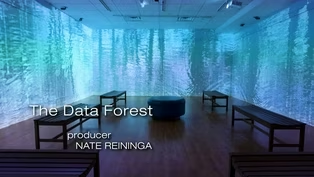
Video has Closed Captions
Clip: S44 Ep4 | 6m 29s | An immersive work by Laia Cabrera and Isabelle Duverger: Perennial Land: The Data Forest (6m 29s)
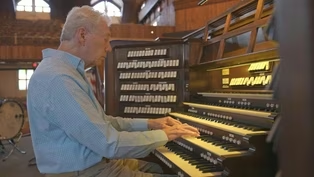
Organist Gordon Turk: "My Ocean Grove Summer Job"
Video has Closed Captions
Clip: S44 Ep4 | 8m 39s | Organist Gordon Turk: "My Ocean Grove Summer Job" (8m 39s)
Providing Support for PBS.org
Learn Moreabout PBS online sponsorship

- Arts and Music
The Best of the Joy of Painting with Bob Ross
A pop icon, Bob Ross offers soothing words of wisdom as he paints captivating landscapes.












Support for PBS provided by:
State of the Arts is a local public television program presented by NJ PBS