
Beyond the News
Season 10 Episode 1 | 26m 24sVideo has Closed Captions
Headlines share the facts, but not always the emotions behind them.
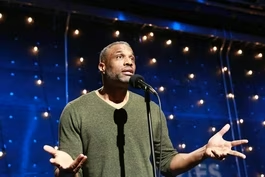
Headlines share the facts, but not always the emotions behind them. Cathy Kang, who served as a vice presidential military aide during 9/11, confronts her grief; Christopher James works to protect his grieving mother from an online romance scam; and Rich Foy returns to his Kentucky hometown after a deadly tornado. Three storytellers, three interpretations of BEYOND THE NEWS. Hosted by Wes Hazard.
Problems playing video? | Closed Captioning Feedback
Problems playing video? | Closed Captioning Feedback
Stories from the Stage is a collaboration of WORLD and GBH.
Beyond the News
Season 10 Episode 1 | 26m 24sVideo has Closed Captions
Headlines share the facts, but not always the emotions behind them. Cathy Kang, who served as a vice presidential military aide during 9/11, confronts her grief; Christopher James works to protect his grieving mother from an online romance scam; and Rich Foy returns to his Kentucky hometown after a deadly tornado. Three storytellers, three interpretations of BEYOND THE NEWS. Hosted by Wes Hazard.
Problems playing video? | Closed Captioning Feedback
Where to Watch Stories from the Stage
Stories from the Stage is available to stream on pbs.org and the PBS app.
Providing Support for PBS.org
Learn Moreabout PBS online sponsorshipCATHY KANG: While I'm getting ready for work, Jack, the Army aide, calls me.
He says, "Are you watching the news?"
"No."
"Turn on the news."
One of the World Trade Center towers is burning.
CHRISTOPHER JAMES: When you hear of a romance scam and it's a stranger, we may laugh, judge.
But when it's someone you love, it's heartbreaking.
RICH FOY: "This is an extremely dangerous EF4 tornado.
If you can hear my voice, you need to take cover now."
WES HAZARD: Tonight's theme is "Beyond The News."
Every day, we are surrounded by headlines.
We read them, we scroll past them, we debate them.
But no headline can hold the full weight of a human life.
Tonight, we're going to hear stories of people who faced impossible choices.
Private grief, who had to stand up and start all over again.
KANG: I'm Cathy Kang.
I grew up on the Jersey Shore.
I now live on the South Shore of Boston.
And I'm a music therapist with my own practice.
So, I imagine that a lot of our audience will not be very familiar with what a music therapist is or what they do.
Can you talk about that, please?
Music therapy is an allied health profession, much like physical or speech therapy, and it is the use of music for therapeutic goals.
And we use neuroscience, psychology, physiology, and anatomy to address health and wellness issues.
If I'm not mistaken, before becoming a music therapist, you spent more than two decades in the Coast Guard.
What do you miss most about that chapter in your life?
I miss being at sea with a crew.
You live at a different level of risk.
We rely on our little microcosm for clean water and food.
And, you know, every little aspect of survival.
It becomes, in one way, very complex and high-risk, but in another way, very simple and comforting.
"You never talk about September 11," Deb says.
She's my best friend.
We've known each other for over 40 years.
It's in the past.
I'm all about, ♪ What have you done for me lately?
♪ (laughter) But there is a deeper reason.
During my interview for a job at the White House, the very first question they ask is, "why do you want to be military aide to the vice president?"
I don't.
They look confused.
I explain.
The Coast Guard was required to submit a diverse list of candidates.
They had six white men.
(laughter) They asked me to apply.
I don't want to be a token, and I like my job.
But I agree.
I tell them, "I'm gonna throw the fight."
"I'm gonna say, 'I don't want the job.
Basically, I'm here so you'll interview the others.'"
Guess what?
They pick me anyway.
(laughter) When I ask why, they say, "Because you don't want the job.
"You're focused on mission.
"You don't pull any punches.
And you're the one we want to have a beer with the most."
(laughter) They give me a day to decide.
My commanding officer says, "You have to accept.
Duty calls."
He's right.
The president and vice president each have five military aides, one from each service.
Their job is to coordinate the team that keeps the government running in any circumstance.
Normal operations in D.C., domestic and foreign travel, and national emergency.
One of us is always with the vice president.
Some of the political staff don't understand that the military is apolitical.
We take an oath to the Constitution to protect democracy, no matter who's in office.
But since we have to work closely with the vice president, they view us as competition.
They pull these little power plays, like for planning flights.
They take over the seating charts, the menus, movie choices.
These little kinds of things don't bother me.
Until they do.
I've spent my entire adult life healing from a painful childhood; self-care, therapy, quality time with the people I love.
All of that came to a screeching halt on a Tuesday morning.
While I'm getting ready for work, Jack, the Army aide, calls me.
He says, "Are you watching the news?"
"No."
"Turn on the news."
One of the World Trade Center towers is burning.
Billows of black smoke, sirens blaring.
Jack explains, "A plane flew into it.
I don't think it was an accident."
Together, we watch another plane crash through the south tower.
Jack says, "It's time to do our job."
It is chaos.
The military and Secret Service pivot on the spot.
The political staff are understandably shaken.
They follow our directions without question.
When the initial shock wears off, and the government is stabilized, the political staff return to work.
The little power plays resume.
In March 2002, we're on a high-risk trip across Europe and the Middle East.
We're in Yemen, the highest risk stop.
As I'm following the vice president on the tarmac, a Yemeni man reaches for the briefcase I'm carrying.
The briefcase is called the football.
It contains the nuclear launch codes.
He says, "Miss, let me carry that."
"No, thank you."
I walk faster.
"No, no, let me carry it."
"I said no!"
I slide my wrist into the handcuff attached to the football and I get ready to draw my weapon.
He retreats.
Minutes later, we reboard the plane, and I see a staffer about to sit in my seat.
I tell him "I need to sit there, by the communications console."
He says, "I need to talk with the higher ups about our next stop."
"I need to talk with the pilots so that we get to our next stop."
We stare at each other.
He walks away.
(laughter) I am fuming.
After what I just went through, this is what I have to deal with.
For the rest of the trip, I complain about every little power play.
When we get back, I have a moment of self-awareness.
I'm in the office with the other military aides.
"Guys.
"I just realized something.
"I don't like myself anymore.
"I complain too much.
I'm a whiner.
I'm going to stop whining starting right now."
My center had drifted towards politics.
I'd gone native.
(laughter) I didn't understand why until later.
The attacks of September 11 were the deadliest in U.S.
history.
Nearly 3,000 people were killed, thousands injured, and thousands more died from secondary illness.
More than 3,000 children lost a parent that day.
Most were from New York and New Jersey.
Their average age was eight.
I'm from New Jersey.
I lost my parents when I was eight.
Every kid who loses a parent thinks, "Why me?
What did I do wrong?"
Like many of those children, I chose a life of service.
I channeled my grief into helping others.
I locked my pain in a trunk.
After September 11, my trunk filled up fast.
There was no room left for power plays.
After we finish our tours of duty at the White House, Jack sums up our experience perfectly.
"We were a damn good team and we did our job."
Now that I finally have some time for myself again, I have another job to do.
Open my trunk.
Healing is a lifelong journey.
Sometimes the way forward is clear.
Sometimes we lose our way.
Sometimes we hit things in a blind spot.
I just watched a documentary about a September 11 hero.
Welles Remy Crowther, the man in the red bandana.
He helped as many as 18 people escape the South Tower.
He was killed when the tower fell.
Incredible selflessness.
I'm an emotional mess.
That was the first time I ever watched anything about that day.
I've been in operational mode all these years.
Back to Deb, after she says I never talk about September 11, I admit something.
I've never been to Ground Zero.
"What?"
she says.
"That's the most telling thing.
You haven't been ready."
She's right.
I wasn't ready to talk about that day.
I wasn't ready to face the horrific acts and unimaginable suffering.
But I was ignoring astounding acts of heroism, too.
This fall, my family and I are going to the ceremony for the 25th anniversary of September 11.
I'm ready.
Thank you.
(cheers and applause) JAMES: My name is Christopher James.
I was born and raised in the U.K.
I live now in New York in Queens, Astoria.
I'm a fashion model and a stand-up comedian.
In your experience of being a model, do you have any reflections on telling a story without words?
Yes.
A lot of the fashion magazines... they are very story-based.
Each page tells a developing story.
So, it's very similar, but it's definitely not the same.
Like storytelling, with words, is way harder.
HAZARD: I am curious-- you are a stand-up comic as well.
So, that's a different way of expressing yourself, a different way of communicating.
What is it like... sharing emotions, sharing part of your experience on a stand-up stage versus a runway?
I think a lot of the times, with stand-ups, they use humor to escape being vulnerable.
With storytelling, just straight-up storytelling, sometimes there's no laughter, you're just bare bones naked, emotionally, and that's very, very, scary for a lot of comics.
When I was five, my mum and dad got separated.
They dropped me off at my grandparents' place to be raised.
My dad wasn't around.
My mum visited on weekends and called me every day.
At 11, my mum sat me down and she said, "Chris, "I'm moving to America and I'm getting married.
Would you like to come and live with us?"
I was terrified!
All those American movies I've seen, with guns and violence?
In England, we prefer polite stabbings.
(laughter) And I don't even know the guy she's marrying.
"Can I just stay with Grandma?"
"Of course, Chris.
"If you change your mind, you always have a home with us."
At 19, I wanted to be closer to my mum and my sisters.
I flew to America.
My mum even helped me get a job as a model, which somehow I made a career.
My mum and I are dreamers.
But when you're asleep, you can't always see what's coming.
My mum's in her 70s, she's separated from her husband, she's living alone.
I'm doing a modeling job in Miami.
I decide to visit my mum in West Palm Beach.
We're in her living room.
She says, "Chris, can you help me with the PayPal?"
"Mum, why do you need help with PayPal?"
"I'm getting a free Tesla.
I just need to pay a processing fee of $300."
(laughter and groans) "Mum, who's giving you a free Tesla?"
"My dear friend on Facebook, Elon Musk."
(laughter) (laughing): "Mum, "you know who I'm going on a date with tonight?
Halle Berry."
(laughter) "Chris, Halle Berry wouldn't be into you."
(laughter) "Exactly.
I don't think Elon Musk is into older Black women."
"Of course he is, he's African."
(laughter and "oh no"s) "Mum, whatever you do, do not send that $300.
It's a scam."
"All you had to say is no!
If you don't want to help me, then fine!"
Mum storms out.
(exhales) What's the worst that can happen?
She loses $300?
A week later, I overhear my mum on speakerphone talking to the fake Elon.
(African accent): "Hello, my queen.
When can you send the money?"
(laughter) Right away, I call my sister.
She convinces my mum to block fake Elon and not to add strangers on Facebook.
She calls me up.
"Chris, to make sure Mom keeps a promise, Maybe we should set up a fake Obama Facebook account."
(laughter) "That would be the easiest $300 we can ever make."
(laughter) "I'm serious, Chris!"
"Me too.
I'm a way better performer than "'When can you send the money?'
(laughter) "I'll call mum up.
"(mimicking Obama): 'Hello, this is Barack.
(laughter) "'Michelle and I are no longer together.
I'm hoping for change.'"
(laughter) "No, Mom will kill us."
My sister and I, we do some research.
There's a news article with a French lady who divorces her husband, and she loses 800,000 euros because she fell in love with a fake Brad Pitt.
Who needed a kidney transplant.
I send that article to my mum.
She replies, "Fake news."
My friends say, "Chris, how can anyone fall for such a scam?"
I don't know that French lady or what she's going through in her life.
But I know my mum.
I have another sister.
She was sick for many years.
Cancer.
My mum took care of her.
During COVID, she passed.
My mum... isolated, devastated.
And around that time, where she was really active on Facebook, maybe my mum was escaping the pain, and took comfort in adventure, love, and romance.
I understand that.
But... Elon Musk?
(laughter) Mum was angry, and still dealing with a lot of pain, and we were in conflict, and I felt like I was losing her.
Me and my sister, we had an intervention.
And my sister got into a huge fight with Mum.
And I stepped in.
I said, "Mum, stop."
She goes, "Why, are you gonna hit me?"
"Mum, I would never do that."
"I know.
You want me to hit you so you can send me to the crazy house."
I looked at my sister.
It's not a bad idea.
(laughter) My sister got her a therapist and we got some MRI scans done.
My sister calls with her results.
"Chris, Mom's brain function is totally normal.
She's just...
dumb."
(laughter) "Don't say that about Mum.
"Years ago, I was scammed, and it was Mum that tried to talk me out of it."
"You're dumb, too."
(laughter) Over the course of five years, my mum has lost $450,000.
(audience reacts) Do you know what I could've done with that kind of money?
I wouldn't be here with you lot.
(laughter) My mum stopped sending the scammers money.
She ran out.
Sometimes you have to hit rock bottom before you can wake up out of a dream.
My mum's moved in with my sister, and I call her every day.
And it's really nice to see her smile and laugh again.
We're better now.
When you hear of a romance scam and it's a stranger, we may laugh, judge, it's news.
But when it's someone you love, it's heartbreaking.
Thank you.
(cheers and applause) FOY: My name's Rich Foy.
I currently live just outside of Hartford, Connecticut.
I'm originally from Kentucky, and I work in hospital and clinic administration.
I'm curious, what drew you to that work?
Growing up in a small community with a small hospital, I thought that I wanted to really be that leader in that community, to make sure that we had access to care, because a lot of my friends and family have to drive two and a half, three hours away to the closest, like, level-one trauma center.
So it was really important to me to make sure that I was that voice and that these small communities need strong leaders as well.
And on the storytelling front, how did storytelling first become a part of your life?
In our organization, we start each meeting with patient stories or recognition.
And I was telling a patient story, we had this great outcome, I believe it was like, with a stroke patient.
And my boss stopped me mid-sentence and said, "Richard, you're not making that patient come alive.
Make the patient come alive."
I was kind of embarrassed.
And, you know, me being who I am, I was like, "I'm going to show her."
So, I signed up for a storytelling workshop in Hartford, and the rest is kind of history.
This will be my third story on stage.
My parents named me Richard, after my grandfather.
I grew up in a small town in western Kentucky called Mayfield, a town of about 10,000 people.
To this day, people still call me Richie.
Makes me kind of cringe a little bit.
Mayfield was too small for me, so I needed to move.
I ended up going to undergrad in Tennessee, grad school in Alabama.
I lived in Galveston, Texas for ten years.
And about five and a half years ago, I moved to Hartford, Connecticut.
I like Connecticut.
It's a lot of what I've always wanted in life.
I have a good career.
I like my friends.
I'm between New York and Boston.
I have coffee shops and a Target.
(laughter) Kentucky doesn't have any of those close by.
In fact, close to Mayfield, I'm in proximity to places called Fancy Farm and Possum Trot.
(laughter) Kentucky and Connecticut, Rich and Richie, feel like so different to me.
But I'm happy.
It's where I wanted to be.
This is what I've worked for for a really long time.
On December 10, 2021, I'm lying in bed in Connecticut.
It's been a long week at work.
It's a cold, dark winter night.
I'm sinking into my mattress, I'm wrapped up into my sheets, and all of a sudden, my phone starts to go off and it's text message after text message after text message.
Everyone in my contact list knows that I do not answer phone calls or texts after 8:00 P.M.
I am in full-on grandpa mode, and I do not understand why these texts are coming in.
I look at my nightstand.
One the texts is from Blake, from college.
"Hey, are your parents okay?"
What?
My parents?
Blake's met my parents once, back in 2009.
All of these text messages are saying-- asking about my family, asking about my friends, asking about Mayfield.
What's going on?
I pick up my iPad, I start scrolling on Facebook, and there it is.
On a live stream from WPSD Local 6 in Western Kentucky.
The two weathermen, Noah and Trent, are pacing back and forth.
They're shuffling papers.
They are panicked.
Weathermen are not supposed to be panicked.
And then one of them says it.
"This is an extremely dangerous EF4 tornado.
If you can hear my voice, you need to take cover now."
A tornado, in December?
In Kentucky?
I mean, we have sirens, but people just ignore them.
They're just... for practice.
My mom and my dad.
I get a text from them.
They're out of town for the weekend, they're okay.
My sister, she's in a friend's basement.
She's okay.
Those texts have to be enough for now.
My family is safe.
But I'm not settled.
Morning comes, I go into my living room.
I turn on the TV.
Mayfield is on CNN and Fox News and MSNBC and the Weather Channel.
They have drone footage showing the entire grid of the city, but there are no buildings left.
Then numbers start to come in.
60 people died in Kentucky the night before.
22 of them are from Mayfield.
A couple weeks go by, and it's the Christmas holiday.
I go home often to see family and friends, but I don't really go home and spend time in Mayfield.
This trip feels different, it feels like I'm needed-- not only with my family, but for the town that raised me.
The next morning, my dad and I make the five-mile drive from my parents' house to the center of town, the courthouse square, where the majority of the damage took place.
On the way there, we're in my dad's truck.
We're not really talking, because he's letting me take it in.
Plus, we're not really good at speaking about our emotions together.
(laughter) We go by Seven Oaks Church, the church that I grew up in, and he tells me that it's basically been turned into a distribution center with clothes and toiletries and household items and basically every item that anybody could need, because people have lost everything.
I make it to the court square, the center of town, and my body stops before the car does.
All of these buildings that I know by heart, these streets that I know by the back of my hand, I should be able to recognize them, but I don't.
The courthouse, the candle factory, First Baptist, First United Methodist, First Presbyterian, First Christian... they're all gone.
And if they're not gone, they're badly damaged.
Then I start moving from places that-- where things are missing, to people that have started showing up.
License plates from out of state, people that I have never seen in my entire life.
They're helping with supplies.
They're cooking food.
They're doing whatever needs to be done to help people.
They're not asking where you're from or what you do.
They're just asking what you need.
The rest of the time in Mayfield, on this trip, I see people that have impacted my life.
I see my Sunday school teacher, Mrs.
Jamie.
I see my elementary school principal, Mr.
Kinsey.
I see parents of high school friends.
On my last day in Mayfield, I go to the CVS where I worked for so many summers.
My shift supervisor, Tammy, is still working there, and when she sees me, she gives me a big old side-hug and says, "when are you coming back so I can hire you?
(laughter) It's really good to see you, Richie."
(laughter and "aw"s) Richie.
Only family, close friends, and apparently my shift supervisor calls me that.
For so long, I thought that Rich and Richie, Connecticut and Kentucky, had to live in different spaces.
I didn't see them as together.
I am standing in the middle of Mayfield.
The news crews are gone.
The drone footage and the helicopters that were circling the town are now gone as well.
I am standing here because I love this place and I love these people.
I had built this barrier in my mind that didn't really exist.
I was expecting rejection, and I didn't get rejection.
It took a tornado tearing that barrier down to allow me to realize where home was.
I'm going to continue to go back to Mayfield to see my family, to catch up with friends, and to pay homage to the place that has made me who I am today.
And when I go back, I'm going to be Rich.
(laughter) But I'm also going to be Richie.
Thank you.
(cheers and applause) ♪ ♪
Video has Closed Captions
Preview: S10 Ep1 | 30s | Headlines share the facts, but not always the emotions behind them. (30s)
Providing Support for PBS.org
Learn Moreabout PBS online sponsorship New Episode
 New Episode
- Arts and Music

Innovative musicians from every genre perform live in the longest-running music series.
 New Season
 New Episode





 New Episode
 New Episode

Support for PBS provided by:
Stories from the Stage is a collaboration of WORLD and GBH.