State of the Arts
Deborah Mitchell: Tap Your Troubles Away
Clip: Season 44 Episode 5 | 7m 32sVideo has Closed Captions
Tap dancer Deborah Mitchell passes down a uniquely American artform to her students.
Deborah Mitchell is a tap dancer who has traveled from Paris, France to Monroe Township, New Jersey spreading the joy of this uniquely American art form. As founder of the New Jersey Tap Dance Ensemble and creator of her class Tap Your Troubles Away, she shares her expertise with students, allowing this African American tradition to continue to thrive.
Problems playing video? | Closed Captioning Feedback
Problems playing video? | Closed Captioning Feedback
State of the Arts is a local public television program presented by NJ PBS
State of the Arts
Deborah Mitchell: Tap Your Troubles Away
Clip: Season 44 Episode 5 | 7m 32sVideo has Closed Captions
Deborah Mitchell is a tap dancer who has traveled from Paris, France to Monroe Township, New Jersey spreading the joy of this uniquely American art form. As founder of the New Jersey Tap Dance Ensemble and creator of her class Tap Your Troubles Away, she shares her expertise with students, allowing this African American tradition to continue to thrive.
Problems playing video? | Closed Captioning Feedback
How to Watch State of the Arts
State of the Arts is available to stream on pbs.org and the free PBS App, available on iPhone, Apple TV, Android TV, Android smartphones, Amazon Fire TV, Amazon Fire Tablet, Roku, Samsung Smart TV, and Vizio.
Providing Support for PBS.org
Learn Moreabout PBS online sponsorshipMitchell: It's one, two, three, four.
Yes.
[ Music plays ] Tap dancing is pure joy.
It uplifts you.
Ain't she sweet?
What's beautiful about it is that it is truly an art form that's American.
And just like America, it is mixed up with all of these different types of rhythms.
[ Music plays ] I can be feeling down.
Something may be happening with me.
If I put on my shoes, it's gone.
That's where my mind is.
That's why I say tap your troubles away.
It's real.
[ Music plays ] [ Music plays ] I've been in New Jersey for 55 years, and 46 of those years has been in performing arts.
The stage is where I always felt comfortable.
I found that it just accepted me and I could be any character I wanted to be when I was on the stage.
I was born and raised in St.
Louis, Missouri, and I grew up in the '50s.
My mom had me taking tap lessons because she said, "Oh, this, this, this little thing."
I'll never stay still long enough to be in a ballet class.
I didn't realize how much my parents, especially my mother, protected us against Jim Crow kind of mentality, all of that.
So she said, "You know what?
One day after you've gone to school, if you want to dance again, then you do that."
And I went to school.
I didn't dance during college, but when I got to New York, it was a melting pot for real, you know?
And I could be whatever I wanted to be.
For the first time, I heard people say, "Oh, you're gorgeous."
So that's when I really realized I started finding my way.
And tap dancing never left me.
[ Music plays ] The one area of my career that is always outstanding is my relationship with my mentor and my dear friend and teacher, Bubba Gaines, who was an elder statesman.
[ Music plays ] People think you have to start dancing when you're very, very young.
I was in my thirties when I met Bubba Gaines.
He said, "You have a gift.
You have an internal metronome."
He said, "You see this little rope?"
He said, "It has taken me around the world.
I'm gonna give it to you, and it's going to do the same thing for you."
[ Music plays ] He saw something in me, taught me everything he knew, and said to me, you know, "The only thing I want you to do is give away what I've given to you."
And after that, my life, it flowed into a certain way.
I had the privilege and honor of being in "The Cotton Club," directed by Francis Ford Coppola.
And then from "The Cotton Club," I went into "Black and Blue," which started in Paris, and then it was mounted a few years later on Broadway at the Minskoff Theatre.
Announcer: "Black and Blue," Broadway's big new musical.
It's elegant, it's witty.
It really moves.
Mitchell: That's when Germaine and I, as the Rhythm Queens, toured with Cab Calloway.
And that's where we ended up going all over Europe.
[ Music plays ] After all of that, I said, you know what?
I'm getting older.
I'm tired of touring.
I want to do exactly what I promised Bubba.
I'm going to pass this on.
[ Cheers and applause ] In 1994, I founded New Jersey Tap Ensemble, which was the first statewide rhythm tap dance company in New Jersey.
It was to preserve, promote the art form of rhythm tap dancing.
I was looking basically to help promote the careers of adult tap dancers who maybe no longer had careers, looking to perform on Broadway and so forth, but still wanted to dance.
The other thing that became big with the company were school time assemblies, and we actually went all over New Jersey.
Hundreds, maybe thousands, I would say thousands by now, school children have been impacted by the art form.
[ Music plays ] It's very closely connected to jazz.
So it gives you a chance to do call and answer, improvisation, that's what makes it so very different, you know, from the traditional tap, which is very structured.
It becomes personal.
It's very individual.
It's very expressive.
It's still an art that needs to be shared.
Sammy Davis Jr.
called it a hand-me-down art form, meaning it's handed down from generation to generation.
And to me, that's why it's so rich.
Tap has a rich history.
The roots of it a long way in the culture of America.
It does have all kind of rhythms in it.
Caribbean, African rhythms.
You've got mixtures there from many marginalized people.
Tell me your story with your feet.
That's how it started.
You know, telling stories with your feet.
[ Rhythmic tapping ] Don't tell me.
Just dance it.
[ Rhythmic tapping ] "Tap Your Troubles Away" is my personal little title for the workshops that I do in senior communities, in retirement communities.
I teach here in the community of Clearbrook.
I have a class for women, men, who are 55 to 100, and if you are older than 100, you join, too.
Heels.
Levine: I'm 97.
97 years young.
I feel it, I feel the music.
I learned how to tap when I came here in 2002.
Wasserman: We love Deborah.
She's so professional, but she's accessible to everybody.
And you can confide in her, and you can talk to her, and you can have a laugh with her.
She breaks it down and makes it so understandable.
I said, like, we're really tapping.
Like, we can't believe it.
Martin: Miss Debbie is absolutely everything.
She's a joy.
I love dancing, I love rhythm.
But this tap is real special.
When I get out of this class, holy cow, you feel so great.
[ Music plays ] Mitchell: It's a class that not only teaches tap, it's a social outlet for them.
It also keeps the mind active.
It's a conduit.
Yes, we have fun, but there's so much more happening besides learning a step.
When they come in there, they know that each one of them, yes, has my attention.
They're important.
What's happening in their lives is important.
It's life.
So you're dealing with more than just dance.
You're dealing with art living.
It's part of the culture of America.
And it's an art form that many marginalized people engaged in it and gave our country some of the most unique artistic contributions.
I want to make sure that they are not forgotten, that what they contributed to this world is not forgotten.
It's so easy to do.
[ Music plays ]
 New
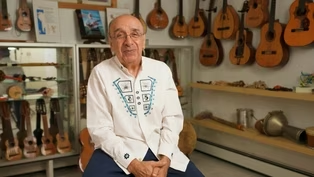
NewPepe Santana: Tending the Fire
Video has Closed Captions
Clip: S44 Ep5 | 7m 31s | Pepe Santana: Tending the Fire (7m 31s)
 New
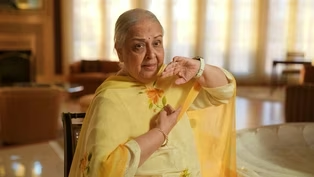
NewRachna Sarang: Kathak Storyteller
Video has Closed Captions
Clip: S44 Ep5 | 7m 27s | Guru Rachna Sarang passes down Hindu Heritage through classical Indian Kathak dance. (7m 27s)
Providing Support for PBS.org
Learn Moreabout PBS online sponsorship

- Arts and Music
The Best of the Joy of Painting with Bob Ross
A pop icon, Bob Ross offers soothing words of wisdom as he paints captivating landscapes.











Support for PBS provided by:
State of the Arts is a local public television program presented by NJ PBS