State of the Arts
Organist Gordon Turk: "My Ocean Grove Summer Job"
Clip: Season 44 Episode 4 | 8m 39sVideo has Closed Captions
Organist Gordon Turk: "My Ocean Grove Summer Job"
More than fifty years ago, acclaimed concert organist Gordon Turk arrived in Ocean Grove, New Jersey as resident organist for the Ocean Grove Camp Meeting Association's Great Auditorium. In the decades since, he helped transform the auditorium's pipe organ into one of the finest and largest instruments in the world with more than 13,000 pipes!
Problems playing video? | Closed Captioning Feedback
Problems playing video? | Closed Captioning Feedback
State of the Arts is a local public television program presented by NJ PBS
State of the Arts
Organist Gordon Turk: "My Ocean Grove Summer Job"
Clip: Season 44 Episode 4 | 8m 39sVideo has Closed Captions
More than fifty years ago, acclaimed concert organist Gordon Turk arrived in Ocean Grove, New Jersey as resident organist for the Ocean Grove Camp Meeting Association's Great Auditorium. In the decades since, he helped transform the auditorium's pipe organ into one of the finest and largest instruments in the world with more than 13,000 pipes!
Problems playing video? | Closed Captioning Feedback
How to Watch State of the Arts
State of the Arts is available to stream on pbs.org and the free PBS App, available on iPhone, Apple TV, Android TV, Android smartphones, Amazon Fire TV, Amazon Fire Tablet, Roku, Samsung Smart TV, and Vizio.
Providing Support for PBS.org
Learn Moreabout PBS online sponsorship[ Organ playing down-tempo music ] Arpert: The organ is really the centerpiece of our community within this auditorium and within this tent city.
And Gordon, as the maestro, is the human embodiment of that instrument.
He makes it sing, and it's his talent that brings that instrument to life.
[ Applause, organ playing dramatic music ] [ Music continues ] Turk: Ocean Grove was founded at the time of the close of the Civil War, or during that.
And it was founded as a retreat by Methodists for people to come and have a summer retreat, a spiritual retreat, and to enjoy the out-of-doors.
People enjoyed the ocean in their heavy woolen bathing suits of that era, and there were no mosquitoes here.
So that was one of the reasons they settled in this particular area.
People settled here in the summer in tents.
There are about 114 of them that are still here.
Narrator: Today, the Methodist community continues to thrive in Ocean Grove, within what is now a diverse village famous for its extraordinary Victorian architecture... [ Music continues ] And the church's spectacular 1894 auditorium.
Turk: The building itself now seats about 6,500, and it has wonderful acoustics.
It was built by 30 workmen in 90 days, or else by 90 workmen in 30 days.
I can't remember which way it goes.
But in either case, it was remarkable in terms of construction.
And there is a steel superstructure above the ceiling of this room, and then the rest of the building is built of wood -- Carolina pine.
So the ceiling is a wonderful soundboard.
It's like the soundboard of a piano or the belly of a cello on a large scale.
And it's wonderful for speaking.
It's also wonderful for music.
Some people call it Carnegie Hall South because the acoustics are so clear and so warm and so good.
[ Music continues ] I came here at the suggestion of a couple people who said, "We hear that that job is open at this summer position."
At the time I was 23.
And so I thought, "All right.
Looks interesting.
I need something to do at this point."
And my expectation was that I would be here for a summer, maybe a second summer, depending on how it went.
Narrator: Gordon Turk graduated from the Curtis Institute of Music, one of America's most prestigious music schools, where he studied with the legendary teacher Alexander McCurdy.
He was already playing concerts throughout the United States and had just returned from a concert tour in Austria before coming to Ocean Grove.
The organ was of moderate interest.
It has some interesting historical roots -- built by a very eccentric English organ builder, Robert Hope-Jones.
But it had been worked on in a way that did not really honor its history.
During that summer, I met John Shaw, who was a summer visitor here also.
But he had come here as a lad, working as a bellhop in a local hotel.
He knew a lot about pipe organs.
His mother was an organist, and he was also friends with Virgil Fox, the famous virtuoso concert organist.
So he said, "I'd like to look at the instrument and see what the possibilities are for improving it."
I thought, "Well, that's very nice.
I'll come back another year."
Narrator: That was more than 50 summers ago.
Those first organ-restoration projects were the beginning of a decades-long partnership and countless improvements to the instrument.
Today, the Ocean Grove Camp Meeting Association's pipe organ is one of the largest and finest in the world.
Turk: Watch your head here.
It has 209 ranks of pipes, which means that there are over 13,000 pipes in the organ, all of which have to be tuned individually when we tune the organ.
So it takes several days to do a tuning.
Some of these are for just the pedals.
This is a lot of the higher-pitched stops, because you see they're smaller.
I'm used to walking around here.
These are the base of wooden pipes, and they go up for 16 feet.
These are from 1907.
Arpert: This is one of the foremost organs in the world, certainly in this country.
It stands in comparison to the Wanamaker Organ in Philadelphia, Balboa Park in San Diego.
[ Organ playing ] Turk: Organists from all over Europe and all over the United States write to me, saying, "I would like to be included in your concert series."
And we've had various guests.
Olivier Latry from Notre Dame was here last summer and Jean-Robin Baptiste from Versailles, the palace there, and from throughout the United States.
[ Music continues ] It's a very intense schedule for me.
I play for Sunday services, I play for choir rehearsals, accompanying singers and orchestra concerts, and I play two organ recitals a week, all of which I enjoy.
Narrator: While Gordon has spent summers in Ocean Grove since 1974, for the past 30 years, he's lived in a small wooden cottage just a few steps away from the auditorium.
Turk: I have a sort of postage-stamp-size garden.
I was particularly interested in perennials, those which, once you plant them, will come back year after year.
And I have some which I planted the first year I was in this cottage, 30 years ago, that are still coming back every year.
The more you take care of them, the more they respond.
You nurture.
You work on it every day.
You prune.
You take care of it.
And you do the same thing in music when you're practicing and rehearsing and shaping the music.
[ Organ playing fanfare ] Arpert: Music is really at the heart of Ocean Grove and always has been, both from a spiritual perspective and a secular perspective.
The organ has been used in services since 1908.
And Gordon, as the maestro, is the human embodiment of that instrument.
[ Dramatic music playing ] Turk: For me to come here in the summer, I know it's going to be a lot of work.
But the rewards are being able to communicate, bring a lot of music to people who come to hear it, and to play this instrument, which over the years I've been with John Shaw working and building an instrument that is now of international significance.
[ Music builds, continues ] [ Music ends ] [ Cheers and applause ]
Video has Closed Captions
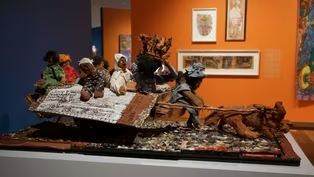
Clip: S44 Ep4 | 10m 33s | Aminah Robinson's storytelling art chronicled Black history and everyday life. (10m 33s)
Video has Closed Captions
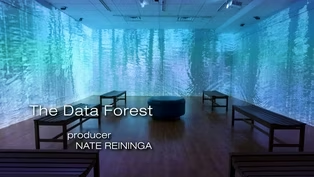
Clip: S44 Ep4 | 6m 29s | An immersive work by Laia Cabrera and Isabelle Duverger: Perennial Land: The Data Forest (6m 29s)
Providing Support for PBS.org
Learn Moreabout PBS online sponsorship

- Arts and Music
The Best of the Joy of Painting with Bob Ross
A pop icon, Bob Ross offers soothing words of wisdom as he paints captivating landscapes.












Support for PBS provided by:
State of the Arts is a local public television program presented by NJ PBS