State of the Arts
Pepe Santana: Tending the Fire
Clip: Season 44 Episode 5 | 7m 31sVideo has Closed Captions
Pepe Santana: Tending the Fire
Pepe Santana, an Andean musician, emigrated from Ecuador to New York City more than 60 years ago. Missing the music of the Andes Mountains, he connected with fellow musicians to form the band INKHAY. The word means “to tend the fire.” For decades, Santana has kept the flame of South American music alive across the United States.
Problems playing video? | Closed Captioning Feedback
Problems playing video? | Closed Captioning Feedback
State of the Arts is a local public television program presented by NJ PBS
State of the Arts
Pepe Santana: Tending the Fire
Clip: Season 44 Episode 5 | 7m 31sVideo has Closed Captions
Pepe Santana, an Andean musician, emigrated from Ecuador to New York City more than 60 years ago. Missing the music of the Andes Mountains, he connected with fellow musicians to form the band INKHAY. The word means “to tend the fire.” For decades, Santana has kept the flame of South American music alive across the United States.
Problems playing video? | Closed Captioning Feedback
How to Watch State of the Arts
State of the Arts is available to stream on pbs.org and the free PBS App, available on iPhone, Apple TV, Android TV, Android smartphones, Amazon Fire TV, Amazon Fire Tablet, Roku, Samsung Smart TV, and Vizio.
Providing Support for PBS.org
Learn Moreabout PBS online sponsorship[ Music plays ] Santana: Why do I do this?
Music was in my soul.
[ Music plays ] Unless you learn about the tradition, you are losing an opportunity to tell people who you are or where you come from.
[ Music plays ] The richness that we possess, that has not disappeared.
There are many communities in the Andes Mountains where they continue to do the music the way their ancestors did it, just to keep alive the tradition, just to know that their indomitable spirit will continue surviving.
And that's my intention with my music, with my instrument making, with my teaching.
[ Music plays ] My name is Pepe Santana.
I was born in a small city of the Andes Mountains of Ecuador.
I came to the World's Fair of 1964, in New York.
My plan was to stay in New York for 15 days.
But it turned out to be 60 years.
When I came to New York, I really came to a universe of sounds and traditions.
But that was the time when I couldn't hear any sounds of the Andes, not even in my own country.
At the time, I could play some musical instruments and some Andean music from other countries, but I wanted more.
And that's how I managed to go to Peru, Bolivia, Chile, Argentina, Colombia and learn.
I traveled almost, at least twice a year to those countries.
By 1974, I met some other musicians that wanted to do native traditional music from the Andes.
That group really went far.
We reached venues like Lincoln Center, Carnegie Hall, Symphony Space in New York, and eventually we made a tour nationally.
At the same time, I was doing independent work on schools, museums, libraries.
And that gave me a good chance to really talk to people and tell them things about our tradition, not only our music, but how the people live.
Dancing, storytelling, literature, food.
INKHAY is the name of the group I founded way back in 1984.
INKHAY is a Quechua word.
Quechua is the native language of the Andes that means "to feed the fire," "to tend the fire."
The idea of keeping alive this flame of tradition.
There are seven countries that are part of a mountain range called the Andes.
The Andes Mountains is the longest mountain range on Earth, and at the center lays Ecuador, Peru, and Bolivia.
These three countries have been geographically isolated since the beginning of time, but isolation has helped preserve many traditions.
Most of our traditional native music is pentatonic with five notes.
When the conquistadors, the conquerors came and blended with the natives and they produced the mestizo music.
Mestizo is the word that defines the mixture of the European and the native.
Before the arrival of the conquistadors, the music was played only with wind and percussions, flutes and drums.
After the conquest, the strings appeared.
[ Music plays ] Calarota-Ninman: It's a special day for Montclair State University, for our center, because for the first time, we are hosting the Festival of the Andes.
The Festival of the Andes is the celebration of the Andean cultures and the indigenous communities, and all Spanish speaking communities.
It's about music and it's about tradition, and it's about people and joy and colors.
Today we're having six Andean countries represented -- Peru, Colombia, Bolivia, Argentina, and Ecuador.
It represents their culture, their relationship with nature and Mother Earth and the sun and their roots and their ancestors.
So for every dance and for every music, there is a call to the past, but also to the present, to the future.
Montclair State University is an Hispanic serving institution, which means that over 40% of the students are Hispanic.
Bringing back to their culture, bridging that gap that some of them may miss because they are growing in New Jersey, but we cannot forget the roots as well.
Pepe Santana is a special person for us.
We share the same vision about the Andes, about the tradition, about the culture, and he's become our artistic director.
He's amazing.
And his music comes from his soul and from his heart.
And he's in our heart as well.
Santana: And over here we have a set of three charangos different sizes, different countries.
These three are from Peru.
This one from Bolivia.
[ Rattling ] Called Chajchas, made out of goat hooves.
This is Chilean guitarrón.
It has 27 strings.
[ Strums khonkhota ] Khonkhota.
[ Music plays ] There are three categories of instruments in my collection -- Winds, percussion, and strings.
[ Rondador whistles ] That's a rondador from Ecuador.
The fascinating part was to get acquainted with the instrument, learn how to play it, and then I would put it in my collection.
I hope one day I find a philanthropist who would help me to create an Andean museum.
The challenge was not only to perform, but to reach young minds and tell them about it.
So I began to work with schools, and as I usually do in my performances, I tell the people the name of the instrument, where it comes from, and the sound of it, how it's made.
I learned that I couldn't really teach a young kid how to cut a reed to make a panpipe, and I came up with a plastic design.
Once I teach them to do the panpipe, I teach them also to take care of the instrument.
They made it.
They have to take care of it.
But how do I play it?
That's how it is retained in the people's mind.
[ Music plays ] We are a group of people that are doing the real thing.
That was the idea that INKHAY has put forward.
We can really interact with people and tell what we do.
The folk sounds really have so many beautiful variations and inflections that are in here.
This is important, and we should pay attention and we should preserve the tradition, not only from the Andes, from anywhere in the world.
It's what to know that we are still alive, that we still have some roots that we have to protect.
[ Music plays ] [ Translation: Long live Ecuador! ]
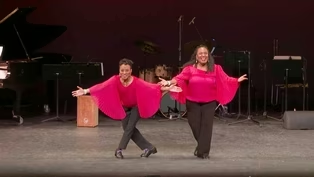 New
NewDeborah Mitchell: Tap Your Troubles Away
Video has Closed Captions
Clip: S44 Ep5 | 7m 32s | Tap dancer Deborah Mitchell passes down a uniquely American artform to her students. (7m 32s)
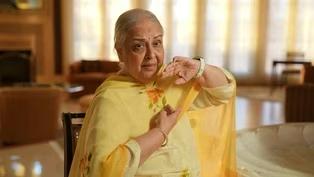 New
NewRachna Sarang: Kathak Storyteller
Video has Closed Captions
Clip: S44 Ep5 | 7m 27s | Guru Rachna Sarang passes down Hindu Heritage through classical Indian Kathak dance. (7m 27s)
Providing Support for PBS.org
Learn Moreabout PBS online sponsorship

- Arts and Music
The Best of the Joy of Painting with Bob Ross
A pop icon, Bob Ross offers soothing words of wisdom as he paints captivating landscapes.











Support for PBS provided by:
State of the Arts is a local public television program presented by NJ PBS