State of the Arts
Rachna Sarang: Kathak Storyteller
Clip: Season 44 Episode 5 | 7m 27sVideo has Closed Captions
Guru Rachna Sarang passes down Hindu Heritage through classical Indian Kathak dance.
Rachna Sarang learned traditional Kathak dance in Mumbai, India. The dance form draws its name from kathakaar, meaning “storyteller”. Rachna Sarang is a master of this art. Through graceful movements and intense emotion, everything she choreographs tells the story of Hindu culture. Rachna now teaches new generations, passing down not only the dance but her heritage.
Problems playing video? | Closed Captioning Feedback
Problems playing video? | Closed Captioning Feedback
State of the Arts is a local public television program presented by NJ PBS
State of the Arts
Rachna Sarang: Kathak Storyteller
Clip: Season 44 Episode 5 | 7m 27sVideo has Closed Captions
Rachna Sarang learned traditional Kathak dance in Mumbai, India. The dance form draws its name from kathakaar, meaning “storyteller”. Rachna Sarang is a master of this art. Through graceful movements and intense emotion, everything she choreographs tells the story of Hindu culture. Rachna now teaches new generations, passing down not only the dance but her heritage.
Problems playing video? | Closed Captioning Feedback
How to Watch State of the Arts
State of the Arts is available to stream on pbs.org and the free PBS App, available on iPhone, Apple TV, Android TV, Android smartphones, Amazon Fire TV, Amazon Fire Tablet, Roku, Samsung Smart TV, and Vizio.
Providing Support for PBS.org
Learn Moreabout PBS online sponsorship[ Music plays ] Sarang: It's all about story.
We are storytellers.
Kathak dance is the storytellers.
In the temples they used to talk about goddess and gods.
It is classical based, but it is -- so many other things are involved, fused in that music.
Keeping the traditional, I do so many things.
Kathak is not only the storytelling.
Kathak is creation.
You can create so many things.
That is what I'm trying to say.
Don't limit yourself.
[ Singing in global language ] Just a brief, I want to show you the emotions of this song.
I'm just doing on the spot.
So it's not practiced or somebody taught me.
Just creation.
[ Music plays ] I'm Guru Rachna Sarang and I'm a Kathak teacher, choreographer, dancer living in New York and New Jersey for almost 50 years.
I am originally from Bombay, India.
I started learning when I was three years old.
I learned South Indian dance and I learned North Indian dance.
I came in 1977 and I didn't know anybody here In Flushing -- Queens, Flushing, there is a Hindu temple.
So I said, I can dance.
Can you give me a chance to come and perform?
My career started from there in America and I didn't look back after that.
Students wanted to learn from me.
So I started my own school of teaching Kathak.
[ Music plays ] Kids who are born here, they don't know who's Ganesh.
Now, through our dance, we have Ganesh idol.
How he was born, history of Ganesh.
I try to give them as much as I could with the culture, our culture.
And also it's good to learn through dance, through the history of not only religion -- it's our culture.
You get the manners.
You know how to talk.
You know how to sit, how to behave, how to respect your teachers, your parents, how to move in the society.
So that also is very important to learn through this dance.
Pandya: Kathak is a complex dance that balances different aspects, like you have to be really graceful, but also try to hit fast notes and really go along with the beat.
I think it's really beautiful.
It's given me like the skill to dance, but also a way to connect to my culture.
Reyna Shah: Rachna Aunty brings such joy and a new style of dance into this space.
I think she challenges me, but like in a good way, it's become one of my biggest passions.
Bafana: Aunty is Kathak, but Aunty is this beautiful amalgamation kind of synthesis of the modern and historic and various dance forms.
Not just Indian, but also Western, all put together.
I started teaching the little girls and get them to a certain level, and then Aunty can take them on and then take them to the, you know, the ultimate level.
We talk a lot about community right now.
The girls are all coming from New York City and Westchester and South Jersey and all over, but they come here and they build relationships and friendships that will last them forever.
It's been 40 years I've been with her, and that's kind of what I would aim to give back to the girls that I'm teaching under her.
And that is this wonderful, safe space that we have.
Gandhi: The way we were taught, Aunty makes a story with any sort of form of dance, and you use all different formations, all different steps and your expressions.
Expressions are a huge aspect of Kathak.
It's very graceful.
You're in love with what you're doing.
So when we do Kathak, like, pure Kathak, you have to have a certain attitude.
You have a confidence.
And then when it's storytelling, you become softer and you use graceful hand movements, graceful expressions.
Vama Shah: So I'm going into medicine, and doctors usually have a very clinical approach to their patients.
What I've learned through dance, by using my facial expressions, by knowing different body languages, I'm able to convey this empathetic type of care through like a very subtle, nuanced way.
[ Music plays ] Bafana: In the beginning, you're a little girl learning from Aunty and kind of like looking up to her, and it's amazing.
Then you go into your profession and you're getting married, and then she gives you a whole nother kind of perspective into what life is going to demand out of you.
[ Vocalizing ] Patel: My name is Barkha Patel.
I am a Kathak performing artist, choreographer, and educator based in New York City and a student of Aunty.
Aunty would actually train me by asking me to teach her classes.
So often, she would give me the class.
She would go away for a bit.
She would come back to see, "Okay, what have you done?
No, the student hasn't understood this.
Show it this way.
Try this this way.
Think of it this way.
Make it more practical."
She always had education or educating the student at the center of her heart and mind.
[ Music plays ] When I decided post-college, I wasn't sure what I wanted to do, Rachna Aunty encouraged me to look at dance as an option, and nobody in my life, in my family that I knew personally, was a full time artist of that sort.
So that's where the teaching journey started.
I teach a lot of adult students.
I used to teach young kids, and I have some classes that are young girls, but I think my biggest desire in these last couple of years has been to develop a dance company of dancers who I could take to perform professionally in professional platforms.
One of my students said this beautifully: that even though I am not a professional dancer, I've made a professional commitment to this form.
We don't see it as a hobby.
We see it as a professional commitment to the craft.
[ Music plays ] Sarang: Right.
[ Music plays ] Everything is history and story.
I feel that music, dance, anything, it is in the air.
Dancing is not artificial to me.
We are all dancing right now.
We are dancing.
You're dancing.
My students are dancing.
Everybody, when we talk, we dance, we do expressions.
Sad or happy or you're crying or you're laughing.
Everything is emotions.
So dancing brings grace.
[ Music plays ] You have to become spiritual in this.
You have to be an artist.
You can't be a dancer only just performing.
Audience has to be connected with an artist.
Artist has to be connected with the audience.
My thought has to go through you and your thought has to go through me.
Then only we can bring up something very beautiful.
[ Music plays ] [ Cheers and applause ]
 New
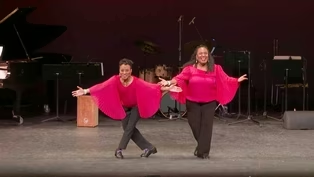
NewDeborah Mitchell: Tap Your Troubles Away
Video has Closed Captions
Clip: S44 Ep5 | 7m 32s | Tap dancer Deborah Mitchell passes down a uniquely American artform to her students. (7m 32s)
 New
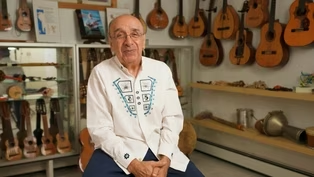
NewPepe Santana: Tending the Fire
Video has Closed Captions
Clip: S44 Ep5 | 7m 31s | Pepe Santana: Tending the Fire (7m 31s)
Providing Support for PBS.org
Learn Moreabout PBS online sponsorship

- Arts and Music
The Best of the Joy of Painting with Bob Ross
A pop icon, Bob Ross offers soothing words of wisdom as he paints captivating landscapes.










Support for PBS provided by:
State of the Arts is a local public television program presented by NJ PBS