State of the Arts
State of the Arts: January 2026
Season 44 Episode 4 | 28m 46sVideo has Closed Captions
An Aminah Robinson exhibition, organist Gordon Turk, and Perennial Land - The Data Forest
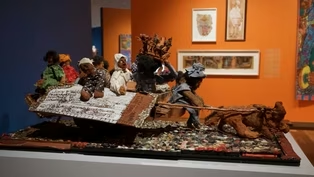
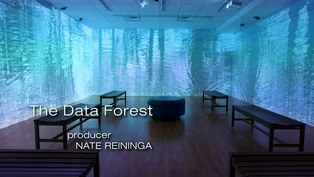
At The Newark Museum of Art, artist Aminah Robinson's work about Black history, folklore, and family. Acclaimed organist Gordon Turk helped transform Ocean Grove's auditorium organ into one of the largest in the world. And at the Morris Museum, Laia Cabrera and Isabelle Duverger’s immersive installation "Perennial Land: The Data Forest" invites reflection about the impact we have on nature.
Problems playing video? | Closed Captioning Feedback
Problems playing video? | Closed Captioning Feedback
State of the Arts is a local public television program presented by NJ PBS
State of the Arts
State of the Arts: January 2026
Season 44 Episode 4 | 28m 46sVideo has Closed Captions
At The Newark Museum of Art, artist Aminah Robinson's work about Black history, folklore, and family. Acclaimed organist Gordon Turk helped transform Ocean Grove's auditorium organ into one of the largest in the world. And at the Morris Museum, Laia Cabrera and Isabelle Duverger’s immersive installation "Perennial Land: The Data Forest" invites reflection about the impact we have on nature.
Problems playing video? | Closed Captioning Feedback
How to Watch State of the Arts
State of the Arts is available to stream on pbs.org and the free PBS App, available on iPhone, Apple TV, Android TV, Android smartphones, Amazon Fire TV, Amazon Fire Tablet, Roku, Samsung Smart TV, and Vizio.
Providing Support for PBS.org
Learn Moreabout PBS online sponsorshipNarrator: At the Newark Museum of Art, the inventive work of artist Aminah Robinson.
Bloom: She's a fantastic storyteller, so there's a really deep treatment of African-American history.
Narrator: At the Morris Museum, "Perennial Land -- Data Forest" is an immersive experience reflecting on technology and nature.
And in the Victorian seaside town of Ocean Grove, Gordon Turk helped transform an organ into a musical wonder with 13,000 pipes.
[ Organ playing ] "State of the Arts" going on location with the most creative people in New Jersey.
[ Cheers and applause ] Announcer: The New Jersey State Council on the Arts, encouraging excellence and engagement in the arts since 1966, is proud to co-produce "State of the Arts" with Stockton University.
Additional support is provided by the Pheasant Hill Foundation, Philip E. Lian and Joan L. Mueller, in memory of Judith McCartin Scheide, and these friends of "State of the Arts"... Narrator: In 1940, the young Robinson family moved into a brand-new apartment on the Near East Side of Columbus, Ohio.
They were lucky.
Housing was scarce, and Poindexter Village was one of the very first housing projects in the nation that served African-American families.
President Roosevelt was there on opening day.
Poindexter Village was a close-knit community, and the Robinsons were happy there.
It was a world that their middle child, Aminah, never forgot.
Hamlar: As a very young artist, she was documenting what she was doing.
She was documenting what she saw, what was surrounding her so that she could then make art from it and about it.
She was born into Poindexter Village.
She was just a couple months old, I think, when they moved into their apartment.
And they were the very second family to move into Poindexter Village.
Toone: All of her family members cherished this place.
So she was also being taught how important it was and how significant this place was.
You know, we like to say this is the sacred land and the sacred area of the city.
And I believe Aminah really believed that as well and then pulled that out in the stories that she told and made sure that we all understood how sacred this land and these stories are.
Hamlar: Prior to the building of Poindexter Village, there was a community that was called the Blackberry Patch.
And it was called that because blackberries actually grew there.
Narrator: People coming north to find work during the Great Migration or for safety during the Jim Crow era came to the Blackberry Patch.
Hamlar: People didn't have money, so they fashioned their own homes, similar to a shantytown.
She got these photos from the Ohio Historical Society.
She got photos from the library.
She did so much research all the time, because she wanted to be as accurate as possible about the renditions that she made.
Narrator: Aminah did library research, but she also treasured her elders and the stories they told.
[ Mid-tempo music plays ] Robinson: There are a lot of stories -- Crow Man tales is what I call them.
And the story goes right behind the Crow Man, there used to be a log cabin that sat at Clifton and Champion.
One day, there was this great big fire.
And this woman was passing through, who lived in the cabin.
Her house was on fire.
And all at once, from the birds who lived on the rooftops, the pigeons and the sparrows, this snake...roars up.
And this woman, with a cane -- flash!
She was gone.
And so when everybody ran to her log cabin... the fire was out.
[ Percussive music plays ] Narrator: "Journeys Home: A Visual Memoir" is a traveling exhibition of Aminah Robinson's work.
Bloom: She's very inventive.
She's inventive with language.
She's inventive with her materials.
She also really celebrates folkways and folk-art traditions at the same time that she doesn't disavow these more conventional approaches to portraiture.
And I think it's that blend that makes her particularly interesting.
[ Music continues ] She's a fantastic storyteller, so there's really deep treatment of African-American history, the Great Migration... ...drawing out some of the difficult history of the Middle Passage and what it was like to work on a plantation.
Hamlar: The earliest thing that Aminah records is that her father's family was from Angola.
She says her Aunt Themba has a recorded history of being from Angola, Africa.
From Angola, the family came to Georgia -- Sapelo Island, Georgia -- where the Robinson family lived.
And then, through Sapelo, they came through Tennessee, and then, from Tennessee, they came to Columbus, Ohio.
She did that research, and she documented it.
She was nurtured by the stories of her Aunt Themba and her Uncle Alvin.
Really gave her fodder for storytelling in her work.
So that became part of her practice as well.
"I'm not just gonna draw a pretty picture.
I'm gonna tell you something.
And sometimes I might even write the story right into it."
She would make books out of everything, whether they'd be textile books or paper books or cardboard books or books that didn't appear to be books, but they may be artworks that are in a series or in a scroll-like fashion that tells stories.
This is part of her Sapelo series.
So, Sapelo, as I said earlier, is the area where her paternal ancestors came through.
And so she went down to Sapelo twice to study the people.
[ Mid-tempo music plays ] This is the island country store... ...the people she encountered... ...in the island county of Hog Hammock.
That was the community that she studied.
This is another book within the book.
This is called "Midnight Funeral Procession."
[ Music continues ] And many times, the books would be extended in this fashion -- sewn together, pages upon pages...upon pages.
Narrator: Aminah called the way she worked "raggin' on."
Genshaft: The "raggin' on" idea -- It's her word, and it means "rag on and on."
In other words, there's a story, you keep telling the story, there's more to the story.
But if somebody purchased it or if the museum had it in exhibition, it was done for that moment.
But that didn't mean she couldn't go back to it after she got it back.
It was just that was her way of working.
[ Music box playing ] Interviewer: What's the button work?
You have buttons in so many of your works.
And you said that came from your mother.
What is that?
Do you make the buttons?
Robinson: No.
No.
They come out of the community.
They come out of the families.
People leave them on my doorstep.
People give them to me.
Some are anonymous.
Others are not.
They're treasures, and there is a history.
But more important, part of the lives of those people who have given me the buttons and the fabrics and stuff are part of the raggin'-ons.
So they are a part of that raggin' on that carries on, that goes on into the future.
Narrator: For the last 40 years of her life, Aminah lived and worked in this house, just a few miles away from Poindexter Village.
Now artists and writers are given time and space to live and work here through local fellowships and national residencies.
Couch: Spaces are porous, right?
And so everything that an artist puts into them never really leaves.
[ Mid-tempo music plays ] A lot of the figures in the pieces are imagined.
They have these multiple limbs often.
And I like to kind of view them as shapeshifters, as they're sort of shifting between these worlds that are sort of building and collapsing all at once.
I think it has so much to do with how I view my place in the world, too.
So it's like I'm between this familial heritage and then everything that's in front of me -- my future, my present.
So yeah, that's a lot of what's going on in the studio right now.
Narrator: Aminah won a MacArthur "genius grant" and showed her work internationally.
But she never wanted to leave her hometown.
The Near East Side of Columbus, Ohio, meant the world to her, and the people here love her for it.
Wilkerson: Whatever you needed, they had.
Between Mount Vernon and Long Street, there was no reason to leave.
They had two movie theaters on Mount Vernon.
There were grocery stores, five-and-dime.
There was Poindexter here, but we were right across the street from Beatty Center.
So we hung out at Beatty Center.
And it's still there.
[ Down-tempo music plays ] Narrator: Now two of the original 1940 brick apartment buildings will be home to the new Poindexter Village African American Museum.
Toone: One of my favorite Aminah quotes is, "These are the untold pages of the American story."
When you think about resilience after slavery and the Great Migration and everyone coming up north for a new beginning, this is that new beginning.
This is where the story began, right?
And yes, we have these brand-new Poindexter Village apartment buildings that surround us, but still there was something to fight for here.
It really wouldn't have been possible without her passion for the story.
Davis: We stand on the shoulders of elders and ancestors.
And those elders and ancestors are integral to our being, and we're the primary link between the past and the future.
It's just another classic example of Aminah.
She understood.
[ Music continues ] [ Mid-tempo music plays ] Narrator: Up next, the story of how a quaint Victorian seaside town became home to a great organ.
[ Organ playing down-tempo music ] Arpert: The organ is really the centerpiece of our community within this auditorium and within this tent city.
And Gordon, as the maestro, is the human embodiment of that instrument.
He makes it sing, and it's his talent that brings that instrument to life.
[ Applause, organ playing dramatic music ] [ Music continues ] Turk: Ocean Grove was founded at the time of the close of the Civil War, or during that.
And it was founded as a retreat by Methodists for people to come and have a summer retreat, a spiritual retreat, and to enjoy the out-of-doors.
People enjoyed the ocean in their heavy woolen bathing suits of that era, and there were no mosquitoes here.
So that was one of the reasons they settled in this particular area.
People settled here in the summer in tents.
There are about 114 of them that are still here.
Narrator: Today, the Methodist community continues to thrive in Ocean Grove, within what is now a diverse village famous for its extraordinary Victorian architecture... [ Music continues ] And the church's spectacular 1894 auditorium.
Turk: The building itself now seats about 6,500, and it has wonderful acoustics.
It was built by 30 workmen in 90 days, or else by 90 workmen in 30 days.
I can't remember which way it goes.
But in either case, it was remarkable in terms of construction.
And there is a steel superstructure above the ceiling of this room, and then the rest of the building is built of wood -- Carolina pine.
So the ceiling is a wonderful soundboard.
It's like the soundboard of a piano or the belly of a cello on a large scale.
And it's wonderful for speaking.
It's also wonderful for music.
Some people call it Carnegie Hall South because the acoustics are so clear and so warm and so good.
[ Music continues ] I came here at the suggestion of a couple people who said, "We hear that that job is open at this summer position."
At the time I was 23.
And so I thought, "All right.
Looks interesting.
I need something to do at this point."
And my expectation was that I would be here for a summer, maybe a second summer, depending on how it went.
Narrator: Gordon Turk graduated from the Curtis Institute of Music, one of America's most prestigious music schools, where he studied with the legendary teacher Alexander McCurdy.
He was already playing concerts throughout the United States and had just returned from a concert tour in Austria before coming to Ocean Grove.
The organ was of moderate interest.
It has some interesting historical roots -- built by a very eccentric English organ builder, Robert Hope-Jones.
But it had been worked on in a way that did not really honor its history.
During that summer, I met John Shaw, who was a summer visitor here also.
But he had come here as a lad, working as a bellhop in a local hotel.
He knew a lot about pipe organs.
His mother was an organist, and he was also friends with Virgil Fox, the famous virtuoso concert organist.
So he said, "I'd like to look at the instrument and see what the possibilities are for improving it."
I thought, "Well, that's very nice.
I'll come back another year."
Narrator: That was more than 50 summers ago.
Those first organ-restoration projects were the beginning of a decades-long partnership and countless improvements to the instrument.
Today, the Ocean Grove Camp Meeting Association's pipe organ is one of the largest and finest in the world.
Turk: Watch your head here.
It has 209 ranks of pipes, which means that there are over 13,000 pipes in the organ, all of which have to be tuned individually when we tune the organ.
So it takes several days to do a tuning.
Some of these are for just the pedals.
This is a lot of the higher-pitched stops, because you see they're smaller.
I'm used to walking around here.
These are the base of wooden pipes, and they go up for 16 feet.
These are from 1907.
Arpert: This is one of the foremost organs in the world, certainly in this country.
It stands in comparison to the Wanamaker Organ in Philadelphia, Balboa Park in San Diego.
[ Organ playing ] Turk: Organists from all over Europe and all over the United States write to me, saying, "I would like to be included in your concert series."
And we've had various guests.
Olivier Latry from Notre Dame was here last summer and Jean-Robin Baptiste from Versailles, the palace there, and from throughout the United States.
[ Music continues ] It's a very intense schedule for me.
I play for Sunday services, I play for choir rehearsals, accompanying singers and orchestra concerts, and I play two organ recitals a week, all of which I enjoy.
Narrator: While Gordon has spent summers in Ocean Grove since 1974, for the past 30 years, he's lived in a small wooden cottage just a few steps away from the auditorium.
Turk: I have a sort of postage-stamp-size garden.
I was particularly interested in perennials, those which, once you plant them, will come back year after year.
And I have some which I planted the first year I was in this cottage, 30 years ago, that are still coming back every year.
The more you take care of them, the more they respond.
You nurture.
You work on it every day.
You prune.
You take care of it.
And you do the same thing in music when you're practicing and rehearsing and shaping the music.
[ Organ playing fanfare ] Arpert: Music is really at the heart of Ocean Grove and always has been, both from a spiritual perspective and a secular perspective.
The organ has been used in services since 1908.
And Gordon, as the maestro, is the human embodiment of that instrument.
[ Dramatic music playing ] Turk: For me to come here in the summer, I know it's going to be a lot of work.
But the rewards are being able to communicate, bring a lot of music to people who come to hear it, and to play this instrument, which over the years I've been with John Shaw working and building an instrument that is now of international significance.
[ Music builds, continues ] [ Music ends ] [ Cheers and applause ] [ Mid-tempo music plays ] Narrator: Last on the show, a meditation on the relationship between technology and nature.
Duverger: "Perennial Land: The Data Forest" is a piece that is conceived as a site-specific immersive installation.
Cabrera: The idea is that we want to create a gathering, and we wanted to do it using the beauty, the powerfulness of nature, at the same time to be able to use a message that is a reminder that we have agency, that we can do something.
[ Down-tempo music playing ] We use the idea of data, of information, because there is a lot of information out there, as a way to question that we can have this dialogue with the environment.
Duverger: This concept of data forest, how nature is bringing us so much data and is communicating to us in such a way that we are finally understanding it and we're also understanding our impact on nature.
And so this piece was a way to be able to convey this care and climate justice through visual poetry and data.
[ Music continues ] Cabrera: My name is Laia Cabrera.
I'm a filmmaker and video artist, and I work in immersive experiences in what's called kind of like immersive art and new cinema, trying to find ways to tell stories that are going, like, beyond the frame.
I'm originally from Spain, from Catalonia.
An award that I won made me come to the East Coast, to New York, and eventually to Jersey City.
And I've been developing my body of work since then, for more than 20 years.
Duverger: My name is Isabelle Duverger.
I'm a French visual artist.
And I'm also an immersive interactive installation artist.
My art practice restarted when I met Laia -- 15 years ago already.
And about five years ago, I started painting again.
And so it has become also an integral part of my practice at this point.
Our work is a lot of working in layers.
There's often two, three layers combined together to convey the message.
Together, we manage to enrich the work of each other by passing it from her to me and from me to her.
Cabrera: I met Isabelle, and soon after, we started creating pieces together and sort of working from A to Z, from conceptualization to implementation to execution.
There's this constant integration of different genres.
from illustration, animation, performative arts, but also the curiosity and incorporation of art and technology.
Duverger: We often work with our installations with different collaborators.
We are very fortunate to have been collaborating for many years with Nana Simopoulos, an amazing composer, a Greek-American composer.
For the composition, Nana chose not to use sound effects.
Every drop of water -- actually not drops of water.
They are sound that evoke the sound of water.
[ Water flowing ] It brings a whole layer of interpretation of what nature sounds like in a musical way.
Cabrera: The whole landscape of the cinematic aspect of the piece has been filmed by us, edited, and layered.
Duverger: "Perennial Land" is a piece that has evolved throughout every implementation that we've done.
Cabrera: Every time that we would present it to a place, we would do a little bit of research on our end of that place, that environment, and what's happening there, what the community is doing.
Small: Laia and Isabelle did an amazing job in including facts about Morris County and personalizing the experience, personalizing "Perennial Land" for this area.
So there are key facts about Morris County and what Morris County is doing for the environment.
Duverger: "Perennial Land: The Data Forest," it's a piece that has come to us through different projects.
We always wanted to have interactive experiences because of the way that audiences can get more and more involved in the piece and how the installation itself transforms with their audience.
So, our first immersive interactive installation was called "Self on the Shelf."
It's an installation that was in the setting of a child's bedroom, where you had projections on floor, ceilings, and all the walls.
So whenever people would touch different objects in the room, the room would transform.
We've created the largest interactive public art installation in New York at the time, which was called "The Now."
It was part of the Culture Impact platform, which we inaugurated.
We created "Illusion" and "Dream-e-scape" in Los Angeles.
"Dream-e-scape" actually traveled to Saudi Arabia and to Hong Kong, which was a beautiful experience.
Cabrera: "Qualia" initially was like a love letter to nature.
That came during the COVID, exploring our longing for connection through consciousness, nature, symbolism, and hope.
Duverger: We are working currently on an interactive piece that is also "Perennial Land."
We want the piece to be as emotional and as interactive to the audience as possible so people really feel involved.
It's partly technical, and it's partly also conversations.
So it's a lot of programming in the back end, but it's also a lot of conversation about how to make that user experience seamless.
Cabrera: We can record and create these complex images that we're interested in that are not -- They don't exist.
You have to build them.
You have to design them.
Technology has helped tremendously.
Duverger: What we want is almost for people to enter an experiment lab.
It's gonna use the language of a video game in some way, but it's gonna be more participatory.
And in that sense, what we want ultimately is for people to talk to each other and make decisions together about climate.
[ Music continues ] Small: It's a call to action.
I hope that people take heed to the message that it only takes 3.5% of the population to enact change.
And hopefully someone that has experienced it stands up and thinks, "I'm gonna do something."
Narrator: That's it for this episode of "State of the Arts."
Find more stories at StateoftheArtsNJ.com.
Thanks for watching.
Video has Closed Captions
Clip: S44 Ep4 | 10m 33s | Aminah Robinson's storytelling art chronicled Black history and everyday life. (10m 33s)
Video has Closed Captions
Clip: S44 Ep4 | 6m 29s | An immersive work by Laia Cabrera and Isabelle Duverger: Perennial Land: The Data Forest (6m 29s)
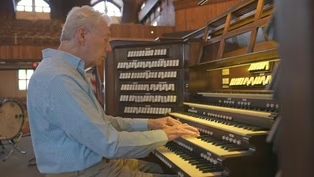
Organist Gordon Turk: "My Ocean Grove Summer Job"
Video has Closed Captions
Clip: S44 Ep4 | 8m 39s | Organist Gordon Turk: "My Ocean Grove Summer Job" (8m 39s)
Providing Support for PBS.org
Learn Moreabout PBS online sponsorship

- Arts and Music
The Best of the Joy of Painting with Bob Ross
A pop icon, Bob Ross offers soothing words of wisdom as he paints captivating landscapes.










Support for PBS provided by:
State of the Arts is a local public television program presented by NJ PBS