State of the Arts
State of the Arts: Music & Movement
Season 44 Episode 5 | 26m 46sVideo has Closed Captions
Tap dancer Deborah Mitchell; Andean musician Pepe Santana; Kathak guru Rachna Sarang.
The New Jersey Heritage Fellowships are given to artists who keep cultural traditions thriving. On this special episode, we meet three, each using music and dance to bring their heritage to New Jersey: Deborah Mitchell, founder of the New Jersey Tap Dance Ensemble; Pepe Santana, an Andean musician; and Rachna Sarang, a master and choreographer of Kathak, a classical Indian dance form.
Problems playing video? | Closed Captioning Feedback
Problems playing video? | Closed Captioning Feedback
State of the Arts is a local public television program presented by NJ PBS
State of the Arts
State of the Arts: Music & Movement
Season 44 Episode 5 | 26m 46sVideo has Closed Captions
The New Jersey Heritage Fellowships are given to artists who keep cultural traditions thriving. On this special episode, we meet three, each using music and dance to bring their heritage to New Jersey: Deborah Mitchell, founder of the New Jersey Tap Dance Ensemble; Pepe Santana, an Andean musician; and Rachna Sarang, a master and choreographer of Kathak, a classical Indian dance form.
Problems playing video? | Closed Captioning Feedback
How to Watch State of the Arts
State of the Arts is available to stream on pbs.org and the free PBS App, available on iPhone, Apple TV, Android TV, Android smartphones, Amazon Fire TV, Amazon Fire Tablet, Roku, Samsung Smart TV, and Vizio.
Providing Support for PBS.org
Learn Moreabout PBS online sponsorshipMitchell: It's one, two, three, four.
Narrator: On "Music and Movement," A special episode of "State of the Arts," meet three New Jersey Heritage Fellows, artists dedicated to keeping their cultural traditions alive and thriving.
Mitchell: You hear that?
Narrator: For tap dancer Deborah Mitchell, it's all about passing it on.
As founder of the New Jersey Tap Dance Ensemble, she keeps this uniquely American art form alive one joyful step at a time.
Mitchell: Sammy Davis Jr.
called it a hand-me-down art form, meaning it's handed down from generation to generation.
And to me, that's why it's so rich.
Ain't she sweet?
[ Music plays ] [ Vocalizing ] Narrator: The traditional Indian dance form Kathak draws its name from Kathakaar, meaning "storyteller."
Rachna Sarang is a master of this art.
Through graceful movements and intense emotion, everything she choreographs tells the story of Hindu culture.
Sarang: I try to give them as much as I could with the culture, our culture.
So that also is very important to learn through this dance.
Right.
Narrator: Over 60 years ago, Pepe Santana arrived in New York from Ecuador.
He met other musicians from the Andes Mountains and they formed a band.
It's called INKHAY, meaning to tend the fire.
Santana: Unless you learn about the tradition, you are losing an opportunity.
Tell people who you are, where you come from.
[ Music plays ] Narrator: On this special episode, "State of the Arts" goes on location with some of New Jersey's masters of traditional art.
[ Music plays ] Announcer: The New Jersey State Council on the Arts, encouraging excellence and engagement in the arts since 1966, is proud to co-produce "State of the Arts" with Stockton University.
Mitchell: It's one, two, three, four.
Yes.
[ Music plays ] Tap dancing is pure joy.
It uplifts you.
Ain't she sweet?
What's beautiful about it is that it is truly an art form that's American.
And just like America, it is mixed up with all of these different types of rhythms.
[ Music plays ] I can be feeling down.
Something may be happening with me.
If I put on my shoes, it's gone.
That's where my mind is.
That's why I say tap your troubles away.
It's real.
[ Music plays ] [ Music plays ] I've been in New Jersey for 55 years, and 46 of those years has been in performing arts.
The stage is where I always felt comfortable.
I found that it just accepted me and I could be any character I wanted to be when I was on the stage.
I was born and raised in St.
Louis, Missouri, and I grew up in the '50s.
My mom had me taking tap lessons because she said, "Oh, this, this, this little thing."
I'll never stay still long enough to be in a ballet class.
I didn't realize how much my parents, especially my mother, protected us against Jim Crow kind of mentality, all of that.
So she said, "You know what?
One day after you've gone to school, if you want to dance again, then you do that."
And I went to school.
I didn't dance during college, but when I got to New York, it was a melting pot for real, you know?
And I could be whatever I wanted to be.
For the first time, I heard people say, "Oh, you're gorgeous."
So that's when I really realized I started finding my way.
And tap dancing never left me.
[ Music plays ] The one area of my career that is always outstanding is my relationship with my mentor and my dear friend and teacher, Bubba Gaines, who was an elder statesman.
[ Music plays ] People think you have to start dancing when you're very, very young.
I was in my thirties when I met Bubba Gaines.
He said, "You have a gift.
You have an internal metronome."
He said, "You see this little rope?"
He said, "It has taken me around the world.
I'm gonna give it to you, and it's going to do the same thing for you."
[ Music plays ] He saw something in me, taught me everything he knew, and said to me, you know, "The only thing I want you to do is give away what I've given to you."
And after that, my life, it flowed into a certain way.
I had the privilege and honor of being in "The Cotton Club," directed by Francis Ford Coppola.
And then from "The Cotton Club," I went into "Black and Blue," which started in Paris, and then it was mounted a few years later on Broadway at the Minskoff Theatre.
Announcer: "Black and Blue," Broadway's big new musical.
It's elegant, it's witty.
It really moves.
Mitchell: That's when Germaine and I, as the Rhythm Queens, toured with Cab Calloway.
And that's where we ended up going all over Europe.
[ Music plays ] After all of that, I said, you know what?
I'm getting older.
I'm tired of touring.
I want to do exactly what I promised Bubba.
I'm going to pass this on.
[ Cheers and applause ] In 1994, I founded New Jersey Tap Ensemble, which was the first statewide rhythm tap dance company in New Jersey.
It was to preserve, promote the art form of rhythm tap dancing.
I was looking basically to help promote the careers of adult tap dancers who maybe no longer had careers, looking to perform on Broadway and so forth, but still wanted to dance.
The other thing that became big with the company were school time assemblies, and we actually went all over New Jersey.
Hundreds, maybe thousands, I would say thousands by now, school children have been impacted by the art form.
[ Music plays ] It's very closely connected to jazz.
So it gives you a chance to do call and answer, improvisation, that's what makes it so very different, you know, from the traditional tap, which is very structured.
It becomes personal.
It's very individual.
It's very expressive.
It's still an art that needs to be shared.
Sammy Davis Jr.
called it a hand-me-down art form, meaning it's handed down from generation to generation.
And to me, that's why it's so rich.
Tap has a rich history.
The roots of it a long way in the culture of America.
It does have all kind of rhythms in it.
Caribbean, African rhythms.
You've got mixtures there from many marginalized people.
Tell me your story with your feet.
That's how it started.
You know, telling stories with your feet.
[ Rhythmic tapping ] Don't tell me.
Just dance it.
[ Rhythmic tapping ] "Tap Your Troubles Away" is my personal little title for the workshops that I do in senior communities, in retirement communities.
I teach here in the community of Clearbrook.
I have a class for women, men, who are 55 to 100, and if you are older than 100, you join, too.
Heels.
Levine: I'm 97.
97 years young.
I feel it, I feel the music.
I learned how to tap when I came here in 2002.
Wasserman: We love Deborah.
She's so professional, but she's accessible to everybody.
And you can confide in her, and you can talk to her, and you can have a laugh with her.
She breaks it down and makes it so understandable.
I said, like, we're really tapping.
Like, we can't believe it.
Martin: Miss Debbie is absolutely everything.
She's a joy.
I love dancing, I love rhythm.
But this tap is real special.
When I get out of this class, holy cow, you feel so great.
[ Music plays ] Mitchell: It's a class that not only teaches tap, it's a social outlet for them.
It also keeps the mind active.
It's a conduit.
Yes, we have fun, but there's so much more happening besides learning a step.
When they come in there, they know that each one of them, yes, has my attention.
They're important.
What's happening in their lives is important.
It's life.
So you're dealing with more than just dance.
You're dealing with art living.
It's part of the culture of America.
And it's an art form that many marginalized people engaged in it and gave our country some of the most unique artistic contributions.
I want to make sure that they are not forgotten, that what they contributed to this world is not forgotten.
It's so easy to do.
[ Music plays ] [ Music plays ] Narrator: Music and movement keep history alive.
Up next, Pepe Santana has spent decades bringing the music of the South American Andes Mountains to the States.
[ Music plays ] [ Music plays ] Santana: Why do I do this?
Music was in my soul.
[ Music plays ] Unless you learn about the tradition, you are losing an opportunity to tell people who you are or where you come from.
[ Music plays ] The richness that we possess, that has not disappeared.
There are many communities in the Andes Mountains where they continue to do the music the way their ancestors did it, just to keep alive the tradition, just to know that their indomitable spirit will continue surviving.
And that's my intention with my music, with my instrument making, with my teaching.
[ Music plays ] My name is Pepe Santana.
I was born in a small city of the Andes Mountains of Ecuador.
I came to the World's Fair of 1964, in New York.
My plan was to stay in New York for 15 days.
But it turned out to be 60 years.
When I came to New York, I really came to a universe of sounds and traditions.
But that was the time when I couldn't hear any sounds of the Andes, not even in my own country.
At the time, I could play some musical instruments and some Andean music from other countries, but I wanted more.
And that's how I managed to go to Peru, Bolivia, Chile, Argentina, Colombia and learn.
I traveled almost, at least twice a year to those countries.
By 1974, I met some other musicians that wanted to do native traditional music from the Andes.
That group really went far.
We reached venues like Lincoln Center, Carnegie Hall, Symphony Space in New York, and eventually we made a tour nationally.
At the same time, I was doing independent work on schools, museums, libraries.
And that gave me a good chance to really talk to people and tell them things about our tradition, not only our music, but how the people live.
Dancing, storytelling, literature, food.
INKHAY is the name of the group I founded way back in 1984.
INKHAY is a Quechua word.
Quechua is the native language of the Andes that means "to feed the fire," "to tend the fire."
The idea of keeping alive this flame of tradition.
There are seven countries that are part of a mountain range called the Andes.
The Andes Mountains is the longest mountain range on Earth, and at the center lays Ecuador, Peru, and Bolivia.
These three countries have been geographically isolated since the beginning of time, but isolation has helped preserve many traditions.
Most of our traditional native music is pentatonic with five notes.
When the conquistadors, the conquerors came and blended with the natives and they produced the mestizo music.
Mestizo is the word that defines the mixture of the European and the native.
Before the arrival of the conquistadors, the music was played only with wind and percussions, flutes and drums.
After the conquest, the strings appeared.
[ Music plays ] Calarota-Ninman: It's a special day for Montclair State University, for our center, because for the first time, we are hosting the Festival of the Andes.
The Festival of the Andes is the celebration of the Andean cultures and the indigenous communities, and all Spanish speaking communities.
It's about music and it's about tradition, and it's about people and joy and colors.
Today we're having six Andean countries represented -- Peru, Colombia, Bolivia, Argentina, and Ecuador.
It represents their culture, their relationship with nature and Mother Earth and the sun and their roots and their ancestors.
So for every dance and for every music, there is a call to the past, but also to the present, to the future.
Montclair State University is an Hispanic serving institution, which means that over 40% of the students are Hispanic.
Bringing back to their culture, bridging that gap that some of them may miss because they are growing in New Jersey, but we cannot forget the roots as well.
Pepe Santana is a special person for us.
We share the same vision about the Andes, about the tradition, about the culture, and he's become our artistic director.
He's amazing.
And his music comes from his soul and from his heart.
And he's in our heart as well.
Santana: And over here we have a set of three charangos different sizes, different countries.
These three are from Peru.
This one from Bolivia.
[ Rattling ] Called Chajchas, made out of goat hooves.
This is Chilean guitarrón.
It has 27 strings.
[ Strums khonkhota ] Khonkhota.
[ Music plays ] There are three categories of instruments in my collection -- Winds, percussion, and strings.
[ Rondador whistles ] That's a rondador from Ecuador.
The fascinating part was to get acquainted with the instrument, learn how to play it, and then I would put it in my collection.
I hope one day I find a philanthropist who would help me to create an Andean museum.
The challenge was not only to perform, but to reach young minds and tell them about it.
So I began to work with schools, and as I usually do in my performances, I tell the people the name of the instrument, where it comes from, and the sound of it, how it's made.
I learned that I couldn't really teach a young kid how to cut a reed to make a panpipe, and I came up with a plastic design.
Once I teach them to do the panpipe, I teach them also to take care of the instrument.
They made it.
They have to take care of it.
But how do I play it?
That's how it is retained in the people's mind.
[ Music plays ] We are a group of people that are doing the real thing.
That was the idea that INKHAY has put forward.
We can really interact with people and tell what we do.
The folk sounds really have so many beautiful variations and inflections that are in here.
This is important, and we should pay attention and we should preserve the tradition, not only from the Andes, from anywhere in the world.
It's what to know that we are still alive, that we still have some roots that we have to protect.
[ Music plays ] [ Speaks global language ] [ Music plays ] Narrator: Last on the show, Rachna Sarang learned traditional Kathak dance in Mumbai, India.
Now, as a guru, she teaches the next generation.
[ Music plays ] [ Music plays ] Sarang: It's all about story.
We are storytellers.
Kathak dance is the storytellers.
In the temples they used to talk about goddess and gods.
It is classical based, but it is -- so many other things are involved, fused in that music.
Keeping the traditional, I do so many things.
Kathak is not only the storytelling.
Kathak is creation.
You can create so many things.
That is what I'm trying to say.
Don't limit yourself.
[ Singing in global language ] Just a brief, I want to show you the emotions of this song.
I'm just doing on the spot.
So it's not practiced or somebody taught me.
Just creation.
[ Music plays ] I'm Guru Rachna Sarang and I'm a Kathak teacher, choreographer, dancer living in New York and New Jersey for almost 50 years.
I am originally from Bombay, India.
I started learning when I was three years old.
I learned South Indian dance and I learned North Indian dance.
I came in 1977 and I didn't know anybody here In Flushing -- Queens, Flushing, there is a Hindu temple.
So I said, I can dance.
Can you give me a chance to come and perform?
My career started from there in America and I didn't look back after that.
Students wanted to learn from me.
So I started my own school of teaching Kathak.
[ Music plays ] Kids who are born here, they don't know who's Ganesh.
Now, through our dance, we have Ganesh idol.
How he was born, history of Ganesh.
I try to give them as much as I could with the culture, our culture.
And also it's good to learn through dance, through the history of not only religion -- it's our culture.
You get the manners.
You know how to talk.
You know how to sit, how to behave, how to respect your teachers, your parents, how to move in the society.
So that also is very important to learn through this dance.
Pandya: Kathak is a complex dance that balances different aspects, like you have to be really graceful, but also try to hit fast notes and really go along with the beat.
I think it's really beautiful.
It's given me like the skill to dance, but also a way to connect to my culture.
Reyna Shah: Rachna Aunty brings such joy and a new style of dance into this space.
I think she challenges me, but like in a good way, it's become one of my biggest passions.
Bafana: Aunty is Kathak, but Aunty is this beautiful amalgamation kind of synthesis of the modern and historic and various dance forms.
Not just Indian, but also Western, all put together.
I started teaching the little girls and get them to a certain level, and then Aunty can take them on and then take them to the, you know, the ultimate level.
We talk a lot about community right now.
The girls are all coming from New York City and Westchester and South Jersey and all over, but they come here and they build relationships and friendships that will last them forever.
It's been 40 years I've been with her, and that's kind of what I would aim to give back to the girls that I'm teaching under her.
And that is this wonderful, safe space that we have.
Gandhi: The way we were taught, Aunty makes a story with any sort of form of dance, and you use all different formations, all different steps and your expressions.
Expressions are a huge aspect of Kathak.
It's very graceful.
You're in love with what you're doing.
So when we do Kathak, like, pure Kathak, you have to have a certain attitude.
You have a confidence.
And then when it's storytelling, you become softer and you use graceful hand movements, graceful expressions.
Vama Shah: So I'm going into medicine, and doctors usually have a very clinical approach to their patients.
What I've learned through dance, by using my facial expressions, by knowing different body languages, I'm able to convey this empathetic type of care through like a very subtle, nuanced way.
[ Music plays ] Bafana: In the beginning, you're a little girl learning from Aunty and kind of like looking up to her, and it's amazing.
Then you go into your profession and you're getting married, and then she gives you a whole nother kind of perspective into what life is going to demand out of you.
[ Vocalizing ] Patel: My name is Barkha Patel.
I am a Kathak performing artist, choreographer, and educator based in New York City and a student of Aunty.
Aunty would actually train me by asking me to teach her classes.
So often, she would give me the class.
She would go away for a bit.
She would come back to see, "Okay, what have you done?
No, the student hasn't understood this.
Show it this way.
Try this this way.
Think of it this way.
Make it more practical."
She always had education or educating the student at the center of her heart and mind.
[ Music plays ] When I decided post-college, I wasn't sure what I wanted to do, Rachna Aunty encouraged me to look at dance as an option, and nobody in my life, in my family that I knew personally, was a full time artist of that sort.
So that's where the teaching journey started.
I teach a lot of adult students.
I used to teach young kids, and I have some classes that are young girls, but I think my biggest desire in these last couple of years has been to develop a dance company of dancers who I could take to perform professionally in professional platforms.
One of my students said this beautifully: that even though I am not a professional dancer, I've made a professional commitment to this form.
We don't see it as a hobby.
We see it as a professional commitment to the craft.
[ Music plays ] Sarang: Right.
[ Music plays ] Everything is history and story.
I feel that music, dance, anything, it is in the air.
Dancing is not artificial to me.
We are all dancing right now.
We are dancing.
You're dancing.
My students are dancing.
Everybody, when we talk, we dance, we do expressions.
Sad or happy or you're crying or you're laughing.
Everything is emotions.
So dancing brings grace.
[ Music plays ] You have to become spiritual in this.
You have to be an artist.
You can't be a dancer only just performing.
Audience has to be connected with an artist.
Artist has to be connected with the audience.
My thought has to go through you and your thought has to go through me.
Then only we can bring up something very beautiful.
[ Music plays ] [ Cheers and applause ] [ Music plays ] Narrator: That's it for this special episode of "State of the Arts: Music and Movement."
To find out more about these and all the other New Jersey Heritage Fellowship artists, visit StateoftheArtsNJ.com.
Thanks for watching.
[ Music plays ] [ Music plays ] [ Music plays ] [ Music plays ] [ Music plays ] Announcer: The New Jersey State Council on the Arts, encouraging excellence and engagement in the arts since 1966, is proud to co-produce "State of the Arts" with Stockton University.
[ Music plays ]
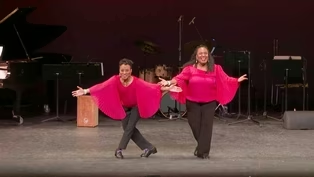 New
NewDeborah Mitchell: Tap Your Troubles Away
Video has Closed Captions
Clip: S44 Ep5 | 7m 32s | Tap dancer Deborah Mitchell passes down a uniquely American artform to her students. (7m 32s)
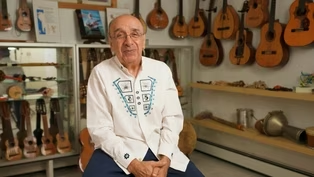 New
NewPepe Santana: Tending the Fire
Video has Closed Captions
Clip: S44 Ep5 | 7m 31s | Pepe Santana: Tending the Fire (7m 31s)
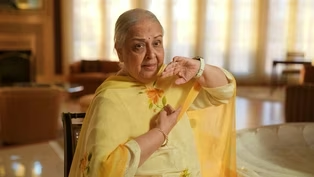 New
NewRachna Sarang: Kathak Storyteller
Video has Closed Captions
Clip: S44 Ep5 | 7m 27s | Guru Rachna Sarang passes down Hindu Heritage through classical Indian Kathak dance. (7m 27s)
Providing Support for PBS.org
Learn Moreabout PBS online sponsorship

- Arts and Music
The Best of the Joy of Painting with Bob Ross
A pop icon, Bob Ross offers soothing words of wisdom as he paints captivating landscapes.











Support for PBS provided by:
State of the Arts is a local public television program presented by NJ PBS