State of the Arts
The Data Forest
Clip: Season 44 Episode 4 | 6m 29sVideo has Closed Captions
An immersive work by Laia Cabrera and Isabelle Duverger: Perennial Land: The Data Forest
At the Morris Museum, Laia Cabrera and Isabelle Duverger’s immersive installation, "Perennial Land – The Data Forest" seeks to spur dialogue about climate change. Through striking imagery and data-driven insights, the exhibition’s visual poetry invites viewers to reflect on the impact we have on the environment.
Problems playing video? | Closed Captioning Feedback
Problems playing video? | Closed Captioning Feedback
State of the Arts is a local public television program presented by NJ PBS
State of the Arts
The Data Forest
Clip: Season 44 Episode 4 | 6m 29sVideo has Closed Captions
At the Morris Museum, Laia Cabrera and Isabelle Duverger’s immersive installation, "Perennial Land – The Data Forest" seeks to spur dialogue about climate change. Through striking imagery and data-driven insights, the exhibition’s visual poetry invites viewers to reflect on the impact we have on the environment.
Problems playing video? | Closed Captioning Feedback
How to Watch State of the Arts
State of the Arts is available to stream on pbs.org and the free PBS App, available on iPhone, Apple TV, Android TV, Android smartphones, Amazon Fire TV, Amazon Fire Tablet, Roku, Samsung Smart TV, and Vizio.
Providing Support for PBS.org
Learn Moreabout PBS online sponsorshipDuverger: "Perennial Land: The Data Forest" is a piece that is conceived as a site-specific immersive installation.
Cabrera: The idea is that we want to create a gathering, and we wanted to do it using the beauty, the powerfulness of nature, at the same time to be able to use a message that is a reminder that we have agency, that we can do something.
[ Down-tempo music playing ] We use the idea of data, of information, because there is a lot of information out there, as a way to question that we can have this dialogue with the environment.
Duverger: This concept of data forest, how nature is bringing us so much data and is communicating to us in such a way that we are finally understanding it and we're also understanding our impact on nature.
And so this piece was a way to be able to convey this care and climate justice through visual poetry and data.
[ Music continues ] Cabrera: My name is Laia Cabrera.
I'm a filmmaker and video artist, and I work in immersive experiences in what's called kind of like immersive art and new cinema, trying to find ways to tell stories that are going, like, beyond the frame.
I'm originally from Spain, from Catalonia.
An award that I won made me come to the East Coast, to New York, and eventually to Jersey City.
And I've been developing my body of work since then, for more than 20 years.
Duverger: My name is Isabelle Duverger.
I'm a French visual artist.
And I'm also an immersive interactive installation artist.
My art practice restarted when I met Laia -- 15 years ago already.
And about five years ago, I started painting again.
And so it has become also an integral part of my practice at this point.
Our work is a lot of working in layers.
There's often two, three layers combined together to convey the message.
Together, we manage to enrich the work of each other by passing it from her to me and from me to her.
Cabrera: I met Isabelle, and soon after, we started creating pieces together and sort of working from A to Z, from conceptualization to implementation to execution.
There's this constant integration of different genres.
from illustration, animation, performative arts, but also the curiosity and incorporation of art and technology.
Duverger: We often work with our installations with different collaborators.
We are very fortunate to have been collaborating for many years with Nana Simopoulos, an amazing composer, a Greek-American composer.
For the composition, Nana chose not to use sound effects.
Every drop of water -- actually not drops of water.
They are sound that evoke the sound of water.
[ Water flowing ] It brings a whole layer of interpretation of what nature sounds like in a musical way.
Cabrera: The whole landscape of the cinematic aspect of the piece has been filmed by us, edited, and layered.
Duverger: "Perennial Land" is a piece that has evolved throughout every implementation that we've done.
Cabrera: Every time that we would present it to a place, we would do a little bit of research on our end of that place, that environment, and what's happening there, what the community is doing.
Small: Laia and Isabelle did an amazing job in including facts about Morris County and personalizing the experience, personalizing "Perennial Land" for this area.
So there are key facts about Morris County and what Morris County is doing for the environment.
Duverger: "Perennial Land: The Data Forest," it's a piece that has come to us through different projects.
We always wanted to have interactive experiences because of the way that audiences can get more and more involved in the piece and how the installation itself transforms with their audience.
So, our first immersive interactive installation was called "Self on the Shelf."
It's an installation that was in the setting of a child's bedroom, where you had projections on floor, ceilings, and all the walls.
So whenever people would touch different objects in the room, the room would transform.
We've created the largest interactive public art installation in New York at the time, which was called "The Now."
It was part of the Culture Impact platform, which we inaugurated.
We created "Illusion" and "Dream-e-scape" in Los Angeles.
"Dream-e-scape" actually traveled to Saudi Arabia and to Hong Kong, which was a beautiful experience.
Cabrera: "Qualia" initially was like a love letter to nature.
That came during the COVID, exploring our longing for connection through consciousness, nature, symbolism, and hope.
Duverger: We are working currently on an interactive piece that is also "Perennial Land."
We want the piece to be as emotional and as interactive to the audience as possible so people really feel involved.
It's partly technical, and it's partly also conversations.
So it's a lot of programming in the back end, but it's also a lot of conversation about how to make that user experience seamless.
Cabrera: We can record and create these complex images that we're interested in that are not -- They don't exist.
You have to build them.
You have to design them.
Technology has helped tremendously.
Duverger: What we want is almost for people to enter an experiment lab.
It's gonna use the language of a video game in some way, but it's gonna be more participatory.
And in that sense, what we want ultimately is for people to talk to each other and make decisions together about climate.
[ Music continues ] Small: It's a call to action.
I hope that people take heed to the message that it only takes 3.5% of the population to enact change.
And hopefully someone that has experienced it stands up and thinks, "I'm gonna do something."
Video has Closed Captions
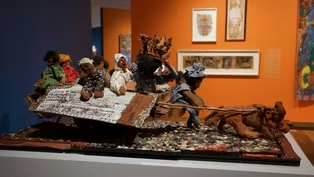
Clip: S44 Ep4 | 10m 33s | Aminah Robinson's storytelling art chronicled Black history and everyday life. (10m 33s)
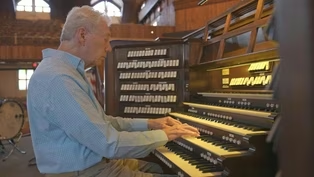
Organist Gordon Turk: "My Ocean Grove Summer Job"
Video has Closed Captions
Clip: S44 Ep4 | 8m 39s | Organist Gordon Turk: "My Ocean Grove Summer Job" (8m 39s)
Providing Support for PBS.org
Learn Moreabout PBS online sponsorship

- Arts and Music
The Best of the Joy of Painting with Bob Ross
A pop icon, Bob Ross offers soothing words of wisdom as he paints captivating landscapes.









Support for PBS provided by:
State of the Arts is a local public television program presented by NJ PBS