One-on-One
Advice for women and mothers rising in their careers
Clip: Season 2026 Episode 2874 | 9m 40sVideo has Closed Captions
Advice for women and mothers rising in their careers
Kiran Handa-Gaudioso, CEO of United Way of Northern New Jersey, sits down with Steve Adubato to share her passion for supporting vulnerable populations and advice for women and mothers rising in their careers.
Problems playing video? | Closed Captioning Feedback
Problems playing video? | Closed Captioning Feedback
One-on-One is a local public television program presented by NJ PBS
One-on-One
Advice for women and mothers rising in their careers
Clip: Season 2026 Episode 2874 | 9m 40sVideo has Closed Captions
Kiran Handa-Gaudioso, CEO of United Way of Northern New Jersey, sits down with Steve Adubato to share her passion for supporting vulnerable populations and advice for women and mothers rising in their careers.
Problems playing video? | Closed Captioning Feedback
How to Watch One-on-One
One-on-One is available to stream on pbs.org and the free PBS App, available on iPhone, Apple TV, Android TV, Android smartphones, Amazon Fire TV, Amazon Fire Tablet, Roku, Samsung Smart TV, and Vizio.
Providing Support for PBS.org
Learn Moreabout PBS online sponsorship(upbeat music) - We're now joined by Kiran Handa-Gaudioso, who's CEO of United Way of Northern New Jersey.
Kiran, good to see you.
- Excellent, so good to see you too.
Thank you for having me, Steve.
- You got it, website is up.
This is part of our Women Business Leaders.
We're doing a cooperation with our partners at the New Jersey Business and Industry Association, CEO, Michele Siekerka, a great friend and colleague.
Tell us what the United Way of Northern New Jersey is.
- So United Way of Northern New Jersey is part of a global network of United Way organizations.
We operate programs to support what we call ALICE Families.
ALICE stands for asset limited, income constrained, employed, and it's those households in our community, in our economy who are often working, yet struggling to make ends meet and find themselves with very, very difficult choices every week, between buying groceries, paying for medicine, car repair, childcare, really struggling.
And so our United Way operates programs to really support these families through all different aspects of their struggle.
And then what makes us really special is that we also operate a national research and analytics project that we call United for ALICE, where we have a team of researchers and writers that produce, you know, statistics and data and all kinds of research tools that are used across the country by United Ways and other stakeholders to help make life better for ALICE across the country.
- Kiran, you understand a little bit about an ALICE-related family or whatever that means, asset limited, income constrained, employed.
You grew up in such a family, did you not?
- I did, I did, and Steve, that's what really drew me to this United Way into this work almost 13 years ago when I joined the team.
The opportunity to really focus on this population really spoke to me based on my career.
I spent a lot of time working in afterschool programs in New York and New Jersey with families that were ALICE, and then myself, I very much grew up in an ALICE home.
My father immigrated here from India in the late '60s.
My mother grew up in Newark, lived in her grandmother's boarding house in the Irish section.
And so when my parents came together, they really struggled.
But fortunately, you know, they both had education, and my dad always said that, you know, "Your education is the most valuable commodity.
It's something you'll always have, and no one will be able to take that from you."
So my parents were fortunate.
Over time, they were able to achieve financial stability.
But very early on, you know, I have very vivid memories of my parents making very difficult choices.
- Kiran, I'm a student of leadership.
I write about leadership, teach, coach, as you well know.
Michele Siekerka and I talk about it all the time.
- Yep.
- The challenges of leadership, the joys, the struggles of leadership, the loneliness of leadership, and I'm not trying to make it sound like, "Oh my God, it's such a terrible life," 'cause we chose it.
Did you see yourself as a leader growing up as a kid?
Like, "I'm going to be a CEO one day," and by the way, don't have to be a CEO to be a leader.
Did you see yourself, at the core, "I'm a leader."
- I think I was always drawn to being in a role, or whenever I found myself in a situation where something needed to be done, and there was a very, you know, stark issue or problem.
I think I was always the first or second person to raise my hand and figure out a path forward, a way to solve the issue, whatever it was.
And so I think, you know, that really led me on the path to being in stages and places and rooms and tables where leadership opportunities were available and needed.
But I don't think I imagined as a young person coming up that I would be a CEO.
I really wanted to do good work, I wanted to be part of a mission-driven organization, and I wanted to be part of a strong team of really smart, dedicated, outstanding individuals.
And I'm very blessed that we have that at United Way and really across our whole sector.
- Finish this sentence for me.
Being a CEO and a mom at the same- And a wife at the same time, being CEO, mom, wife, family member is so challenging because?
- Because I think there's an expectation that's created from a variety of sources that women can do it all with the same level of performance at the same time.
So I talk a lot about the fact that we have to acknowledge we can't do it all.
Something is, always has to give.
We need help, we need support, we need resources, and we need to give ourselves grace that we can't do it all, and also give ourselves permission to let something go and know that we can't do everything at the same time.
I was fortunate enough to come into the CEO role when my children were in college and really, you know, on their path to independence.
I don't think I would've been able to work the way I do and lead the way I do when my kids were, you know, in the height of, you know, schedules and drop offs and after school and homework.
I wouldn't have been able to do it and be the kind of mom.
- Curious about this.
Discrimination toward women in the C-suite, still there?
- Yes.
- Make the case.
- I think that it kind of goes back to what we just talked about.
I think some of it is the expectations around women that are very different for men, especially at the C-suite level.
And some of that is kind of internalized, you know, expectations and pressure that we put on ourselves, but there is also just an inherent difference the way a woman CEO is treated compared to a man CEO.
We don't question whether a man is gonna get home for a baseball game or back-to-school night, but when a woman misses that, it's noticed, and there's typically some kind of comment about it, so yeah.
- Sorry for interrupt, I appreciate your point, but as we're taping, our daughter has a state tournament field hockey match as soon as we finish recording today, and I know I need to be there, I want to be there, but I will say this.
I'm glad that the pressure is a little bit more on dads and husbands, but it ain't the same, meaning there is definitely more pressure on women.
Before I let you go, I'm wanna try this.
In our nonprofit, I have to, 24/7, I'm raising money, you too?
- Yes, all day, every day.
- Can we admit that it sucks?
- It does, it's incredibly, it's very, very challenging, especially now, especially now.
- Let me ask you this from your point of view.
I find it hard, but I've been doing it for 30 plus years and I have to keep doing it, and I'm glad to do it because we get to do this work.
- Right.
- Do you think it's even harder for women to raise money in the corporate foundation world?
- I don't think so.
I don't.
- Okay.
- I don't really see that playing out there.
I think it's hard in general.
I think it's multi-year, unrestricted, general ops funding, very challenging.
I will say where we have success is when we really bring a group of partners, stakeholders, funders together to co-create, right?
You know that, Steve.
Design and build something together, that's the fun money to raise, I like to say, but it is very challenging, and we're feeling it, for sure.
- No money, no mission, but we have no choice.
That's what we signed up for.
Kiran, I wanna thank you so much.
Keep doing important work with your colleagues at the United Way.
And we thank the NJBIA, Michele Siekerka and our colleagues for helping us produce this Women Business Leader series.
Thank you, Kiran, all the best.
- Thank you, appreciate you.
- You got it.
Appreciate you.
Stay with us, we'll be right back.
- [Narrator] One-On-One with Steve Adubato is a production of the Caucus Educational Corporation.
Funding has been provided by NJ Best, New Jersey’s five-two-nine college savings plan.
Seton Hall University.
Hackensack Meridian Health.
Valley Bank.
New Jersey Board of Public Utilities.
PSEG Foundation.
Robert Wood Johnson Foundation.
The Russell Berrie Foundation.
And by The North Ward Center.
Promotional support provided by ROI-NJ.
And by New Jersey Globe.
- (Inspirational Music) - (Narrator) Great drive fuels the leaders of tomorrow and today.
Great vision paves the way for a brighter future.
Great ambition goes places, moving onward and upward.
Great empathy finds strength in kindness and in each other, working together to create something bigger than they ever imagined.
Great minds can change the world and great minds start at Seton Hall.
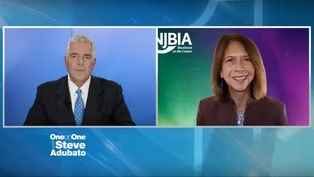
CEO of NJBIA discusses the next generation of NJ leaders
Video has Closed Captions
Clip: S2026 Ep2874 | 9m 3s | CEO of NJBIA discusses the next generation of NJ leaders (9m 3s)
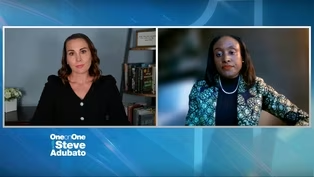
Overcoming adversity as a woman of color in the C-suite
Video has Closed Captions
Clip: S2026 Ep2874 | 9m 21s | Overcoming adversity as a woman of color in the C-suite (9m 21s)
Providing Support for PBS.org
Learn Moreabout PBS online sponsorship
- News and Public Affairs

Top journalists deliver compelling original analysis of the hour's headlines.

- News and Public Affairs

FRONTLINE is investigative journalism that questions, explains and changes our world.











Support for PBS provided by:
One-on-One is a local public television program presented by NJ PBS