State of Affairs with Steve Adubato
Breaking the cycle of homelessness and addiction in NJ
Clip: Season 9 Episode 27 | 8m 41sVideo has Closed Captions
Breaking the cycle of homelessness and addiction in NJ
Peg Wright, Founder and CEO of The Center for Great Expectations and 2025 Russ Berrie Making A Difference honoree, joins Steve Adubato to discuss her non-profit’s mission to break the cycle of homelessness and addiction by providing comprehensive care to marginalized, pregnant, and parenting individuals.
Problems playing video? | Closed Captioning Feedback
Problems playing video? | Closed Captioning Feedback
State of Affairs with Steve Adubato is a local public television program presented by NJ PBS
State of Affairs with Steve Adubato
Breaking the cycle of homelessness and addiction in NJ
Clip: Season 9 Episode 27 | 8m 41sVideo has Closed Captions
Peg Wright, Founder and CEO of The Center for Great Expectations and 2025 Russ Berrie Making A Difference honoree, joins Steve Adubato to discuss her non-profit’s mission to break the cycle of homelessness and addiction by providing comprehensive care to marginalized, pregnant, and parenting individuals.
Problems playing video? | Closed Captioning Feedback
How to Watch State of Affairs with Steve Adubato
State of Affairs with Steve Adubato is available to stream on pbs.org and the free PBS App, available on iPhone, Apple TV, Android TV, Android smartphones, Amazon Fire TV, Amazon Fire Tablet, Roku, Samsung Smart TV, and Vizio.
Providing Support for PBS.org
Learn Moreabout PBS online sponsorship[INSPRATIONAL MUSIC STING] - We're now joined by Peg Wright, President and CEO of the Center for Great Expectations.
Good to see you, Peg.
- Thank you, it's great to see you, Steve.
- And you're also a Russ Berrie Making a Difference Awardee, correct?
- I am, yes, I'm proud of that.
- Yeah, tell us what the Center for Great Expectations is.
The website's up.
- The Center is a continuum of care for pregnant and parenting women that are presenting with substance use and mental health disorders.
So we do that in residential settings, outpatient settings, in home, child development, a whole continuum of care.
- Talk to us about government funding cuts, it matters.
What cuts, what are the cuts and how have they affected the people you serve every day, Peg?
- It's a bit of a nightmare.
We received SAMHSA funding, federal funding for 10 years, and then.
- Hold on, SAMHSA that's an acronym that not everyone knows, what is it?
- That's the Federal Substance Abuse and Mental Health Administration - Okay.
- At D.C.
And yeah, we received 500,000 for the last 10 years, which allowed us to serve Medicaid and underinsured individuals in our outpatient saying, that's gone.
I'm praying we have about $600,000 shortfall on the outpatient, which is a critical component of our continuum.
So I'm praying that we get that funding somehow.
We lost our state appropriation.
I'm hopeful that we can get a supplemental legislative appropriation in sometime in November.
That's roughly 1.5 million.
- It's interesting how some legislators and others are critical of those items that are added to the budget, those supplemental items.
As a former state legislator, I represented a district where there were dollars that we brought back to the district that we believe helping community members, helping municipalities, helping nonprofits like yours.
For those who say, hey, that's pork barrel stuff that they used to call them Christmas tree items.
Explain to folks why that is it 1.5 million?
- The legislators that had supported our appropriation really would like it to be a line item in the budget.
Maternal mortality is a critical issue in the state of New Jersey, and we are the premier provider of pregnant and parenting women presenting with substance use disorders.
So it's a no brainer for me.
- But I wouldn't call that pork barrel.
- No.
- Describe for us, Peg, the term trauma-informed care.
What does that look like?
- Well, the women that we serve have been generationally impacted by trauma, which includes poverty.
Complex trauma is, for example, living in a home with a mom that is using substances.
There's a tremendous amount of dysregulation going on.
There's, you know, food source is lacking, there are just a number of issues that create domestic violence.
So if you don't look at the underlying causes of substance use, it's a problem.
It's a big problem.
And, you know, we've been evolving a way of delivering care over the last number of years and collecting data.
We work very closely with Rutgers University, so it's just not my idea.
We have the data to prove it, and we're about to launch the Relational Recovery Model, which we've been working on for three years with Dr.
Denise Hien at Rutgers, and Dr.
Emily Bosque, who's the co-author along with my team.
So it's a big deal.
- Here's the thing that I'm not struggling with, but trying to make sense of.
We talk about these funding cuts.
We talk about certain programs that you and your team are leading at the Center for Great expectations.
We'll put up the website again.
Talk to folks about what happens to those women, those families, without those resources, if your organization can't provide those services?
- Well, the cycle continues.
And, you know, quite frankly, you know, living in the types of environments that the women that are referred to us live in without significant support.
And, you know, substance use is not an acute illness.
It doesn't, it's not one and done.
So someone doesn't come into my program for nine months and we just say, that's it.
They access outpatient care.
They access an in-home team that works with them for potentially 18 months in clinical case management, doula support, and peer support.
So we've recently partnered with Robert Wood Johnson University Hospital in providing their women with our care, which is really a big deal.
- Peg, how'd you get into this work?
- I'm a woman in long-term recovery.
You know, I was in a corporate setting.
It was the late 80s, you know, 90s.
I was selling diagnostic imaging equipment.
We partied hardy, and I had my, I got pregnant late in life.
And when I did, the light bulb went on and I said, I just can't live like this.
And ended up volunteering at Great Expectations Maternity Home, met Sister Rita Wilkie, and she changed my life.
- Wait a minute, you got help from the Center for Great Expectations?
- Not formally, no, you know, I was one of those lucky people, I didn't... and I'm not saying I did not get help at Great Expectations.
We were a maternity home at that point.
- Well, why'd you start volunteering?
- Because I was bored.
My son was at two years old then he was in preschool.
So it was a God thing, Steve, really it was.
And then I met Sister Rita, and she created a mission statement that spoke to Safe Place, Safe Presence, and Safe Path.
And that was in 1996 before people were even using the word trauma-informed.
- And PS, the Robert, excuse me, the Russ Berrie Foundation, being an awardee also means there's a grant that goes with it.
Those dollars matter, do they not?
- Oh, big time, that was just a magical day.
- It was, it was, - It was just.
- I was proud to host it with wonderful people like you.
- You did a great job.
And it was so wonderful to be with others that are impacting the community when it was really a tough, it's a tough time.
It's hard right now.
- Hey, Peg, you have an open invitation, we'll continue.
I know you're dealing with incredibly difficult fiscal challenges.
We will be here to continue to promote the work that you and your colleagues are doing and drive people to your website.
Thank you Peg, we appreciate it, all the best.
- Thank you very much, very grateful.
- I'm Steve Adubato, thank you for watching.
We'll see you next time.
- [Narrator] State of Affairs with Steve Adubato is a production of the Caucus Educational Corporation.
Funding has been provided by The Russell Berrie Foundation.
Robert Wood Johnson Foundation.
RWJBarnabas Health.
Let’s be healthy together.
The Adler Aphasia Center.
New Jersey’s Board of Public Utilities.
The New Jersey Economic Development Authority.
Johnson & Johnson.
The Fidelco Group.
And by Kean University.
Promotional support provided by NJBIZ.
And by Meadowlands Media.
Hi, I'm Naomi Gwartz from the Adler Aphasia Center.
Aphasia is a language disorder that usually results from a brain injury such as stroke or a brain tumor.
While aphasia can affect one's ability to speak, understand, read, and write, it does not affect intellect.
Programs offered at our center help improve communication skills as well as confidence and quality of life while surrounded by others who understand aphasia.
If you or a loved one is diagnosed with aphasia, there is hope and community.
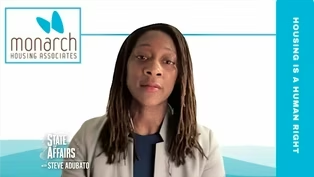
Discussing homelessness and affordable housing in New Jersey
Video has Closed Captions
Clip: S9 Ep27 | 10m 35s | Discussing homelessness and affordable housing in New Jersey (10m 35s)
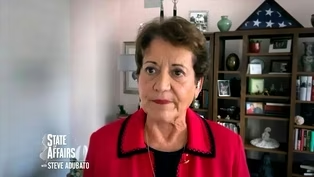
Examining the evolution of public health
Video has Closed Captions
Clip: S9 Ep27 | 8m 19s | Examining the evolution of public health (8m 19s)
Providing Support for PBS.org
Learn Moreabout PBS online sponsorship
- News and Public Affairs

Top journalists deliver compelling original analysis of the hour's headlines.
- News and Public Affairs

FRONTLINE is investigative journalism that questions, explains and changes our world.








Support for PBS provided by:
State of Affairs with Steve Adubato is a local public television program presented by NJ PBS