Here's the Story
Here's The Story: Karmic Farmers
Season 2026 Episode 4 | 29m 11sVideo has Closed Captions
Karmic farming, growing wellness in Asbury Park.
Producer Steve Rogers follows Mychal Mills and Rodney Salomon, founders of KYDS, (Konscious Youth Development & Services), as their personal wellness journey grows into a mission transforming youth and communities through holistic practices. Filmed over two years, the episode captures their work at the newly opened Konscious Community Center in Asbury Park
Problems playing video? | Closed Captioning Feedback
Problems playing video? | Closed Captioning Feedback
Here's the Story is a local public television program presented by NJ PBS
Here's the Story
Here's The Story: Karmic Farmers
Season 2026 Episode 4 | 29m 11sVideo has Closed Captions
Producer Steve Rogers follows Mychal Mills and Rodney Salomon, founders of KYDS, (Konscious Youth Development & Services), as their personal wellness journey grows into a mission transforming youth and communities through holistic practices. Filmed over two years, the episode captures their work at the newly opened Konscious Community Center in Asbury Park
Problems playing video? | Closed Captioning Feedback
Where to Watch Here's the Story
Here's the Story is available to stream on pbs.org and the PBS app.
Providing Support for PBS.org
Learn Moreabout PBS online sponsorshipHere's the story.
[ Music ] >> My brother was a pivotal inspiration behind who I am and how I came to this work.
The leader I am today is because of my brother.
And growing up, my brother was my idol.
He kind of like was everything to me.
I seen him.
He was a celebrity in my eyes.
And having an idol can be very tricky because if that idol goes on a path that you don't really idolize or look up to or is causing some pain in your life, then there's a rupture there.
And my brother started going into the streets early in his life, early in my life, and seeing the pain that it caused our family, getting calls from not now schools, but from police.
Your son got arrested, or your brother got arrested, or your brother got shot, stabbed, this, that, and the third, and it caused a lot of pain in our household.
Seeing his suffering caused our suffering as well.
And so that idol became an inspiration to be something more, to do something more in a community.
And one of the first things it inspired me to do is become a big brother.
And then I realized a couple years after that relationship started that there's a mutuality in this relationship.
There's not a mentor-mentee, but there's a relationship between two individuals.
And it was almost a brotherhood that was being developed.
And it wasn't about me saying the right things, but being the right things.
I went to school, I got a full scholarship to play football at the University of Maine.
And I was playing as a true freshman and I ended up falling in love with a young lady on campus.
And then my sophomore year, right, in the first month we were kind of having a rough time because I got hurt in football, pulled my hamstring, and I knew that my position might have been at threat.
I lost my starting spot, so like I wasn't in the right mental space, wasn't spending as much time checking in, whatnot.
And lo and behold, the girl I was with ended up cheating on me with one of my teammates.
And I was drinking, I was smoking, just trying to numb everything away.
And you know, I ended up transferring schools.
I went to Monmouth University thinking I could just leave it all behind, right?
But like wherever you go, there you are.
We just decided we know what we want the space to be, multi-youth workshops, you know what I mean?
Meetings for our staff, sensory space for our youths who are going to have multiple -- like whether it be a youth programming, adult workshop.
And it just hit me one day, man.
It was like, oh, wow.
Like when I'm under stress, when I'm under fear, I don't access that higher voice, inner voice inside my mind.
I'm not able to project the energy inside of my heart and practicing how to do meditation, learning how to change my diet, learning to have more space so I could be my authentic self.
Some of these yoga studios I was going to, a meditation class I was taking, really allowed for me to be in containers, an environment that I felt safe enough to not have to be this big, macho football player.
I could take that guard down and be myself and working with youth in real time, I was able to see myself.
I used to have a smart mouth and I had an issue with one of my coworkers.
We were cool, but I just didn't like his work ethic and style.
And I remember one day he said a smart comment in front of the kids, and I usually would just go back to him, but I just took a deep breath and I paused.
I'm like, "Ronnie, do you have to do this right now?"
And that was the moment where I can really perceive myself being self-aware.
We still have a lot of work to do with the interior designer.
As far as her, we did a couple walk-throughs with them.
We have another walk-through with another interior designer who's going to be supporting us this weekend.
But for us to give them our vision, and also how it may look, so gather... At the end of my college career, I just finished my master's and there was nothing else after, right?
There's nothing else.
It's life, right?
You work, you're life.
Nothing else to obtain.
And I remember that empty feeling, like, "Who am I now?"
You know, I started cleaning up my diet.
I started cleaning up my mind, my heart.
And I was like, "Oh, wow.
There's a lot inside that I need to heal."
And as I was starting that journey and really going within, that's what kind of birthed the kids because that's where I met the other co-founder Rodney Solomon and he was on that journey as well.
And then I met Mike in 2013.
Well actually me and Mike met a lot.
It's crazy.
We were on the same AAU basketball team.
I was the older kid, he was the younger kid.
We went to the same college at Monmouth.
He was more involved and engaged on campus.
I was more just the athlete, the jock, but not a lot of Black people in Mounmouth so I was always going to give that honorary head nod, play intramural basketball.
There's always a debate on who won more games and won those championships, but hey, we are here now.
And then I was working at the high school, we would take our students to volunteer at a local soup kitchen.
Mike was working at the food bank and he would just volunteer his time.
I called Mike "The Mayor" when I first met him, like for real, for real, like we spend more time, because he was always involved in volunteering, and we were talking like, I go once a month, he happens to be there most of the month, and we just talk about all the challenges, all the issues in the community, and we were like, you know what, let's not complain about it no more.
Let's find ways that we can create a solution.
[MUSIC] How can we build a bridge of giving kids, giving adults, giving individuals the necessary skills and tools that they need to awaken to their full potential?
[MUSIC] How do we show individuals to access that inner voice, that inner wisdom by remaining in a state of coherence where the heart and mind is in balance and how can we do that in a way that is simple and practical to give folks the light that already exists inside of them and doing that through the sacred wisdom, the ancient wisdom and turning it into a modern form that can be embraced and accepted by all and that was the ultimate goal of why Kyds was created.
And there's really something powerful that happens when you have all these different types of people from different backgrounds come and have like a collective breath.
This is a space for everybody to come and to be able to participate and to be able to feel like you are in a community of like-minded consciousness.
We appreciate you all.
We care about you all.
And we love you all.
I did not know something like this even existed.
Something where people had genuine love for others and wanted them to succeed.
In today's society it's hard to find people like that.
Hard to find people who really care and want the best for you.
I thought, "Wow, I was in these kids' shoes once."
I was in a place where you may not be able to speak the truth.
You may not be able to be your authentic self without negative consequences.
So it was beautiful to really see how they were loving on these children and caring for them, and just helping them find their true selves.
I'm like, "Wow, they're having everlasting impact on these kids, and I really want to take part in something like that."
I love me.
I love me.
Everyone say I love you.
I love me.
Let's take a nice deep breath in.
We have our community wellness.
We started back in Cooley Cafe in 2015.
The monthly meditation system, monthly sound bowls, and we always believe inner peace should have a cause.
Seeing how you go to a yoga studio, like right now, it could be $20 per class.
Sometimes $25 if you don't have a membership at that location.
Sometimes $15.
And yes, you gotta value what you deserve, but there's something powerful when folks recognize and see themselves and have access to it, and they can be embraced and accepted, that awakens something inside of them.
So, being able to offer that bi-monthly yoga on a regular basis, meditation classes on a regular basis, and if we're able to have this impact from the data that we have seen, from what we're doing right now, man, we have a limitless possibility of what we can do to really show this community how to make wellness accessible, how to make this cool and normal within spaces that people interact with.
I don't really consider this a job.
It's like, it's more like a purpose.
People will come and be like, "Oh, it feels good in here.
Just being here feels good."
I have heard people say, "It feels good here.
This energy feels so positive."
Kyds is an organization of pure love.
Kyds is family.
Kyds is community.
Kyds is belonging.
Kyds is a place where everyone can go and be accepted for who they really are.
Wow.
It is love, acceptance, embracing anything and everything, meeting people where they're at, and everything that I feel we need in this world right now.
Kyds is a beacon of love, a beacon of light and hope.
Kyds is a place where you return back to your wholeness.
Kyds is a place where you remember who you are.
Kyds is a place where you can heal, where you can feel, where you feel like you belong to something, you feel like you're connected, you matter, and all of you is welcome.
Kyds is empowerment.
It doesn't do it for you, it does it with you.
And Kyds is everything we all needed when we were children.
One, two, three, Kyds!
Alright, let's go.
It's like that huddle break, you go in too.
Peace, peace.
Clap once if you hear my voice.
Clap twice if you're listening.
Clap three times if you're happy to be here.
[Clapping] [Music] You know, in a western system, everything is fragmented, compartmentalized, and really designed to, you know, be very clinical, which I think is beautiful.
We need systems of that nature, but holistic is really the things that don't require much outside of you.
It's the natural way that our body flows and functions that we can access through movement, through breath work, through meditative practices and skills that we can utilize, but also the ability to see natural ways of coming back to peace.
Only you can give up on you.
Our mind gives up long before our body does.
A lot of times when we're in that strong pose, this, that, and the third, our mind is giving up before our body is.
So I invite you to have a strong mind, and behind that, we'll follow a strong body.
Does that make sense?
And I know some of us, we don't want to practice, we don't want to practice.
You know, I had a lot of school-based experience working in school since 2008 and starting this off, so I recognized the gaps that were missing in school, you know, and all the pressure they have to handle and how important the nervous system of the staff, the teacher is in that classroom.
So being able to be working there and be in the shadows of observing the space, I knew what we can offer youth.
So we incorporated youth programming that I was kind of doing already, but making it cool and fun, bringing SEL, social-emotional learning and mindfulness, into a conscious classroom, these 30-minute bite-sized pieces.
And we did the whole entire District of Asbury Park.
Over 80% of the youth of the 1,200 that participated all showed growth and self-regulation and developing skills.
I'm not saying perfect, but developing coping skills and self-awareness skills that are truly going to impact them for life.
And from being in Asbury, we started bringing that same program to other school districts.
It opened up the doors for schools all around Asbury Park.
It's like, if you're able to accomplish this in Asbury, man, can you help our school out as well?
And the same impact we had in Asbury Park, we've seen the same impact in those other school districts.
It's difficult for them to focus on the well-being when they have so much pressure on the academics in the building.
And we come in not to teach you anything, but to show you how to awaken what's already inside of you.
Not to control you, but to show you how to regulate the nervous system of the school in doing this from the formula and blueprint that we learned.
And it was a financial foundation.
We weren't big on grants.
We weren't big on foundation support.
So almost 80% of our revenue came from school-based.
And we took that school-based money that we had and took the extra profits and used that for our summer program, used that for our community programs.
And we were always giving back.
And school-based is a space where you get the highest volume of youth, the highest volume educators.
Everyone's not going to come to our community center.
But when we're in a school with you, we're going to see youth that we'll never see, the ones who probably need our program the most, and that has been truly transformational in helping us develop and cultivate the framework of how we function today as an organization.
What kind of kid were you growing up?
So I was definitely a quiet kid growing up.
What changed?
My voice changed.
I found my voice.
[ applause ] So we're gonna get right into it man.
This next poem is a dedication to my big brother.
It's called "Spoken Letters."
I'm repping my brother right now and the life, the legacy that he lived and this is about our relationship and the life that he lived as well.
And I started hearing my voice more and more and also liking my voice, liking what I'm saying and liking how it was being received around me and really enjoying that.
So there was definitely a shift in my life where a lot of my life that was internal became externalized.
And that was also because this is how you impact others.
Dear brother, it's been a long time.
It's been a long, long time.
I've had a lot on my mind.
Our family, me and you, been on my mind.
I've been so caught up in mine, I've neglected that you've been doing time.
Lost in time and time we lost, now we're back in time.
So no more hiding, now I can see it, now I could feel it, now we can heal it.
Big bro, on a real tip, I see you, I feel you, I'm happy with you, with you, and everything we've been through.
Conversations overdue.
I'm just happy to say, Big Bro, I love you.
The man you became, came from the man you became.
Becoming better and better, our relationship better and better.
I meant everything I said, because it reflects everything I said.
And I guess I forgot that we had the same blood.
What's in yours, also in mine.
Now we're back in time.
Five years strong.
Man, you got strong.
You came home with your head up high and your feet down low, ready to go.
A new beginning for you, a new beginning for me.
We are now the brothers we were meant to be.
Big bro, family strong, remix a song, let go of the wrongs, our family's home.
Words never spoken, written in my heart.
Words never spoken, written in my heart.
Dear bro, time has passed.
That time has passed.
Our time is now.
I love you forever, right now.
Unspoken letters, spoken together.
Unspoken letters, spoken together.
Mr.
Consistent, stay fly and stay fit.
Big bro, rest in power, rest in peace.
Thank you.
( applause ) You know, your voice can shift and transform an entire population and community.
So I wanted to make sure that my voice was a voice of righteousness, of morality, that someone could look up to because I started like looking around me, it's like, okay, if they're listening to all these voices that aren't righteous, that are toxic in a lot of ways, and it's like they need to hear a balance of perspective and leadership.
So that was kind of like a catalyst.
It was like kind of pulling me out and pulling me more into the community where now it's almost like second nature for me to be in rooms full of folks and I'm speaking in front of them and speaking in a lot of ways.
I still get nervous, but there's a lot of confidence in there.
Poetry has definitely been a great journey for me to develop that confidence and to really embody my voice so it's not just me speaking in monotone.
I'm just speaking to you, but there's a lot of there's a lot of passion behind it and there's a lot of me behind my voice.
I have to say this, as I started going off on this path, wellness, healing, organization, my brother, it felt like we were going further and further apart.
And two of the same worlds couldn't be further apart.
And one time that was extremely significant to me is the very first event that we had as an organization, One Mic One Soul, December 2014.
I remember having our event on Springwood Ave in Asbury Park, right down the street.
And I remember seeing it and just recalling this in my memory, my brother's right down the street in a different world, doing different, very different things, on the block, on the ave.
And I'm like, two worlds, two brothers, couldn't be further apart.
And so that disconnect became wider and wider in time.
And I remember there was a moment where it's like, "Okay, you're giving this all out to the community."
This is my own internal thought.
Like, "You're giving this out to the community, the world.
You're healing.
You're growing.
What about back home?"
That's where I started, like, starting to look at my relationship with my brother.
Because he was an inspiration for where I was and where I am now.
So, I think it was 2016, yeah, around 2015-2016, where we started reaching out to each other just to patch up old harm and hurt.
And I wished him a happy birthday.
I think it was 2016.
And it was because we were absent in a lot of our birthday celebrations.
And that led to further disconnect.
But I remember wishing him happy birthday and him texting back saying, bro, that meant the world to me.
And that day, he got arrested.
You know we would communicate here and there.
We weren't talking about the thing that we needed to talk about.
So I remember writing him, sending it to him, and it opened the door for a deeper connection that really was born when he was away in prison, but revitalized when he came home from prison, which was in 2020.
And for a year and a half, they were the best moments of our lives.
There was a lot of healing that took place.
And my brother was on a different journey.
He wanted to be a positive role model in the community.
And so our worlds that were disconnected were coming back together.
We're having conversations around him mentoring youth and inspiring other people to live a positive life.
And him having an influence that I'll never have because he was on these streets, right?
He was involved in different ways where he can influence other minds.
And we just had those conversations.
We were planning on doing things together.
And my brother's life was stopped.
It was cut short, his physical life on earth.
He transitioned in 2022.
He was shot and killed in our home.
But even that was the best and worst time of my life because we were able to do all the things we needed to do.
Before and after he transitioned, we had the conversations we needed to have.
Even as he transitioned, there was a sense of peace inside of me, because peace as much as there can be in grief, but because he was the person he wanted to be when he came home.
He did the things he wanted to do when he came home.
He became an entrepreneur, a mentor, a fitness trainer.
He became a father to his children, his two children, my niece and nephew, and being with our family once again.
If the younger version of yourself were sitting in one of the programs here at KYDS, what would you hope that she would hear?
I would hope that she would hear you are enough, you don't have to change for anyone, don't live in other people's skin, and I would like to hear that you are perfect just the way you are.
Don't conform to what others are doing, but act as your true self, and that is what's going to help you blossom.
I think about that all the time.
I always wonder, would I be who I am right now if I had that at an early age?
Like, if the struggle was taken away from me too soon, would I have the experience in life to really see the purpose and value?
But I also recognize, I think it would probably happen a lot sooner.
I probably would have more clarity on my purposes.
I wouldn't have been going to all those parties in college.
I probably would have been focusing on the grind and work more immediately.
And I think time would have been sped up.
But everything happens in divine timing.
Everything happens.
I think, that's my children right now.
Like, I know my dad loves me, but like we don't say that verbally.
But when I'm with my son, I hold him every single day.
I'm like, man, I love you, man.
And I'm like, oh, you're getting the spirit and soul that I wanted.
But I'm like, oh, now I'm going to see how you become.
Like, my dad had a lot of trauma, you know, but the trauma got meted out through me.
And now, my children won't have the same amount of trauma that I had to go through.
And now, man, if I'm able to create this, what they're going to bring into this world.
And I think that's the excitement, but yeah, accelerated, more grounded version of who I am today.
I think I would still be doing what I'm doing, just with more knowledge, because I did have not kids, but I had that little bit of influence.
So if it was a greater influence, I can imagine it being, me being even greater.
I can't really conceptualize what that would be like, but I know that I would maybe have a further reach, but I'm grateful for the reach that we do have, because I know that it's a continuation of my evolution and it's never going to stop.
In ways I'm glad it didn't, because who I am today is why we're here, and in ways I wish it did, because I wouldn't have had to go through all that suffering.
So I think it would have just brought me into a space where I found people, find a place where I belong, where I can call home, and where I can be welcomed for all of who I am, and without judgment or criticism.
But just me being me, you know, it would have just happened earlier.
What does the future of KYDS look like to you?
To infinity and beyond.
You know, honestly, I think about that all the time and I get these visions, I get these insights and it's very clear, like, this is just the pilot of community wellness, but I really see a very staple, rounded component in our school base that might even be separate from this entity of our community work and expanding our community wellness centers, figuring out the process, the flow, the structure, and how we can replicate this because every community could benefit from this.
Every community could benefit from spaces of belonging and developing skills of self-awareness and accessible wellness and really beginning to see that this being the training ground, like our first years in Asbury Park, of cultivating that plan and then beginning to replicate this in opening centers in different counties, in different communities, in different cities, and learning how to expand this in a way that is sustainable, economical, but also impactful.
And really beginning to take our programs and really grounding them and turn them into curriculums where we can have not just us being present, but more digital media.
We always talk about documentaries.
It's a blessing to be here right now.
More digital content, more curriculums that you can have access to where we're in the physical, we're in the virtual, the digital, and really tapping into all dimensions and doing that in a grounded way that creates a level of excellence.
Someone called us "karmic farmers," right?
We're planting seeds of karma and seeds in their destination, their timeline is different, right?
It doesn't happen overnight.
But with the cultivation, that seed will break shell, take root and begin to blossom.
And this is generations, right?
We know when one person heals, you heal yourself, but you heal seven generations prior, seven generations after.
So the these karmic seeds that we're planting, it's like, oh, man, these are seeds for a lifetime, right?
You might go, might be halfway around the world and someone says, hey, you know what, Mr.
So and So, you transformed my life when you spoke at that assembly or that workshop.
And we've had so much of that already, right?
Where it's been beautiful.
You have young people in their 20s and even as early as their 30s now coming up and say, "Hey man, you really transformed who I am now and I appreciate you for that."
So these are karmic seeds that are planting seeds of consciousness, not just here in Asbury Park but throughout the entire world.
[MUSIC] ♪ We are ♪ ♪ Exactly what you see ♪ ♪ Bruised and sprained of knee ♪ Hey Stephen!
Put a coat on!
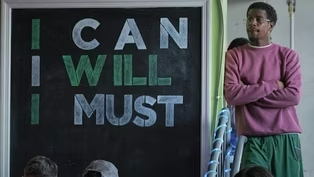
Here's The Story: Karmic Farmers
Clip: S2026 Ep4 | 5m 13s | Karmic farming, growing wellness in Asbury Park (5m 13s)
Providing Support for PBS.org
Learn Moreabout PBS online sponsorship












Support for PBS provided by:
Here's the Story is a local public television program presented by NJ PBS