Keystone Edition
Mark Duda on Parkinson’s, Football, and Knowing When to Step Away
Clip: 1/19/2026 | 14m 59sVideo has Closed Captions
Mark Duda reflects on Parkinson’s, retirement, and integrity in leadership.
Mark Duda opens up about his Parkinson’s diagnosis and the painful decision to retire from coaching. He explains how football contributed to his condition, why honesty with his players mattered most, and how resilience, exercise, and purpose continue to define his life beyond the sidelines.
Problems playing video? | Closed Captioning Feedback
Problems playing video? | Closed Captioning Feedback
Keystone Edition is a local public television program presented by WVIA
Keystone Edition
Mark Duda on Parkinson’s, Football, and Knowing When to Step Away
Clip: 1/19/2026 | 14m 59sVideo has Closed Captions
Mark Duda opens up about his Parkinson’s diagnosis and the painful decision to retire from coaching. He explains how football contributed to his condition, why honesty with his players mattered most, and how resilience, exercise, and purpose continue to define his life beyond the sidelines.
Problems playing video? | Closed Captioning Feedback
How to Watch Keystone Edition
Keystone Edition is available to stream on pbs.org and the free PBS App, available on iPhone, Apple TV, Android TV, Android smartphones, Amazon Fire TV, Amazon Fire Tablet, Roku, Samsung Smart TV, and Vizio.
Providing Support for PBS.org
Learn Moreabout PBS online sponsorshipfrom all corners of the nation.
And I wanna go to the audience one more time.
We have representative from Lackawanna College here, Brian Costanzo.
Brian, what's it like for you to sit here and see real time all of the people, not even all, a small portion of the people he has helped in his career?
- All right it's great to see some of the old players on the video.
If you don't think that coach knows all their names, it might just be their nicknames, but he does know every one of their names that have walked through the halls of Lackawanna College.
His impact has been countless and there's so many ways, you know, obviously football is one everybody knows about.
He changed the way Lackawanna College looked at athletics.
He put Lackawanna College on the map nationally, you know, created the football program there was a national competitor every year.
And it probably affected all of our other athletic programs, but there's so many other ways that he impacted the college.
And we talked about financial stability before.
Mark doesn't talk about this a lot, but one, he was one of my first bosses at the college 24 years ago.
And we were doing some fine admissions work back in the day.
He was the Director of Admissions 15, 20 years ago.
And it was hard work.
And not only are you recruiting your students, but you're bringing in other students that are gonna make a difference.
You know, it was a different time at Lackawanna College and you know, he talks about the 120, 130, 140, football players sometimes.
And that was real because he understood the impact of how those students were gonna affect the college and also was willing to take on the responsibility to coach those kids and keep them there and make them successful because it was important to the institution and make us successful in where we are today.
- Thank you for being here and thank you for your comments tonight.
We should talk about Parkinson's disease.
The reason for your retirement.
I imagine you're not just hanging it up for no reason.
- No, I would never do that.
- I don't think so.
- If I had my way, I would probably coach till I died on the 40 yard line.
I just love this so much, but I don't love it enough to cheat the players that I coach.
So when we started talking about, this is a few years ago, like a few years ago, some strange things started to happen.
Like I'd go for walks with Denise and I really couldn't like, walk as fast as she was walking.
It was just the most bizarre thing.
And then I would, I wake up in the morning, it'd be super like so stiff that I couldn't really even really.
And I thought, what's going on?
And then finally a year or so down the road, my thumb started moving without wanting it to move.
So I knew I had to go find out what this was.
I had a friend of mine who played in the League with me and he said, oh, you have to go see a doctor.
You really have to go do that.
And sure enough, I got the diagnosis that I had Parkinson's disease and I knew nothing about Parkinson's disease.
I knew nothing about it whatsoever, but I knew that, you know, I needed help along the way and I just didn't want to be somebody who sat at the desk as the head coach and wasn't truly a head coach.
Like if you can't, if you're not actively involved with the players, you're cheating the players.
Now my players have been cheated a lot before they ever met me, right.
And some of have been lied to before they ever met me.
And the last thing I was gonna do was ever lie to them.
And so what we tried to do was, myself and Denise we were quiet and stuff about things.
We tried to go through those seasons, even two seasons ago and get through the seasons to work as hard as we possibly could, hoping that maybe it would improve.
We get better but it didn't, and it sort of got worse and worse and worse to the point where I knew I couldn't do the job like I should have done the job.
And so that would've been taking everything we did, whatever we talked about in this hour and just, and what, and just lied the same people who we've been not lying to for 32 years, is that what we're gonna do?
So I wasn't gonna do that.
So coming out with it was very difficult.
Not as difficult as having Parkinson's, not as difficult as my classmates have to live every single day.
They have, it's difficult.
Like, so for me it it's a journey like all are, and I'm gonna do everything I can and make it as long as a journey as I can.
But I don't want sympathy.
I just want people to understand that I would never stop coaching Lackawanna until I absolutely couldn't because some people coach for a living and for some people it's their life.
And for me it's my life.
All right, so I'm gonna figure out how to get around that.
I'm gonna go around the country next year and watch all the guys who play.
I'm gonna go to Phoenix and I'm gonna go to all over the place and watch our guys play.
'cause I really want to see 'em play and I wanna do all those kind of things.
And I want to help our athletic department as much as I possibly can, but from a physical standpoint, like I can't, I can no longer, it's hard to admit this, I can no longer wake up at 5:30 and coach 'em and train them and then go and then come home at eight o'clock at night and do it again, I just don't have that capability.
And my wife, who is my like, not only confidant, but my conscious very often, she'll be the first one to tell me when I can't do something.
Like she'll tell me, Mark, you really shouldn't do this.
And so then I had to go talk to coach Dr.
Murray of course, and talk to my team, which was very difficult.
But I would rather be a poster boy for somebody with Parkinson's who's trying to make it better than somebody who's trying to hide it.
If that makes any sense to you.
- Do your doctors think that your time in football contributed to the Parkinson's diagnosis?
- Yes, they do, I've both of them.
They do, they've determined that was the case.
Because remember football was different.
In the 1980s and the 1970s, you hit in practice every single day and you had true tour days and these guys are laughing back there.
Where's my brother?
Yeah, two days, Steven, right.
And so you were in full gear twice a day and you hit full contact twice a day and your training camps were six weeks long.
Okay, so there is no Parkinson's in my family.
None in any part of my family.
The only person in my family has Parkinson's me.
And so there is football induced Parkinson's and that's what I have.
And that's, you know, it came on slowly.
This is the thing that kind of like is devious about it like.
- How did you say a year, it took you a year?
- Like a couple years, like the first year.
Like you dismiss things we all do, right?
And so you'll, like you ever see that test they give you where you like when the breathalyzer test you take when you walk, when you're drunk.
They never said that when you walk like?
- No, I've never seen that.
- Well, you should try that.
Hey, some of you have seen it?
- Nope.
(audience laughing) - 'Cause Mr.
Costanzo has seen that.
And so when you walk like, and you walk foot to foot and you lose your balance and you fall, well as a player, I could have done that with my eyes closed backwards.
- Sure.
- Right?
And then I tried it in the Doctor's office and basically fell.
And I thought there was, like what's going on here, Doc?
How's that gonna be?
And so like, all these things start happening progressively over a couple of years.
And finally I just couldn't ignore them anymore and you have to do something.
And so then you go and you go to one doctor and then you go to another doctor and with the hopes of a being diagnosed and figuring out what to do next, medication, so forth.
And then also with the hopes of the NFL, you know, helping financially, because you know, when you, like in any business, when you're injured on the job, then hopefully they're gonna do the right thing by you and make sure that you're compensated for being hurt on a job.
And all these things are going through your head.
Meanwhile, everyone, you don't wanna retire.
I know this is the most bizarre thing, but you don't wanna retire.
You want to coach every game you possibly can.
You know how hard it is.
And my wife told me this too, she's so much smarter than me.
See, every year you are there.
Sooner or later you're gonna have to tell those freshmen you're not coming back, sooner or later.
Right, well, I wanted to be much later, right?
As late as it could possibly be.
And so you feel like you left them and it really does bother me to this day, but hopefully being around 'em, like Dr.
Murray said, being around them, at least I could be around 'em enough to make them feel like, hey, I haven't abandoned you.
I just can't do it in the same capacity.
I hope that's the case.
- Is boxing helping you?
- It is, markedly, it's helping me enormously like movement skills.
Like I do it every day, like I do something physically every day.
So there's never a day where I don't exercise every single day because all the Doctors tell me that is the thing that is gonna slow the progression down.
And so I'll be damned if I sit on my couch and lament my life instead of get out there and go, I'm gonna exercise.
And so I do it all the time, it's crazy.
- I'm gonna go to one more person in the audience right now, my colleague Sarah Hofius Hall from WVIA News.
It was largely her reporting that brought this topic to life.
And I know the two of you have spent some time together.
So Sarah, I just wanted you to have a chance to speak and say some of the, what you have experienced working with Mark through the years.
- Well, you know, I keep thinking back to, you know, so many players have mentioned this.
You've mentioned it to me getting up early in the morning and you would be in that residence hall with your whistle waking those young men up.
And what you said to me was that when they realize someone cares about them enough to be up that early blowing his whistle, then they start caring about themselves.
And I think your story has just resonated with so many people, you know, after I published the story about you retiring, I heard from so many current players, former players, even people with Parkinson's who were just so inspired by it.
- You know, it's appreciated, I mean, I think, I don't know.
I just think it's like you need to give 'em a chance.
And sometimes they need to give themself one too, right?
Because sometimes our kids don't give themself a chance, right, they feel like for some reason they're not worthy for some reason.
So I think they are worthy, but they have to earn it, right?
And so I said, why do you work at six o'clock in the morning 'cause it's harder than six o'clock at night.
Right, it's harder, I want it to be harder.
I want it to be extremely hard every single day.
So when they go to Oklahoma, they go someplace special, it's not hard, right.
It's not hard.
- We do.
- And so I think in our situation, that's what we try to do.
And academically, and there are some teachers, I see docs here, all these guys are here, hi.
Like, what makes those people special is that they take students who have not had enough education by the time they're a certain age, and they're willing to go back and work with them to make 'em special.
So there's special people for doing that.
And I say it to 'em all the time, I says, you know, like everybody, I always talk about guidance counselors.
Remember when you're a kid, you had a guidance counselor, and he would always write four letters for the top four people that were gonna go to Harvard anyway.
Where's the guy's counselor writing it for the last 20 people who just wanna try to go to college?
Like, where's that guy?
That's my guy, right, that's my guy.
So I wanna be that guy, right?
I wanted to be the guy who helped the kid who, oh, you know, he missed too many days of school or, you know, like or he got hurt when he was a senior, you know, and he didn't get the film he needed.
I wanna be that guy.
Our teachers are those people.
Our professor are those people.
And so when you see those work with somebody and somebody goes from being like Jaquan Brisker, you guys have Brisker, God love you.
So Brisker comes, you know, and he wasn't really a student when he got there, you know I mean, the son of a gun, didn't miss a class, didn't miss a lift, went to Penn State, graduated, we went to his graduation.
Now he's with the Bears and everybody loves that and all go Bears or whatever.
But the bottom line is he graduated from Penn State.
Who the hell thought he was gonna graduate from Penn State?
And he did easily.
So maybe these guys did a great job, just maybe, and maybe he bought in as well.
So I think that that's our institution, in my view.
That's who we are, right.
And if we always keep that empathy, I said this when I spoke to the group, if we always are empathetic with our students, not sympathetic, empathetic with our students, I think that the dividends will be enormous for them and certainly for us too, I believe that.
- Just one question left here, coach, which is knowing what you know now, anything you'd do differently?
- Probably win the ones I lost.
- You'd win more, you'd win more.
- No, I don't think I'd do anything differently.
I think that the only thing and once again, I allude to my wife all the time.
When I first got at the Lackawanna, I had just sort of gotten outta the League and I went from there and for a year or so, and I just got there, when I got there, I was absolutely a bull in the china shop, okay?
There was no question that the rules were kind of bothered me a little bit, right.
Like if it didn't make sense to me, it bothered me a little bit I would go, but I had great mentors, right, I had Jay Manion, right, And President Angeli and President Volk and President, I had great mentors who would calm me down.
But, you know, I would rather be calm down than have to be sped up, right?
I'd rather somebody say, hey Mark, you gotta sit down than to sit there and just like, oh my God, the sky is falling.
So I think that their leadership was fantastic for me at that time in my life because it was quite a transition going from, you know, St.
Louis and Phoenix where they basically carry your bag to the airport, drop, fly you to the game, take your bag, pack it, bring you back, put you on the plane again, and basically chauffer to your house, then go into Lackawanna or I gotta tell you, no, those things existed.
(audience laughing) All right, so we did everything ourselves.
So I think that was the biggest change I had to make.
And once I understood how much these people cared about the students that we had, that everything was fine with me.
I just had to realize they did, that's all.
- Coach Mark Duda, you have been an amazing guest.
We thank you for the enormous, tremendous impact you have had on this region, and we wish you all the best in the future.
- Thank you, those for having me.
And hey, thanks for coming.
- That is all the time we have here.
(audience applauding)
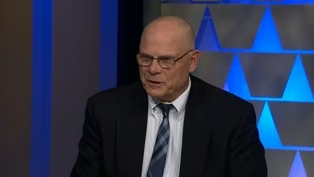
From Coal Country to the NFL: Mark Duda’s Football Journey
Video has Closed Captions
Clip: 1/19/2026 | 15m 48s | Mark Duda reflects on his journey from small-town football to the NFL. (15m 48s)
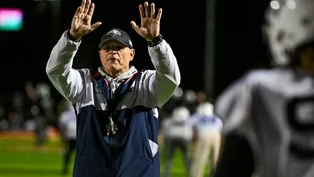
Legendary Coach Mark Duda - Preview
Preview: 1/19/2026 | 30s | Watch Monday, January 19th at 7pm on WVIA TV (30s)
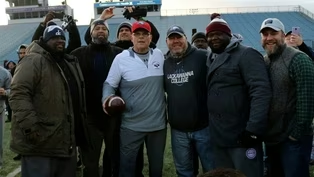
Why Mark Duda Chose Impact Over Fame
Video has Closed Captions
Clip: 1/19/2026 | 7m 50s | Mark Duda on leadership, discipline, and choosing impact over fame. (7m 50s)
Providing Support for PBS.org
Learn Moreabout PBS online sponsorship
- News and Public Affairs

Top journalists deliver compelling original analysis of the hour's headlines.

- News and Public Affairs

FRONTLINE is investigative journalism that questions, explains and changes our world.












Support for PBS provided by:
Keystone Edition is a local public television program presented by WVIA