NJ Spotlight News
NJ Spotlight News: November 21, 2025
11/21/2025 | 26m 46sVideo has Closed Captions
We bring you a special NJ Spotlight News edition of Reporters Roundtable.
We bring you a special NJ Spotlight News edition of Reporters Roundtable. We’ll talk to a panel of local journalists about this week’s top political headlines and other major stories.
Problems playing video? | Closed Captioning Feedback
Problems playing video? | Closed Captioning Feedback
NJ Spotlight News is a local public television program presented by THIRTEEN PBS
NJ Spotlight News
NJ Spotlight News: November 21, 2025
11/21/2025 | 26m 46sVideo has Closed Captions
We bring you a special NJ Spotlight News edition of Reporters Roundtable. We’ll talk to a panel of local journalists about this week’s top political headlines and other major stories.
Problems playing video? | Closed Captioning Feedback
How to Watch NJ Spotlight News
NJ Spotlight News is available to stream on pbs.org and the free PBS App, available on iPhone, Apple TV, Android TV, Android smartphones, Amazon Fire TV, Amazon Fire Tablet, Roku, Samsung Smart TV, and Vizio.
Providing Support for PBS.org
Learn Moreabout PBS online sponsorshipMajor funding for NJ Spotlight News is provided in part by NJM Insurance Group, serving the insurance needs of residents and businesses for more than 100 years.
Horizon Blue Cross Blue Shield of New Jersey, an independent licensee of the Blue Cross and Blue Shield Association, and by the PSEG Foundation.
From NJ PBS Studios, this is NJ Spotlight News with Briana Vannozzi.
Hello and thanks for joining us.
I'm Briana Vannozzi.
We're bringing you a special NJ Spotlight News edition of Reporter's Roundtable with Joanna Gagis, who has a roundup of the top political stories of the week with the help of a panel of local journalists.
But first, a few headlines.
Less than 12 hours after Governor-elect Mikie Sherrill officially resigned from Congress, Governor Murphy ordered a special election to fill her seat, issuing what's known as a writ of election.
That directs a special primary to be held on February 5th, and a special general election on April 16th.
Now, both elections will have early in-person voting periods.
Candidates for either party have until December 1st to file if they want to run, but plenty are not waiting.
The crowded field already includes about a dozen Democrats, including Essex County Commissioner Brendan Gill and former District 7 Congressman Tom Malinowski.
Lieutenant Governor Tahisha Way is expected to run, but she hasn't yet filed paperwork.
And so far, just one Republican has thrown his hat in the ring.
That's Randolph Mayor Joe Hathaway.
New Jersey's ballot no longer offers preferential placement to candidates backed by county political parties, but endorsements will still be critical and so will name recognition.
The winner will serve out the rest of Sherrill's term into January of 2027.
Also during one of the final speeches of his term, Governor Murphy this week said there is still work to do, namely fixing the state health benefits program for local government workers.
Murphy says it's on track to collapse next year without immediate action.
Speaking at the annual League of Municipalities conference in Atlantic City, Murphy unveiled a $260 million bailout plan to keep coverage in place for about 150,000 county and municipal employees.
Now, the money would wipe out the program's debt and rebuild a depleted reserve fund.
There is a catch, though.
Workers would face higher premiums, higher out-of-pocket costs, and fewer choices, dropping from 50 plans down to just six.
Premiums have already jumped significantly in recent years, pushing some counties and towns to ditch the program.
The governor warned, though, tens of thousands could lose access to care and rates will only go higher.
His proposal needs fast approval from the legislature and buy-in from labor leaders who are blasting it so far, saying it doesn't address the root cause of health care costs.
And now that respiratory virus season is here, the state is stepping in, offering free pediatric COVID and flu shots for children six months and older.
The Department of Health announced it's partnering with regional health systems across the state to create special clinics offering the shots in Hackensack, Neptune City and Camden.
Pediatric COVID vaccines will also be available at the Henry J. Austin Health Center in Trenton.
The department says it's working with more partners to set up additional sites and it'll share that information on its website and social media.
The move comes as parents have reported difficulty finding COVID vaccines for their youngest kids.
Last month, parents told NJ Spotlight News they'd struggled to get appointments for children running from six months to three years old who were eligible for the vaccines but can't get them at pharmacies.
That age group needs special pediatric doses given only at a clinic or doctor's office.
Some doctors aren't stocking the vaccines since they're expensive and demand is low, which advocates say is due to confusing messaging from the White House and the CDC.
And those are our top headlines.
Reporters Roundtable begins right now.
(upbeat music) Many campaign promises were made.
Will they be kept?
And what will that look like under a Governor Sherrill administration?
Hi everyone, I'm Joanna Gagis and this is Reporters Roundtable.
We'll talk about all of that in just a minute, but first let's meet our panel of journalists.
First up we have Hannah Gross, Education Reporter for NJ Spotlight News, Matt Friedman, Reporter with Politico New Jersey, Brent Johnson, Politics Reporter for NJ Advanced Media and NJ.com.
Welcome to all of you.
So since her massive win in New Jersey, Governor-elect Mikie Sherrill's been out there sharing more details about what her early priorities will be when she takes office in January.
She sat down yesterday for a lengthy interview with our own NJ Spotlight News anchor Brianna Vannozzi.
Let's get right into it.
Brent, I know you also sat down with the Governor-elect.
What did you hear from her in terms of her early priorities?
Anything new to report there that we didn't already hear on the campaign trail?
No, I know one thing that people are going to immediately look to, because she said on day one she's going to declare a state of emergency and freeze utility energy rates.
And that's the big campaign priority.
She talked broadly about affordability, but her big hook of her campaign was, I'm going to freeze your utility bills.
So that's one thing people are going to look to do, to see, one, if that happens, because there's a lot of pushback, including from former Governor - and her soon-to-be former Governor, Phil Murphy, saying that he doesn't know if that's possible.
I'm sure there might be some legal challenges.
So that'll be something to watch right away.
And knowing broadly, she said she's going to focus on affordability, you know, so there's going to be questions on that.
School funding is going to be a big issue.
I know that's something that Craig Coughlin, the state assembly speaker, wants to bring up in lame duck.
So there's a number of things to look out for and to see how she acts at the beginning of her tenure.
I think it's interesting to note Governor Murphy walked back his comments a bit when he had that first meeting with Governor-elect Sherrill.
He said, you know, I regret saying that there might be some things she can do.
We need a more thoughtful approach.
How complicated, Brent, do you think it's going to be for her to get in and do the things that she said when it comes to an energy freeze and pushing utilities, really?
They say they're not the ones to blame here.
One thing is that a new governor will have a lot of capital, especially in a state where now Democrats have strengthened their hold on both the governor's office and the state legislature, at least the state assembly.
So she's going to have a-- she can throw her weight around a little bit at the beginning, but I do expect there to be some sort of legal pushback.
I don't know how strong it's going to be.
But that is really going to be what people pay attention to first, because it's a major promise and it will be something she said she's going to do right away.
Hannah, Brent brought up school -- well, he brought up the school funding formula.
We're going to get into that in just a little bit.
But I want to ask you about Sherrill's promise for school consolidation.
She says we really need to look at these districts where there are K-8 schools or sometimes less, sometimes just elementary or lower elementary grades, and that the administrative costs there are creating bloat.
Are there enough of those schools?
How many of those schools are there right now in the state?
Does that actually create some type of meaningful savings if she moves forward with that plan?
- So there are about 700 school districts in the state if you include traditional school districts, non-operating school districts, charters and renaissance schools.
In only 260 of those schools can a student go from either pre-K or kindergarten all the way through 12th grade.
So in the majority of school districts, they're not serving a student throughout their academic life.
And so that can lead to some administrative bloat where a district that maybe if it was K through 12 would have one superintendent.
If it's broken up into two or even three districts that's a lot more administrative staff than you would have otherwise.
You know I know that NJ.com will give another shout out to Brent and his team but I saw a story this morning that there are superintendents making upwards of $300,000 in the state.
This was a big issue when Governor Christie took office and he put the 2 percent property cap in and that really did limit how much superintendents could see increases in their their raises year over year.
Do you think that Sherrill administration would be likely to take on that type of issue or keep the cap reduce the cap.
Where do you see this going.
Has she indicated anything like that Hannah.
She's not talked too much about that.
Some of the highest paid school superintendents are from the biggest districts like Newark and Jersey City.
But you also have some really highly paid charter school superintendents who are paid a lot more per pupil than this larger public school superintendents.
So there are some bills moving through that could be passed during lame duck that would put some more restrictions on charter schools.
So that would be something to watch for.
Yeah, we're gonna get into the school funding formula and what that means later on.
Matt, interestingly, she has finally said, I know she was left it in the gray area originally, but she has said she will not keep New Jersey Attorney General Matt Plattken in position.
What type of attorney general do you expect her to pick?
He has been very aggressive.
He's had countless lawsuits against the Trump administration, took on the New Jersey State Police.
Do you expect her to take on someone as aggressive?
It's funny because I just, I think it was on NJ Spotlight News, read interview remarks from her where she said she wants an attorney general who will take on Trump.
And I'm like, well, Matt Platt must be looking around like, whoa, how many lawsuits?
I lost count of lawsuits.
I know there are dozens and dozens of them.
I think she'll take on one who will take on Trump, but who will be less likely to take on people like George Norcross and some of the other powerful people Platkin has kind of set himself against, with mixed results at best, honestly.
But yeah, I think it's going to be, we've heard a lot of names circulating.
I won't bother listing them all right now.
I guess probably know sometime not long after Thanksgiving who the next one will be.
But yeah, I know I very much doubt it's going to be someone as aggressive as Plattken and maybe not someone as at least seen as politically ambitious.
So that was my next question.
Do you read the tea leaves here that perhaps he's got some political ambition in terms of the way he's been willing to take on, like you said, members of his own party and of course fighting, you know, Republicans across the aisle.
Do you think that there's some conflict there and that maybe his political ambition is something she doesn't want to see in her administration?
Well, well then good luck finding anyone.
But I think, you know, with him, it's been a knock on him, but also it's like, yeah, we've had prosecutors before who have been politically ambitious, that's not unusual.
Also, despite that, he's not running in the 11th district, where he lives for Congress, even though there's an open seat there.
So maybe he has his eyes on something else.
I do think it's that, you know, one of the knocks on him is that his prosecution of George Norcross was political.
And, you know, I don't know, the judges have rolled against him, but it's also like, if you look at the conduct of Norcross and his allies there, there's a question of where it is on the law, but there's also the question of where it is ethically.
And I think we're getting some answers on the law, which by the way, when you're in a position in which you have a lot of influence in writing the laws, it's harder to break them.
But secondly, I don't think anyone can look at the conduct and say this is the way we would like government to operate, as if people were getting a fair shake there.
So there's been a lot of knocks on it for that, but I don't think if you look at it, it's like there's complete utter ethical innocence going on here that the EU offers.
Yeah, and we're not legal scholars here, but RICO cases are hard.
They can be hard to prosecute, and they can be hard to get a win.
Just switching gears a bit, during our special half hour with the governor yesterday, Brianna Vannozzi pushed her on the immigrant trust directive and whether she would sign it if it were codified into law as the immigrant trust act.
She said no.
Here's a look at what she had to say about it.
I'm very concerned about trying to put that through the courts.
We know a Republican judge has already approved the immigrant trust directive.
It set a law that has better standing right now.
And the idea of opening this up in courts right now, when I don't think the courts seem to be very suggestible to the Trump administration's suggestions, I don't think that's a good idea.
The immigrant trust directive as written, I've been supportive of.
I just want to make sure on the ground it's functioning and we're still understanding how it's being implemented across the state and we have had several meetings, we'll continue to have those to make sure it's functioning as I want it to function.
And as I've said, what's important to me is people can go to church, they can go to school, they can go to health care, they can go report crimes.
So Brent, coming to you, she said she wants people to be able to do all of those things safely.
That was her final thought there.
This is something that the Latino community pushed hard for during her campaign.
I have spoken to some leaders who say, look, she has to come in and look at this and decide what is best.
But do you think that this is an area where people who voted for her are going to be unhappy that this doesn't turn into an act, a piece of legislation that's law in New Jersey?
This is something I know that even top members of the legislature aren't keen on passing because they're afraid of the legal ramifications.
So she won't be the only person against it in Trenton's leadership.
But yeah, I mean, there are a lot of progressives who may not have supported her in the primary, who came out and supported her in the general election, who may now be upset that she doesn't take moves like this, especially after there was such a Democratic victory, meaning that we have five more seats in the state legislature now for Democrats and the state assembly for Democrats and that, you know, you also have a big win.
She won by a decisive margin.
So I'm sure there's going to be people who are disappointed and still pushing for this.
But I don't know how much pushback she's going to get in the legislature.
Yeah.
Like you said, this never moved under the Murphy administration.
It seems they did kind of find that sweet spot where it was supported by the law.
She said this is case law now.
Hannah, switching back to schools, obviously, you know, we've spoken to Governor-elect, we talked to her many times on the campaign trail.
I've asked her how she would revise the school funding formula.
It's something that the legislature hasn't quite figured out.
There are task forces started by Senate Education Committee Chair Vin Gopal.
No one has a clear answer on what should change or how it should change, but we know districts are calling for it.
What have you heard from her in terms of any specificity of what she'd like to see?
There haven't been too many details about Sherrill wants to see in terms of changes to the school funding formula.
She's talked about modernizing and stabilizing the formula.
The most concrete thing is more state support for special education costs, which have been rising astronomically in recent years and are eating into other parts of districts' budgets.
When we, during the campaign, we heard Cittarelli talk a lot about how he wanted to roll special education entirely under state funding, and he wanted to do that by changing the formula so there was no more aid for at-risk students and then set this one price for folks who are English language learners versus English language speakers.
Have you heard anything from districts about wanting to see those changes?
Do you think she's going to be hearing those calls now that it's been laid out by Chittarelli, especially in districts like Monmouth and Ocean, where they've seen significant cuts?
What do you think she's going to face as she works with districts?
I think different districts have different needs and wants out of the school funding formula.
Districts that have been losing funding for S2, we want to see that restored.
But one thing I think almost every district, if not all of them, can agree on is that they want to get an aid from here to the next.
And that is something Sherrill has said she plans to do.
And it's something she would be able to do even in her first year by writing changes into the budget, which is Governor Murphy did this past year.
One thing I can't help but think is that the Murphy administration maybe had the worst of it when it came to school funding because it was this eight year rollout of a level setting period.
Have we gotten to a point where there is a level set where there shouldn't be as many fluctuations anymore now that S2 and the School Funding Reform Act have really been fully enacted?
Exactly.
Now if there are changes it should be because there's changes in the local wealth of a community or changes in enrollment but there shouldn't be that gradual phasing in of S2 anymore.
All right, let's switch gears again.
This week leaders from the black community, the New Jersey statewide black agenda met to outline their priorities.
They say, look, we turned out voters in record numbers.
We helped get Mikie Sherrill into this position.
And so now it's time for her to consider what it is that we're asking for.
I spoke with Reverend Dr.
Charles Boyer earlier this week.
Let's take a look at what he had to say about what their top priorities are for the first 100 days of office.
Within the first 100 days, we're looking forward to them convening a bi-annual meeting with black leadership, the governor, lieutenant governor, and the cabinet to talk about ways to move policy issues forward.
Discussions in the state budget around restorative youth employment programs, housing for first-generation home buyers, deeper investments in freedom schools, looking towards building on the affordable housing movement, particularly working with the black faith community and other faith communities to do that.
Convening really targeted action oriented work groups to move on economic and community development in cities like Trenton and Newark.
An introduction of black maternal health legislation to address the black maternal health crisis in the state.
And finally within the first 100 days convening a task force to look at and deal with and take action on the racial wealth gap.
Matt, one of the things that I heard from the Reverend is that they're asking for a rollback of punitive youth waiver bills and they want to see a lot more restorative justice programs put in place.
I asked if that included penalties against people involved in carjackings.
We know that's been a big issue in New Jersey.
He said yes, he wants to see that rolled back.
Do you see this legislature being willing to roll back some of the things that they passed in the last year or two when it comes to that type of crime?
With the caveat that I have not asked specifically about this, no, because they just passed all these things.
They just, you know, they had their period maybe pre-pandemic where it was sort of rolling back stiffer penalties for crime.
Then there was a bit of a crime spike, you know, in the earlier years of the pandemic, which has reduced.
But between that, there was sort of, you know, the quote unquote law and order push in the legislature.
I don't see them going back.
I don't see a legislature that's all up in two years, look, giving Republicans a chance to tag them any more than they already will as soft on crime.
It's just, it doesn't seem like a realistic prospect to me.
But the caveat that I haven't talked to the leaders and given that it was such a Democratic blowout and given that 2023, despite fighting against that message, was also a strong year for Democrats and legislature.
Maybe I'm wrong and the political calculus has changed, but I don't see it.
Yeah, and there are, listen, a number of priorities that were outlined there.
And so it seems that they can probably check off some other boxes without touching that, like you said, that they just pushed through.
Brent, I know that you were at the League of Municipalities conference this week down in Atlantic City.
Governor Murphy spoke, pretty much a goodbye speech, even though we will hear an official one, but it was kind of his last farewell to the municipalities.
He laid out a pretty dire circumstance for New Jersey's state health benefits plan.
What did you hear there?
Yeah, this is one of the issues that maybe the public is not paying close attention to, but I know that the public workers definitely are.
This is a big issue in Trenton right now.
The fear is that the state health benefits plan is going to be utter chaos and collapse in the coming years if something is not done to fight back against it.
And Murphy is proposing using state funds to help save the program, but he's asking for buy-in from union members, the public workers themselves, saying they have to pay more for their health insurance.
I know unions aren't very happy about it, but Murphy's saying this is what needs to be done in his closing days, and this is something that will not happen easily in Trenton.
I don't even know if it spills into the Sherrill administration, but it's not going to be an easy fight, but it's one that you'll probably hear more about the coming days.
Why didn't we hear more about this from Sherrill or from Murphy before the election?
We heard Jack Chiarelli talk about it plenty.
Why have Democrats been quiet until now?
Brent.
It's a touching story.
Yeah, you heard a lot, especially around the budget time.
Over the summer, this was something that Murphy and Coughlin and Scutari were working on and trying to find some common ground on with lawmakers and unions.
It was a tough issue.
You're definitely going to hear more about it now.
It's also kind of an esoteric issue.
If you're not a state worker, you might not understand the more broad theme of affordability was something you heard more during the campaigns.
So, you know, but this is not something they can ignore.
You're going to hear more about this.
Matt, go ahead.
Jump in there.
Yeah, I also wonder if it's going to be, I mean, putting maybe some pressure on the unions here, is the fact that, like, if Obamacare subsidies are cut, if the rates do go up that much and other people are paying so much more for health insurance, there might not be as much of a political appetite to say, yeah, you know what, public workers, we really need to fix this just for you.
And you'll still be paying way less than everybody else as they see their rates go.
You know, I don't think that will be a helpful movement for the unions if what happens with the Medicaid funding, with the Obamacare subsidies that it goes through.
Yeah, and we haven't heard it quite in the way that Governor Murphy said it this week, which is like, we're in a death spiral and this needs an immediate subsidy or it's going down the drain.
My words, not his.
Hannah, we just have a little bit of time left.
I know desegregation, another priority for leaders of the black community.
Sherrill said she's going to take that on.
Do you see her coupling that with any of her other school initiatives?
How realistic, how quickly can she actually begin to integrate some of New Jersey's school districts which are the most segregated in the nation?
Sherrill has talked a lot about school consolidation really as a cost-saving measure, but depending on how it's done, it also has the potential to be an integration measure.
She's talked about county-based school districts that are regional or increasing magnet schools or vocational schools and opening those up to students from different backgrounds and different communities.
So that would be quickly though, Hannah, does this happen quickly or is this a slow rollout?
I think it would have to be a pretty slow rollout.
I mean, you're not going to have kids changing where they go to school in the middle of the school year.
So earliest could be at the beginning of next school year.
But these sorts of things take time, especially if students need to be bused from one school district to another.
That takes a long time and is very expensive for districts to figure out.
Yeah, transportation costs, we know, have been one of the biggest drivers for districts year over year as they're struggling to make those budgets work.
That is all the time we have for this week's Reporters' Roundtable.
Thanks so much to all of you, our terrific panel, for being with us today.
You can follow me on Instagram @joannagagisnj and go ahead and scan that QR code that you see on your screen for more episodes of Roundtable.
For all of the crew here at Gateway Center in downtown Newark, I'm Joanna Gagis.
Thanks for being with us.
Have a great weekend.
That's going to do it for us.
But before we leave you, we're wishing farewell to our longtime director, Elvin Badger, who's led us through not only each night of our show, but every bit of live coverage and on location specials with calm command, a sharp vision and just an overwhelming amount of talent.
You will be so, so very missed, Elvin.
For the entire hardworking team here at NJ Spotlight News, I'm Brianna Vannozzi.
Thank you for being with us.
We will see you back here on Monday.
New Jersey Education Association, making public schools great for every child and RWJBarnabas Health.
Let's be healthy together.
You're not texting your symptoms to your old roommate again, are you?
You need real answers.
Horizon Blue Cross Blue Shield of New Jersey has over 80,000 doctors you can ask and 24/7 virtual care.
Oh, so I don't have to scroll forums or keep texting Sheila?
Exactly, because when it comes to your health, you deserve answers that you can trust.
Finally, advice I don't have to fact check myself.
A healthier you, covered by Blue.
[MUSIC PLAYING] Have some water.
Look at these kids.
What do you see?
I see myself.
I became an ESL teacher to give my students what I wanted when I came to this country.
The opportunity to learn, to dream, to achieve, a chance to belong and to be an American.
My name is Julia Torriani-Crompton, and I'm proud to be an NJEA member.
[MUSIC PLAYING]
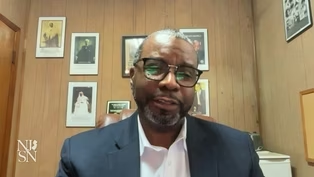
Black leaders demand bold action from Sherrill in first 100 days
Video has Closed Captions
Clip: 11/21/2025 | 9m 39s | Interview: Rev. Charles Boyer, pastor of Greater Mt. Zion A.M.E. Church (9m 39s)
Providing Support for PBS.org
Learn Moreabout PBS online sponsorship
- News and Public Affairs

Top journalists deliver compelling original analysis of the hour's headlines.

- News and Public Affairs

FRONTLINE is investigative journalism that questions, explains and changes our world.










Support for PBS provided by:
NJ Spotlight News is a local public television program presented by THIRTEEN PBS