State of the Arts
State of the Arts: April 2026
Season 44 Episode 6 | 27m 46sVideo has Closed Captions
Zora and Langston write a play, artist Robert Birmelin, and the art of battle reenactment.
At Passage Theatre in Trenton, Muleheaded, or Zora and Langston Write a Play explores the intense friendship between two of the greaters writers of the Harlem Renaissance. We visit artist Robert Birmelin at his home studio in Leonia, where his style is taking a new turn in his 90s. And the Princeton Battlefield Society brings Revolutionary War history to life through the art of reenactment.
Problems playing video? | Closed Captioning Feedback
Problems playing video? | Closed Captioning Feedback
State of the Arts is a local public television program presented by NJ PBS
State of the Arts
State of the Arts: April 2026
Season 44 Episode 6 | 27m 46sVideo has Closed Captions
At Passage Theatre in Trenton, Muleheaded, or Zora and Langston Write a Play explores the intense friendship between two of the greaters writers of the Harlem Renaissance. We visit artist Robert Birmelin at his home studio in Leonia, where his style is taking a new turn in his 90s. And the Princeton Battlefield Society brings Revolutionary War history to life through the art of reenactment.
Problems playing video? | Closed Captioning Feedback
How to Watch State of the Arts
State of the Arts is available to stream on pbs.org and the free PBS App, available on iPhone, Apple TV, Android TV, Android smartphones, Amazon Fire TV, Amazon Fire Tablet, Roku, Samsung Smart TV, and Vizio.
Providing Support for PBS.org
Learn Moreabout PBS online sponsorshipNarrator: Some of the most important battles of the Revolutionary War took place in New Jersey.
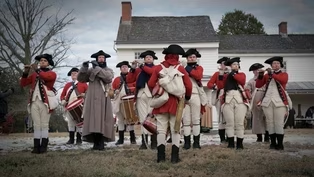
The Princeton Battlefield Society uses the art of reenactment to bring this history to life.
Gavin: We have a real obligation to stage that in a way that respects the honor and the memory of individuals who fought there, who were maimed there, who died there, of the civilian population left to worry about and clean up the aftermath.
Narrator: Now in his 90s, Robert Birmelin continues to explore the ways we see and remember the world.
Birmelin: I have within myself images.
They come out of my past.
They come out of my dreams.
They come out of my imaginings.
They come out of my realities.
I want to get them out.
I want them down on paper.
Zora: I am the darker brother.
Narrator: And at Passage Theatre Company in Trenton, a play about one of the most intense and explosive friendships of the Harlem Renaissance, between Langston Hughes and Zora Neale Hurston.
Robson: We still don't know exactly what happened between the two of them, but we know enough for me to put the breadcrumbs together, to connect the dots.
Zora: I'm a little too much for some people.
I understand.
Langston: No, you just speak your mind, that's all.
Narrator: "State of the Arts" going on location with the most creative people in New Jersey.
Announcer: The New Jersey State Council on the Arts, encouraging excellence and engagement in the arts since 1966, is proud to co-produce "State of the Arts" with Stockton University.
Additional support is provided by these friends of "State of the Arts."
Gavin: "I must study politics and war, that my sons may have liberty to study mathematics and philosophy, to give their children a right to study painting, poetry, music."
John Adams.
Godzieba: These are the times that try men's souls.
The summer soldier and the sunshine patriot will, in this crisis, shrink from the service of their country.
But he that stands it now deserves the love and thanks of man and woman.
And we plan to return to the Jerseys.
And I promise you, we will be victorious.
Commanders, prepare your troops for the boats.
Gavin: New Jersey is, without a doubt, the state with the most rich Revolutionary War heritage, and in many ways that is credited with saving the revolution itself.
My hope would be that when individuals attend a reenactment at a place like Princeton, we want to try to take history out of a book and bring the words to life.
Man: Present.
[ Drum bangs ] Fire.
Gavin: The mission of Princeton Battlefield Society, really we work hand in glove with the state of New Jersey, staging a portion of the Battle of Princeton.
[ Gunfire ] I think when you look at reenacting, it's an art, it's a science, and it's educational theater, to make history tangible for folks.
Man: Fire!
Gavin: To learn about history, to learn about the past.
If you look at the American Revolution as a really innovative experiment that has the capability, and I think the key word is really "capability," to lead not just to the emancipation of human beings, but the emancipation of humanity from the condition we know as suffering, that American Revolution never ends.
[ Fifes and drums playing ] So if we want to think about how we stage an event like Experience the Battle of Princeton, it's rooted in the history itself.
In political and philosophical thought, we have a real obligation to stage that in a way that respects the honor and the memory of individuals who fought there, who were maimed there, who died there, of the civilian population left to worry about and clean up the aftermath of something as horrific as combat.
So it really begins and ends with research -- how the choreography of the event will flow and what actions we want to portray.
What are they going to be wearing?
Lichack: I make historical reproductions of clothing, especially military uniforms, that a lot of the living historians and reenactors use for battle.
We look at all these different resources, paintings of the time, engravings, firsthand accounts, in order to, you know, decipher what people wore.
And then my wife, Eliza, and I will then assemble the garment for the person.
The sewing machine wasn't invented yet during this time period, so everything would be done by hand.
The point of it is, when the public comes, they're going to look at how the uniforms are and they're going to determine that that's how it looked back then.
And that's one thing that we pride ourselves in doing to keep the authenticity level high like that.
[ Fifes and drums playing ] Gavin: There's a lot of dedication that goes into the research.
And then we put together the battle.
[ Fifes and drums conclude ] Man: Forward march.
[ Drums play ] Gavin: The final 45 minutes to an hour before, all of the commissioned officers, Continental and Crown Forces, are having basically what amounts to a final huddle, going over the choreography of the day.
Man: These are people that you need to fill in.
Man: None of this or this.
Or there will be slope.
Gavin: The timing elements and components.
Man: Let's get through this exercise, lads.
Come on.
Man: Oh.
Man: That's alright.
That's alright.
Man: Take aim.
Fire!
[ Gunshot ] Gavin: The musicians as well, the musicians are practicing, because musicians in the 18th century, they are the timepiece for the army.
[ Fifes and drums playing ] Spontaneity is really important to have in place in the course of a reenactment.
We do need individuals or whole units to react to developing situations around them that force them to move and maneuver in a realistic kind of way.
So a lot ends up falling on the command staff in making sure that the choreography is moving as it should.
Man: Do not anticipate me.
Participate based on my orders.
Gavin: So it is a mixture of loose and really highly choreographed moments that make it all come together, and then it's off to the races.
[ Cannon fires, men shouting ] Man: Fire!
[ Cannon fires ] [ Drum beats ] [ Man shouts indistinctly ] [ Men shouting ] Take the fence!
Charge!
Praria: Whether it's a historic home or a historic landscape, essentially is our stage.
People can smell the smells of the gunpowder.
They can see what it's like to fire off a musket or a rifle.
[ Gunshots ] Watts: To be out there and hear the sounds, hear the cannons, hear the commands being shouted see some of the confusion when things don't go exactly as planned, we become the people who we portray.
Gavin: I've been a reenactor for over 20 years at this point in time.
Whether or not you're portraying an individual and you know their name or you're portraying a soldier or a civilian and you're doing a living history program on the actual ground where it took place, it's very emotional.
There's a lot of weight to those moments, because you can't help but reflect upon the reality of what they experienced and what they suffered.
[ Cannon fires ] We try to tell a holistic story.
It was not just the men on the field.
It wasn't just the military.
You saw females who were present there.
You saw people of color.
There are people of color in the army.
Watts: People of color have fought for this country since its inception and even before its inception.
We were here and we served.
It warms my heart over the last 18 years of doing this that our stories are coming out there and being talked about, because as a kid, you would not even see us.
I would not see us.
Praria: The women were there, whether we were there as camp followers... Woman: Anybody else?
Hot meat pie?
Praria: ...or whether it was being at home with the battle in your front yard.
Having some sort of portrayal of -- of that, I think it really -- it helps make it a more human experience instead of just a military experience.
Lichack: We all work together to put on a good show.
It all kind of comes together as one happy union to portray history.
It's very satisfying to see your own work and especially you could really feel they appreciate making these things to recreate a war that, you know, won our independence from Britain.
Watts: If we don't know who we were, where we came from, how we came to be, how can we be or aspire to what the Founding Fathers really wanted us to be?
E pluribus unum -- out of many becomes one.
Gavin: What is the American Revolution?
How does it go on?
How do we extend those promises of freedom to ever-broadening groups of individuals?
And I think that's exactly what Adams is hinting at when he talks about why he must study war so his children can study these other things.
I think the individuals who fought through the American Revolution had a very keen understanding of the fact that they were planting a seed.
This was not necessarily for them.
This was the beginning of something new within the world that would be for the benefit of future generations but that future generations would also have to nurture over time if this great experiment was going to continue to succeed.
[ Mid-tempo music plays ] Narrator: Up next, the celebrated figurative painter Robert Birmelin.
Birmelin: The 16th-century German painter Albrecht Durer, his friend said of him he was inwardly full of figures.
And that's what I've always aspired to, through drawing and observation, to be inwardly full of figures so that they were there to be realized visually in painting and drawing.
I'm Robert Birmelin and I am an artist.
I've been working, drawing, and painting for 75 years.
I'm in my 93rd year right now.
Narrator: Born in Newark, New Jersey, Robert Birmelin grew up in Bloomfield, where a high school art teacher encouraged him to apply to New York City's Cooper Union, which was tuition-free at the time.
He went on to get his master's at Yale, then studied at the Slade School of Fine Art in London on a Fulbright grant, followed by a three-year fellowship at the American Academy in Rome.
Later, he became a professor at Queens College in New York.
Birmelin: There are people who you meet along the way who are crucial to what you become.
Dorothea Fischer, the art teacher at Bloomfield High School, was crucial.
I never would have made that step.
Narrator: Works by Robert Birmelin are in the permanent collections of many museums, from MoMA and the Met to the Smithsonian American Art Museum.
His passion for visualizing figures captured in moments remains a constant theme throughout a series of wide-ranging stylistic approaches.
Birmelin: Well, in a long career, if one doesn't go through various phases, it must be mean that you're pretty numb, right?
My work has indeed gone through a number of phases.
At one point I did quite a number of landscapes, and I discovered when I was working on these rocky shores that the configuration of the rocks suggested to me the way I could deal with complex groups of figures in space.
And that led me to working with a subject of crowds of people in the city, not only interested in the crowds as such, but the way the observer takes in a complex visual situation with differences in degrees of attention, focus, different kinds of noticing.
That was something that was a preoccupation in the paintings I did of crowds.
When I had a studio on 14th Street near 7th Avenue, they always seemed to be digging up the street.
I made some sketches of the shovel and built the painting around that.
There's this large figure, the man in the brown suit, who's very close, but, in fact, you look past him.
It's as if your attention is not fully on him.
It's looking beyond.
The whole thing is inventive -- a moment or two of noticing and the sense of looking through.
I was talking to a relative about things which had happened in our family, and I realized that our memories were very different, even when dealing with the same event, and I came on the idea of making paintings which could be seen this way, that way.
I call them reversibles.
Part of the painting which was oriented in a normal way, another part of the painting which was not.
They were irreconcilable, just the way that memory between myself and my family member was an irreconcilable memory.
Narrator: For a commissioned project at the New Jersey State House, Robert visited and quickly sketched figures all around him, resulting in the large three-panel mural called "Session Day."
Birmelin: I found it incredibly exciting.
And -- And it offered wonderful opportunities of the variety of space and movement and the way everything was happening at once.
Some elements are seen very close up, others at a distance.
I was pleased with it.
I have been doing, in the last few years, a series of scrolls inspired by Chinese and Japanese narrative scrolls, which I admire a great deal.
I found I was making paintings which were long and narrow.
I was interested in reading from side to side and the time that was involved.
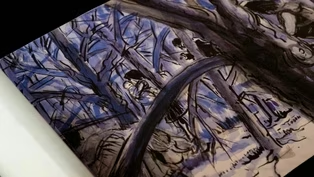
In the scroll I call "Into the Woods," as the scroll moves, you all of a sudden see a person up close sort of moving through the trees.
Some of the trees are so close, drawn in such a way that you can feel the bark, as if they are within your physical reach.
Someone has fallen.
Someone is trying to help.
All seen and half seen through the tangle of trunks and branches.
As it unrolls, there is a sense of surprise.
There's a dog he seems to be chasing and another dog.
And then there's a very large hand out of scale with the figures and a combat boot.
It is a kind of flexible narrative, because you can move both ways in noticing what was happening in the work.
I set up a studio here in my house, which fortunately has very nice light.
It's an old house with good windows.
Over the last 10 years, my vision has been slowly deteriorating due to macular degeneration, and that's been the struggle I've had in the last few years, which is increasing.
I can no longer really deal with detail.
And I've had to find alternate ways of working.
I use larger sheets of paper and try to work for a broad effect, which sometimes can be different, maybe even better than when you're working with all the small details.
I do it every day.
I have to do it.
It's just in me, right?
I feel I have within myself images.
They come out of my past.
They come out of my dreams.
They come out of my imaginings.
They come out of my realities.
I want to get them out.
I want -- I want them down on paper.
And as long as I'm able to.
I feel incredibly fortunate that in my 93rd year that -- that I can do this.
[ Down-tempo music plays ] Narrator: Last on the show, a play about two legendary figures from the Harlem Renaissance.
[ Lyrics ] You may leave and go to Halimuhfack.
But my slow drag will bring you back.
Well, you may go... Thompson: My name is Constance Sadie Thompson.
The character that I'm portraying is a real lived woman, extraordinary woman.
Her name is Zora Neale Hurston.
[ Lyrics ] Bring you back.
Merchant: My name is Anthony Vaughn Merchant, and I'm playing Langston Hughes.
He's the one that you think about when you think of the Harlem Renaissance.
Miller: Langston Hughes is considered the most important poet, if not of the 20th century, at least of the Harlem Renaissance.
And there has not been of that time a bigger female writer than Zora Neale Hurston.
All of the different voices of the Harlem Renaissance came together and kind of set the East Coast on fire for about 10 years.
Zora: I, too, sing America.
I am the darker brother.
They send me to eat... Langston: Okay, stop it.
Zora: ...in the kitchen when company comes.
Langston: Zora.
Zora: But I laugh and eat well.
Langston: You're embarrassing me.
Zora: And grow strong.
Own it, honey.
Own it.
You're becoming a cottage industry.
And you're very lucky to have her as a patron.
You know that, right?
Langston: I do.
Miller: What "Muleheaded" does is it tells the real story of Zora Neale Hurston and Langston Hughes, who were best friends in the 1920s, and they had a falling out in 1930 over the writing of a play.
Zora: Sounds too serious to appeal to a wide audience.
Langston: You have a better idea?
Zora: I don't know.
Maybe move things around, huh?
Make it a comedy.
For the people, by the people, of the people.
A black folk comedy.
Langston: I mean, do you think the people need that?
Zora: Who doesn't like to laugh?
And we want to make something from it, don't we?
Langston: Oh, money you mean.
Zora: It's not a dirty word.
Robson: They were struggling artists.
He was a bit more famous than Hurston at this time.
He was a known person in the Harlem Renaissance.
And they had this patron, Charlotte Osgood Mason, whom they were told to call Godmother.
Langston: We'll see you on -- on Monday, Godmother.
Yes.
I can't wait to show you my notebook full of poems that I've been working on.
Okay.
Goodbye.
Robson: The patron, Charlotte Osgood Mason, is not a character in the play.
She's an offstage character.
So we hear about her through phone calls that she makes to Langston Hughes's apartment, but we never see her.
And so that kind of patronage was always a pressure pushing down on them.
And so she would provide a certain amount of money for them to pretty much check the boxes that she wanted them to check.
Zora: Did she mention money?
Langston: [ Laughs ] She is sending you a check for $60.
Zora: $60?
Langston: What?
Five minutes ago, you were willing to sell your soul for $30.
Zora: I'm not selling my soul, darling.
I'm under no illusions.
The old white woman gets another smart darky to brag about to her high-class friends, and I get myself a regular paycheck to keep me going until I make my bones.
After which, I can tell said old white lady what she can do with her money and her driftwood sculptures.
Robson: When I write a play that's based in history... Zora: There's no other way, really.
Robson: ...I tend to want to be a fly on the wall.
I want to be the fly on the wall that can listen and can see.
We still don't know exactly what happened between the two of them, but we know enough for me to put the breadcrumbs together, to connect the dots.
Langston: Seems to me that... Robson: They had written a play together as collaborators, and as the process went on, it seemed, from what we know, that one or both of them took a little more ownership than the other person.
The third character was the typist on the project.
Her name was Louise Thompson, and of the three, she lived the longest.
Zora Neale Hurston died in 1960.
Hughes died in 67, and she died in 1999.
So in a sense, she was kind of the one person who knew what had happened.
Louise: Does Langston know they want to produce the play in Illinois?
"Mule Bone" by Zora Neale Hurston.
By Zora Neale Hurston, period.
Now, you may be spinning fairy tales to Godmother about who wrote that play, but I know the truth.
Robson: Sadly, through the course of them writing this play, things broke down.
Langston: You still want the play.
Zora: Is that too much to ask?
Langston: Oh, God.
Zora: We can help each other.
Langston: Yeah, what if it's a hit?
Zora: Then I'll send you a check.
I don't care about the money.
Langston: God, then what is all this about?!
Miller: You can break up with a friend that hard, but it feels like a divorce when you look at the evidence of what we have and the fact that after the action of our play, they did not speak to each other for the next 30 years of their life.
Robson: You know, this is Zora's play.
She's the one who has perhaps the biggest arc.
Merchant: Zora is the catalyst of this play.
Like, this thing doesn't work without her.
It doesn't happen without her.
Thompson: She loved adventure.
And she was a go-getter.
She didn't let anything stop her.
Robson: Her confidence and her -- her brashness and her "this is who I am" attitude.
Zora: I'm a little too much for some people.
I understand.
Langston: No, you just speak your mind, that's all.
Robson: I admire that in anyone, but I admire it in her particularly because of the time period.
Langston: I've had to work hard for everything.
Zora: Not as hard as me.
Langston: Don't feel sorry for yourself.
Zora: I'm stating facts now.
Langston: Why?
Because you're black?
Zora, I'm as black as you!
Zora: Because I'm a woman.
And black women are the mules of the Earth, conditioned to serve everybody before we serve ourselves.
But by the time it's our turn to join the feast, there ain't nothing left.
You know it's true.
I've been knocking on the door of opportunity longer than most people I know.
Robson: She died in 1960.
She died in poverty.
By the end of her life, she had been mostly forgotten about.
Famously, in 1972, Alice Walker, the author of "The Color Purple," kind of rediscovered her grave.
And that was the beginning, it seems, on the path of what we have today, which is this enormous recognition of her place not just in the Harlem Renaissance, but, like Langston Hughes, just in -- in world literature, American literature.
Miller: To live and breathe with these characters onstage and to have them play and to have them create together and have them get drunk together... Langston: But you should know... Miller: ...it lets us explore with history in a way you can't do without the theater.
Zora: May we get what we want.
Louise: Yes.
Zora: May we get what we need.
Langston: Hear, hear.
Zora: But may we never get what we deserve.
[ Laughter ] Louise: Whoo!
Langston: Oh, goodness gracious.
Zora: Mm!
[ Lyrics ] I'll atone.
Narrator: That's it for this episode of "State of the Arts."
Find more stories at StateoftheArtsNJ.com.
Thanks for watching.
[ Music plays ] [ Music plays ] [ Music plays ] [ Music plays ] [ Music plays ]
 New
NewVideo has Closed Captions
Clip: S44 Ep6 | 8m 40s | The Princeton Battlefield Society brings the Battle of Princeton to life. (8m 40s)
 New
NewRobert Birmelin: Artist Full of Figures
Video has Closed Captions
Clip: S44 Ep6 | 7m 55s | Artist Robert Birmelin’s evolving visual style takes a new turn in his 90s. (7m 55s)
Providing Support for PBS.org
Learn Moreabout PBS online sponsorship

- Arts and Music
The Best of the Joy of Painting with Bob Ross
A pop icon, Bob Ross offers soothing words of wisdom as he paints captivating landscapes.












Support for PBS provided by:
State of the Arts is a local public television program presented by NJ PBS