
Build your business by the numbers
Season 7 Episode 4 | 26m 48sVideo has Closed Captions
Louis Mosca, Pres/CEO of AMSERV, discusses business fundamentals for sustainable growth.
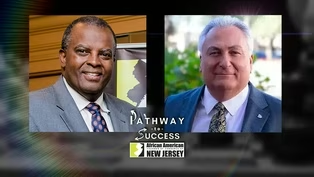
Host John E. Harmon, Sr., Founder and CEO of the AACCNJ, sits down with Louis Mosca, President and CEO of American Management Services (AMSERV). Mr. Mosca shares insights from his career as a pioneer for small businesses and discusses the vital importance of following sound business fundamentals to achieve sustainable growth. Pathway to Success highlights the African American business community.
Problems playing video? | Closed Captioning Feedback
Problems playing video? | Closed Captioning Feedback
Pathway to Success is a local public television program presented by NJ PBS
Build your business by the numbers
Season 7 Episode 4 | 26m 48sVideo has Closed Captions
Host John E. Harmon, Sr., Founder and CEO of the AACCNJ, sits down with Louis Mosca, President and CEO of American Management Services (AMSERV). Mr. Mosca shares insights from his career as a pioneer for small businesses and discusses the vital importance of following sound business fundamentals to achieve sustainable growth. Pathway to Success highlights the African American business community.
Problems playing video? | Closed Captioning Feedback
How to Watch Pathway to Success
Pathway to Success is available to stream on pbs.org and the free PBS App, available on iPhone, Apple TV, Android TV, Android smartphones, Amazon Fire TV, Amazon Fire Tablet, Roku, Samsung Smart TV, and Vizio.
Providing Support for PBS.org
Learn Moreabout PBS online sponsorship- Support for this program was provided by Horizon Blue Cross Blue Shield of New Jersey.
- Hello, this is John Harmon, founder President, CEO of the African American Chamber of Commerce in New Jersey.
We're delighted to have you tune in today to Pathway to Success.
Today's guest is Louis Mosca.
He is the President and Chief Executive Officer of American Management Services, better known as Amer Lou, welcome to Pathway to Success.
- John, thank you so much for having me.
It is a privilege.
- We're delighted to have you.
And let's just start with getting to know you a little bit.
Where are you from - Originally?
Originally?
Originally.
- Originally, yes.
- Okay.
So I was raised in Mount Vernon, New York, which is the first suburb above the Bronx.
I went to Mount St.
Michael in the Bronx and it's, you know, I never took education too seriously until I got to college and went to Iona College because it was one of the few that would accept me back in the day.
And then my parents didn't have money, so I had to work nights to pay for school for me to go to school.
And once I started paying for it myself, it was like a light bulb went off.
Yes.
And you better take this stuff seriously because you don't get a second chance that that's really how it happened.
- So what did you major in?
- I didn't know what to major in and I, my mother's brother, my uncle had made a pretty good living as an accountant, so I said I might as well be an accountant.
So accounting was as good as anything else and that's what I chose.
- So you went on in the accounting field, CPA, what was the examination all about?
- So first time I took the CPA exam and it didn't go well for Lou, and two months later I said never doing that again.
So I hunkered down and I get home from work every night, spent two or three hours and then every Saturday was at Mount Vernon Library for five or six hours and I wasn't gonna fail again.
And I passed everything.
And that was a long time ago.
- But, you know, Lou, I think you're making a good point here and I, I would appreciate if you could elaborate on this a little bit for us.
You know, the, the - Mindset of a winner.
My reality set in when, when I had to work from 1130 at night to six o'clock in the morning in a plastics company to make enough money to cover my $900 a semester tuition.
And that was my sophomore year of college and it continued for the remaining three years of college.
So my reality was, you better pick up your game 'cause no one's gonna do it for you.
And that's, that's, that's the way it always was for me.
But I will also tell you that I think about things in terms of winners and champions.
You know, winners find ways to win.
Champions find ways to beat you all the time.
- So, so Lou, I think you, you touched on a real important characteristic of being successful in life about not willing to lose, being committed to success.
Can you just speak to that a little bit?
- Well, I, I'd be happy to do so.
Don't think I haven't lost, 'cause I have, everybody has.
But I remember watching my dad leave the house every morning, a quarter to seven, getting home every night, six 30 or seven o'clock at night.
And we did not eat until dad was at dinner table.
And then dad watched us all eat to make sure there was enough food for the kids.
There were three boys and a girl.
And I just, this stuff stuck with me.
And my grandfather lived downstairs and I was named after him.
So who did he call every Saturday or Sunday to go do work with him or go do errands with him?
And I couldn't wait to do it.
I just, I couldn't wait to do it.
So I don't know if it was a cognitive decision that this is the way I wanted to be or it was just instilled in me as a kid, but there's gotta be a, a driving force to get you there.
For me, it was my father and my grandfather.
They just set the tone for you.
You just keep fighting, keep fighting, and you're gonna get knocked down.
But so what, - You know, I just think that's a great story of the significance of family.
So as you took those lessons learned within the house, how did that prepare you for the world of work?
- I think before prepared me for a business career, I, I think, I hope it prepared me to be a dad, right?
So to me, I, it always matters to me what my core group thinks of me and how they think I'm acting as a human being.
And as a, as a father, husband, sibling, employer, I, I think they all go together.
I don't think it's one or the other from an EM employer's perspective.
I, I think your people need to see you do the right thing all the time.
Just all the time, even if it's at your expense.
So, you know, I, I watched my grandfather give people stuff that needed it.
I watched my parents sacrifice what they didn't have.
So to me, being a, being a leader means you're willing to put yourself second, not first all the time.
- So talk about some of your corporate experience, wr grace suddenly of America.
Let's unpack those experiences.
- So WR Grace was where I learned things I did not like, I, I did not enjoy working.
There was not pleasant for me.
I did not enjoy how the organization operated, how people were treated, sort of like a trickle down approach to business.
And Sony of America was totally different.
Where Sony of America, I was a young guy, I don't know, 32, 33 years old, where they would empower you to do things.
If you made a mistake, it was okay.
You were not measured by the day, you were measured over time.
And if I would've stayed in corporate America, I would've stayed there.
But both, both experiences taught me things that I didn't like and things that I do like that I probably still use today that I'm not even aware of.
It - Was like a good piece of fish.
You eat the meat, you throw out the bow, - There you go.
- You spend a lot of time, and we'll talk more about this on the other, other side, but you, American Management services, you, you spend a lot of years there.
How did you arrive there?
- For me to get to American Management Services was almost dumb luck.
I had owned in total, or in part several businesses before that.
So after, after WR Grace and Sony, I got involved with three or four different privately owned businesses where I was either a minority owner, majority owner or sole owner.
And the end result was, I had done really good with some really not good with others.
And my net net was about a zero.
So I had decided I would take a few weeks and I would just sit on the beach and I was sitting on the beach truly on the Long Island sound, and I was flipping through the Wall Street Journal and there was an advertisement for American management.
And I picked up my cell phone, if you want to go back 30 years ago, they weren't like they are today.
It was sort of like a, a shoe.
I picked up my cell phone and I called them from the beach and set up an interview for the next day.
And with the seagulls in the background, I'm telling you that's the truth.
I'm telling you that's the truth.
But I, I set an interview for the next day and it just proceeded from there.
- So you described yourself as an unapologetic advocate for small businesses.
First job - I ever had was 12, 13 years old working in a a paint store and watching this man go up and down ladders lifting five gallon, 10 gallon jugs of paint.
And there'd be days when no one came into the store, always registered with me, the sacrifice that independent owners go through to try to keep their doors open and move him.
And he was paying me $5 an hour at the time and he let me go after three weeks because people weren't coming through the door.
How did that make you feel and how did that set up your future trajectory in life?
And when he laid me off to me, I was sad for him and I was devastated for me.
As I walked home, I wondered to myself, how does this guy, I'm 12, right?
I'm 12.
How does this guy pay the rent?
How, how does he, how does he take care of his family?
And and I sort of said to myself, what am I gonna do?
So I didn't know at that time that I'd wanna do what I do to help independent business owners, but I knew I didn't wanna be him.
I didn't wanna be in his shoes where he was so dependent and helpless on, on what was actually going on in his life.
You know, if you, if you fast forward a couple of years after that, and now I'm in college and I'm working for this plastics firm and I'm working at night.
I'm working 1130 at night to six o'clock in the morning.
And what I was supposed to be doing was quality control.
So they'd be running these, these machines that extruded colored pellets.
So if you bought like a joy bottle of, of soap and it's yellow, they made the yellow.
So that went into that and it was a privately owned company that did about 30 million bucks a year.
And I was on the graveyard shift in quality control in the laboratory and I fell asleep and the machines ran for about five hours and everything they ran was bad.
And when the management and the ownership came in the next day and they saw this, I thought I was getting canned on the spot.
I'm this college freshman getting paid a whopping eight bucks an hour to make sure that all you gotta do is take the sample and run it through the sample tester.
And I fell asleep.
And what they did, believe it or not, is they called me into a meeting with all the senior management and they said to mistake mistakes happen.
And I will tell you it was one of the first times in business I was sweating.
I didn't know what was gonna happen 'cause I needed that job to pay for college.
And they taught me compassion can go along with profitability.
- I think that's a phenomenal story.
And just a little more about Amer, about the things you did and how many years you were there.
- I joined in August, 1998 and I had a plan, a very simple plan.
Consulting was crazy.
So I was gonna do this for six months and move on and do something else.
So 30 years later I'm still chatting about it, but I started as a senior consultant being the person they send around the country to work with independent business owners, try to get them healthier.
About six months in they ask me to be what they call a project manager, a group leader, a group manager where you manage seven or eight assignments at a time.
I'm like, sure, I'm gonna leave in six months anyway, so it's borderline but then it just starts to become addictive.
You know, if it's something that you love and it's something that grabs you, why fix what ain't broken?
So I liked it and I liked helping owners.
I don't know, probably three or four years later I got another move up and then three or four years later and I've been basically running the company now for probably 18 to 20 outta my 30 years.
And the beauty was, the beauty was I never asked ownership for anything.
Just go do it.
You get recognized, you get rewarded.
I believe in that philosophy.
If your hand's out something's wrong, if you're showing me what you can do, you should be rewarded.
Extraordinary results should get extraordinary compensation - N low.
This is a great place to take a break.
We'll be back in a moment.
- For more information, please visit our website.
- Welcome back to Pathway to Success.
Welcome back Louis Mosca.
So a little, if you could just talk to us a little bit about American Management Services.
What does the - Company do?
American Management was founded in 1986 with the primary goal of providing real world services, profit enhancement, margin improvement, people training to privately held businesses, sort of like value and services that fortune companies could get.
But the 1, 2, 5, $10 million guy didn't have the ability to get those resources.
So our job is to try to help enhance anything and everything that an independent business owner wants in his or her life for his employees, for his family, and for his business.
- Folks call you or you call them and you connect with business owners to do what?
- Well, we connect with business owners to help enhance what they've created and what they're doing.
Listen, our goal is to come in and see if we can identify ways to make your life better as an owner.
Because what our original founding was to help small business owners that don't have access to big business owner tools because the African American small business community is overlooked way too often.
How do I know that?
I know what our database looks like, I know what our client base looks like.
I am speaking from experience.
So when we come into a business, whether they are in New Jersey or not, our goal is to one, do an objective analysis of their business to see if we can help them identify ways to improve.
- So Lou, you know, I'm going a little bit off script here with this question, but I see these commercials time to time and they say who you call in to do the work and they'll say something like A BDO or something like that.
Is that in your sphere or their competitor?
- Well every accounting firm believes they are consultants and every accounting firm believes they are right sizing experts.
PDOs a great company.
In fact, we use them for our tax preparation 'cause we operate in about 40 states.
Alright.
And, and they're on such a bigger plane than we are.
It's okay.
- Examples when you, your first client and you were supposed to provide the secret sauce and right ship disorganization.
Tell us about that.
- My first client was in New Hampshire in the fall of 1998.
And this gentleman was a manufacturer of some big type of electronic units that were used in the telecommunications industry.
And he'd gone from about 9 million to about 3 million in revenue.
It's my first day, I don't know anything.
I've been trained for two weeks.
But training and doing, not always the same thing.
So I go walking in with the manager that I'm with and unfortunately we had a right size that company immediately and that required significant downsizing in headcount, which is not something I ever want to take on.
It is not what I believe in to fix or address issues.
I believe accountability and training should fix and address issues.
But in this case, the ship had left the port and we had no choice.
The evening of the layoffs, which were dramatic, young man walked up to me and he was huge.
This, look, I'm not a big guy.
This guy was huge.
And he came up to me and he's poking me in the chest, poking, poking, and you know, if you got an attitude, you can't back up no matter what, you just can't back up.
And I, he said to me, it's 'cause of you.
I lost my job.
And I said, listen, it's 'cause of the owner, you lost your job.
You should have corrected this years ago.
And the guy said to me, you know what?
You're right, I'm wrong.
You're right.
That client, I had so many issues getting that client correct, that I was not there one day.
And their controller called me and said, you can't come here tomorrow.
The owner's son, his name was George, the owner was George, his son has a gun.
And he says, when you come back, he's gonna shoot you.
That's what he's telling everybody in the building.
And I called the the, I went to the state troopers in New Hampshire and they walked me in the next day and the young man did have a gun and he claimed he was cleaning it for a friend.
But I sat down with the parents and I said, your son needs to go, he needs to go.
A year later, the owner George called me and he said, we took your advice.
Our son is gone.
We made 800 grand in profit this year versus nothing the prior two years.
And we're happy with our relationship with our son.
Wow, - That's incredible.
What separates business success versus just - Surviving owners have too much pride.
They, they let pride get in the way of profit or accountability or results or demanding what they should get for their investment.
You know how many owners tell me, I pay for an eight hour day, I'm happy if I get five hours of productivity.
So owners have to put their pride aside and be okay that someone else might be able to assist them, guide them, help them get to the result that they should want for themselves and their family and for their employees.
How, how do you get - Owners to understand profitability, margins, growth and they, and they don't know if they're making money or not, Lou - Sure.
So I don't think a good product or a service or a good service is good enough to make a business.
You gotta have plan, you gotta measure by the numbers.
And we're never gonna try to turn owner into a bookkeeper or a bean counter.
But there's certain fundamentals you gotta know, like what, what's your pipeline of work?
What do you got coming in over the next 30, 60, 90 days?
What kind of margins do you have to get to cover your sg and a and how are you measuring them all the time?
We believe that too many owners, number one, don't look at their financials, actually don't even do them.
Number two, don't manage by the numbers.
And number three, don't have the proper profit mindset.
What I mean by that is if you're doing 5 million a year and you should be making 5% profit, then that's $250,000.
We want you to run your company on the other 4.750 million.
And we want you to balance and manage so that you get that 5% return.
'cause you are the owner, you've taken the risk, you are, you're responsible for the employees, the employee taxes, the rent, the bank payments, all those other things.
You're responsible for them.
So we want you to have a profits first mentality, but that doesn't mean you can't be great to your staff.
So profitability is not like a, a bad word, right?
So I, I want our clients to understand that they should look at profit as the first line item of expense is we're gonna put together an incentive plan for all of your employees so they share in your success.
So we don't think ownership alone should win.
We want ownership to win.
Ownership has a huge responsibility, right?
But we want everybody in the organization to win.
- But I want you to go back a little bit, Lou, because some business owners get inate about the top line.
Successful companies run largely because the bottom line, but focusing on expenses as well as revenue, right?
- Sure.
So here you think about it, every time you turn on Squawk Box or CNBC or anything that ticker tape, every time they report results to Fortune companies, they report sales up or down versus the prior quarter, right?
They go for sales and they go for profit, but they start with a revenue number.
But revenue has to be a planned revenue with the right margin in it on a timeline that you can collect the money, not just hocus pocus revenue.
So I have clients right now that have $60 million in backlog, but until you stick that fork in the ground, it's just numbers on a piece of paper, you can't spend it and won't pay your bills.
I just think those numbers, just e ego conversations.
I, I have a client right now that is not too far from here, that is close to a hundred million dollars a year and couldn't cover their payroll last week because things got outta hand with people in the organization and had to be cleaned up.
- So American Management Services during COVID, what are some of the things you guys did working with businesses to help them navigate - That period of time?
But we had 31 active consulting clients when the pandemic hit, all of them froze all of them.
We put together a plan for every one of them.
We implemented that plan on the United States Conference of Mayor's side Conference of Mayors came to us and asked us to work with independent owners around the country.
So we set up a hotline that was promoted through the United States Conference of Mayors.
And I bet you in those first three or four months of the pandemic, we took 5,000 calls with people looking for advice, how to handle specific problems, landlords, bankers, employees.
And we talked to every one of them and we never charged them a penny.
In fact, some of the calls we got were from mayors that owned their own businesses.
- So lo, talk about your relationship with mayors across the country.
Well, our relationship - With the United States Conference of Mayors is probably 26, 27 years now.
And we've traveled the country, we've probably done between 102 hundred events for specific mayors in their communities, talking to their constituents, their small business owners in their communities about opportunities and options for them to improve what they've got.
Small business owners want several things.
They want opportunity to compete, they want access to capital and they want people, they want good people that wanna work with them.
But the mayors are like the frontline of defense out there in their communities walking Main Street.
So it's privilege to work with them.
- Along those same lines, the importance of business owner - In the community.
So I think the role of the independent business owner in any community is, is, is powerful.
And if they take it seriously, it should benefit the owner, it should benefit the community and it should benefit the youth in the community.
I encourage every owner I ever talk to to get out there and go get involved in high schools, go get involved in trade schools, go get involved in anything philanthropic in your community.
Number one, where people get to know you.
Number two, it's a great feeling to provide value.
And number three, you're gonna make a difference on a kid.
You make a difference on a kid that's a good long-term investment and you're building a future of potential employees that might wanna work with you.
Why is that not the right thing?
To me, that is the only thing owners should be doing once they're entrenched and they're managing by the numbers and they've achieved a specific success.
- I love it.
So Lou, what does a typical day look like for you?
- Every day is a little bit different.
I am very fortunate that after all of these years I have some amazing people that know what I want and how I want it.
I have not spoken to anybody in the office today.
They know what to do, they know how to do it.
But I do like to stick my nose in.
I like to see what's going on with recruiting.
I will stick my nose in on accounting every day just to make sure stuff's going the way it should.
I talk to our salespeople probably once, twice, three times a week.
But most of what I do is I review work that we're doing at our consulting clients.
- So Lou ai, is that - A part of your, your toolkit?
Actually, we have just started to incorporate AI into our, into our work product in 2026.
I'm very reluctant with AI because I will not use AI to replace people.
Alright, so AI as a tool to enhance, to develop, to, to move forward quicker, I'm all for it and we are just starting to incorporate it in 2026.
But AI to replace not happening.
- What about give us five years from now, what does things look like at American Management Services?
- So I think the next five years are gonna be dynamic and of course incorporating AI into gonna make it even move quicker.
- Well Lou, I thank you so much for joining us today.
- Well, I thank you for inviting me up here - And we thank you all for tuning in to Pathway to Success.
Until the next time, this is John Harmon.
Thank you.
Today's message, if you're not in the conversation, what you think doesn't matter.
And so my word to you, ladies and gentlemen, attend a school board meeting.
Attend a city council meeting.
So as an example, if you attend a school board meeting or city council meeting, the first thing you want to do is grab the docket or grab the agenda and see what's being discussed on that evening.
You review that as preparation for the next meeting, and then you may come prepared to ask one very succinct question that may be of interest to you or interest of your community to the representatives that are in attendance.
Attend a meeting of the county and you'll find out how your tax dollars are being distributed, what priorities there are, and how your business or your family could be an integral part of society.
And if we could do that, we could find ways to make our state more competitive and mitigate some of the large social and economic disparities.
Thank you.
- Support for this program was provided by Horizon Blue Cross Blue Shield of New Jersey.
Build your business by the numbers
Video has Closed Captions
Preview: S7 Ep4 | 30s | Louis Mosca, Pres/CEO of AMSERV, discusses business fundamentals for sustainable growth. (30s)
Providing Support for PBS.org
Learn Moreabout PBS online sponsorship
- News and Public Affairs

Top journalists deliver compelling original analysis of the hour's headlines.

- News and Public Affairs

FRONTLINE is investigative journalism that questions, explains and changes our world.












Support for PBS provided by:
Pathway to Success is a local public television program presented by NJ PBS