One-on-One
CEO of Teen Arts New Jersey talks about art education
Clip: Season 2026 Episode 2908 | 8m 55sVideo has Closed Captions
CEO of Teen Arts New Jersey talks about the importance of art education
Kevin Ciak, Executive Director & CEO of Teen Arts New Jersey, joins Steve Adubato to explore how access to arts education contributes to student engagement, personal growth, and long-term success.
Problems playing video? | Closed Captioning Feedback
Problems playing video? | Closed Captioning Feedback
One-on-One is a local public television program presented by NJ PBS
One-on-One
CEO of Teen Arts New Jersey talks about art education
Clip: Season 2026 Episode 2908 | 8m 55sVideo has Closed Captions
Kevin Ciak, Executive Director & CEO of Teen Arts New Jersey, joins Steve Adubato to explore how access to arts education contributes to student engagement, personal growth, and long-term success.
Problems playing video? | Closed Captioning Feedback
How to Watch One-on-One
One-on-One is available to stream on pbs.org and the free PBS App, available on iPhone, Apple TV, Android TV, Android smartphones, Amazon Fire TV, Amazon Fire Tablet, Roku, Samsung Smart TV, and Vizio.
Providing Support for PBS.org
Learn Moreabout PBS online sponsorship(upbeat music) - Hi everyone.
Steve Adubato at the New Jersey Education Association Convention in Atlantic City.
We are thrilled to be joined by Kevin Ciak who is the executive director and CEO of a great organization called Teen Arts New Jersey.
Did I get that right?
- You got that right.
Thank you Steve.
It's a pleasure to be here.
- Tell everyone what it is.
- So Teen Arts New Jersey is a 501(c)(3) nonprofit.
We've been in existence.
- That's a tax code, if you will.
501's, let everyone know.
We are as well.
- Okay.
- Okay, so you go to the IRS, it's a 501(c)(3), which means you're a nonprofit, which does not mean, by the way, that you don't have to raise money.
- Correct.
And it also does mean that people can donate to us, which we would always welcome to support our mission.
- The mission of the organization is?
- So we inspire artistic creativity in students and provide them with opportunities that they wouldn't normally get in a traditional high school setting or middle school setting.
- [Steve] Because.
- Because the arts are so important.
And as you look at students, you know, after they graduate and they move on to different careers, it's the creativity piece that we instill that will make them a success later on in life and just add more beauty and more meaning to their lives.
- And for those who are convinced or have convinced themselves that arts, the arts, that's extra.
It's nice, but not necessary, talk to them.
- I would say it's even more necessary today than it has been in the past, especially when you look at things like generative AI.
- Yeah, I was gonna ask you about AI and the arts.
- Because when you look at the AI piece, that's gonna be doing all of the mechanical functions.
What we need students and what we need adults to be is creative.
So the arts and our programs that we offer give students the opportunity to think outside the box and develop that creativity, to really bring value to not only the world, but their future employers.
- So, talk about AI, those who think artificial intelligence will do the art.
Are they right?
- Listen, they're right, I think, to an extent that it can create art.
It can certainly do that.
- It can create a broadcast as well.
- It can create a broad, it can replicate you and me.
- Don't you dare go there, okay?
They could try.
But what's missing?
- What's missing is the human element.
And when you talk about AI, what people forget is, you know, ChatGPT, the G stands for generative.
It's taking information, programs, data tables, that it's been fed and just reassembling it and generating it in new ways.
What it's not providing is the human connection.
And that's what art is.
Art taps into our human emotions, our human experiences, the way that we interpret things as humans, that AI just simply can't do.
Because no matter how good it looks on the screen, it's not human.
- Talk about your connection here to the convention.
- So the New Jersey Education Association has been a long time partner of our organization because they see the value of the arts and the creativity and the need to teach students to think outside the box.
So they've not only been a funder of our organization and a supporter, but they've been an incredible partner.
Every single year when we do our State Teen Arts Festival, which features.
- What is that?
- It's a three day gathering at Middlesex College and it features the best student artwork from all 21 counties.
Not only, you know, the art that you're gonna see at our booth here at the convention, but also large instrumental groups, small instrumental groups, vocal music, and the NJEA not only helps us fund that event to keep costs low to allow students to participate, but there are officers every single year they're in force and they're interacting with the students.
They're, you know, looking at the artwork, they're partnering with us.
They have been a tremendous partner to our organization.
- For argument's sake, whether it's my hometown or anyone else in New Jersey, or across the nation, you start making cuts.
Budgets are tight, art teachers, music teachers.
Those in the arts, they get cut.
To what degree do you believe, Kevin, that people understand the impact of those cuts on those teachers/those kids?
- I think people still struggle with that understanding because they still see.
- Don't cut my math teacher.
- They still see the arts.
- You do the arts.
- As an added, as a bonus.
But the ultimate goal, and look, I used to be the president of the National School Board Association.
The ultimate goal of public education is to offer a well-rounded program to create well-rounded citizens.
So you need math and you need science as much as you need arts and phys ed.
So unfortunately, if those cuts need to come, those cuts need to be looked at across the board as an entire organization and not isolated into what we perhaps think is superfluous.
- We've been talking to some folks here at the, we're at New Jersey Education Association 2025 Convention here in Atlantic City.
We've been talking to folks about inclusion, and I don't want to use the term DEI.
We know that it's a trigger for some, but diversity in art and people who politicize art as if it's left, right, democratic, republican, conservative, liberal.
You don't see it that way.
Art is art.
- Not only don't we see it that way, our students don't see it that way.
- Talk about that.
- As they come to our programs, what we're increasingly finding is that our students are viewing our programs as a safe place.
- [Steve] Define safe.
- Safe where they can feel free to express themselves.
They can feel free to talk to their teacher, talk to their peers about things that they may not feel safe discussing in their own, you know, schools or their own classrooms.
- Or their own home.
- Or their own home.
So it's a welcoming space where students can feel free to express themselves.
And I think art is a conduit for that because it allows them, first, to put it on a medium, which is a lot less, you know, dangerous to them, because it's just them expressing it to the medium.
And then once it's out there, I think it starts to open them up to feel more comfortable to share it verbally and share it with others as they talk about their art.
- Why are you so passionate about this?
- I've always, first of all, been passionate about education, but when you look at the students that we work with and the artwork that they generate for us and the expression, it's just absolutely amazing.
And it challenges us to think, you know, better.
For example, one of the pieces of artwork that we saw at the Teen Arts Festival last year was an entire dress that was designed out of sustainable materials.
And this not only was a piece of art, this looked like something that you could wear to a formal event.
And that led us, as we looked at this piece of art, to say, okay, well what can we do with this?
And that's how we envisioned a new student challenge program that we're launching this year's statewide called Creative Change Makers.
- Right.
- Which is a statewide call for art focused around sustainability.
So now it's not only about, well, create a sustainable piece of art, it's how can you use your art to let your art speak and advocate for a cause.
And we're gonna choose a different social cause each year and focus our creative change makers program around that.
- That's awesome.
We've had your website up throughout the entire segment, Kevin, so people can find out more.
We really appreciate you joining us.
- And I thank you for having me, Steve.
It's been a great opportunity.
- You got it.
I'm Steve Adubato.
This is the New Jersey Education Association Convention in beautiful Atlantic City.
You can see all kinds of stuff going on around here, but mostly talking to really interesting people making a difference.
See you next time.
- [Narrator] One-On-One with Steve Adubato is a production of the Caucus Educational Corporation.
Funding has been provided by NJM Insurance Group.
NJ Best, New Jersey’s five-two-nine college savings plan.
Stockton University.
Hackensack Meridian Health.
PSEG Foundation.
The Turrell Fund, a foundation serving children.
Robert Wood Johnson Foundation.
Delta Dental of New Jersey.
And by The Fidelco Group.
Promotional support provided by NJBIA.
And by Insider NJ.
- (Narrator) A cancer diagnosis changes everything.
- So does where you go for treatment.
- (Narrator) Where other cancer centers offer radiation, at Hackensack Meridian, John Theurer Cancer Center, We’re utilizing the world's most advanced precision radiotherapy... - That can pinpoint and destroy your cancer.
- (Narrator) Some performed clinical trials, but we have one of the nation's most rapidly growing drug discovery programs... - Providing hope with the medicine of tomorrow.
New Jersey's best cancer center.
Know the difference.
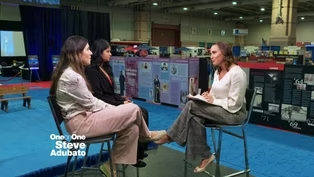
NJEA Student Panelists discuss goals for the future
Video has Closed Captions
Clip: S2026 Ep2908 | 9m 19s | NJEA Student Panelists discuss goals for the future (9m 19s)
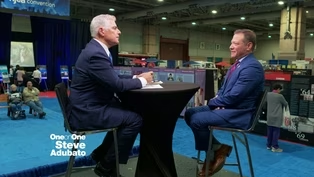
President, NJEA, examines how public policy impacts teachers
Video has Closed Captions
Clip: S2026 Ep2908 | 9m 31s | President, NJEA, examines how public policy impacts teachers (9m 31s)
Providing Support for PBS.org
Learn Moreabout PBS online sponsorship
- News and Public Affairs

Top journalists deliver compelling original analysis of the hour's headlines.

- News and Public Affairs

FRONTLINE is investigative journalism that questions, explains and changes our world.











Support for PBS provided by:
One-on-One is a local public television program presented by NJ PBS