One-on-One
Combatting food insecurity with nutritional education
Clip: Season 2026 Episode 2907 | 13m 42sVideo has Closed Captions
Combatting food insecurity with nutritional education
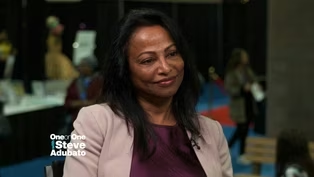
Senior One-on-One Correspondent Jacqui Tricarico talks with Alicia Newcomb, Executive Director of C.R.O.P.S., to examine how their non-profit alleviates food insecurity by cultivating fresh produce, ensuring access to nutritious food, providing educational programming, and advocating for sustainable food systems.
Problems playing video? | Closed Captioning Feedback
Problems playing video? | Closed Captioning Feedback
One-on-One is a local public television program presented by NJ PBS
One-on-One
Combatting food insecurity with nutritional education
Clip: Season 2026 Episode 2907 | 13m 42sVideo has Closed Captions
Senior One-on-One Correspondent Jacqui Tricarico talks with Alicia Newcomb, Executive Director of C.R.O.P.S., to examine how their non-profit alleviates food insecurity by cultivating fresh produce, ensuring access to nutritious food, providing educational programming, and advocating for sustainable food systems.
Problems playing video? | Closed Captioning Feedback
How to Watch One-on-One
One-on-One is available to stream on pbs.org and the free PBS App, available on iPhone, Apple TV, Android TV, Android smartphones, Amazon Fire TV, Amazon Fire Tablet, Roku, Samsung Smart TV, and Vizio.
Providing Support for PBS.org
Learn Moreabout PBS online sponsorship(upbeat music) - Hi, I am Jacqui Tricarico on location at the NJEA Convention here in Atlantic City.
So pleased to be joined now by Alicia Newcomb who's the executive director of a nonprofit called CROPS, and it's this year's NJEA Convention charity.
It's so great to have you with us, Alicia.
- Thanks so much for having me.
- What is the acronym CROPS stand for?
- It stands for Communities Revolutionizing Open Public Spaces.
- Okay, let's get into that.
What does that mean?
Describe the organization for us that's right here in Atlantic City.
- Sure.
Our mission is to alleviate food insecurity, and we do that through a number of ways.
So we have a couple of main focus areas.
We focus on food production, food distribution, a wide range of education, and then advocacy.
So our food production piece deals with both producing food for free for the community through a number of community gardens that we manage.
And then we also have an urban farmer training program called the UCAN program, which stands for Urban Coastal Agriculture Network farmer training program.
So we have residents of Atlantic City and community members that are a part of that three-year program where they learn to build and run and then make sales through their own urban farming businesses.
And then in terms of food distribution, we partner with regional farms from both our farmers in Atlantic City, but additionally farms throughout the county and the neighboring counties, mostly small family farms that really want to get their food to people and communities that are wanting access to it, but they don't have like the infrastructure to do it.
So we distribute their food.
We purchase and buy from small local farms, mostly pesticide-free and organic farms.
And then we have farmer's markets and a sliding scale farm share program that functions like a CSA, and all of our programs where we do markets and the farm share program take SNAP and WIC and the FMNP program and also good food bucks through our partners with City Green.
And then we do a number of, you know, community education at our gardens and at our markets.
But we also work with the schools and a number of other like partner organizations throughout the city to share our workshops with community members, educate about gardens and nutrition and the relationship between growing food and eating food.
And then we also do advocacy.
So we work at the state level and the county and local level.
- So let's break down some of that because you're getting your hands into a lot of different things.
The organization has really grown so much over the last couple of years, and it's really about getting fresh, healthy produce into the hands of residents here in Atlantic City, which is considered a food desert.
Describe that first for us.
What is a food desert, and why is Atlantic City specifically one of the top of the list for food deserts in the state?
- So Atlantic City's number two on the NJEDA'S list of the 50 most severe food deserts in the state of New Jersey, and a food desert is really defined by proximity to like grocery stores and transportation access to grocery stores, how far away it is from somebody's home.
And, you know, that is what defines it.
There's a number of USDA data and also like local demographic data and transportation data that they use to create that list.
But it's really just about the fact that it's not accessible.
And actually the USDA a few years ago changed the definition from just being a lack of access to food, to being a lack of access to nutritious food, which really makes a big difference.
- Right, right.
And that's where the farm share comes in and partnering with so many local farmers.
So dive in a little bit more into the fact that you can sell local farmers' produce in a farmer's market here in Atlantic City, so it's more accessible to the people to walk to or get to easily.
And like you mentioned that sliding scale where the prices can vary depending on a person's income, family income.
- Yeah, so we try very hard to partner with our local farms because we feel that really we've identified what we think is one of the biggest problems with inaccessibility to nutritious food not just New Jersey, but really across the nation is just that there's no pathway, there's no like connective tissue between the people growing the food and the people that really want access to the food.
And we're not talking about working with growers that are like hundreds of thousands of acres and growing soybeans.
We're talking about small farms, you know, that are maybe 10 acres or 70 acres that are family farms.
And many of them have been in the family for multiple generations, but they're primarily producing vegetables and fruit and things that people can eat and not just, you know, like crops that are going to a factory or something like that.
So, you know, we are talking about connecting farmers to communities that really need access to it.
And so we do that by keeping the produce affordable.
We pay the farmers a fair amount for the produce, you know, that they've identified.
And then sometimes we're selling it at cost, sometimes we're selling it below what we paid for it.
Sometimes, you know, there's a little bit of a profit there.
But then in, that's for the farmer's markets.
And then with the sliding scale farm share, we have a mobile app through our partnership with New Roots, and we've used a model that comes from Kentucky that they ran there for 16 years.
And it's basically just anybody can be a part of the farm share.
You sign up through this app, and it asks you three questions about household income, whether you're already on SNAP benefits or not already, how many people in your household, are you vegetarian or not?
And it populates a suggested price.
So all of our SNAP customers that are shopping with the Farm Share program, they automatically qualify for a $6 share.
But then there it goes all the way up to like 25, and then, you know, we have our food justice share that people can pay $40.
So the people who are paying $40 are helping us to offset the cost of running it for everybody.
So it's really something that's made for everyone, but it allows people to access produce at a level that is comfortable for them and also affordable for our families and our individuals that need access to affordable produce.
- Well, you brought up SNAP and WIC a few times.
Right now we're in November, there's so much uncertainty, so much confusion around SNAP benefits.
How are you seeing this directly impact the population that you're describing?
- So, I mean, all of those SNAP customers that we work with that we know of, like have not received their funding obviously for November.
And, you know, it's really a toss up whether people had money left over from October and a lot of our partners that run pantries and run food distributions for free are just seeing an uptick in the number of people that are needing to access that because it's not even just people utilizing SNAP, it's also the fact that the government has been shut down for so long that we have federal workers who also are not being paid.
So there's just a higher need across the board.
And I heard a statistic recently that came from Temple University that says every single one meal that a food bank provides, SNAP provides nine.
So we've just created a huge gap in terms of hunger in the United States that's probably worse than what we saw during COVID.
- Well, what is CROPS able to do to help bridge that gap right now in the interim of all the confusion and the benefits not getting out?
- Right now, anybody that we work with that has been impacted by the government shutdown and a lack of access to food benefits, we are covering the cost of, you know, whether it's produce at a farmer's market or a farm share at one of our farm share pickups.
But we're also working with all of the partners that we work with in the city.
So both the city and the county.
We work with probably over a hundred other organizations in the area.
And so we're actually doing something next week in addition to working with the NJEA to run a food drive and get shelf stable items out to some of our pantry partners.
We are also next week working with our local farms to order a big wholesale order of produce that's getting delivered to our food hub in the city.
And then we're giving those boxes of produce out to our partners that are running pantries or organizations that are directly connected with families or individuals in their neighborhoods, and they're just giving them out.
- Yeah, that's gonna make a big impact.
The educational piece of this, I know trying to get the education out there is so important.
You're doing that through schools, local schools as well.
Describe that.
- Yeah, so we partner with local schools in a way that's a little bit different than we have in the past.
We used to partner with schools and try to come in and run programming like at the community gardens or at the school gardens that we sometimes help to build, sometimes they were already there.
But it's really tough to like insert yourself into a teacher's school day.
So we started doing something actually last year here at NJEA where we developed like workshops just for educators.
So we do educational workshops for teachers, and that's actually what our booth is doing.
- [Jacqui] Yeah, right behind you, yep.
- You can go over there and grab a garden kit and learn all about what's in it and how to teach that in your curriculum and take it back to the classroom with them.
So that's what we've done a lot with teachers over the last year.
But we work with a couple of local organizations, so we work with Oceanside and Family Success Centers across Atlantic City as well as Atlantic City Senior Services.
And we either provide a space where they can bring clients out to us to come do a workshop with us or we travel to them, so.
- It sounds like a really amazing collaboration, so many organizations and entities working together to really tackle this food insecurity issue.
Lastly, you just came from the keynote address, which was with Padma Lakshmi and she has a new cookbook out, but you were able to be a part of that panel discussion.
What were your takeaways from that?
- I just think, you know, a lot of the messaging that she was talking about like helping kids see themselves in food, but also in justice, you know, and how closely related the two of those things are.
And also she was really very cognizant and aware of telling teachers, like, I'm not here to tell you what to do because you're already doing more than you're even required to do.
So just small ways that people can get involved, small ways that people can incorporate food in the classroom and in their students' lives.
You know, I mean, right now it's critical.
A lot of families and students just don't have access to food across the board, but ways that we can look at the system of education and infuse it a little bit more with food is very helpful.
- Yeah.
And lastly, where does your passion for this work come from?
- I have two daughters and I really got involved in working with farms and buying from farms, you know, when my first daughter was born and she was a baby and I started wanting to like make food for her myself and thinking more about, you know, understanding where our food is coming from and spending my money in a local capacity too is important to me, you know, because I like to spend my dollars where I know it's gonna stay, you know?
And also with everything, I feel like I have a newfound passion and, you know, really anger about everything that's happening with SNAP because when I had my first daughter, I was utilizing New Jersey FamilyCare insurance, and I think that there's already a stigma around people accessing, you know, public benefits.
And I think that everything that's going on with SNAP right now, we're making it even harder for people to feed their families.
Not just from a lack of the funds being there, but from, you know, a shame aspect.
And that just doesn't stand with me.
- Yeah, yeah.
Well, your passion comes through.
Thank you for all the work you and your colleagues are doing with CROPS, this year's NJEA convention charity.
So great to meet you.
Thank you for all the work you're doing and thanks for sitting with us so we can learn more about CROPS.
- Yeah, thanks so much for having me.
- Thank you.
For Steve Adubato and myself, thanks for watching.
We'll see you next time.
- [Narrator] One-On-One with Steve Adubato is a production of the Caucus Educational Corporation.
Funding has been provided by The New Jersey Education Association.
NJ Best, New Jersey’s five-two-nine college savings plan.
Seton Hall University.
Valley Bank.
PSE&G.
EJI, Excellence in Medicine Awards.
A New Jersey health foundation program.
The Fund for New Jersey.
Horizon Blue Cross Blue Shield of New Jersey.
And by The Fidelco Group.
Promotional support provided by NJBIA.
And by Insider NJ.
- [Narrator] To see more One on One with Steve Adubato programs, visit us online at SteveAdubato.org.
If you would like to express an opinion, email us at info@caucusnj.org.
Find us on Facebook at facebook.com/steveadubatophd and follow us on X @steveadubato.
- (Narrator) New Jersey is home to the best public schools in the nation, and that didn't happen by accident.
It's the result of parents, educators and communities working together year after year to give our students a world class education.
No matter the challenge, because parents and educators know that with a shared commitment to our public schools, our children can learn, grow and thrive.
And together, we can keep New Jersey's public schools the best in the nation.
 New
NewExamining youth mental health at the 2025 NJEA Convention
Video has Closed Captions
Clip: S2026 Ep2907 | 11m 23s | Examining youth mental health at the 2025 NJEA Convention (11m 23s)
Providing Support for PBS.org
Learn Moreabout PBS online sponsorship
- News and Public Affairs

Top journalists deliver compelling original analysis of the hour's headlines.

- News and Public Affairs

FRONTLINE is investigative journalism that questions, explains and changes our world.











Support for PBS provided by:
One-on-One is a local public television program presented by NJ PBS