One-on-One
Dr. Lamont Repollet; Ginny Hill and Nikita Goyal
Season 2026 Episode 2920 | 27m 59sVideo has Closed Captions
Dr. Lamont Repollet; Ginny Hill and Nikita Goyal
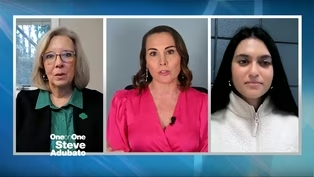
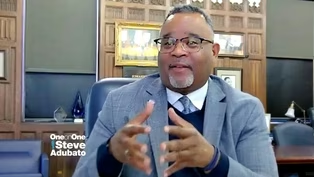
Dr. Lamont Repollet, President of Kean University, former NJ Commissioner of Education, discusses the future of higher education. Ginny Hill, Chief Executive Officer of Girl Scouts of Central & Southern New Jersey, and Nikita Goyal, High School Girl Scout and Board Youth Advisor at Girl Scouts of Central & Southern New Jersey, examine how they are committed to helping girls build confidence.
Problems playing video? | Closed Captioning Feedback
Problems playing video? | Closed Captioning Feedback
One-on-One is a local public television program presented by NJ PBS
One-on-One
Dr. Lamont Repollet; Ginny Hill and Nikita Goyal
Season 2026 Episode 2920 | 27m 59sVideo has Closed Captions
Dr. Lamont Repollet, President of Kean University, former NJ Commissioner of Education, discusses the future of higher education. Ginny Hill, Chief Executive Officer of Girl Scouts of Central & Southern New Jersey, and Nikita Goyal, High School Girl Scout and Board Youth Advisor at Girl Scouts of Central & Southern New Jersey, examine how they are committed to helping girls build confidence.
Problems playing video? | Closed Captioning Feedback
How to Watch One-on-One
One-on-One is available to stream on pbs.org and the free PBS App, available on iPhone, Apple TV, Android TV, Android smartphones, Amazon Fire TV, Amazon Fire Tablet, Roku, Samsung Smart TV, LG TV, and Vizio.
Providing Support for PBS.org
Learn Moreabout PBS online sponsorship- [Narrator] Funding for this edition of One-On-One with Steve Adubato has been provided by Valley Bank.
NJM Insurance Group.
Serving New Jersey’s drivers, homeowners and business owners for more than 100 years.
PSE&G.
Powering progress.
Myron and Elaine Adler private foundation, in support of the Adler Aphasia Center.
The Russell Berrie Foundation.
Making a difference.
The New Jersey Education Association.
Robert Wood Johnson Foundation.
Working to create a future where health is no longer a privilege, but a right.
The Turrell Fund, a foundation serving children.
And by Horizon Blue Cross Blue Shield of New Jersey.
Promotional support provided by ROI-NJ.
Informing and connecting businesses in New Jersey.
And by CIANJ, and Commerce Magazine.
- This is One-On-One.
- I'm an equal American just like you are.
- The way we change Presidents in this country is by voting.
- A quartet is already a jawn, it’s just The New Jawn.
- January 6th was not some sort of violent, crazy outlier.
- I don't care how good you are or how good you think you are, there is always something to learn.
- I mean what other country sends comedians over to embedded military to make them feel better.
- People call me 'cause they feel nobody's paying attention.
_ It’s not all about memorizing and getting information, it’s what you do with that information.
- (slowly) Start talking right now.
- That's a good question, high five.
(upbeat music) - Hi everyone.
Steve Adubato.
We kick off the program with our longtime friend, Dr.
Lamont Repollet, president of Kean University, Kean University, Jersey City, which we'll talk about in just a moment, and the co-author of a compelling new book called, "Leadership By Design: Winning Hearts, Building Your Brand, and Achieving Success."
He's also on the 2005 ROI Power list and the New Jersey Business Magazines Innovate 100 list two of our media partners.
Good to see you, my friend.
- Good to see you, Steve.
How you doing, sir?
Thank you for having us.
Thank you for having me.
- Always.
You think you're busy enough?
- Just a little bit.
Just a little bit.
But I kind of like it that way, right?
- I love it.
Hey, listen, by the way, check out previous interviews we've done with Dr.
Repollet.
And Kean is one of our higher ed, our significant, very significant higher ed partners.
Let me put that out there.
I'm looking at the table of contents, put up the cover of the book.
There's so many areas I want to talk about, but the one I wanna jump right into, is this book, 'cause I write about leadership, coach about leadership, this is about more than leadership.
Why is it not just leadership by design, but winning hearts and building your brand and achieving, what's all that?
- Well, this book is a compilation, Steve, about lived experiences, right?
My lived experience as a leader.
It's about how to interact with individuals.
It's about being authentic.
It's about always being centered, people centered.
So there's this quote that I've had for years that was always in my cover letter.
I'm not quite sure the quote, whoever authored this.
But it said, "People are the greatest asset in any organization.'
And as a result of that, my leadership kind of built around being people centered, right?
I always say that, right?
Whether it's student centered when I was in the school systems, well now as a leader, people centered, and it's always been about authenticity.
And so leadership by design is pretty much a manuscript for those who prescribe to leadership to learn about leadership, right?
It's not a novel.
It's not something that I encourage you to read, from page one to the end of the page.
It's about something that we can pick and choose a la cart to look at things that maybe you may find yourself, meaning what to learn more about, whether it's being the chief architect in chapter one.
And that goes back to leadership by design.
So leadership by design is being very intentional.
The book is also based off of faith, right?
So winning hearts is about faith, it's about trust.
It's about when people are watching you in action, how do they react based off of your decisions?
And I think that's winning hearts, right?
And then also building your brand.
Building your brand equates to your brand, your character, the values you espouse.
And so if you look at those things, and the last piece is always gotta be when you're asked to have some metrics and have to be able to achieve success, right?
There need to be elements to show that you've achieved success or you have a plan of action or strategic plan of action to identify that.
So I took the fact that the book is about intentionality and leadership by design, being intentional.
That's why I call myself the chief architect.
But then also, I talked about the faith aspect, right?
You're talking about Ecclesiastic chapter four, verse 12, and it talks about the three strands.
I've always used things in threes.
And so if you look at the three strands, each strand together could hold itself, each individually, but together, it strengthened.
And I think if you're looking at your leadership being intentional, on creating a culture, being of high value, moral, and your mission and being guided by that and success, then now you have the ability to sustain your leadership because based off of those three characteristics, which we call our framework, our three frameworks, which is building your hearts, building your brand and achieving success.
So the book was based off of my lived experiences, is based off my faith, understanding that my faith is strong.
And when you do that, you win hearts.
You build your brand, right?
And you achieve success.
- I wanna go into this a little deeper.
You said a la carte.
You wanna do a la carte?
We're gonna do a la carte.
- Let's do a la carte.
Let's do a la carte.
- You say that great leadership isn't born.
It's designed.
What about those who say, "Dr.
Repollet, come on."
And people say this to me in my leadership seminars all the time.
"I'm not a natural leader, Steve.
I wasn't born to be a leader."
And you're saying, what?
It's design.
Pick it up.
- So yes, some folks would say, "I wasn't born to be a leader."
However, leadership, like anything, is a science, right?
Leadership is a science.
Let's just break it down.
Leader, ship.
Let's look at leader.
In order to be a leader, you have to lead individuals, right?
Simple as that.
And so those individuals will follow you.
However, some folks are natural born leaders, right?
They actually can get up the command of space.
Some folks actually are strategic in planning, but may not have a presence.
But however, when you are intentional about your leadership, you can design a system that benefits your personality.
We talk about leadership styles later on in the book.
You can benefit those things.
So when we're talking about, you know, the size of leadership, you're talking about learning the ability to lead, to lead others, how to inspire an individual, right?
What is your mission?
What's your vision?
And how do you get the best out of folks in order for you to have those outcomes?
And I think that's where it is.
So I would say it's intentional because like a strategic plan, you have to be strategic in how you look at things and how you approach.
I always talk about the art of war being strategic.
I talked about our plans, understand that, being intentional at what we do.
So I think for me, the book is really about being intentional and how to develop those skills in order to be intentional, right?
So for us, this book is about, how do you develop the skills necessary to be intentional in your leadership approach?
- I'm gonna get a quick answer to this if I can.
In my book, "Lessons in Leadership 2.0 - The Tough Stuff," I have a chapter called, "Is Everyone Really a Leader?"
I mean, and I also make the argument, it's not about my book, it's about yours, but I say everyone can and should become a leader on a great team.
And someone will say to me, "Steve, we need doers on the team to wait to be told what to do."
Our response is, on a great team, not so sure.
Do you believe, Dr.
Lamont, that everyone on a great team, not an average or mediocre team, can and should become some form of a leader?
Please.
- Yes, I do agree, the fact that individuals on great teams can be leaders because they can lead within their division, within their sphere of influence, right?
And so that's how you become the great leader.
Now, collectively, if you have individuals that are leading their division, their office, their unit, their whatever, whatever it is they have, whatever sphere of influence they have to lead, then collectively, you add those pieces up, right?
The sum of the whole.
And now you have a complete group of individuals who are leading the unit, the division or the organization, the way, what you desired it to be.
Because within it, you should have your mission.
See, folks need to understand where are we going, and how we're gonna get there.
And I think as you start to look at those individuals that's on the team, they need to lead their teams because there's a team and there's a team and there's a team.
And so that's the fact that people can be leaders on their team, even if they're divisional leaders, even if they're unit leaders or office leaders, but they can be leaders.
- Wow.
There's another chapter, one of my favorite chapters, the crystal ball effect.
What is that, and why are you smiling?
- Because that was drawn, honestly, I created the crystal ball effect when I was a superintendent at Asbury Park Schools.
- By the way, by way of background, we're talking to the former head of the department education in the state of New Jersey, a really big job, superintendent in the school system, where again?
- Asbury Park Public School District.
- Just a few challenges.
So we're talking to Dr.
Lamont Repollet.
Let's just say he's led in some challenging situations.
Pick it up, doctor.
- And so it was challenging times in Asbury Park, and I wanted to demonstrate the individual, where we can go, and how far we can lead this organization.
But because of systemic failure within the organization, they would have blinders on and they couldn't see, they couldn't see ahead.
And so I created this concept that I called the crystal ball effect because I needed to demonstrate, to show individuals the future, and then work ourselves back from that, right?
And so what I've done for that is that we created these incredible videos that depict the university, sorry, depicted a school district as this thriving academic center, right?
I mean, branding, our social media, the videos captured, what we could become if we just imagined it, right?
And so I showed them the future, and then I talked about each individual, their role they could play within this future.
So I would say, "Principal X, if you do X, Y, and Z, this can be the future."
But they couldn't see it though.
They couldn't imagine it because of systemic failures, because of whatever challenge they may have had in front of 'em.
So the crystal ball effect shows 'em the future and then allows us now to create, to be intentional, to create a strategic plan to reach that mission and to reach that vision.
- Get the book.
Dr.
Lamont Repollet is the co-author of "Leadership By Design: Winning Hearts, Building Your Brand, and Achieving Success."
We've only scratched the surface.
Lamont, can we do this?
Dr.
Repollet, can we talk about a couple of other issues, - Yes.
- Outside the book?
How about this?
We're doing a series in cooperation with Kean University, called "Urban Matters."
Kean University is the official research institution in the higher ed community for urban matters.
And that's the John S. Watson Urban Research Institute, if I'm not mistaken.
- Yes.
Yes.
- The merger between Kean University and what was Jersey City University with serious financial problems, now becoming its merged organization, Kean Jersey City, - Yes.
- Because the Jersey City urban community matters and more.
Pick it up from there, Dr.
Repollet.
- Yes.
So we wanted to create this space, right?
So as we create this new Kean University system, which it covers our Wenzhou Kean University campus in China, our Kean ocean, which is down the shore, and Kean Union, which Kean Union is our headquarters, is our main campus.
We wanted to create this opportunity where we can focus on urban matters.
We got an urban policy, urban issues.
And so we're creating a Jersey City, our metro campus, which will be totally different from our campus.
We have on Union campus, and not gonna be as comprehensive as our campus in Union, it's gonna be focusing on issues and focusing on workforce development that's particular to that county, to Hudson County and to Jersey City.
So we're gonna pare down some of the programming and put those major programmings on our main campus, would have programs to support the workforce, to support the skill levels, to support the need of that community, such as business, education, nursing, all of those programs that we consider anchor programs, right?
The anchor down into the university.
And so the folks would be looking at problems within the urban center and coming up with solutions via research, the applied research, right, the experienced students have, whether it's through traveled learns, to go back and to create, I would say a more just or better community.
And they're looking at those individuals and demonstrating the fact that it doesn't matter where you come from, what your zip code is.
It's pretty much, you have quality mentors, quality professors, you have research, and can you contribute back to that community?
And so that's what we're gonna do right now with our students to go back to anchor down the community.
Not saying they're not anchoring down right now 'cause they are, but under the Kean brand, under the Kean umbrella, under the Kean resources and research to really dig down into Hudson County and create a true community, community university that serves Hudson County and the metropolitan area.
- And the time we have left, I'm curious about this, how incredibly important is it for university college presidents to be very effective business professionals?
And not simply, you have to be.
Someone says, "I'm an academic.
I don't really want to get involved in fundraising and strategic mergers, relationship building, all that stuff.
I just wanna be an academic."
You say what to that person who wants that higher ed institution today?"
- I would say, so good luck.
And clearly you have a track record of success because leadership encompass leadership by design, encompasses those skillsets to be able to have the political acumen, the business acumen, the fundraising acumen, 'cause these are all things on the outside, right, that support the ecosystem.
So these are all of the pieces that support the ecosystem.
And I think that once you understand the impact of taking our students, developing the workforce to support the economy, hence therefore, the education is the economic engine of the economy.
Understanding that and however, understanding that finance and resource supporting, you just can't rely solely on the state or the federal government.
You have to be creative in such ways as philanthropy, fundraising to accomplish those goals, partnering with business institution, businesses, right, to ensure that, that whatever you need to have to build up the workforce, we can support you.
So I think that whole process, but it comes again Steve, by being intentional and how you do this, right?
- Leadership by design.
- And that's the strategic point that people don't necessarily get.
It's the strategy.
So you just can't say, I'm an academic anymore.
Yes, you're an academic by heart, and that is your strength, but you also need to understand that you're an educational leader.
And being an educational leader encompasses all of those different pieces that support the ecosystem of higher education.
- Final thing, and I will not get on my soapbox.
Partnering is not an option.
Collaborating is not an option.
The things we do as leaders, doesn't mean everything we do we want to do.
It means you can't succeed without them.
I'm off my soapbox.
Read his book.
He's got an important book, Dr.
Lamont Repollet, co-author of "Leadership by Design: Winning Hearts, Building Your Brand, and Achieving Success.
Thank you, my friend.
Well done.
Congratulations.
- Thank you, Steve.
Thank you for having me.
- You're a great partner.
Stay with us.
We'll be right back.
- [Narrator] To watch more One on One with Steve Adubato find us online and follow us on Social media.
- Hi, I am Jacqui Tricarico, Senior Correspondent for One-on-One.
And so pleased to be joined now by Ginny Hill, who is the CEO of Girl Scouts of Central and Southern New Jersey, as well as Nikita Goyal who is a high school girl scout and a board youth advisor at the Girl Scouts of Central and Southern New Jersey.
It's so great to have you both with us.
- Thanks Jacqui, we're thrilled to be here.
- Thank you, well, you know the Girl Scouts we know is known to really help young girls build confidence and character and really they're taking a step further right now in terms of girls and young girls and their mental health.
Describe that for us, Ginny, and the more recent report that came out is called Her Future and Focus, New Jersey Girl Report.
What were the findings for that report?
- Yeah, so Girl Scouts has always had an interest in the health and wellbeing of all girls.
You know, first and foremost our Girl Scout members, but then all girls in the communities in which we do our work.
And over the last year the Girl Scout leadership in New Jersey came together and commissioned a research project, Her Future and Focus that you just referenced, to really study girls in New Jersey and to get underneath what are the challenges that they are facing.
And mental wellness was one of the key areas, right?
So one of the things that we learned is that one out of every two girls in high school in New Jersey reports feeling a little depressed, a little blue.
We know girls are struggling with online, their online presence, you know, so feeling bullied or isolated because of the influx of technology.
So the report in its entirety, looks at the status of girls.
It gives us direction for the future programming that we may do as Girl Scouts, but we're also sharing it really broad and wide all across the state because we want all New Jerseyans to understand the status of girls and give them opportunities to lean in to be part of the solutions as well.
- As a mom of two young girls, I mean some of this data that was revealed with this report is very staggering.
It is upsetting and things that we already kind of knew, but this really brings it to light.
A couple other of the stats that I saw, one in four middle school girls are using a controlled substance, cyber bullying, like you said, and social isolation is really on the rise.
37% of young girls struggle with body image.
Nikita, I wanna bring you into the conversation 'cause you are a high school student and I'm sure these are some issues that you've either personally dealt with or you see your peers dealing with.
Talk about your own personal struggles and how the Girl Scouts has really played such a pivotal role in your growing up so far.
- Yeah, I definitely see that in my own community, in my own school, girls are really struggling with their mental health and part of that is stemmed from society's expectations of us, our own expectations and our own beliefs in ourselves.
I think we hold ourselves to high standards and part of that can be attributed to feelings of not being enough or feelings not really being able to live up to the expectations of others.
So I think that students have really been struggling in that regard.
And I would also say that there is pressure being placed on girls, especially because of social media.
So things like Instagram, Snapchat, are generally applications that I'm on, my friends are on.
But there's so many different types of influences that you can gain from them, such that students are really feeling that pressure from society in that sense.
And Girl Scouts was absolutely incredible for me as a presence because it gave me like these amazing role models with whom I could learn from and grow from.
And they taught me that you really don't need to always hold yourself to other people's expectations.
It's more about trying to grow into your own and become the best version of yourself.
And so there's so many workshops that I've done through Girl Scouts that help me build my own confidence.
And even just being with my own troop and being with other girls my age and fostering that amazing connection with all of them through our programs, has really showed me that we have the power to make a change ourselves.
And we don't always have to hold ourselves to other people's expectation.
- And it's so important just to hear from you directly how the Girls Scout has positively impacted you.
Ginny, for this report obviously you take this data and you say, what can we learn from it and what can we do to help with some of these issues?
What is the Girl Scouts doing to address some of these issues, especially when it comes to body positivity?
- Yeah, so one of the key first steps I think is awareness.
The statistic in the report actually is, you know, 34% of girls believe that they are overweight when the statistics are actually, you know, less than a quarter of girls are actually overweight, right?
So really making sure that the information is out there, that's the first step.
And then second to that, Nikita referenced events programs.
Nationally, we just introduced a whole new curriculum around body image and body positivity, right?
To really help girls to learn to love the skin they're in, to build that sense of self-confidence, where they are proud of who they are, how they look, how they look different than the girl next door or the girl, the image they see on social media.
And to really educate girls so they can build that confidence.
Because that really is the essence of girl scouting, is we help girls find their own voice, find their own goals, their own dreams, and then to build that self-confidence from within to help them buoy all those times in life.
You know, when they are gonna butt up against other people's expectations.
- Yeah, and Nikita, you are really radiating that self-confidence, which is so beautiful to see in young girls.
Talk about leadership for you and how leadership within the Girl Scouts has helped you really continue to work on that self-confidence.
- Yeah, I think that going into Girl Scouts, I wasn't the most outspoken student and that I was just the way I grew up.
But Girl Scouts taught me how to use my voice to make a change, and make a change within my community especially.
And so the first like most outstanding program I can think of for me was the bronze, silver, and gold word experience.
And in that Girl Scouts are learning how to make their own project for the community and really serve their community in a way that makes a change for the better.
And so I can distinctly remember my Silver award experience where I ran a literacy camp for students to teach English and writing during COVID, because I saw that education was being affected.
And for me, like through that process of working with my Girl Scout stroke manager, a leader to design a really comprehensive plan, working with fellow Girl Scouts and being able to teach young girl and help them grow into their own in the literacy sense made me really think that maybe really know that Girl Scouts is like genuinely the most incredible leadership training experience possible.
And I definitely think that all students would really benefit from being able to go through workshops like that, programs like that, because learning that you have a voice, even as a young girl, like can help you become so much more motivated to keep making a change for the better.
- I'm sure that will continue to help you in this next journey, going to college next year.
And what lies ahead for you, Nikita?
Ginny, I wanna follow up or just finalize our conversation with this.
I found it interesting to see the Girl Scouts posted something recently on social media talking about social media, but using it in a positive way.
We know right now we're taping this in January and it is Girl Scout cookie season and I saw something really interesting.
I wanted you to elaborate on it a little bit for us.
Cookie booth etiquette.
What should people know- - (Indistinct).
- As they're in their neighborhoods and seeing young girls selling cookies, what are some really important dos and don'ts when it comes to approaching the tables where we see young girls selling cookies?
- Yeah, so I think one of the really big dos is if you're interested in buying cookies and you wanna engage with the girls, ask them what they're going to do with the money that they're earning or what some of their Girl Scout dreams are for the year.
You will hear amazing things that will really warm your heart about what the proceeds of the cookie program are going to do in our communities, like Nikita has described.
And then for the don'ts, you know, I think a polite no thank you is fine.
We actually teach our Girl Scouts that not every customer is going to say yes, right?
And that life is full of yeses and nos and that's an opportunity for them to build their self-confidence.
You know, our girls, you know... They aren't necessarily the ones you need to have a dialogue with if you have issues, you know that that's really better set for the professionals like me.
But really ask them what are they involved in?
What are they learning in girl scouting?
There is so much that they will share with you and it really will surprise you.
There's so much behind the cookie program that most people just are not aware of.
- That's great.
Well, thank you for sharing that.
And I know I've already gotten a couple of boxes, my Girl Scouts, I was like, the Thin Mints are my favorite.
- Right, thank you, thank you, thank you.
- But thank you both so much for joining us.
We really appreciate it.
And Nikita, good luck in the next phase of your journey and your leadership journey.
Ginny, thank you so much for joining us.
We really appreciate it.
- Thank you Jacqui, - For Steve Adubato and myself, thanks for watching.
We'll see you next time.
- [Narrator] One-On-One with Steve Adubato is a production of the Caucus Educational Corporation.
Funding has been provided by Valley Bank.
NJM Insurance Group.
PSE&G.
The Adler Aphasia Center.
The Russell Berrie Foundation.
The New Jersey Education Association.
Robert Wood Johnson Foundation.
The Turrell Fund, a foundation serving children.
And by Horizon Blue Cross Blue Shield of New Jersey.
Promotional support provided by ROI-NJ.
And by CIANJ, and Commerce Magazine.
- (Narrator) New Jersey is home to the best public schools in the nation, and that didn't happen by accident.
It's the result of parents, educators and communities working together year after year to give our students a world class education.
No matter the challenge, because parents and educators know that with a shared commitment to our public schools, our children can learn, grow and thrive.
And together, we can keep New Jersey's public schools the best in the nation.
 New
NewHow Girl Scouts are helping girls in build confidence
Video has Closed Captions
Clip: S2026 Ep2920 | 11m 34s | How Girl Scouts are helping girls in build confidence (11m 34s)
 New
NewPresident of Kean University talks keys to great leadership
Video has Closed Captions
Clip: S2026 Ep2920 | 15m 45s | President of Kean University talks keys to great leadership (15m 45s)
Providing Support for PBS.org
Learn Moreabout PBS online sponsorship
- News and Public Affairs

Top journalists deliver compelling original analysis of the hour's headlines.

- News and Public Affairs

Today's top journalists discuss Washington's current political events and public affairs.












Support for PBS provided by:
One-on-One is a local public television program presented by NJ PBS