One-on-One
Dr. Patrick F. Leahy; Bob Kendrick; Jeffrey Kanige
Season 2026 Episode 2936 | 27m 31sVideo has Closed Captions
Dr. Patrick F. Leahy; Bob Kendrick; Jeffrey Kanige
Dr. Patrick F. Leahy, President of Monmouth University, talks about the future of higher education and the University’s Urban Coast Institute. Bob Kendrick, President of the Negro Leagues Baseball Museum, talks about the historical opposition to the integration of Major League Baseball. Jeffrey Kanige, Editor of NJBIZ, discusses the challenges and opportunities facing media today.
Problems playing video? | Closed Captioning Feedback
Problems playing video? | Closed Captioning Feedback
One-on-One is a local public television program presented by NJ PBS
One-on-One
Dr. Patrick F. Leahy; Bob Kendrick; Jeffrey Kanige
Season 2026 Episode 2936 | 27m 31sVideo has Closed Captions
Dr. Patrick F. Leahy, President of Monmouth University, talks about the future of higher education and the University’s Urban Coast Institute. Bob Kendrick, President of the Negro Leagues Baseball Museum, talks about the historical opposition to the integration of Major League Baseball. Jeffrey Kanige, Editor of NJBIZ, discusses the challenges and opportunities facing media today.
Problems playing video? | Closed Captioning Feedback
How to Watch One-on-One
One-on-One is available to stream on pbs.org and the free PBS App, available on iPhone, Apple TV, Android TV, Android smartphones, Amazon Fire TV, Amazon Fire Tablet, Roku, Samsung Smart TV, LG TV, and Vizio.
Providing Support for PBS.org
Learn Moreabout PBS online sponsorship- [Narrator] Funding for this edition of One-On-One with Steve Adubato has been provided by Hackensack Meridian Health.
Keep getting better.
The Adubado Center for Media Leadership.
Because media matters more than ever.
The Center for Autism New Jersey Sharing Network.
The Fund for New Jersey.
Delta Dental of New Jersey.
We love to see smiles.
NJM Insurance Group.
Serving New Jersey’s drivers, homeowners and business owners for more than 100 years.
The Port Authority of New York and New Jersey.
Moving the region through air, land, rail, and sea.
And by NJ Transit.
Your ride to the world’s game.
Promotional support provided by The Chamber of Commerce Southern New Jersey.
And by BestofNJ.com.
All New Jersey in one place.
- This is One-On-One.
- I'm an equal American just like you are.
- The way we change Presidents in this country is by voting.
- A quartet is already a jawn, it’s just The New Jawn.
- January 6th was not some sort of violent, crazy outlier.
- I don't care how good you are or how good you think you are, there is always something to learn.
- I mean what other country sends comedians over to embedded military to make them feel better.
- People call me 'cause they feel nobody's paying attention.
_ It’s not all about memorizing and getting information, it’s what you do with that information.
- (slowly) Start talking right now.
- That's a good question, high five.
(upbeat music) - Hi, everyone.
Steve Adubato.
We are honored to be joined by Dr.
Patrick Leahy, the president of Monmouth University in beautiful Monmouth County, New Jersey.
Good to see you, Pat.
- Nice to see you, Steve.
Thanks for having me on.
Really appreciate it.
- Hey, listen, I was on the campus, I told you a while back, our daughter plays field hockey around Monmouth County campus.
And we're also there for the HMH Gala, which was there as well.
It's beautiful.
Does everyone tell you that it's a beautiful campus?
- They do.
We've often compared to like Pepperdine, if you've ever been on the campus at Pepperdine.
- Out there.
- Southern California.
We're often considered the Pepperdine of the East Coast, which I'm quite proud of.
Working really hard to make it increasingly more beautiful and increasingly more functional for our students.
But it's always great to hear from members of the community that they see what we're trying to do there.
- Pat, do this for us.
We talked to a whole range of higher ed leaders in the public/private sector, independent sector.
How many students?
There's about 5,000?
- 5,000-ish.
Mm-mm.
- (sighs) I hate the question who's a typical student?
What are the demographics of the student body?
- Yeah, the demographics are actually changing.
So, it's a very pertinent question, Steve.
So, you know, 70% or so of our students still come from the great state of New Jersey, increasingly from outta state, but still 70/30.
In the past we would've been a campus for middle upper class students.
And that's changing as we become more accessible as an institution.
In fact, we're really proud of the fact that this past fall in September, we enrolled the best class we've ever enrolled in part because 55% of our first year class were what we call fly students, which is you're either the first in their family to pursue a four-year college degree and/or are low income as evidenced by their eligibility for Federal Pell grants.
So, we're trying to make it an increasingly first rate private education as accessible as possible.
So, it's harder for us now more than ever to sort of describe a typical student because the student body's diversifying in really great ways every year.
- Yeah.
Let me follow up on this.
I was asking one of your colleagues this question the other day about being a college president.
And I don't think most people can appreciate what a college president does.
And obviously it's different at different institutions.
How much of your work as the president at Monmouth University, Pat, is A, fundraising, B, fundraising, C.
(laughs) How much of it is the economics, if you will, of running the place?
- It gives me a chance to tell you one of my favorite definitions of a university president.
- Go ahead.
- Someone who lives in a big house yet begs for a living.
That is how I feel.
So, to answer your question.
I always say this, Steve, that 80% of my job is selling the place.
You know, now some big portion of that is asking for money, but 80% of the job is selling the place and hyping the place and trying to get people increasingly interested in it.
And a big part of that is fundraising.
We're really lucky as a not-for-profit institution that in addition to our business model, we also have fundraising as a revenue source, if you will.
It's a really unique, a great opportunity for us to enhance what we're able to do day in and day out through the generosity of donors.
So, like all university presidents, I spend a lot of my time on it.
I happen to love that part of the job, so it comes naturally to me.
- Pat, hold on one second.
80% of my job is raising money as well to run our not-for-profit, but highly entrepreneurial production company.
But let me ask you this.
I love when the deal gets done, I'll say that.
You love the process?
- Yeah.
I love the process in part because in my opinion, Steve, the best fundraising is the marriage of institutional need and donor passion.
And my view of this is the process is trying to uncover that donor passion and connect it to almost limitless institutional need that we have and pull those together.
And if we do that properly, it's a very, very satisfying thing for donors.
As you know when you connect with people who are generous.
So, I love that process.
It's like, putting little mini deals together.
(laughs) You know?
- Yeah, be a deal maker and partner.
- Yeah.
- Kinda like being a deal maker.
- You partner with a lot of folks too.
- We do.
I mean, you know, one of our biggest partners is Hackensack Meridian Health right now.
We have been able over the last year, year and a half to partner with them in a very comprehensive manner so that we can grow at Monmouth University.
I keep saying a healthcare juggernaut in the center part of the central part of the state.
We know that one of the great threats to the delivery of healthcare in our community going forward is gonna be the shortage of qualified nurses and physical, physician's assistants and occupational therapists and on and on.
We feel like it's incumbent upon us as an educational institution that serves our community to make sure that we're doing our part to produce as many of those healthcare providers as possible.
Our growth was stunted a little bit without a major partnership.
We now have that with Hackensack Meridian Health and they've been able through that partnership to help us grow our programs.
And we hope that that will continue in the future.
So, we're always on the lookout for partnerships.
- How about this one?
I don't know if this is a partnership, but I am excited.
Talk about the Springsteen Initiative on campus.
- That is a partnership.
Thank you for positioning it that way.
- Go ahead.
- It's one of the great things.
I mean, I always say, Steve, to be the president of Monmouth University would be privilege enough for people in my field.
But to be the president at Monmouth University when we are building the Bruce Springsteen Center for American Music is like next level altogether.
Years ago before I started at Monmouth, we hatched this partnership with the Bruce Springsteen organization to keep his archives, his legacy, his story here in the state of New Jersey.
And we wanted it hosted on a college campus so that it might be a place where researchers can come and where we could make this programming available to our students.
And so, we started this way back in 2017.
And then I started, I joined in 2019 with the dream of building what is now emerging as a 30,000 square foot center dedicated not only to telling Bruce Springsteen's story, but at his insistence telling the story of American music in all of its forms.
So, when he insisted on that, Steve, this grew from a little idea to preserve his archives and turned it into what we believe will be one of the great cultural assets, not only in New Jersey, but in the entire country.
And that building will have its grand opening in early June of this year.
- It's the Bruce Springsteen Archives and Center for American Music, that is awesome, at Monmouth University.
- At Monmouth University.
And how privileged are we, as I mentioned, to be able to host that center?
And again, it is not just to tell Bruce's story.
It is to tell the story and to celebrate the story of American music, which we think of as one of our great exports to the world is American music.
- Absolutely.
Pat Leahy.
Dr.
Pat Leahy is the president of Monmouth University.
He loves fundraising and representing the university.
I am pretty good at it when the deal gets done and I'm happy.
But to your point, I have to tell you, Pat, being on your campus and having a feel for it?
Better than Pepperdine.
I just wanna put that out there.
- Oh, well you're nice to say that.
Thank you.
- Looking forward to be down there again and visiting soon.
All the best to you and the team at Monmouth.
- Thank you, Steve.
Really appreciate it.
- You got it.
Atay with us, we'll be right back.
- [Narrator] To watch more One on One with Steve Adubato find us online and follow us on Social media.
- We're honored to once again be joined by our good friend Bob Kendrick, who is president of the Negro League Baseball Museum.
Their website's up check it out.
Bob, good to see you again.
- Man, it's great to see you as well.
And again, thanks for having me on the show.
And by the way, check out the interview we did with Bob on the great Elston Howard as part of our series Remember Them.
Jacqui Tricarico and I, who co-anchors She co-anchors the show as our executive producer.
Jacqui was like, "We need to do something on Eltson Howard", a great Yankee, more to that story.
Here we go.
Bob, we were having a conversation after that in which we were talking about integration from the Negro leagues into the major leagues.
I want you to share, not just with me, In a private conversation.
So the Yankees, who were one of the last teams to integrate.
- Yeah.
- With Elston Howard, the first African American baseball player with the Yankees, who should have been by all rights, he knew baseball better than any manager of the Yankees.
- Yes, sir.
- Never gonna happen, even though he was a coach, not gonna happen.
Tell everyone about the letter that is on display at the museum, your museum, from, is it Lee MacPhail's father?
- I believe so, Larry MacPhail.
- Larry MacPhail.
- Who was, was he- - Who was then- - Was he an owner or a- - He was the managing partner for the Yankees.
- What the heck, so 1945.
(Bob laughing) - 1945.
- What the heck is in the letter that's in the museum that puts integration of baseball and a lot of other issues, including race relations, in context?
Go ahead.
- Well, one of the treasured items that we have in our archives is called the MacPhail Memorandum, and it was written by New York Yankees managing partner Larry MacPhail in late 1945.
Well, New York City Mayor Fiorello LaGuardia had put together a commission to explore the integration of Major League Baseball.
There was a lot of pressure being put on Major League Baseball to open its doors to those Black and brown players from the Negro Leagues.
And the mayor was one of those pushing that agenda.
Well, MacPhail was part of this commission.
He pens the infamous MacPhail Memorandum that we have here on display at the Negro Leagues Baseball Museum.
But the interesting thing about the letter that he wrote, there were some points of validity included in the body of the letter.
For instance, he would say, "If we sign players from the Negro Leagues, we will put the Negro Leagues out of business."
That was going to be a natural byproduct of what was going to occur with integration.
- 'Cause you take the best players?
- You take the best players and it was just ultimately going to hurt he league.
So he's right there.
He would also say that, "We can't just go take these players from their teams because they are legally bound by contract."
And again, theoretically, he is right once again.
Now, Branch Rickey didn't necessarily think this.
- With the Brooklyn Dodgers?
- Exactly.
Because contrary to popular belief, he did not sign Jackie Robinson away from the Kansas City Monarchs, Steve.
He took Jackie Robinson away from the Kansas City Monarchs.
The Monarchs' owner, J.L.
Wilkinson, as my late mother would say, never got one red cent for a ball player who was under contract, uh huh.
But that's a whole 'nother story.
But again, theoretically, MacPhail is right.
But then he would go on to say something completely asinine.
He would say, "You know they lack the faculties to play in our league."
Now, I don't- - They, they.
- Yeah, they, those players from the Negro Leagues, exactly.
And I don't know where you had to be a Rhodes Scholar to play baseball, but that was this underlying belief that those Black players weren't smart enough to play in the Major Leagues.
But here's the thing.
Over 40% of the athletes who called the Negro Leagues home had some level of college education.
Less than 5% of those who played in the Major Leagues at the same time had any college education for the simple reason that the Major Leagues then didn't want you to go college.
They got you right out of high school.
- From high school right in?
- Exactly, and then you work your way to the big league.
Well, the Negro Leagues didn't have that kinda sophisticated training regimen.
What they did was, they would spring train on the campuses of historically Black colleges and universities.
They would play the Black college baseball team, recruit a great deal (Steve laughing) of their workforce from those HBCUs, and as a result, had a disproportionate number of college-educated athletes in comparison to the Major Leagues.
So that had no validity whatsoever.
But then he finally gets to the crux of the matter.
- Go ahead.
- By the time that letter was written, near the end of 1945, the New York Yankees had made nearly $100,000 off the Negro Leagues.
They were renting Yankee Stadium.
They were renting Ruppert Stadium across the river in Newark and Blues Stadium here in Kansas City to those Negro League teams.
They did not want to lose that source of revenue.
And as I always tell my guests, anytime they say it ain't about the money, - It's about the money.
- It's always about the money.
(Bob laughing) By the way, plug your guests.
Talk about, plug your podcast, Bob.
- Yes, the podcast is called "Black Diamonds."
We've completed five seasons, over 100 episodes.
"Black Diamonds: Untold Stories of the Negro Leagues."
I had my dear friend, the great Curtis Granderson, voice the MacPhail Memorandum in one of those episodes.
And Steve, as you can well imagine, as he was reading that initially, he was blown away by its context and just trying to understand the complexities of what again a segregated society was and how these Black players were viewed.
- So first of all, I wanna thank Bob and the great team at the Negro League Baseball Museum.
Those of us who love baseball, who grew up loving baseball, for me, loving the Yankees, and we did a whole Yankee week with my colleague and friend Neal Shapiro, the president of WNET, and we included Elston Howard and some other great Black baseball players with the Yankees, it's a beautiful game, but if we do not acknowledge, recognize, and talk candidly, openly about the abject racism and, I mean, it's dead wrong.
And to read that MacPhail letter (Bob laughing) the way you did, the excerpts from it, puts things in context.
Even if you wanna be Yankee fans, you can't deny the history.
You can't deny that the Yankees were one of the last teams to integrate and take in Ellie Howard.
And we have- - They got one, but they went out and got a good one.
(laughing) - They got a great one.
And I wanna thank Bob for putting that in perspective.
Bob, you have an open invitation to help share historically relevant, significant facts, not just about baseball, but about society and America and the Negro Leagues and why they're so important.
Thank you, Bob, we appreciate it.
- Oh, my absolute pleasure, thank you all.
- Same here.
Stay with us, we'll be right back.
- [Narrator] To watch more One on One with Steve Adubato find us online and follow us on Social media.
- We're now joined by our good friend and media colleague, Jeff Kanige, who's editor at a great publication, NJBIZ.
Good to see you, Jeff.
- Good to see you too, Steve, thanks for having me.
- You got it.
You know what?
You're way more than a publication.
As we put up your website, tell everyone what NJBIZ is and why, this is part of our "Media Matters" series, why it matters more than ever.
- Well, yes, we do have a publication, a weekly newspaper.
We also have a website, njbiz.com, and we produce a series of events pretty much once a month.
Awards events, recognition events, things like that.
What we do is we focus like a laser on New Jersey businesses.
We give business owners, corporate executives the information they need to make better decisions about investments, about hiring, about expansion or contraction.
What we try to do is give these folks all the information they need to run their businesses in a better way.
It's been tough for that kind of information, as I'm sure you know, daily newspapers are cutting back around the state, around the world, around the country.
So we figure, we think we are providing the kind of information that they really can't get anywhere else.
- Along those lines, Jeff, this is, as I said, part of our series, "Media Matters," and staying in any one place doesn't work, meaning constantly evolving, which NJBIZ does every day, and they're one of our longtime media partners.
We created, as I mentioned to you offline, the Adubato Center for Media Leadership, privately funded, a family foundation, to look at media leadership, which is what this is a part of, and the website will come up for the center.
Here's the question, from your perspective, Jeff, you just talked about, it's a print publication, it's digital, it's got a website, we have all these events, we have awards.
Is media leadership in 2026 dramatically different than media leadership would've been in 2016?
- I have to believe that's true.
I mean, well, 2016, yes.
I mean, you're still talking about there was the.
- 2010, 2010.
- Okay, yes, because back in 2010, you didn't have all these podcasts, influencers, digital media, digital video, multimedia was something that we were just starting to get into, if I recall correctly, when I was working in New York at the time.
So yes, I mean, there was a lot, there are a lot more channels, there's a lot more competition.
Even though print publications have been pulling back, you have all of this competition from digital.
It doesn't take that much, as you know, to put up a website and to start producing videos, and to start sending out information.
And a lot of that information is misinformation, disinformation.
It's very difficult to know what you're getting, and yes, it's far more difficult, in the face of all of that, to convince people that what you are presenting to them is information that they need and that they can use and rely on.
- Let me ask you this, I often think about the next generation of media leaders, and part of this Adubato Center for Media Leadership puts aside money for scholarships for students on the college level going into media and journalism who are challenged by paying for their tuition.
That being said, I often wonder, when I've taught at different universities, media, journalism, communications, and I think back on those courses I taught, I never really talked about the economics of media and journalism.
I think it's more important than you think.
For younger people going into our profession, whatever the heck that means, do you think they, say they say, "Now I just wanna be a journalist.
I just want to be on the editorial side.
I wanna write, I wanna report, I wanna do investigative reporting, I wanna do business reporting.
I don't wanna be involved on the business side."
Do you really have that luxury?
- I don't think so, I really don't.
Back in, we talk about 2010, 2016, when the internet and online sources became much more prevalent, we started to be told, as reporters and editors, that one thing we had to do to make sure that we were successful was to develop our personal brand and make ourselves into essentially a profit center, a business, a revenue generating organism, if you will, because that's the only way you can survive.
As you say, if there's no money, there's no publication, there's no website.
- How hard was, I'm sorry for interrupting, Jeff, because by the way, go on njbiz.com website.
You'll see so many interviews.
Jeff does one-on-one interviews, features.
He did one on us a while back, but he also does these great panel discussions on all sorts of issues.
Check that out.
How challenging was it, or is it, for you, Jeff, to be the brand?
- Well, it's something that I'm used to.
I've been doing it for a long time, actually dating back to my time when I was working in New York, I was at a publication called The Deal, which covered mergers, acquisitions, bankruptcy, private equity, things like that.
It was acquired by thestreet.com, which was more of an investor-focused website, and I was editor in chief there for a while too.
And that was, at that point, when I was editor-in-chief of thestreet.com, I was also an executive of the company.
I was in board meetings and I was part of the budget process, all of those things.
You can't get away from it now.
Not everybody's involved, in our staff, is as involved as I am.
I don't think I go to more meetings than anybody else does.
So there's that.
But I come back from those and we have our planning staff meetings, and a lot of the discussion is on the kinds of things that we can do to help generate revenue and to help keep the company afloat.
- Question about media independence.
how the heck do you keep your journalistic independence while being involved on the business side?
'Cause I find it challenging at times.
- It is challenging because you're always tempted to, you're having to choose, because again, I'm sure you're aware too, resources have been pulling back.
Our staff is smaller now than it was before the pandemic.
We don't have a lot of leeway and there's no fat at all.
So when you're talking about deciding what you're gonna spend time on and who's going to do what, part of your calculus is, is this gonna result in, is it worth it to produce the kind of revenue?
And is it worth our time to do this?
Even if it sounds like it's a great story.
Fortunately, our company is committed to doing good journalism, and so that is always front and center of what we do.
I don't know that that's the case everywhere.
I hope it is.
And I think at some places the lines are blurrier than they are in other places.
And you talk about years ago, I would never have thought, when I first started out, that it would be like this, that it would get to this, that separation that you talked about, that was a real thing.
That was something that we felt, that we talked about.
It was like a brick wall that could not be breached.
And now, as you say, you have to be a business person too.
You can't just sort of be pure and pure as the driven snow.
You have to worry about where the money's coming from.
- PS, not to mention, there are owners of certain media organizations who step in on the editorial side and say, "Yeah, that endorsement you were gonna do of that candidate?
That's not happening.
You know the programming we have, you know the department we have that covers X, Y, Z?
That's going away."
Who's making that decision?
The person who controls the money, the owner, the publisher.
I'm off my soapbox.
That's Jeff Kanige.
He's a great editor at our partners at NJBIZ, our media partner.
Hey, Jeff, cannot thank you enough.
We look forward to future conversations about being a leader in the media in these challenging times.
Thanks, Jeff.
- Thank you, Steve.
- You got it, we'll see you next time.
- [Narrator] One-On-One with Steve Adubato is a production of the Caucus Educational Corporation.
Funding has been provided by Hackensack Meridian Health.
The Adubado Center for Media Leadership.
The Center for Autism New Jersey Sharing Network.
The Fund for New Jersey.
Delta Dental of New Jersey.
NJM Insurance Group.
The Port Authority of New York and New Jersey.
And by NJ Transit.
Promotional support provided by The Chamber of Commerce Southern New Jersey.
And by BestofNJ.com.
- Hi, Mary.
So sorry you’re not feeling well today.
Let’s see what we can do.
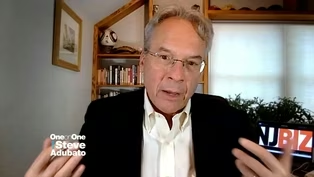 New
NewEditor of NJBIZ discusses the challenges facing media today
Video has Closed Captions
Clip: S2026 Ep2936 | 8m 42s | Editor of NJBIZ discusses the challenges facing media today (8m 42s)
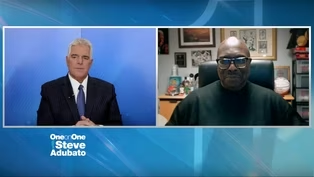 New
NewThe historical opposition to the integration of MLB
Video has Closed Captions
Clip: S2026 Ep2936 | 8m 27s | The historical opposition to the integration of MLB (8m 27s)
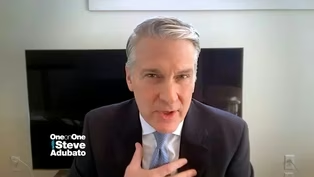 New
NewPresident of Monmouth University addresses freedom of speech
Video has Closed Captions
Clip: S2026 Ep2936 | 10m 23s | President of Monmouth University addresses freedom of speech (10m 23s)
Providing Support for PBS.org
Learn Moreabout PBS online sponsorship
- News and Public Affairs

Top journalists deliver compelling original analysis of the hour's headlines.

- News and Public Affairs

Today's top journalists discuss Washington's current political events and public affairs.











Support for PBS provided by:
One-on-One is a local public television program presented by NJ PBS