State of Affairs with Steve Adubato
Examining funding for students with special needs in NJ
Clip: Season 9 Episode 30 | 7m 51sVideo has Closed Captions
Examining funding for students with special needs in NJ
Steve Adubato is joined by Danielle Farrie, PhD, Research Director of the Education Law Center, to examine the consequences of inadequate funding for students with special needs in New Jersey and the nation.
Problems playing video? | Closed Captioning Feedback
Problems playing video? | Closed Captioning Feedback
State of Affairs with Steve Adubato is a local public television program presented by NJ PBS
State of Affairs with Steve Adubato
Examining funding for students with special needs in NJ
Clip: Season 9 Episode 30 | 7m 51sVideo has Closed Captions
Steve Adubato is joined by Danielle Farrie, PhD, Research Director of the Education Law Center, to examine the consequences of inadequate funding for students with special needs in New Jersey and the nation.
Problems playing video? | Closed Captioning Feedback
How to Watch State of Affairs with Steve Adubato
State of Affairs with Steve Adubato is available to stream on pbs.org and the free PBS App, available on iPhone, Apple TV, Android TV, Android smartphones, Amazon Fire TV, Amazon Fire Tablet, Roku, Samsung Smart TV, and Vizio.
Providing Support for PBS.org
Learn Moreabout PBS online sponsorship[INSPRATIONAL MUSIC STING] - Hi, everyone, Steve Adubato.
We kick off the program with Dr.
Danielle Farrie, who is the research director at the Education Law Center.
Their website will come up right away.
Danielle, good to have you with us.
- Thank you for having me.
- Tell everyone what the Education Law Center is.
It's an important institution in the state.
- Yeah, and our Education Law Center is a nonprofit advocacy organization that works to enforce the rights of public school students in New Jersey and also nationally across the country.
- You have a concern.
You and your colleagues have a concern.
You've done research on special ed, special education funding.
First of all, what's the problem in special education and what does it have to do with the funding of special ed?
- So, from our perspective, the funding for special education is just not aligned with the needs of school districts.
So the way that New Jersey funds special education under the school of funding formula is what's called a census method.
So it assumes that every school district has the average classification rate and has the average cost, or you know, the average spending per special ed student.
And what we know is that that is not actually how special education works across the state.
So there are some districts that have very high classification rates and some that have low.
And so districts are not really being funded based on their actual students, either the number of students or the needs of students in terms of the severity of their disabilities - And the impact of that?
- So that causes a major funding concern for school districts.
So some districts are getting far less funding through the formula for special education than what they're required to actually fund to serve their students appropriately.
And when they don't have, you know, the funding through the special education categories, it just puts more pressure on the school district to find that- - Danielle, hold on one second.
I'm trying to move from the formula to the impact on the student.
Most people wanna understand, okay, so what's the impact on a child who is, I don't even like this, classified as a special education student?
What's the impact for that kid?
- aSo the impact on students with disabilities is that it becomes harder for them to receive the level of services that they're entitled to.
And it creates pressure within the entire school district so that students of all types are now in this funding crunch where the district is forced to make decisions about which programs are gonna get funded and which programs aren't gonna get funded.
And unfortunately, that often leads to students with disabilities not getting the level of services that they really need in order to thrive and, you know, reach their full potential.
- And those children with the disabilities that you talk about, if they don't get... I'm very caught up in impact, the impact on these students, on these young people, their lives.
If I'm not mistaken, and I'm no expert on this, there are long-lasting potential negative implications for those children.
Am I engaging in hyperbole right now?
- No, I don't think so.
I mean, I think that, you know, we have come a long way in this country in terms of understanding what students with disabilities need in order to succeed, both in school and, you know, long-term in terms of their, like lifelong outcomes.
And those students need supports along the way.
And if you are lacking those supports at the early stages, it only makes those students fall further and further behind.
And it makes it very hard for them to catch up and, you know, be able to live the life that they, you know, should be able to lead.
- So there's gonna be a new governor.
We're taping this program in mid-November.
There's a new governor, Governor Mikie.
Governor-elect as we speak.
She'll be the governor, Mikie Sherrill.
She'll have an education commissioner.
There'll be a whole infrastructure around education and special education.
What is the most tangible, practical advice you would give to the new governor and her administration as it relates to the children we're talking about in special education?
- I think that the number one thing that New Jersey should be focused on is figuring out a way to improve our inclusion of special ed students into the general education program.
New Jersey is one of the worst, if not the worst states, in terms of students who are classified the amount of time they spend in a general education environment.
So too often, our students with disabilities are basically segregated into separate classrooms or separate schools, and they don't interact with their peers or, you know, the other students in the school.
And one of the best ways that New Jersey could attack the problems in special education, both among funding side and from an achievement side, is to improve our inclusion rates so that students with disabilities are being educated among their school peers and not being segregated into separate environments.
- Last question here.
How did you get into this field and why do you clearly care as much as you do?
- So I actually came to education policy through sociology, and I studied basically the impact of segregation and stratification in public schools.
And so I was looking at it from a race and economic perspective, but obviously that's also translates into other areas, English learners, special education.
And yeah, that's how we ended up here.
- I take that back.
One more quick question.
Federal funding matters here as well.
The Trump administration as it relates to special education funding.
Help us understand where are they on this and how much has it helped or hurt?
- Yeah, so it's a little unclear right now.
The proposals for special education are not so much to cut... To basically leave funding levels flat, which is a problem because federal funding has been underfunded for special education for decades.
But then also, there has been talk about switching over to a block grant, which would give states much more flexibility in how they spend special ed money.
But that is also sort of subject to a lot of concern because federal government plays a very important role in oversight and monitoring to make sure that students with disabilities get the services that they are entitled to.
And so we're concerned about that.
- Dr.
Danielle Farrie, who is a research director at the Education Law Center.
Danielle, thank you so much for joining us.
We appreciate it.
- Thank you.
- You got it.
I'm Steve Adubato.
Stay with us, we'll be right back.
- [Narrator] State of Affairs with Steve Adubato is a production of the Caucus Educational Corporation.
Funding has been provided by The Russell Berrie Foundation.
EJI, Excellence in Medicine Awards.
A New Jersey health foundation program.
PSE&G.
Valley Bank.
Kean University.
New Jersey Board of Public Utilities.
The New Jersey Economic Development Authority.
The New Jersey Education Association.
And by Robert Wood Johnson Foundation.
Promotional support provided by BestofNJ.com.
And by CIANJ, and Commerce Magazine.
- (Narrator) Since 1903, PSEG has worked to keep our commitment to customers and communities, to keep your lights on and homes warm.
We’re there when challenges strike like storms or economic uncertainty.
We're preparing for tomorrow by working to replace aging infrastructure, provide carbon free nuclear energy, and deliver energy efficient options to customers.
PSEG, powering progress.
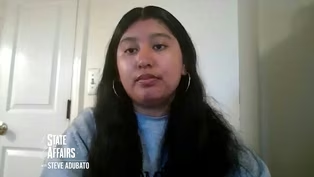
Immigrant rights activist discusses uplifting her community
Video has Closed Captions
Clip: S9 Ep30 | 10m 33s | Immigrant rights activist discusses uplifting her community (10m 33s)
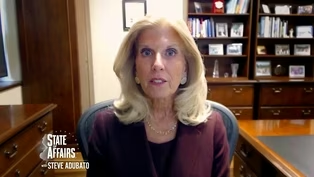
Michele Acito on the vital role of nursing & public health
Video has Closed Captions
Clip: S9 Ep30 | 9m 51s | Michele Acito on the vital role of nursing & public health (9m 51s)
Providing Support for PBS.org
Learn Moreabout PBS online sponsorship
- News and Public Affairs

Top journalists deliver compelling original analysis of the hour's headlines.

- News and Public Affairs

FRONTLINE is investigative journalism that questions, explains and changes our world.











Support for PBS provided by:
State of Affairs with Steve Adubato is a local public television program presented by NJ PBS