One-on-One
Examining youth mental health at the 2025 NJEA Convention
Clip: Season 2026 Episode 2907 | 11m 23sVideo has Closed Captions
Examining youth mental health at the 2025 NJEA Convention
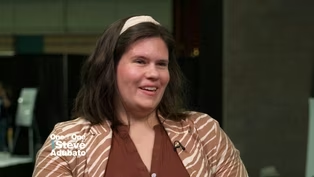
On location at the NJEA Convention, Senior One-on-One Correspondent Jacqui Tricarico is joined by Dr. Meera Wells, Statewide Medical Director of NJ Pediatric Psychiatry Collaborative and Assistant Professor at Hackensack Meridian School of Medicine’s Department of Psychiatry, to emphasize the significance of youth mental health for educational, emotional, and social success.
Problems playing video? | Closed Captioning Feedback
Problems playing video? | Closed Captioning Feedback
One-on-One is a local public television program presented by NJ PBS
One-on-One
Examining youth mental health at the 2025 NJEA Convention
Clip: Season 2026 Episode 2907 | 11m 23sVideo has Closed Captions
On location at the NJEA Convention, Senior One-on-One Correspondent Jacqui Tricarico is joined by Dr. Meera Wells, Statewide Medical Director of NJ Pediatric Psychiatry Collaborative and Assistant Professor at Hackensack Meridian School of Medicine’s Department of Psychiatry, to emphasize the significance of youth mental health for educational, emotional, and social success.
Problems playing video? | Closed Captioning Feedback
How to Watch One-on-One
One-on-One is available to stream on pbs.org and the free PBS App, available on iPhone, Apple TV, Android TV, Android smartphones, Amazon Fire TV, Amazon Fire Tablet, Roku, Samsung Smart TV, and Vizio.
Providing Support for PBS.org
Learn Moreabout PBS online sponsorship(upbeat music) - Hi, I'm Jacqui Triarico on location at the NJEA Convention here in Atlantic City, and I'm so pleased to be joined now by Dr.
Meera Wells who is the statewide medical director of the New Jersey Pediatric Psychiatry Collaboration.
It is run by Hackensack Meridian Health in 20 out of the 21 counties here in New Jersey.
It's so great to have you with us.
- I'm happy to be here.
- So you're over with part of the Youth Mental Health Pavilion that's set up here at the convention this year.
First, describe for us what this New Jersey Pediatric Psychiatry Collaborative is in the state and really how it's making such an impact.
- Sure.
So, as you may know very well and most people who have children know or have come across children, that children's mental health was declared a national emergency in 2021.
For most people, as you know here, are educators who deal with children all the time, they knew and we knew there was a tsunami coming towards us way before it was declared an emergency.
The problem is that there is a huge shortage in child psychiatry, and back in 2015 we were sort of getting to the point where we were like, "We don't want to stand around and say there's a shortage.
"Let's come up with a solution."
And that's how the New Jersey Pediatric Psychiatry Collaborative first came into being.
It was started as a pilot program in four counties, which was Monmouth, Ocean, Burlington, and Camden.
We applied for a grant.
The Department of Children and Families gave us a grant, $2.5 million, and the idea was that we would have a hub that would have child psychiatrists, licensed clinical social workers, mental health specialists, and we would help the primary care provider in being able to address children's mental health.
So that's how it started.
By the success of that pilot, by 2017, we went statewide which means every county in New Jersey right now has this.
The Hackensack Meridian Health run one which also partners with Cooper University as well as Atlantic Health System.
We manage 20 of the 21 counties.
So the vision or the mission for this program is to really transform access to children's mental health care by empowering our pediatric care providers.
- 'Cause really the pediatricians are the first line of defense, right?
What and should they be doing to really screen and make sure that we're catching these mental health issues early on before it really kind of gets out of control.
- Exactly.
I'm glad that you asked what should we do, especially the screening part of it, and remember we are talking about mental health.
Mental health is what everybody needs.
We're not talking about illness.
So it starts with screening, screening during well visits using age-appropriate tools, and we sort of, you know, train them in using a broad-based screening tool that can pick up things like anxiety, depression, ADHD, ODD, a very wide screen, right?
So if we are doing that before kids start showing that, or a teacher sees something, or you as a parent notice something, we can pick things up very, very early, and the earlier we see things in children, especially in the mental health, less the need for medicine.
What we need are like the supportive therapies for children.
- And you talked about this before, but even the demand of child psychiatrists is so big right now in the state, and there's just not enough to really help get those kids to see those doctors where they need that help.
How else is the collaborative making sure that the pediatrician has more of a role in that part of the child's healthcare?
- Right, and as you mentioned, the frontline for everything is pediatricians, right, our pediatric care providers.
So, you know, on that comes a pediatrician, family physician, nurse practitioners, physician assistants, all of them, to be aware that a whole child is not just physical but also a mental health as well.
So the sooner they learn the broad-based screening tools and how to sort of recognize certain things, for example, you know this particular program's completely free of cost, doesn't cost anything to the pediatric provider, nothing to the children, we don't care if they have insurance or not, whether they're documented or not, they have access to us.
So we are training our pediatric providers: one, to screen, and then, not only that, once they become members, they have access to us.
Say, for example, they refer a child to us, and I'm the child psychiatrist who sees this child.
I'll actually pick up the phone and call them even before I see the child, want to introduce myself, but also to hear what their concerns are so that I'm addressing that.
Once I see the child, I'll actually pick up the phone and call them and talk to them even before I start writing to give them the impression of what I saw and what my recommendations are.
And yes, this is completely free, but the beauty of it is that I don't fall off the face of Earth at that point.
They can continue collaborating for this child as many times as they want, for as long as they want.
Down the road in one week, they want to call me, call me.
Three months later?
So we train them not only in what probably is the diagnosis, how to do medications, and how to manage the child as well.
So that's one aspect of it.
The other big aspect of what we do is we take a huge burden off the pediatric provider's desk, which is really how do you get the support services for these children.
Now because we are in all counties, our sort of navigators are the social workers.
They know exactly what's available in that county, and they will now do a tailored referral for your child.
This is not like saying, "Here's a list of numbers.
"Good luck.
Call them."
No, this is based on the bio-psychosocial assessment they've done.
They will now try and see what fits the child.
They will call the, you know, local providers and for three things.
One is do they have availability for the child that matches the needs?
Second is do they take the insurance?
And third is, do you have an appointment that can be done faster.
So that huge burden is really taken away from the pediatric provider 'cause otherwise what do you get?
A list of numbers, and say, "Good luck.
Go call them."
Third part of this is the education part of it, which is we do a lot of webinars and learning collaboratives where they learn about the common mental health issues like anxiety, depression, ADHD, and how to manage as well.
- And talking about the burden, I mean what about on the parents, the caregivers, because it is so hard.
I know from family experience it's really hard to navigate the system when you're the parent or the caregiver dealing with the child where there is anxiety, OCD, ADHD.
Something's going on, and, you know, you're just trying to navigate the system.
"Where do I go first?
"How do I get the proper help?"
How is this collaborative helping really with the parents and caregivers too.
- Glad you asked that as well.
So this is like one for the pediatrician.
We are like, I'm in their pocket.
Call me anytime.
As a parent, you're absolutely right.
It's the most confusing thing to try and navigate on what's going on.
That's what our social workers are called navigators, which means they will sort of be there from step one with the parent, and then once we've done those recommendations, our mental health specialists will actually pick up and connect with the parent within a week of those recommendations to see were you able to make these appointments.
If you were not, let me problem solve.
Sometimes it might be where they make a three-way call and get them.
Sometimes it may be where the parent did not understand really.
What do you mean?
Like we talk this language all the time, and they're like, "I don't even know how to talk to them."
Or we may have an 18-year-old who's magically an adult, doesn't know how to do this themselves.
So we'll get on the phone with them and make those calls for them and get them connected.
- And what about, so we are at this education convention here.
What about the educator?
What are you making sure that the educators who are coming over to the mental health pavilion over there, that the information that they're getting that they can bring back into the classroom 'cause they're picking up on these behaviors as well that could be, you know, something that needs to be addressed.
- Absolutely.
You know, children spend more time in school than they do in their own families.
Oftentimes the teachers know these children far better than unfortunately even us as parents because they're on their social media all the time.
So we have actually collaborated outside of just the physicians.
We do collaborate and have worked with the New Jersey Statewide Support System for Children, so the NJ4S, which is in their third year.
They're identifying children with mental health issues, and they can refer to us.
They don't have to be a physician to refer to us.
Secondly, obviously just hearing about a program like this, which is completely free, most parents are most likely to turn to a teacher, to a coach, a religious leader before they actually even go and a pediatrician.
So teachers are often the first people that parents will turn to and say, "I don't know what's going on with Joy."
And they can say, "Do you know about this program, "which is completely free?
"Call your pediatrician, "or take this, here's a flyer, take it.
"There's a QR code.
It's as simple as that."
They look at that.
They're registered, They're ready to refer those children.
- I mean, the information is key in getting the word out about this program.
Thank you so much for taking the time to describe it for us and helping us get the information out about the New Jersey Pediatric Psychiatry Collaborative.
Thank you so much, Dr.
Wells.
- Thank you.
Thank you.
- Thank you for watching.
We'll be right back after this.
- [Narrator] One-On-One with Steve Adubato is a production of the Caucus Educational Corporation.
Funding has been provided by The New Jersey Education Association.
NJ Best, New Jersey’s five-two-nine college savings plan.
Seton Hall University.
Valley Bank.
PSE&G.
EJI, Excellence in Medicine Awards.
A New Jersey health foundation program.
The Fund for New Jersey.
Horizon Blue Cross Blue Shield of New Jersey.
And by The Fidelco Group.
Promotional support provided by NJBIA.
And by Insider NJ.
- [Narrator] To see more One on One with Steve Adubato programs, visit us online at SteveAdubato.org.
If you would like to express an opinion, email us at info@caucusnj.org.
Find us on Facebook at facebook.com/steveadubatophd and follow us on X @steveadubato.
- (Narrator) New Jersey is home to the best public schools in the nation, and that didn't happen by accident.
It's the result of parents, educators and communities working together year after year to give our students a world class education.
No matter the challenge, because parents and educators know that with a shared commitment to our public schools, our children can learn, grow and thrive.
And together, we can keep New Jersey's public schools the best in the nation.
 New
NewCombatting food insecurity with nutritional education
Video has Closed Captions
Clip: S2026 Ep2907 | 13m 42s | Combatting food insecurity with nutritional education (13m 42s)
Providing Support for PBS.org
Learn Moreabout PBS online sponsorship
- News and Public Affairs

Top journalists deliver compelling original analysis of the hour's headlines.

- News and Public Affairs

FRONTLINE is investigative journalism that questions, explains and changes our world.











Support for PBS provided by:
One-on-One is a local public television program presented by NJ PBS