One-on-One
Father Edwin Leahy, O.S.B.; Kim Guadagno; Joseph Youngblood II, JD, PhD
Season 2026 Episode 2918 | 27m 59sVideo has Closed Captions
Father Edwin Leahy, O.S.B.; Kim Guadagno; Joseph Youngblood II, JD, PhD
Father Edwin Leahy, Headmaster of St. Benedict's Preparatory School, celebrates the growth of St. Benedict's Prep. Kim Guadagno, Former Lt. Governor and President and CEO of Mercy Center, discusses how Mercy Center supports the Asbury Park community. Dr. Joseph Youngblood, Chancellor of Kean USA Regional Campuses at Kean University, discusses their new partnership with Bermuda College.
Problems playing video? | Closed Captioning Feedback
Problems playing video? | Closed Captioning Feedback
One-on-One is a local public television program presented by NJ PBS
One-on-One
Father Edwin Leahy, O.S.B.; Kim Guadagno; Joseph Youngblood II, JD, PhD
Season 2026 Episode 2918 | 27m 59sVideo has Closed Captions
Father Edwin Leahy, Headmaster of St. Benedict's Preparatory School, celebrates the growth of St. Benedict's Prep. Kim Guadagno, Former Lt. Governor and President and CEO of Mercy Center, discusses how Mercy Center supports the Asbury Park community. Dr. Joseph Youngblood, Chancellor of Kean USA Regional Campuses at Kean University, discusses their new partnership with Bermuda College.
Problems playing video? | Closed Captioning Feedback
How to Watch One-on-One
One-on-One is available to stream on pbs.org and the free PBS App, available on iPhone, Apple TV, Android TV, Android smartphones, Amazon Fire TV, Amazon Fire Tablet, Roku, Samsung Smart TV, LG TV, and Vizio.
Providing Support for PBS.org
Learn Moreabout PBS online sponsorship- [Narrator] Funding for this edition of One-On-One with Steve Adubato has been provided by The Russell Berrie Foundation.
Making a difference.
RWJBarnabas Health.
Learn More at RWJBH.org.
The North Ward Center.
The Fund for New Jersey.
Community FoodBank of New Jersey.
PSEG Foundation.
Newark Board of Education.
Robert Wood Johnson Foundation.
Working to create a future where health is no longer a privilege, but a right.
And by Horizon Blue Cross Blue Shield of New Jersey.
Promotional support provided by ROI-NJ.
Informing and connecting businesses in New Jersey.
And by NJ.Com.
Keeping communities informed and connected.
- This is One-On-One.
- I'm an equal American just like you are.
- The way we change Presidents in this country is by voting.
- A quartet is already a jawn, it’s just The New Jawn.
- January 6th was not some sort of violent, crazy outlier.
- I don't care how good you are or how good you think you are, there is always something to learn.
- I mean what other country sends comedians over to embedded military to make them feel better.
- People call me 'cause they feel nobody's paying attention.
_ It’s not all about memorizing and getting information, it’s what you do with that information.
- (slowly) Start talking right now.
- That's a good question, high five.
(upbeat music) - Hi everyone, Steve Adubato.
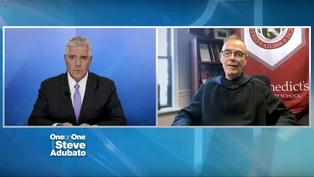
We kick off the program with our longtime friend, Father Edwin Leahy, headmaster of St.
Benedict's Preparatory School.
Good to see you, Father Ed.
- Good to see you, Steve.
Good to be here.
- It is good for you to be here.
Is it not a fact that you recently turned 80?
- It's a fact.
80, yep.
- Did you also turn it into some sort of fundraiser for St.
Benedict's Prep?
- Nah, well, I did not.
(Steve laughing) Somebody did, no doubt, but I did not.
- Where did you learn that?
By someone we know.
(Father Ed laughing) We both know.
- Show me the money.
Economics 101.
- By the way, Father Ed makes reference to my late dad who was on the board of St.
Benedict's Prep, and my son Steven taught there.
We have a long time... Conflict of interest, yes.
There's a lot of history with St.
Benedict.
Father, let me ask you this.
The 53rd year as headmaster at St.
Benedict's, it was in 1973, St.
Benedict's had closed for a year.
Many of your students came to my high school at Essex Catholic.
- Yep.
- You were 25 I think, at the time.
You came in, ya start at the school again.
How many students in 1973 when you started?
- 89.
- How many now?
- Almost 1,100.
- What grades?
- Now, kindergarten to grade 12.
- Boys and girls?
- Back then, it was grade 9 to 12.
Yes, boys and girls as well as a kind of a, what the people in special operations in our military, would call a forward-operating base.
We have a relationship developing with a school up in Newburgh, New York, San Miguel Academy.
So yeah, lots happening.
- And by the way, check out a couple things, the previous interviews we've done with Father Ed.
Father Ed is also, he was in the inaugural Russ Berrie Making a Difference Awards in 1997, which I was honored to host.
Father Ed was one of the first honorees, right?
So they're celebrating its 30th, 30 years coming up at the Russ Berrie Making a Difference Awards.
You've been recognized many times, Father Ed, but what did that award mean to you then, and why is it so important to, as the foundation says, make a difference?
- Well, I mean it was, first of all, Russ Berrie was one of the most unassuming people that I've ever met in my life, I think.
He was interested in making a difference, trying to highlight those places, in his opinion and the opinion of whoever worked with him was making some kind of a difference.
So, any of those recognitions that happened way back then were ways of kinda turning attention to what these kids here in Newark were doing positively, right, so I think he was a huge help to us back then.
- Let folks know, Father Ed, about the population of students at St.
Benedict's.
- So most of our kids are from the African dispersion.
Back then, when we first started, it was, they were all African Americans, because the West African immigration didn't happen until the mid to late '80s.
And the Latin American immigration in any great numbers, didn't happen until slightly after that.
So our kids back then were all African American or Puerto Ricans because they're citizens of the US.
Now it's kind of the African dispersion and the Latin American dispersion, I would say.
- Father Ed, for those who have a preconceived idea about urban kids, urban young people, that you've worked with for 53 years plus, what do most people have wrong about their, sometimes preconceived ideas about innercity young people?
Well, they have... - The preconceived ideas are about, not just the young people, but about all of us who live in the inner city, I think, and then the kids, by just by association.
And kids are more inclined frequently to get into the kinda trouble that becomes public, right?
Adults are much better at hiding it, (laughs) the things that they're doing that they might not, ought not be doing.
And there's the media has attention drawn to it as well.
So I mean, the kids don't have a, in one sense, don't have a chance to hide because somebody's always making a point of it and making a point negatively about them.
But the kids are, they're no different than any other kids.
And their resilience is astounding, 'cause a lot of times they're doing it in adverse circumstances.
So they're either doing it by themself or they're doing it with only one parent present, all of that.
- Yeah, and by the way, check out an interview we did with one of Father Ed's alum, one of the alums at St.
Benedict's, Quadeer Porter, an alumnus of St.
Benedict's, received a 2022 Russ Berrie Making a Difference Award for his work with Brothers Building a Better Nation.
And this year the foundation, the Russ Berrie Foundation, is honoring and recognizing Gen Z young people making a difference.
What's your message to the Gen, (laughs) to the Gen Z, and their need to make a difference, Father Ed, 'cause you see them doing it every day.
You promote them doing it every day.
- Yeah, the challenge for Gen Z kids, I think, is working together as a team, because they live this kind of an isolated life, in one sense, on their phones nonstop.
So hanging on street corners like a lot of kids did growing up, and especially in the inner city, that's all disappeared.
They all hang on their phones.
And it's difficult for them to work together as a team.
So working, putting them in situations where they have to rely on one another is the key.
Because doing it all by yourself isn't gonna work longterm as you get older and older.
So that's the biggest challenge I think Gen Z has.
- By the way, let me recognize, that in 2024, Father Edwin was one of the folks inducted, one of the honorees of the New Jersey Hall of Fame 2024, in the Hall of Fame, check that out.
We're partners with the Hall of Fame as well.
Final question, Father Ed, you know I'm a student of leadership.
I struggle with it all the time, write about it, try to understand it.
You've been leading through incredibly challenging times.
The most significant leadership lesson you have learned after 53 years leading St.
Benedict's Prep with 89 students to start, 1,100 plus now, and very different than when you started and much more impactful than anyone ever imagined, greatest leadership lesson you learned is?
- Teamwork.
Relying on the people around you that helps shape your thinking, not to make decisions on your own.
- Yeah, sometimes we think we can do it on our own and we delude ourselves.
Father Ed - Bad idea.
- is the headmaster of St.
Benedict's Preparatory School.
Also let me disclose, he doesn't like me to say this.
He is the spiritual advisor to the Adubato family.
(Father Ed laughs) And I'm not convinced he's doing that good a job at it.
(laughs) I'm only kidding.
Thank you, Father Ed.
- Thank you, Steve.
- Stay with us.
We'll be right back.
- [Narrator] To watch more One on One with Steve Adubato find us online and follow us on Social media.
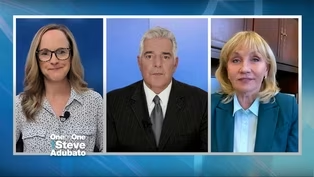
- Recently on our sister series "Lessons in Leadership, my colleague and co-anchor, Mary Gamba and I, sat down and spoke with Kim Guadagno, who's former Lieutenant Governor in the great state of New Jersey, and also President and Chief Executive Officer of Mercy Center, a terrific organization based in Monmouth County, making a difference every day in the lives of those who are struggling, struggling to figure out where their next meal's gonna be, struggling because they're in a domestically dangerous situation at home, violence, trauma.
They're there every day.
Kim talks about the work of Mercy Center in this conversation with Mary Gamba and myself.
Check it out.
- Kim, good to see you again.
- Good to see you, Steve.
Always.
- You got it, the website's up.
Tell everyone what Mercy Center is and more important now than ever.
- Well, you know, it's a really simple thing.
We're just trying to end generational poverty, not some little small project.
So it's in the greater Asbury Park area.
We feed people in 24 different cities in Monmouth County, six different counties in the state of New Jersey.
We feed them, we get their trust, and then we help them live a full life, whatever that is.
We speak English, Spanish, Creole, and Arabic.
And then we get the kids outta the worst academic system in the state of New Jersey in Asbury Park by giving 'em a great education, girls a great education for fourth to eighth grade.
Get 'em into good high schools, get 'em on to college.
So it ends the generational cycle of it all.
- Incredibly important.
Again, go on the website to find out more and to our good friend, Larry Downes, who's the Chairman of the Board at Mercy Center.
Larry and I have had these conversations about Mercy Center for years and also your leadership.
And to that end, you've been a leader in corporate America as a lawyer, you've been a leader in government and government as well, a variety of capacities including Lieutenant Governor and now leader of this nonprofit.
From your perspective, Kim, is there any significant difference, and if so, what is it between leading in those different arenas?
- Oh, it's night and day.
You cannot just hop from being the Lieutenant Governor where you're policy-driven.
You are a leader.
You walk in the room like you know everything, even if you don't, especially if you were the Lieutenant Governor to Chris Christie.
So that's politics.
You have to exude fearlessness, if you will, even if you are, you know, not sure about what you're about to say, but on the nonprofit side, completely different.
It's mission-driven.
People have a vision of what they wanna do and where they wanna go.
They wanna make sure that you go with them and that you are as committed as they are.
You walk in and you do a lot of listening, a lot of looking people straight in the eye, and you're not, and I find it's often the case, the smartest person in the room.
And so you do a lot of trust building.
If you leave, I like to say I did eight years in hell and now I try to earn my way back into heaven.
But you have to earn people's trust as a, I like to say, a completely rehabilitated politician.
You have to earn their trust again.
And you do that by just simply working hard and look 'em straight in the eye and listening.
- And in addition to that, as Mary jumps in, as a not-for-profit leader, Kim and I, and all of us who are leaders of not-for-profit organizations know that no money, no mission.
We raised at least half of our, you roll your eyes, you know, at least half of our time raising money.
Fair to say?
- You know, I like to say, Mary, you know this already.
I like to, my husband, you know, never used to be able to go with me to any political events 'cause he was a judge.
He now gets to go to events with me.
However, when the time for begging starts, I literally walk over to him, tap him on the shoulder, and I said, "The begging is about to begin.
"You might wanna leave."
- I love it.
- And inevitably, he gets up and leaves 'cause it's horrifying to him.
But it's the job, right?
- It is.
- It really is.
- It is.
- And it's well worth every effort.
I'm not asking for money for myself.
You don't ask for money for yourself.
And it's, you know, if I get to keep somebody off the street at night because they don't have a home, I'm good with that.
- Well said, Mary.
- I'm 100% confident that you have earned your way back into heaven officially.
So keep doing the good work over there.
Part of earning your way back into heaven, in my opinion, has to do with partnerships, right?
Everything that you're doing cannot happen without donors, without volunteers.
Talk about the keys, from your opinion, obviously, is it the same, is it different, the keys to building partnerships?
You talked a little bit about trust, but what is another key to building these strong partnerships that get people to buy into the mission of Mercy Center?
- Well, and we have a lot of different partners on every level, whether it's a volunteer, I'll give you one simple, we were doing Christmas gift distributions last year, and then we found somebody here in Asbury Park who did it much better, much smarter, much less abuse of the system.
And so now they're using our new building and they're doing all the gift giving and what does that do, that makes us stronger all the way around.
Did it happen overnight?
No.
You had to reach out to people.
You had to accept that you can't be everything to everyone and you don't wanna be, that you have a limited, well, I don't wanna say limited, but you don't have unlimited resources and you can't do it all by yourself.
So when it comes to volunteers and getting stuff done, you just have to know what your limitations are.
Like I try very hard not to duplicate somebody else's efforts in our area, but when it comes to donors, donors is care and feeding.
You spend a lot of time with donors, a lot of time talking to donors, a lot of time thanking them for all of their gifts, whether it's their gift of time or gift of treasure.
Either way, it's a very different conversation.
I don't go out to dinner a lot, but as I would as a politician.
But I certainly go out to coffee, have a lot of coffee, have a lot of tours, have a lot of, you know what?
I try to tell a story that will make them cry so that they feel, my donors feel like they're a part of it.
And if I don't make them, cry then I'm not doing my job.
And quite frankly, there is something to cry about every day here where we work, there is a sad, one more sad story than another.
So my goal is to engage them that way.
- And along those lines, the Sisters Academy.
What is Sisters Academy and how is it connected to making a difference, Kim?
- Well it ends the circle, the Sisters Academy is a school for four to eighth grade girls.
What many people don't know is that in Asbury Park, Asbury Park is the worst school system in the state.
I'll say that again.
Asbury Park is the worst school system in the state.
Objectively New Jersey, DOE numbers show worse than Camden, worse than Trenton, worse than Paterson, you name it, we are the worst.
It's nothing to be proud of.
- The Department of Education says that?
- Yeah, worst math and science scores for the third to eighth graders.
So if you go to the public school system in Asbury Park, you will not be able to get into a decent high school or a decent college, which means you will get back on my line at the pantry here in Asbury Park.
And that is not the goal.
The goal is to end that line by getting you a great education and getting you that out of this school system while they try to fix it.
Look, I don't wanna get into the politics of why it is the way it is, but while they're trying to fix it, we take girls out of the system, get them educated enough so they can get into good high schools and from there, go on to great colleges or some kind of advanced degree so they can support themselves and have a full life.
- Good stuff.
Last question, Mary.
- So many people want to help, myself included, but don't know how to help.
How can someone that's watching right now get involved and help to end this cycle that you're talking about?
- Well, it's pretty easy.
If you don't have my cell phone number, it's the same one I've had for 15 years.
You just call me or you find someplace local 'cause you are a statewide organization.
We are based in Asbury Park and we serve all of Monmouth County, and in sexual assault and DV cases, we serve six counties.
But go to your local pantries.
You can find them very easily.
Just type into AI , and go give your time, give your treasure.
We just opened a warming center.
So we are our shelter for families that are homeless overnight.
And we found it, you know, surprisingly easy to find some volunteers to come and help people with comfort and warmth overnight.
So there is always somebody and who needs help and there's always somebody you can go to to help them help them.
If that makes any sense.
- Kim Guadagno, former Lieutenant Governor, but now as she continues to work her way into heaven, as she said, the President and Chief Executive Officer of a terrific organization.
I've had the honor of being down there and just watching a little bit of the work that goes on at Mercy Center.
Kim, our good friend, thank you so much for joining us.
We appreciate it.
- Thanks for having me.
Thanks for raising awareness.
It's great.
- You got it.
Stay with us, we'll be right back.
- [Narrator] To watch more One on One with Steve Adubato find us online and follow us on Social media.
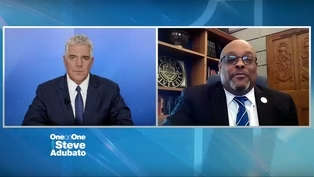
- We now welcome Dr.
Joseph Youngblood, Chancellor of Kean USA Regional Campuses and Strategic Global Initiatives.
Good to see you, Dr.
Youngblood.
- Good to see you as well, Steve.
Always a pleasure to be on the show.
- You got it.
Kean University, one of our higher ed partners.
Also, check out the interview we did with Kean Jersey City University President, Dr.
Lamont Repollet.
We just did that interview.
It'll be really important, check it out.
Dr.
Youngblood, talk to us about this.
We're gonna talk about urban matters.
We're doing a series, "Urban Matters," in cooperation with Kean and your institute, the John S. Watson Urban Research Institute.
What is the connection between Kean University and Bermuda College, and what does that have to do with urban matters?
- Thank you, Steve.
There are actually very interesting historical ties.
We were mining data, really trying to assess pockets of alumni around the world so that we could reengage and develop partnerships, and identified that there was a longstanding history of students from Bermuda who were coming to Kean University.
So a really fascinating piece for us that led to a couple of intentional conversations about how we could bolster a partnership in the context of everything that Kean is doing with the social impact and work around the world.
So we were clear that Bermuda was globally connected.
The island, ironically, has about 65,000 citizens.
So you put that in the context of a lot of the mid-size cities that we work with here in New Jersey.
I mean, that puts Bermuda in the space of East Orange, Union Township, in fact, our neighboring community.
And we thought it really set the context for a perfect relationship that would allow us to leverage our identity as an urban research university to support and advance the issues that are impacting that urban island nation.
And Bermuda College, as a two-year college there, was very interested in creating an articulation agreement with Kean University so that students from the island could complete their two years there and then come to the U.S., come to Kean, and complete their studies here as they have done for decades.
- Doctor, let me ask you this.
Why is it so important?
Because Kean University, again, one of our longtime higher ed partners, has either campuses or affiliations with universities in China, Canada, Britain, and obviously, the Caribbean.
Question: how important is that?
And we talked to Dr.
Repollet about this as well.
How important is that to a thriving, successful, financially stable university?
- It's mission critical for us, Steve.
One, it exposes our students, our faculty, and our staff such that they become world citizens and a part of a global environment and context to really sustain and impact change around the world.
What that represents for our students when you see them on these campuses around the globe is nothing short of amazing.
I was just in China a couple of months ago and had the opportunity to meet with some of our students who were there.
A young man from Passaic who has just had a phenomenal, eye-opening experience because he had the opportunity to have that kind of cultural and educational exchange.
And so that's always been a critical part of Kean's global identity.
But what has enhanced our presence internationally now is what we bring as an urban research university, leveraging our resources, the tremendous intellectual property that we have, our faculty and our students to be a part of these global solutions in the same way we have been an anchor institution here in the U.S.
- Tell folks what it means to be an urban research institution, because Kean is, in fact, New Jersey's official urban research institution of higher education.
Explain to folks what that means from a practical point of view.
- Absolutely, Steve.
I've spent approximately 30 years working across education and public education.
And what I believe inherently, that's a part of the vision that Dr.
Repollet brought to Kean University, is that as a public university, we have an inherent responsibility to solve problems alongside with average citizens, government, school districts, et cetera, that we just can't educate in isolation.
So what our urban research identity does for us, it allows us to leverage those resources to be a part of the solutions to some of the most challenging issues in New Jersey and now around the world.
So it positions us, again, to not just be a player on the world stage, but to be a critical thought partner in shaping those issues that we know are plaguing societies around the world.
What we're doing in these cities in New Jersey, we're now replicating all around the world.
And that is so exciting for our students, faculty, and everyone in the Kean community.
- Dr.
Youngblood, let me ask you this.
For students in Bermuda or Bermudan students, do they face any unique or different challenges than all the many challenges students currently face who happen to be American citizens, U.S.
citizens?
Are they different?
- Yeah, issues are the same, ironically, which is another reason why the Bermudian context was so exciting for us.
Everything that we experience here in terms of access, in terms of the cost of a higher education degree.
But what they don't have is a four-year public university to support their transition from the two-year environment that they have at Bermuda College.
So we close, I think, a critical gap for those students in terms of access, the two-plus-two pathway model that we're creating in Bermuda.
- What's that mean, two-plus-two?
- Two-plus-two is basically a pathway arrangement that is, in many ways, simple yet so effective because it allows students to complete their first two years at home on the island via Bermuda College, close to home at a lower cost, and then to transition seamlessly to Kean University.
It's something, again, that is not new, that is not new to Kean University.
So, for example, we have had a partnership at Kean Ocean for approximately 18 years, where we have a partnership with Ocean County College.
We are physically co-located there.
Those students, when they enter OCC, they know that they're coming directly through on a two-plus-two pathway to Kean University.
And we've been able to deliver that level of access in a region of the state that, ironically, like Bermuda College, does not have a public four-year institution.
So this is not new to us.
It is now just taking it to scale and applying almost two decades of lessons learned to be able to have this kind of impact, not just in New Jersey but around the world.
- Let me follow up on this.
At a very critically important, challenging time for higher education, what gives you reason, or what is the primary reason why you are optimistic in these incredibly challenging, fiscally difficult times where often some folks anecdotally or otherwise question the value of higher education?
What do you say to those folks?
A and B, why are you bullish?
Got a minute left.
- Absolutely.
I think that what we understand here at Kean is that no margin, no mission.
So the business model and the business infrastructure is a critical aspect of us making sure that we are positioned to be solvent and to be able to provide these opportunities.
What I say to students, what I say to families, is that a bachelor's degree and that aspect of an undergraduate education is still the most central factor in social mobility.
So we are also understanding of the fact that accessibility is an issue, cost is an issue.
So we wanna create programs that are flexible, that are affordable, but that have the same quality that allow these students to obtain what we know to be the gold standard in our education.
- Dr.
Joseph Youngblood is Chancellor of Kean USA Regional Campuses and Strategic Global Initiatives again at Kean University.
Kean University, Jersey City, I'm gonna get it right.
- It's gonna be Kean Jersey City, which is gonna be our Jersey City campus.
- That'll work, and by the way, check out the interview with the president, Dr.
Lamont Repollet, who talks about that merger and that collaboration.
Thank you, doctor, we appreciate it.
- Thank you, Steve, always a pleasure.
- I'm Steve Adubato, that's Dr.
Youngblood.
We'll see you next time.
- [Narrator] One-On-One with Steve Adubato is a production of the Caucus Educational Corporation.
Funding has been provided by The Russell Berrie Foundation.
RWJBarnabas Health.
Learn More at RWJBH.org.
The North Ward Center.
The Fund for New Jersey.
Community FoodBank of New Jersey.
PSEG Foundation.
Newark Board of Education.
Robert Wood Johnson Foundation.
And by Horizon Blue Cross Blue Shield of New Jersey.
Promotional support provided by ROI-NJ.
And by NJ.Com.
The North Ward Center continues to expand their services and outreach in Newark, from the childhood years to the golden years, Offering programs like preschool, youth leadership development, Casa Israel Adult Medical Day program our Family Success center, as well as a gymnasium.
And most recently Hope House, a permanent home for adults with autism, supporting and nurturing our autism community with Hope House 2 coming soon.
The North Ward Center.
We’re here when you need us.
 New
NewFather Leahy celebrates the growth of St. Benedict's Prep
Video has Closed Captions
Clip: S2026 Ep2918 | 8m 44s | Father Edwin Leahy celebrates the growth of St. Benedict's Prep (8m 44s)
 New
NewHighlighting Kean University's partnership with Bermuda
Video has Closed Captions
Clip: S2026 Ep2918 | 9m 13s | Highlighting Kean University's partnership with Bermuda (9m 13s)
 New
NewKim Guadagno discusses how Mercy Center supports Asbury Park
Video has Closed Captions
Clip: S2026 Ep2918 | 10m 29s | Kim Guadagno discusses how Mercy Center supports the Asbury Park community (10m 29s)
Providing Support for PBS.org
Learn Moreabout PBS online sponsorship
- News and Public Affairs

Top journalists deliver compelling original analysis of the hour's headlines.

- News and Public Affairs

FRONTLINE is investigative journalism that questions, explains and changes our world.











Support for PBS provided by:
One-on-One is a local public television program presented by NJ PBS