One-on-One
George Helmy, EVP; Tom Donahue; Sarah Steward
Season 2026 Episode 2945 | 27m 7sVideo has Closed Captions
George Helmy, EVP; Tom Donahue; Sarah Steward
George Helmy, EVP and Chief Corporate Affairs and Policy Officer at RWJBarnabas Health, discusses initiatives to combat food insecurity. Tom Donahue, Executive Producer & Director of Mafia Spies and Co-Founder of CreativeChaos vmg, discusses how the government targeted Fidel Castro. Sarah Steward, CEO of HomeFront, explores reducing homelessness and how child care supports families.
Problems playing video? | Closed Captioning Feedback
Problems playing video? | Closed Captioning Feedback
One-on-One is a local public television program presented by NJ PBS
One-on-One
George Helmy, EVP; Tom Donahue; Sarah Steward
Season 2026 Episode 2945 | 27m 7sVideo has Closed Captions
George Helmy, EVP and Chief Corporate Affairs and Policy Officer at RWJBarnabas Health, discusses initiatives to combat food insecurity. Tom Donahue, Executive Producer & Director of Mafia Spies and Co-Founder of CreativeChaos vmg, discusses how the government targeted Fidel Castro. Sarah Steward, CEO of HomeFront, explores reducing homelessness and how child care supports families.
Problems playing video? | Closed Captioning Feedback
Where to Watch One-on-One
One-on-One is available to stream on pbs.org and the PBS app.
Providing Support for PBS.org
Learn Moreabout PBS online sponsorship- [Narrator] Funding for this edition of One-On-One with Steve Adubato has been provided by EJI, Excellence in Medicine Awards.
A New Jersey health foundation program.
The Adubado Center for Media Leadership.
Because media matters more than ever.
NJM Insurance Group.
Serving New Jersey’s drivers, homeowners and business owners for more than 100 years.
The North Ward Center.
PSEG Foundation.
The Russell Berrie Foundation.
Making a difference.
New Jersey Sharing Network.
United Airlines.
And by Newark Board of Education.
Promotional support provided by CIANJ, and Commerce Magazine.
And by NJBIZ.
Providing business news for New Jersey for more than 30 years, online, in print, and in person.
- This is One-On-One.
- I'm an equal American just like you are.
- The way we change Presidents in this country is by voting.
- A quartet is already a jawn, it’s just The New Jawn.
- January 6th was not some sort of violent, crazy outlier.
- I don't care how good you are or how good you think you are, there is always something to learn.
- I mean what other country sends comedians over to embedded military to make them feel better.
- People call me 'cause they feel nobody's paying attention.
_ It’s not all about memorizing and getting information, it’s what you do with that information.
- (slowly) Start talking right now.
- That's a good question, high five.
(upbeat music) - Hey everyone.
Steve Adubato.
We kick off the program with our longtime friend, George Helmy, who is the Chief Corporate Affairs Officer at RWJBarnabas Health, and also an Executive Vice president at RWJBarnabas Health, one of the longtime underwriters of public broadcasting and of our programming.
George, good to see you.
- So great to be back with you, Steve.
Thank you for having me.
- George, talk about this initiative, "Our Healthy Communities" initiatives.
What is it and why does it matter so much when it comes to access, improving access to healthcare?
- Yeah, I mean, we're a singular in this space and we're so proud of this work.
I think as a system who has never left some of our more vulnerable communities where the social determinants of health seriously impact health outcomes, whether that be the city of Newark, New Brunswick, Jersey City, Rahway, Elizabeth, and so on.
You know, the idea was for us to be a true community anchor and how do we build not only the best technology and clinicians within our four walls, but really get out into the communities and make our patients, our families, and our communities healthy.
And so just in the last three years, we started this program in 2023, and just in the last three years under the leadership of Dr.
Balpreet Grewal-Virk, we've invested about a hundred million dollars really tackling the social determinants of health in a comprehensive way.
And, you know, that single individual who can't get access to primary care, who can't get a pharmacy, who can't get to their appointment because they don't have access to transportation, or they can't take the day off of their jobs, don't have access to healthy food, don't have a roof over their head, that same person presents over and over in our emergency department, A, never getting better.
B, that's the highest cost of care, and for a system like ours, the highest cost of under-imbursed or unimbursed care.
And so to connect that person with a community health worker who helped them navigate the federal or state resources they were available to access, and then in a singular place, we've made these investments in community partners and nonprofits and faith-based institutions.
So you can get all of that in one place.
And we're seeing the benefit, not just feel good, and you and I have talked about this by government programs who have names that sound like mom and apple pie.
This is real ROI, not only to a healthier community, but to the taxpayer.
Every dollar we put in, we're seeing returns of 3 to 6x from an economic return to the taxpayer.
- By the way, mentioning ROI, full disclosure on this, ROI our longtime media partner, ROI-NJ 2026 Power List.
George is listed on that.
Go check it out,the website of ROI is on there.
Some people who make a difference in our state.
Hey George, do this for us.
Help us understand this.
To what degree has the role of hospitals expanded exponentially as the need becomes greater and greater in terms of access to healthcare?
Because people go, "Oh, the hospitals have an emergency room.
They do surgery."
A lot of stuff we're talking about including this Harvest, farm to community center initiative, I'm thinking hospitals are doing more than ever.
- It's so true, and I think many are a little bit late to catch up to where we are, but we took this on early.
Again, being in these communities and believing that everybody, regardless of what zip code you live in, deserves access to the best care available.
And so we know as the state's largest academic health system, we already within our four walls have the best care, but we want to keep you out of our facilities.
And frankly, a lot of that, again, Steve is like, it's driven by the simple finances of healthcare.
Federal and state resources continue to deteriorate.
The "One Big Beautiful Bill", otherwise known as H.R.
1, will have catastrophic impacts on hospital finances.
So again, how do we, from a practical perspective and a policy perspective, make healthier communities?
So we have stepped out and said, we can be the anchor institution that delivers whole of service to that individual and that family.
A, keeping them outta the four walls of our hospitals and delivering better care outside of those hospitals.
And as you know, 'cause we've talked about this on this show and when I was in the Senate, access to that basic care, access to that primary care physician, if you can't get in there, you continue to deteriorate, you can't get your medication, where you get it from is your emergency department.
And we have taken painstaking steps to connect all of the dots to create a wraparound service through our community health program.
- It's interesting, George mentions his work in the Senate, the United States Senator, also the chief of staff to former governor, Phil Murphy.
You understand the role of government from a federal and a state level as well as local level.
To what degree is access or people's access to healthcare, particularly in more vulnerable communities, dependent upon beyond what RWJBarnabas Health and other solid healthcare systems are engaged in.
To what degree is it dependent upon government?
- I have said this before and I know it irks some of my former colleagues in the halls of Trenton and DC.
Government is a good payer of services.
They fund things.
They expect analysis and analytics to determine what's impactful for the taxpayer.
They are not a great provider of services.
And so what we've done with the funds provided to us under the Murphy and Sherrill administrations is take that fund, and really, again, it doesn't go to the bottom line of our institution.
It goes to fund faith-based institutions, which are a trusted source of truth.
It goes to fund the FQHCs, it goes to fund, as you were mentioning, Steve, transportation.
If you can't get to those places- - That's right.
- You can't get better.
And so we've invested in a partnership that's nearly statewide at this point, at least in our catchment area.
So if you need a ride to the FQHC or to our facility- - One second, George.
Federally Qualified Healthcare... - Federally Qualified Health Center.
- Thank you.
Guys, there's a lot of acronyms in healthcare.
- Yes, there are.
And in government, which makes it more complicated.
- Yeah.
- But allowing you a free Uber health ride to take you there and then connecting you with all the services, so working closely with Joe Di, Jo Di Vincenzo, the county executive in Essex and Nicole Fields, the CEO of St.
James Health in Newark.
That patient who goes to St.
James, gets all of those things I mentioned in one place.
They're not bouncing around to five places where we know they won't be able to get there.
- Hey George, the other piece of this, the food insecurity issue, talk about that and the role of RWJBarnabas Health and in responding to the needs of people that are food insecure.
They don't have enough healthy food that the rest of us often take for granted.
- This is something we're so proud of.
And, I remember, you know, my work with Senator Cory Booker, the senior senator in the state of New Jersey, and he would talk about healthy communities.
If you can get a Twinkie in closer proximity and cheaper than you can get an Apple, your health outcomes and frankly, your economic outcomes are going to be deteriorating.
And the work we're doing is, again, whole of system.
We've just partnered with a nation leading program in to provide healthy food to every single public school in the city of Newark.
So that kid in Newark now is getting a healthy meal, getting well-nourished, not just so they can have great food, that's all important, but because it's gonna impact their educational outcomes, their ability to pay attention, their ability to be nourished and be able to have a good day at school.
The Harvest kitchen in Newark, which you just mentioned- - Again, Harvest farm to community center?
- That's right, the Harvest, farm to Community Center, as you mentioned, will provide a kitchen for small businesses, for community members to come in, learn to cook, start their projects, have a space where they can work.
It's again, transformative opportunity dedicated in Halsey Street right next to Rutgers Newark.
It's transformative.
And we were so proud to launch that just last week.
Again, a massive investment in the millions outside of the four walls of our hospital.
- George Helmy, Executive Vice President, Chief Corporate Affairs Officer at RWJBarnabas Health, again, full disclosure, longtime underwriters of public broadcasting.
George, thank you so much for joining us.
We appreciate it.
- Thank you, Steve.
Like I always like to say, just thank you and thank you for your team for all the work you do.
It's vitally important today and always.
- Yeah, more than ever.
Stay with us, we'll be right back.
- [Narrator] To watch more One on One with Steve Adubato find us online and follow us on Social media.
(device beeping) (upbeat music) - The message had come.
There's no living with Castro.
- [Speaker 1] The Soviet Union is putting missiles- - 90 miles from Key West.
- [Speaker 2] Kennedy was really keen on getting rid of... - Fidel Castro.
- [Speaker 3] Our operation must be delicate.
- [Speaker 4] Refined.
- [Speaker 5] The big question was, how do we do this?
- [Speaker 6] The CIA came up with an Operation Mongoose.
- A ridiculous plan.
- Probably a little crazy.
- The CIA wants them hired from Mafia to kill Fidel Castro.
(intense music) (gunshot bangs) - There it is.
That's a clip from "Mafia Spies."
Paramount Plus' "Mafia Spies."
Absolutely love this.
Go check it out.
And how that happen?
Gentlemen you see on camera.
Tom Donahue, writer, director, and executive producer of Paramount Plus' "Mafia Spies," and also co-founder of Creative Chaos.
Tom, it's an honor to have you with us.
- It's great to be here Steve, and an honor to meet you.
- Creative Chaos, what is it?
- So Creative Chaos is my production company that I co-founded with my partner, Ilan Arboleda.
And we've been making films for 15 years, unscripted documentary films.
And we do both films about Hollywood, about pop culture, and films that have social impact.
Films about gun violence, films about gender equality.
We did a film about the Hollywood casting director that led to the Oscar category that just came out this year.
- Well, I gotta tell you, I'm obsessed by... I grew up, you know, in a neighborhood in Newark, New Jersey, "Frank Sinatra," let's just say there were a lot of guys in the neighborhood- - Yeah.
- who were on either side of the law.
And so I thought I understood a little bit about organized crime and the Mafia.
But to read about Operation Mongoose that the Feds, the CIA, the obsession from JFK, the President at the time, to get "Castro," was so intense, the Feds through the CIA connect with the Mafia to take out Castro?
- That happened.
And it sounds so bizarre and like such a conspiracy theory, that we knew in going into this, we had to really, really use the FBI and the CIA documents as foundational.
We had to keep going back to them, because nobody would believe this story if we didn't show the proof in the documentation.
- And the feds did not want the federal government, JFK at the time, the CIA, the FBI headed by J. Edgar Hoover at the time, they did not want the American public to know that they were doing business with the mob.
- No, of course not.
- But here's the really weird part about this.
The specific mobsters that are featured in the film, and also the book, "Mafia Spies," Thomas Maier, fascinating book, Sam Giancana, the mob boss in Chicago, who followed up Al Capone, if I'm not mistaken.
Right?
- Mm-hmm, exactly.
Yep.
- And also, Johnny Roselli.
These mobsters were violent mobsters.
They're not like business people who happened to be involved in an organized crime.
These are violent mobsters.
And where does Sinatra's Rat Pack come into this?
- Well, because there's this in the early '60s, I think you start to see this confluence of politicians, celebrity, in all kinds of power, mixing it up in the world and in the United States.
And so you start to see... I mean, basically, Sinatra is playing at clubs that are being run by the mob.
I did a documentary on Dean Martin and Tony O, who was Sinatra's manager for many years, said "Listen, Sinatra hung out with mobsters because if it was the cardinals and the bishops who were running the clubs, he'd be hanging out with the cardinals and the bishops."
- So here's the thing that's fascinating to me, Castro takes over from Batista, who the American government was very much "in bed" with.
The casinos were doing well in Cuba.
American business making money, government, positive relationship.
Castro comes in, the revolution happens.
What is the obsession that Kennedy had with taking out Castro?
- It wasn't Kennedy.
It was Eisenhower.
And it started in- - Pre 1961?
- Yeah, it was 1957.
They launched Sputnik.
Can you imagine the first satellite launched by the Soviets, by the communists, over our heads, is the Soviet Union satellite.
They could drop nuclear bombs on us.
I mean, there was such a feeling of fear in the country that the next step for Eisenhower was whatever we need to do to protect ourselves.
Then Castro, suddenly aligns with the Soviet Union 90 miles south of Key West.
So that's what they were thinking about.
They were not thinking about Castro.
This was geopolitical.
This was about the- - Oh, hold on.
So it's not so much Cuba and Castro, it's the Soviet Union?
- Yeah.
- And Cuba's connection.
So hold on.
Help us understand this.
- Yeah.
- I don't want... - This is, I think, the tragedy of it, Steve, is, I think we could have- - Right, talk about that.
- accommodated Castro if we had played it smarter.
But with the Dulles brothers, they were so vehemently anti-communist that they could not take those- - Hold on the Dulles... Hold on.
You're talking about Allen Dulles?
- Sorry.
Allen Dulles was, yeah, the secretary.
- Fed's secretary?
- I'm sorry.
Allen Dulles was the head of the CIA, and John Foster- - Okay.
- was the Secretary of State.
They were brothers.
- And what was... So they had the obsession?
- They were incredibly obsessed.
Yeah, they overthrew the leader in Guatemala.
They were responsible for killing Allende in Chile.
- Is the whole thing... It's so weird that we're in 2026, and the term communist... "You're a socialist communist," it gets thrown around all over the place.
Help folks understand, Tom, how intense the fear slash hatred, and paranoia in the post, if you will, Senator Joe McCarthy era, "looking for any red," which means a communist.
How intense was it in the country at the time?
Not just with Eisenhower and Kennedy, but among American citizens?
- I know for me, growing up in the 1980s, and maybe you too, I had nuclear nightmares.
I would walk home the night thinking, God, a nuclear bomb could drop suddenly in the cornfield.
I mean, I was that... There was that much, I would say, anti-communist propaganda.
But in our country, it was really kind of embedded in that propaganda.
Did it turn out to be... Were they as scary as we thought?
No.
They turned out to be... It kind of was a shell game.
I mean, ultimately, as we know, when Reagan built up and then they built up more, their economy collapsed as a result of the Cold War between us.
But at the time we thought, you know, they have nuclear weapons, we have nuclear weapons, we're ideologically opposed to each other, we could end up in a nuclear war.
And it all came down to that.
- By the way, the Mafia, they obviously failed to get Castro, but there were attempts to assassinate him.
- Yeah, there were something like over 630 attempts to assassinate Castro.
- What?
(chuckles) - Yeah.
Recorded events.
Documented.
- And the mob involved in many of them?
- The mob involved in many, many of them.
Yes.
Other ones were guerrilla groups out of Florida who were aligned with anti-Castro forces.
- Is that how the Bay of Pigs went south?
Because the Bay of Pigs disaster with Kennedy, and Castro's folks were ready for them in the jungles of Cuba, right?
Is that- - Exactly.
Bay of Pigs was a parallel operation with the exile community in Florida to basically have the United States prop up the exile community as if it's an "independent group," going and attacking and trying to take over Cuba from Castro.
Meanwhile, the mob was still working their angle.
So what I loved about the story is, you have, you know, J. Edgar Hoover hated Allen Dulles, did not like the CIA, he felt like that should be his purview.
So he finds out the mob is working with the CIA, he goes after the mobs.
And now you have to see the FBI going after the mob.
Well, the mob actually believes they're doing their patriotic duty in helping the American government and the CIA.
(laughs) - And by the way, don't think the mob didn't want certain things from the feds in terms of the FBI laying off them.
- You're right.
I'm not defending the mob.
But there was this patriotic streak within the mob, and certainly with Johnny Roselli.
I think he did... He was born on the 4th of July.
He was an an illegal immigrant.
- Yes.
- But he really loved America.
- Tom Donahue, writer, director, and executive producer of Paramount Plus' "Mafia Spies."
Hey, listen, if you can find it, watch it.
It's worth it.
It's about a piece of American history that folks don't really understand or appreciate, and it's worth it.
And also co-founder of Creative Chaos.
Hey Tom, thanks so much.
We appreciate it.
- Thank you, Steve.
Good questions.
- You got it.
Stay with us.
We'll be right back.
- [Narrator] To watch more One on One with Steve Adubato find us online and follow us on Social media.
- We're now joined by Sarah Steward, Chief Executive Officer of HomeFront, a not-for-profit organization making a difference.
Good to see you, Sarah.
- Thank you, it's great to be here.
- We have the website up.
Describe the organization and who you serve.
- Sure, so, HomeFront, we're actually celebrating our 35th anniversary here in Central New Jersey.
We're based in Lawrenceville, in and around Mercer County and Trenton, New Jersey, serving families that are experiencing homelessness and poverty in our community.
So, we actually have about 35 different programs, but our real focus is on ending homelessness in our community and supporting families that are living through homeless and living beyond homelessness towards a life of self-sufficiency for themselves and their children.
- Sarah, you told our producers that ending homelessness, is a direct quote, ending homelessness is actually very doable.
You're smiling because you really believe that.
- I- - Explain that.
Explain that.
- I do, you know.
I get to talk about HomeFront's work and homelessness in our community, in our state a lot, and one of the things I often encounter is this sense that it's something like ending hunger or world peace, right?
One of these things you always strive for but never can actually achieve.
And ending homelessness is actually very tangible.
First of all, homelessness is solved by one thing, having a home, and so we can get our hands around the number of families in our community that don't have a safe place to stay tonight and find solutions for those families.
The challenge we're experiencing right now in our state is that families are falling into homelessness as quickly as we're able to get them back on the road to self-sufficiency.
So, to really end homelessness, we have to make sure it never happens in the first place, and that's a lot of HomeFront's focus right now of how do we work further upstream?
How do we support families before the crisis?
We do a great job in responding to crisis.
I'm proud of that work.
We run emergency shelter and emergency response work, but as a community, we can reach out to families that are on the edge, that are facing that crisis.
And while the numbers are overwhelming, if you count it by county, it's a few 100 families each night, for instance, that are experiencing homelessness.
That's a lot, but that's not an insurmountable number.
And we've come close in the past.
The pandemic really set us back in a lot of different ways, but I want folks to know and understand that if we marshal the resources and we take this collective caring that our community has and put it in action, this is a problem that we actually can solve in our time.
- If people go on the website right now, how can they be helpful?
- So many ways.
I mean, we rely on the caring of our community and whether that's caring with your hands, right?
Folks that wanna volunteer and help in our food pantries or in our shelters.
Folks that wanna volunteer their expertise in whatever their expertise may be.
Folks that can donate their resources or their goods, right?
We accept clothing and furniture, right?
All of these ways to get the things that our community has to the folks that need it the most.
- Five key areas that HomeFront's involved in, housing, as Sarah talked about, emergency shelter, job training and adult education, health and wellness, and here's the other one that is the focus of ours, childcare.
The website will come up for our series "Start Strong" or the series we're doing," Start strong NJ."
in cooperation with the Start Strong NJ organization.
HomeFront's commitment to childcare, affordable, accessible, quality childcare.
Please talk about it, Sarah.
- Absolutely, yeah.
It's foundational to everything else.
And you know this, having talked with so many leaders on this work in our state, but having access to high-quality childcare can actually offset the negative impacts of poverty and homelessness for young people that are experiencing it.
It's one of the things that people misunderstand about homelessness.
When we think about homelessness, we often think of single adults, you know, living unsheltered, and that's real, and we need real solutions for that.
But the age in this country that you're most likely to live in a emergency shelter is infancy, before the age of one.
And so, we don't always immediately think of families with children experiencing homelessness, and then how do they access the childcare system?
For those of us with privilege and resources, it can be hard to access childcare system, and so you're a family living in a shelter or, you know, moving from house to house, how do you regularly access high-quality childcare?
So, at our HomeFront Family Campus in Ewing, we actually have licensed childcare built right into the shelter building so families can access it.
It's important for the kids, obviously, but it's also important for the parents, right?
We're working with mom and dad to help them get stable, find that job, find that apartment, get that degree.
How can any of us do that without childcare in our lives?
And so, it's a really critical piece, and like I said, it can also offset the negative impacts of homelessness and poverty for those young people, giving them a shot at achieving their real potential.
- Sarah, I'm a student of leadership, always been fascinated by it.
But particularly, I grew up in not-for-profit leadership with my dad starting and leading a not-for-profit.
My sister's very involved in not-for-profit leadership as well.
For you, how did you find your way to HomeFront as a leader?
- Yeah, so my background was in government and politics.
We actually met many ago because I've worked for Congressman Rush Holt for a dozen years, who was a really special person- - Hold on one second.
- For me.
- Hold on.
Rush Holt, 12th Congressional District, one of the smartest, forget about just politicians, one of the smartest human beings I've ever met and had the pleasure to know, but I just wanna share that.
Go ahead.
- Me too, yeah.
Me too.
(laughs) So, I had the honor of working for Rush for many years, and I always say, I didn't leave that job, that job left me because Rush retired from Congress.
And I was looking for something.
You know, Rush set the bar high for me in terms of what I expect from a leader and from a community leader, and so I was looking for something that was that same set of skills and network in service of my community, right?
I live three miles from here, right?
This is my home.
And so, I actually find leadership and government leadership and non-profit to be very similar, right?
It's the ways the community comes together to support.
And sometimes it's appropriate that that be government and sometimes it's appropriate that that be community institutions, but I don't see a big difference there, and so it felt very natural to me to transition from the government space to the non-profit space because, again, it's all the ways that the community comes together to do important things.
- Sarah Steward, you are making a difference, you and your team at HomeFront.
You're Chief Executive Officer of HomeFront.
I wanna thank you so much for joining us, we appreciate it.
- Thank you, glad to be here.
- You got it.
I'm Steve Adubato.
We thank you so much for watching.
We'll see you next time.
- [Narrator] One-On-One with Steve Adubato is a production of the Caucus Educational Corporation.
Funding has been provided by EJI, Excellence in Medicine Awards.
A New Jersey health foundation program.
The Adubado Center for Media Leadership.
NJM Insurance Group.
The North Ward Center.
PSEG Foundation.
The Russell Berrie Foundation.
New Jersey Sharing Network.
United Airlines.
And by Newark Board of Education.
Promotional support provided by CIANJ, and Commerce Magazine.
And by NJBIZ.
- How long you been waiting?
- About a half hour.
- Brutal.
This keeps up, I'm gonna miss my pickleball game.
- I've been waiting eight years for a kidney.
What can you do?
(gentle music) - [Narrator] Over 100,000 people in the US are waiting for a life-saving transplant.
But you can do your part in an instant.
Register as an organ donor today at NJSN.org.
 New
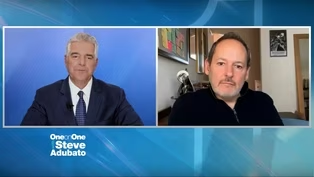
NewAuthor discusses the true story of targeting Fidel Castro
Video has Closed Captions
Clip: S2026 Ep2945 | 10m 24s | Author discusses the true story of targeting Fidel Castro (10m 24s)
 New
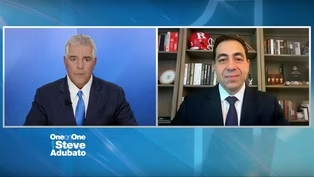
NewExpanding community health and combating food insecurity
Video has Closed Captions
Clip: S2026 Ep2945 | 9m 17s | Expanding community health and combating food insecurity (9m 17s)
 New
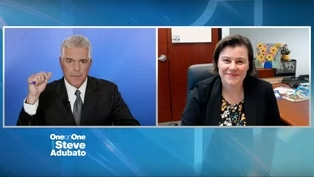
NewHow childcare is a key factor in self-sufficient families
Video has Closed Captions
Clip: S2026 Ep2945 | 7m 53s | How childcare is a key factor in self-sufficient families (7m 53s)
Providing Support for PBS.org
Learn Moreabout PBS online sponsorship New Episode
- News and Public Affairs

Top journalists deliver compelling original analysis of the hour's headlines.
 New Episode
- News and Public Affairs

Today's top journalists discuss Washington's current political events and public affairs.
 New Episode
 New Episode
 New Episode
 New Episode
 New Episode
 New Episode
 New Episode
 New Episode
Support for PBS provided by:
One-on-One is a local public television program presented by NJ PBS