
Giving Back Feels Good
Season 7 Episode 6 | 26m 45sVideo has Closed Captions
John Barber III, TD Charitable Foundation talks about the importance of giving back.
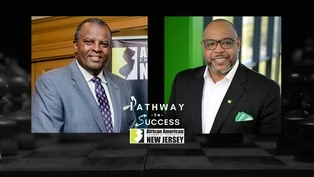
Host John E. Harmon, Sr. (Founder/CEO AACCNJ) sits with John Barber III, Senior Regional Giving Manager, TD Charitable Foundation. Mr. Barber highlights the profound influence that HBCU's have had on his career and his passion for giving back. Pathway to Success highlights the African American business community.
Problems playing video? | Closed Captioning Feedback
Problems playing video? | Closed Captioning Feedback
Pathway to Success is a local public television program presented by NJ PBS
Giving Back Feels Good
Season 7 Episode 6 | 26m 45sVideo has Closed Captions
Host John E. Harmon, Sr. (Founder/CEO AACCNJ) sits with John Barber III, Senior Regional Giving Manager, TD Charitable Foundation. Mr. Barber highlights the profound influence that HBCU's have had on his career and his passion for giving back. Pathway to Success highlights the African American business community.
Problems playing video? | Closed Captioning Feedback
Where to Watch Pathway to Success
Pathway to Success is available to stream on pbs.org and the PBS app.
Providing Support for PBS.org
Learn Moreabout PBS online sponsorship- Support for this program was provided by Horizon Blue Cross Blue Shield of New Jersey.
- Hello, this is John Harmon, founder, president, and CEO of the African American Chamber of Commerce of New Jersey.
Thank you for tuning into Pathway to Success.
I'm delighted to have on the show today.
John Barber ii.
He's senior regional Giving manager, TD Charitable Foundation.
Mr.
Barbara, welcome to Pathway to Success, - Dr.
Harmon.
It's a pleasure.
I'm honored to be here and I'm really excited about this interview and this opportunity.
- You know, I'm excited as well.
And we're gonna start off just a little bit of getting to know you, where you're from.
- Philadelphia, west Philadelphia.
Born and raised, not like Will Smith, but my brother.
My brother did go to high school with Will Smith, so I know, I knew Will growing up.
Small family, mom, dad, younger brothers, 16 months younger, but both fa, both sides of family have seven brothers and sisters.
So my background is really raising a big family.
Love.
Very fortunate to have still both my mother and father living and, and getting to spend some time with them as often as I can.
Uncles, aunts, all the major floaters in my life.
- You know, I tell you, just to have both parents still alive.
Unfortunately, both of my parents have since long been gone, but I think about them every day.
So let's talk a little bit about the importance of parents.
Now they're a little more seasoned and, and then growing up in Philadelphia, - Really, John that I, that hits home because I just spent time with my parents yesterday.
They're both at 80 years old.
Dad is a four time cancer survivor and had a heart attack during COVID.
He's also a Delaware State Hornet alumni and a Hall of Famer.
So he's been one of my major influences in life.
But to be able to pick up the phone and talk to him as also an executive and learning the ropes and understanding my life career path has been a blessing.
And my mom, the words of encouragement, even to this day, even looking at her yesterday and looking at her eyes and talking about this opportunity, and she was just so encouraging and saying, Hey, you got something to say and you're going to do great.
- You know, I tell you, I lost my mother.
I was 17 years old and I tell people today, particularly young people, because, you know, we're in a different environment today where parents are not respected or looked up as role models or people that they want to emulate down the road.
And so I say to folks, any opportunity to to just go up and hug, kiss your mother and tell her you love them.
It it, it goes a long way because you don't know what your parents are dealing with in life.
And just to have that connection, it means so much.
Would you reference your dad being a Hall of Famer?
- He's a Hall of Famer.
He went as an individual, hall of famer, played football.
Dad had a, a trajectory.
He actually had opportunities to play pro football.
Houston Oilers picked him up out of college.
He went to Philadelphia Eagles.
He played for what was then you could have considered like a farm team, the Phil Potstown Firebirds, the Wilmington Clippers.
And then he went back to the Eagles and decided that football was not what he was going to do.
And then went on and become an executive at Glaxo Smith Klein ended up being a VP before he retired and did some amazing things.
Was actually known as the man who led diversity and inclusion for Glaxo.
So when people hear my name in Philadelphia, they often get me confused with him.
But, and even to see him in Overbrook High School where he went, same school as Will Smith, Wil Chamberlain, Wally had Wal Hazard, all those greats.
My father is in there, very proud of him and my mother both attending Overbrook High School and the stories they tell about the school up on the hill.
- You went to A-H-B-C-U Talk about that.
- You know, John, it, it is really amazing how that happened because I, I attended Central High School in Philadelphia, which is a magnet school known for, you know, education and the academics.
And when I came outta Central, I was recruited.
- Wow.
There's - A lot of schools that started sending letters that I wasn't even aware about.
I only played football for two years.
I was really a basketball player and actually ran track was an Allstate track run all public basketball man.
But when the opportunity came, I did a visit at Cornell, came back.
Now imagine being flown out private plane.
Never a kid from Philly, never been on a plane before.
That was a overwhelming experience for me as a kid who had no desire to really play football.
My football coach in high school made me play, cut me from varsity basketball in order for me to play JV basketball for him and play varsity football.
So a lot of the, this is when we started talking about pivoting and pathways, it all started back then.
So leaving Cornell, after visiting there, I went to University of Delaware, was recruited by them, and my father says, Hey, my school was right down the road, why don't we go take a ride?
And I rode down, I remember seeing the football field.
I said, dad, I played on high school fields bigger than it.
I mean, I just left Cornell.
We talking big stadiums, man, I can't come down here.
And I, I met the head coach and his name was Bill Colick, I call him my second father.
Wow.
And he was a young black man just coming into the head coaching position.
The school was known for just having lost 105 to nothing to Portland State quarterback was Neil, Neil Lomax, who ended up playing for Cardinal.
So, excuse - Me.
- So - Delaware was playing football and the other team was playing basketball.
- That's what the sound like.
Exactly, exactly.
It was like no defense, 105 to nothing.
So when I, I met the coach and he starts talking about the culture, what he was trying to instill and what he needed.
And I'm looking at him like, I can't help you and I'm 105 to nothing.
What can I do?
I'm just one person, you know, and I'm a kid that's only two years playing this sport in my mind.
And he said, I need a leader.
I need someone who's gonna be able to stay in school four years and I need athletes.
And that coach said to me, I need you to be part of building this new culture and being a foundation.
It stuck with me, you know, that somebody would believe in me that much.
And, and he said, take your scholarship with you.
And I can remember looking across the table at my dad, and he looked at me and I signed it, signed my scholarship.
Wow.
And I can say proudly, I won four championships at Delaware State with that coach.
I was a captain.
And the guys all say that.
And you know, I was really blown away to hear them say that recently, how, you know, I would inspire them to believe that we were bigger than what other people.
That little black college became the university that was beating Division one A schools.
We were division one aa.
The more of that story to me was, you know, be prepared, take every opportunity, you know, and I'm gonna make it as a growing experience.
And I started learning that as my trajectory through life.
Working, like I said, athletics, arts and culture and music, you know, finance.
But especially being, coming from that little HBCU biggest proudest moment being them, those big schools.
And then, you know, growing from there and seeing the program where it is today.
- But you know, as I'm listening to you, your personality traits doesn't align so much with a, a, a, a a, a proficient athlete.
In other words, most of the, the, the, the top playing athletes have egos.
Right?
- Guy named Blair Thomas, one of the best running backs come outta Philly.
And one of my best friends said to me in the locker, and I said, to this day, I still stand by it.
A bunch of guys were bragging about all the accolades.
And they, he said, you know, John, when you're good, other people talk about you.
- That's it.
- And I looked at him and we had this conversation just last week and we were laughing about it and I said, man, I, it never left me.
It's like, humble, don't stumble.
- Yeah, I like that.
But speak to other things you did in college, student government leadership roles.
- Delaware State student government was my polishing of professionalism.
You had to be on point.
I was the treasurer for our student government, so it taught me finance.
That's where the finance part came in.
I was an accounting major, accounting and business.
So it started honing some of my tools.
It was a great feeling to be with some really smart individuals who were about empowerment, about education, about enjoying our culture, our ethnicity, and uplifting each other.
So when you mentioned being humble and humility, it's like Dell State has a sign used to have a sign up front us to go forth to serve.
And I can remember being on student government and we complained about this side.
You know, we were, you know, we serve, we're the leaders.
We're going out here and we're going to take the world by storm.
And then we really started thinking about what that meant and what the people that built who had gave us this opportunity to be at this school, what this really meant.
It was like, you have to learn and learn to serve in order to be the great leader.
- Absolutely.
- And, and to give back.
My parents had a painting, the painting is called, he's not heavy.
He's my brother.
Yeah.
And I have that in my home office.
And every time I think about what I'm about to do, I always look back at that painting and realize, you know, when I'm tired, I look back because I gotta do it so I can reach back and help the next man.
- So let's talk about your post-college career.
What things you did professionally and, and we in how those leadership attributes contributed to the, the, your professional career.
- Well, it started off kind of rocky, to be honest.
You know, I was still trying to play football.
I was going to try, I had an agent, I had a brain aneurysm.
But when I, I look back at going into the career, I, I can remember saying I never will work for bank.
I never wanted to go into banking.
And so I'm trying out for these teams.
I'm World Football League Arena, football League, I'm going everywhere.
I had a, a scout from the Kansas City Chiefs who really liked me.
And the Cincinnati Bengal said, when we found out about your head injury, you're like a cracked egg.
Nobody's gonna take an opportunity for a guy that can get hit and you can die on a field.
That was the first dose of reality when I realized how serious the injury was.
So then that was that pivot.
What do I do now?
So the first job I got was at a bank, you know, and I ended up at this job.
I, and went through my growing pains there, got outta that position, had opportunity at a, a financial institution, and worked there and started growing up everything.
I would work for three or four years shift to another job.
Three years exception of the job.
Ended up at GL Smith Cline where my father and my brother were actually well known in their positions, my younger brother.
And didn't stay as long as they did.
And then I got the opportunity to work at music.
And I, so I completely pulled out of accounting and some friends of mine had discovered an artist named Music Soulchild.
And it was during the neo soul explosion in Philadelphia.
So you had music soulchild, you had Jill Scott who, you know, who was a poet, actress activist, doing amazing things.
It's a group called Kindred Jaguar, Wright Bal.
It was all these artists coming out and a group of friends and myself, we formed our own company called Come Clean Productions.
And this was my entrepreneurial stage when I said, I'm gonna be an entrepreneur and start my own business.
And so I started asking the club owners there, what does it take?
And I always give credit to Mark Barnes in DC for sitting down and telling the young guy he did know, Hey man, you know, this is the formula and this is how you do it and this is what you and what you don't invest in.
And I took that to heart.
It became successful.
The events started growing in a show called Blue Funk.
And all these artists were a part, it was music, poetry, jazz comedy and food vendors space.
And we started out in a small room, blue Moon Jazz Club, went to the Philadelphia Cleft Club, pay label Bell, had a space called Shayla Bells, went there for a while next.
And now I was in the museums and then the, the Kimmel Center Performing Arts, which is the large venue in Philly.
And that's when I stopped doing the show.
But we're actually celebrating 30 years in entertainment there.
So that was a passion that I continued doing.
And then I shifted into what else am I passionate about, which was education, working in the school district of Philadelphia, working for a program called the Gear Up Program.
Then going into grants compliance, learning more about monitoring and managing those grants dollars.
And after that, I found an opportunity to go to the Urban League of Philadelphia.
- John, let's, let's talk about what motivated you really to, to, to wanna make a difference.
- Poverty.
Poverty and comes from p what, what stems or kicks off poverty.
What's the spark?
Housing, job opportunities, career pathways, financial education.
These were things I was seeing that in in our high schools.
Our kids weren't learning how to, to sign a checkbook, didn't understand about, you know, debit or a credit or a savings account.
They're still going to the cash checking place with the adults.
I started looking at them not having job skills or any kind of certified trades and, and an ability to keep a job.
You know, different neighborhoods you will walk around and, and I looked at my city of Philadelphia, especially dilapidated homes, lack of housing, lack of proper housing.
Not the affordability.
You know, it was, it was so many things that was hitting me as a young man that I was seeing as a young adult.
And I said, okay, it's time for you to become a part of the solution and not just talking about it.
So when I was given the opportunity to be part of the Urban League of Philadelphia and really witness things they were doing, it really kind of generated where I'm going and where I am today.
- So this is, this is a good place to, to kind of take a break.
This is a fascinating story.
You, you, you cover a lot of areas, sports, entertainment, life, health and self-determination and leadership underscored with excellence.
So we're gonna take a break here on Pathway to Success.
We'll be back in a moment.
- For more information, please visit our website.
- Welcome back to Pathway to Success.
And we're just having a great conversation with John Barber ii, senior Regional Giving Manager, TD Charitable Foundation.
And so how were you recruited for TD Bank?
- It was word of mouth.
I had some friends who actually had worked for TD Bank and worked for a couple other banks also.
And when I was looking to make a transition into the giving side, they told me about an opportunity I was available.
So I applied, I went through a headhunter, applied, and my first interview, I'll say the second interview after the headhunter was with a lady, Paige Carlson Heim, who is my boss right now under corporate citizenship and Social Impact.
And we just had a really strong conversation about the needs of the community, being able to listen, being able to decide what's the effective and efficient way of, of meeting those needs.
And I was inspired by her, you know, so it inspires me to continue giving my all and listening to all these different forms of nonprofits and small businesses and entrepreneurs and trying to set them up to have the opportunities that TD had, the, all these resources from TD back.
- So talk about personality traits of someone doing the work that you do.
- The, the biggest challenge with doing this work is that you had to know where to separate your personal emotions, your beliefs stay true to the, the commitment that TD is making to the community, being able to effectively listen to the needs, but also be able to bring that back to your leadership.
And then also look at when looking at applications and having those discussions, how many people are gonna be impacted?
How, what's the most impactful program?
How sustainable it is?
Is it serving the low to moderate income community that you really know is the need?
And making sure that TD can serve and has opportunities of engagement.
You know, because you don't wanna just write a check.
I think that's one of the things that really stood out.
It wasn't just write a check and go off and do your thing, run to the site.
It was write a check and say, Hey, how else can we support you?
What else can we do?
Is it volunteerism?
Is it just, is it coming and doing a class on financial education and financial literacy?
What are, how other ways can we show up for you?
Sponsorship for an event?
Those all things that line up under t TD umbrella.
- How does your success or the efforts of TD Bank encourage other organizations to do the same?
Can you speak to maybe some collaborations or, or others that have saw the great impactful work of TD Bank?
They try to replicate that or they are replicating it to the benefit of the community from that impact perspective?
- I serve on the board for the Phil Philanthropy Network as a co vice chair.
So it's a number of organizations are all doing the philanthropic giving and trying to meet various needs.
I think that's what a collaborative effort comes in.
When you start looking at, Hey, I don't give to this, but this organization does that.
That has been really empowering and that has been an exciting arena to work in.
Where I, I don't have to say, I just don't, I don't just say no to organization.
I can say we don't give, but let me go ahead and let me give you a referral to another organization that can meet that need.
And I think that the city really, I'm saying the cities, because my whole metro, everyone I've met politically is starting to understand that you can't just go to one organization and ask for one big check all the time.
There's so many needs.
We gotta slice this pie as much as we can.
We're stretching budgets, we are looking, but at the same time, we want the money to make a difference.
The dollars have to make sense.
And I mean, not since C-E-N-T-S, that's since S-E-N-S-E.
So that's why I'm trying to tell people that.
I always tell people lead it off.
Like, listen, don't take it personal.
If you don't get the dollars the first go round, it's hard, bro.
It's hard.
I I tell 'em, listen, you, you need, let's engage, let's date.
It's, it's dating.
You know, when you, you didn't get married as soon as you met the person, - Right?
- You gotta date and let's date a little bit, get to know you a little bit and then we'll find out ways we might serve on your board.
We, it is other ways.
We'll, we will help you and, and find ways to help - Build.
Let's talk about you, your organization, response to the needs of the community - On the philanthropic side when it comes to giving, you know, we give to programs that deal with, I'll say green, green initiatives, we'll say low carbon economy jobs and low carbon economy, financial stability.
We look at career pathways, career development, helping entrepreneurs, certifications people to find sustainable jobs.
Affordable housing is always gonna be something that's big because we know it's needed across the country.
Better health, that's access to care.
And that's, and I always say when I say access to care for the little amount of income I'm talking about, and we think from screenings to personal treatments and that, you know, that's really important right now.
Especially we look at what's happening nationally here in the United States.
We need to find ways to make sure people are healthy because health is wealth, but if you don't have a sustainable home and, and a job to stay in it, the problems in our communities.
- So talk about the role of arts and culture.
How does that play in this whole community development?
- People don't have access to it.
I mean, there's a lot of things I'm talking about from ballet to the opera, ensemble Arts in Philadelphia, njpac, njpac, and in, in New Jersey.
There's so many different programs that are giving exposure to people who take, I'm talking about the kids, our seniors having an opportunity to go out and, and see some the performers that, you know, they see on TV or see the up and coming or learn the business behind the arts.
And artists are entrepreneurs and I always say that they need those same resources like a small business.
And this is one of the things that TD lists us to.
How can we help them on their career pathways?
And that's what makes me excited to see that the culture within the organizations where they encourage us to be more human.
And when I say more human, we are not just giving philanthropically only to our funding drivers.
They're encouraging us as individuals to find ways to pull some dollars out and give to the organization that we're passionate about.
So when we start thinking about be setting an example, we set the example not only as td, the corporation we're sitting as TDS individuals and other small businesses, nonprofits understand they can benefit from us and, and follow that as an example.
Giving feels good, it really does, but is you're giving gonna be impactful?
Sometimes people don't understand that 500 to a thousand dollars donation does mean a lot.
So we encourage people to give no matter what kind of organization you have, give back.
- You know, it's been my pleasure to have this conversation with you, John, and thank you for appearing on today's segment of Pathway to Success.
- Dr.
Harmon, I want thank you and Pathway to success for having me and allowing me to share my story.
- Well until the next time on your Pathway to success.
This is John Harmon, founder, president, and CEO of the African-American Chamber of Commerce in New Jersey.
Thank you for tuning in today's message.
Keep Hope alive.
Another transformational leader is gone.
The late Reverend Jesse Jackson, who I consider as a friend, a mentor.
I had the, the privilege of spending some time with him.
Very strategic, very soft-spoken.
Sometimes you have to lean in, but he was, his mind was always running and he will be missed.
But I could say that he contributed to some of my success, always optimistic, notwithstanding the tomo and the challenges and the opposition that he faced.
Keep hope alive, finding common ground.
And so I apply that to our, our new leadership here in the state of New Jersey.
I'm encouraged, I'm inspired by the possibility of a woman that's leading the state from the Democratic Party.
There are a number of women that she has designated to be a part of her cabinet, part of the leadership.
But we're all about the bottom line.
The disparities in the state of New Jersey exist.
They're real and we need someone to acknowledge them, to apply some intentionality around how we going to make things more equitable, more transparent, more inclusive, more fair black people on the bottom.
Black people contributed to the success of the current administration and we are definitely looking for certain reciprocity.
We want to keep hope alive, but the realities exist and we want them to be addressed.
You know, often used his quote, keep Hope alive because being a a chamber executive for, for a black business organization, you have to be optimistic.
You have members that have risk capital on the line members who are facing all types of uncertainty and opposition.
My job is to keep a spirit of optimism so they too can achieve their success.
So Jackson, thank you.
Keep hope alive.
- Support for this program was provided by Horizon Blue Cross Blue Shield of New Jersey.
Video has Closed Captions
Preview: S7 Ep6 | 29s | John Barber III, TD Charitable Foundation talks about the importance of giving back. (29s)
Providing Support for PBS.org
Learn Moreabout PBS online sponsorship New Episode
- News and Public Affairs

Top journalists deliver compelling original analysis of the hour's headlines.
 New Episode
- News and Public Affairs

Today's top journalists discuss Washington's current political events and public affairs.

 New Episode
 New Episode
 New Episode
 New Episode


 New Episode
 New Episode

Support for PBS provided by:
Pathway to Success is a local public television program presented by NJ PBS