
Governors’ Perspectives Through the Years
6/23/2026 | 26m 46sVideo has Closed Captions
A retrospective of the last 14 years discussing important issues that affect New Jersey.
This time on Governors’ Perspectives with Kent Manahan, a retrospective of the last 14 years discussing important issues that affect our State, through the lens of New Jersey’s former Governors.
Problems playing video? | Closed Captioning Feedback
Problems playing video? | Closed Captioning Feedback
Governors' Perspectives with Kent Manahan is a local public television program presented by NJ PBS
Governors’ Perspectives Through the Years
6/23/2026 | 26m 46sVideo has Closed Captions
This time on Governors’ Perspectives with Kent Manahan, a retrospective of the last 14 years discussing important issues that affect our State, through the lens of New Jersey’s former Governors.
Problems playing video? | Closed Captioning Feedback
Where to Watch Governors' Perspectives with Kent Manahan
Governors' Perspectives with Kent Manahan is available to stream on pbs.org and the PBS app.
Providing Support for PBS.org
Learn Moreabout PBS online sponsorship- [Announcer] Funding for "Governors' Perspectives with Kent Manahan" is made possible by the Robert Wood Johnson Foundation, committed to helping Americans lead healthier lives and get the care they need.
Additional funding provided by Seton Hall University, Seton Hall School of Law, and by Connell Foley LLP.
(upbeat music) (upbeat music continues) (upbeat music continues) - New Jersey is officially known as the Garden State, dating back to 1876 when Camden's Abraham Browning described New Jersey as "a garden located between two states, New York and Pennsylvania."
New Jersey is home to nine and a half million people living in 21 counties with nearly 9,000 square miles of farmland, pinelands, highlands, parklands, Atlantic coast, Appalachian Mountains, cities, suburbs, national historical parks, and cultural centers.
New Jersey was one of the 13 original colonies and is referred to as the Crossroads of the Revolution.
Both Princeton and Trenton briefly served as a nation's capital in the late 1700s.
The New Jersey plan of 1787 was an important proposal at the Constitutional Convention adopted to ensure all legislatures in each state will have equal state representation.
It was a commitment designed to protect small states from being dominated by larger ones.
New Jersey led the United States to the Industrial Revolution.
And the state's ports and military bases have and still play an important role in the economy and defense of the nation.
People around the world followed the news of the 1932 kidnapping of Aviator Charles Lindbergh's young son from the family's Hopewell home, and for the 1937 Hindenburg Airship disaster involving dozens of fatalities in Lakehurst.
Orson Welles's "The War of the Worlds" fictional radio broadcast in 1938 caused widespread panic among some 6 million listeners who thought a real Martian invasion was actually occurring in Grovers Mill, New Jersey.
Many fled their homes in panic.
Thomas Edison established the world's first industrial research laboratory in Menlo Park.
And Albert Einstein, the founder of modern physics, who knew and respected Edison, lived and worked in Princeton.
Renowned American poet, Walt Whitman, lived in Camden till his death in 1892.
The world of course knows Bruce Springsteen, one of the bestselling musical artists of all time.
He grew up and still lives here on his horse farm in Colts Neck.
Jackie Kennedy had a country home in Somerset County.
Actress Meryl Streep grew up here, as well as Frank Sinatra, Whitney Houston, Jack Nicholson, and Queen Latifah, Martha Stewart, Danny DeVito, Charlie Puth, Halsey, and Dionne Warwick, to name only a few.
Travelers from across the globe come to visit famous landmarks here, including Ellis Island and the Statue of Liberty.
The Atlantic City Boardwalk, Paterson Great Falls, MetLife Stadium, home to the Giants and Jets and upcoming World Cup matches.
And of course, the New Jersey shore, as well as the Delaware Water Gap, the Sandy Hook Lighthouse, the Battleship New Jersey, and the Pine Barrens.
Yes, New Jersey has had quite a history and remains one of the most important states in the country due to a skilled, highly educated workforce and a prime location between New York and Philadelphia, drawing international business investment, including pharmaceuticals, banking, wealth management, energy and technology giants, as well as advanced manufacturing.
New Jersey is a democratic leaning state with a full-time legislature, a highly regarded supreme court, and the most powerful governorship in the country.
All of this, New Jersey's rich history, the power given the governor under the state constitution, the issues, the laws, the politics, the diverse population, all deserve analysis and perspective.
That concept is why "Governors' Perspectives" went on the air more than a decade ago to help us, New Jerseyans, better understand how government operates from those we've elected to the Office of Governor from both sides of the aisle.
Here's a look back at some of those "Governors' Perspectives" discussions that we hope have helped our viewers over the years to know more about how government works for us.
Governor, you signed the Casino Control Act back in 1977, and on that day you used a famous phrase.
- I think the phrase I used was, I told the mob to stay out of Atlantic City.
- How did that come to be?
What were you thinking when you delivered that line?
What was the warning?
- Because that was the, that was the whole incident.
The whole opposition to legalized gambling was that you couldn't patrol it.
And I had made the promise that I would keep gambling clean, and I did.
- Well, certainly you are known for your one-liners, Governor.
I've been in the room a number of times when you've brought the house down with your one-liners and your sense of timing.
And that comes through in this book, even on the last page of the final chapter in the last lines.
- Oh, the "I must be buried in Jersey City so I can remain active in politics."
(Kent laughing) That is quoted off it.
- What are you most proud of, do you think?
- Just that my record is in that book.
- And what do you want New Jersey to remember about Brendan Byrne?
- That he was the man who couldn't be bought.
- Would you share with us, Governors, one of your favorite places in New Jersey?
Maybe a place to relax or take your family, or just spend a few days away from home?
Governor Kean?
- So many of them.
There's a wonderful place called Sunfish Pond, which is one of the few lasts glacial lakes up in the Kittatinny Ridge, right over the Delaware River.
Beautiful place.
Sometimes you see Eagles swoop up over the Delaware.
You wouldn't even know you were in New Jersey.
It's a wonderful, wonderful place.
Short hike, wonderful place to enjoy.
Wonderful place to take the whole family.
- Can I ask you the same question, Governor Florio?
- I'd say the Batsto River in the Pinelands.
In that whole area, you just feel like you're transformed into a whole nother universe.
The Pinelands itself is something that's really, that's about 20% of New Jersey.
Most people don't even know that.
But it's something that's very, very special.
- Well, as you like to say in your day, Governor Kean, "New Jersey and you, perfect together."
- Perfect together.
(all laughing) - Thank you, Governors, very much.
The Christie administration's argument though is New Jersey has been slow to recover from the recession in the last few years, and now it's increasingly doing better.
And this could set it back.
- Well, there's a whole bunch of reasons as to why the economy's been slow.
The minimum wage increase is not really legitimately pointed out to be one of the reasons for the slowing economy.
Actually, you one can make the argument, and I would make the argument that we can increase the economic growth by providing people with more purchasing power, particularly those who are gonna expend the money as rapidly as possible.
- Now, California and New York have raised the minimum wage.
- That's true.
- Over a period of time, it will come to $15 an hour.
Is there anything we can learn from those experiences and what could be the result here in New Jersey?
- Yes, I mean, the thing we can learn is that they don't have an adverse impact upon people and enhances purchasing power and contributes to economic growth.
So the situation in New Jersey, situation in New York has been relatively similar over the years.
Unfortunately, growth in New Jersey over the last number of years has not kept up with New York.
So ironically enough, New York's growth has been better than New Jersey's, notwithstanding the increase in minimum wage.
- What it means for the state is you can see when you look out there at the hay fields the hays in now, farmland tends to be better drained and pretty flat, which makes it easy to develop.
So there's a lot of pressure on farmland to be developed because of what it means.
It cut costs for the developer.
So with the Farmland Preservation Program, we've been able to make it economically viable for farmers to keep the land, because so many want to, they'd like to pass it down.
They'd like to be able to afford to do that.
This way, they sell the difference between the assessed value as farmland and the assessed value where it developed.
They can keep that money, they can sell the place and keep the money that they get from the sale, but it can never be developed.
- New Jerseyan certainly understand the need for preservation in our state.
Certainly when we go to vote and there's a bond issue on the ballot, overwhelmingly, residents vote in favor of preserving our land.
- Yes, we really have figured it out as the most densely populated state in the nation.
People appreciate what it means.
And even when we had the million dollar, the billion dollar bond issue on the ballot in 1997, people still voted both for that and for their local bond issues.
They will vote to tax themselves more in order to preserve the open space because they understand what it means for the economy, what it means for their way of life, and the ambiance it provides.
- So we certainly want to keep the garden in the Garden State.
- Without question.
- Governor Kean, you spent a good part of your career in education.
As a professor, you taught history, President of Drew University.
Help us to understand the need and the value of early childhood education.
- Of all the proposals that are made to improve education, there are about 50 of 'em, everybody, from choice to, you know, all this stuff, improving teaching, nothing is more important and nothing has been tested more.
We know it works.
The areas in New Jersey that have gotten early childhood education are doing better than those schools that haven't.
That's true nationwide.
There's a lot of proposals, how to improve education, how to reform education, how to do better in urban schools, probably 50 of 'em.
And people are for choice of a this or that.
And all of those things may be okay.
There's only one that everybody agrees on.
Early childhood education.
All the education research has sewn now for the last 20 years, that can improve the outcome.
And nobody disagrees.
So shame on us for not doing it.
- So what does it take funding, a priority in the budget?
- Yeah, it takes a commitment.
And this governor wants to do it.
It's not quite as high on his priority scale as I'd like it to be, but he wants to do it, and I hope he will, because there's nothing else he could do for education more important, absolutely nothing.
And there's nobody who disagrees.
That's a silly thing.
Some of these programs, you know, I'm for it or against it.
Nobody disagrees.
Everybody's for early childhood education.
Every researcher has said it works.
And, you know, that's the future.
It used to be when I was younger, it was, you had to try and finish high school.
If you finished high school, there was a good job awaiting you somewhere.
Now it's not high school anymore, it's college, or it's least some form of higher education.
It's at least community college.
If you don't have that, every study shows your income is lower than your neighbors and you cannot really escape lower middle class or even less without having that education.
We know that.
- Only a handful of states have moved to legalize recreational marijuana.
Will New Jersey take that step, Governor, Codey?
What's the status at this point?
- Well, it's up in the air right now.
I think in the next four to six months, you'll probably see a vote as long as they have the votes.
We're not sure about that.
And, you know, there's some people like myself, I don't like the recreational.
The medical marijuana's fine with me.
If you wanna decriminalize it, fine with me.
So it's gonna be interesting because it's been talked about for a good two or three years now, and never put it up for a vote because the votes necessarily weren't there, but now we have a governor who clearly is in favor it.
- So obviously there are still issues to be resolved.
As you indicated, Governor Murphy campaigned on this issue of legalizing recreational marijuana.
So the process, Governor DiFrancesco, appears to be more complicated than originally thought.
- It very complicated.
- So what are the challenges that you see?
- Well, on the one hand, you know, you can do a poll and most people, I guess the majority of people say it's okay, right?
But then that same majority of people, if you started asking 'em questions, they would probably disagree on a lot of the issues.
For example, are you gonna let municipalities opt out of this issue?
Or, you know, are you gonna preempt them?
Are you gonna have prosecutors and police chiefs calling their legislators saying, don't vote for this, we don't think there's a good idea?
- That's already happened.
- As they said that there's a lot of, Governor Codey said, there's a lot of, we already have these issues with alcohol.
We're gonna have the same issues with marijuana in many cases.
You know, how do you redefine, statutorily, driving on the influence of marijuana or other drugs?
So it's very complicated.
And what about the tax?
Do they agree even on the tax?
Well, I don't even think they agree on that.
- How do you assess the state of gambling in Atlantic City today, Governor Kean?
In your analysis, what's happened over the years?
- Well, it's in a sad state.
I mean, it's never fulfilled its promise to the city, particularly for African Americans to live in that city.
And their lives hadn't really been improved at all, unfortunately.
And the was that it would.
Gambling itself because in the early years when they making such money hand over fist, they all took it with 'em instead of using it to redevelop the city in a way that would help preserve the industry when other people got gambling.
So they never took it to make it into a family resort.
They never did it to expand certain facilities.
They never used the money that they made for those purposes.
And so it was short-term gain over long-term hope.
And the result is we're having problems in Atlantic City today, competing with a lot of other venues now.
And Atlantic City's not doing that well.
- Have you heard from Republican Party leaders, from colleagues, from other GOP people around the country giving you an attaboy, you did the right thing, good for you, you're taking on the conspiracy theorists and talking about truth?
Have you heard from those people, that you've done the right thing?
- I have from a number of them.
And then there's been some who've whispered it 'cause they didn't want to be heard publicly.
- More whispers than not?
- More whispers than not, sure, still at this point.
But what I was doing in writing the book, Kent, was to give everybody else cover.
No one could call me a Never-Trumper.
When I dropped outta the race in 2016, I was the first- - You supported him.
- Yep, I was the first major elected official in the country to support Donald Trump.
I chaired his transition.
I, you know, chaired his Opioid Commission.
I prepared him for the debates in '16 and in '20.
But he crossed the line on election night of 2020 when he stood in the White House and said that the election had been stolen when he had no evidence that it was.
And that context has continued now for the better part of the next 15 months.
And I'm sorry, I can't support that.
I can't support leading the American people to believe that somehow the election was stolen when all the evidences I laid out in my book is quite to the contrary.
- Wouldn't this be a root, this effort going on now to bring about change?
- Kent, I tried so many times to change the Republican Party from within it.
I mean, I have started groups that have worked on that.
And that's what happened to Andrew too.
And we were just part, the last- - Andrew Yang, your co-founder.
- Andrew Yang.
Yes, the co-founder.
We both tried to work to get our parties back to the center from within this existing system.
There's no way to do that because the two major parties have such a strong hold on everything that they don't want of that challenge.
And they put all kinds of hurdles in front.
I mean, it's almost impossible to become a third party here in New Jersey.
They make it very, very difficult.
Some states, they change the rules as soon as you start to, they see a third party starting to take off, they change the rules and make it even more difficult to become a recognized party.
- Do you see the fact that JD Vance is the vice presidential candidate on the Trump ticket as an indication that MAGA just has the future of this Republican Party in its hands?
Tell me about that.
- I do.
I unfortunately do.
I mean, I grew up on the Republican Party.
My parents were part of it, my grandparents.
You know, I hate to say it, but yes, there isn't a Republican Party today.
There is a, it's all about Trump.
It's a cult.
- No more core principles of the party- - They don't seem to have any.
They're all, whatever Donald Trump tells him to do.
- Democracy is at its stake every time an election is up.
I think in the era that we live in, because of how the courts have drifted and have decided to side with those who want to narrow the electorate, I think it's very, very important that people vote recognizing, particularly in Senate races, that they're making a statement about what they want to happen.
- [Kent] The leaked Supreme Court draft opinion on Roe versus Wade has thrust abortion front and center into the midterms.
Polls show a majority of Americans think abortion should be legal.
And Governor Corzine believes the issue and the high court's decision will be a priority for voters in November.
- I think the issue of Roe v Wade is at stake in this election, very clearly, because if the ruling comes down that Roe v Wade is no longer actable or narrow to a very significant degree, then I think it's gonna be up to the Congress to really begin that argument of challenging that by writing new laws.
- Governor, you are aware, I'm sure, of the concerns that have been raised by some school district personnel, by medical professionals, and by some democratic members of the legislature.
They're concerned that those existing programs, which you mentioned might have to go away because funding won't be available.
And they also would like to be more included in the process, which you're describing for the new initiative.
Can you reassure them?
- You bet.
On the latter, the so-called stakeholder engagement process, our folks are really, the professionals who work with me on this front are really good at that.
So I'm highly confident that that's not just going to happen, but it is happening.
And as I said, it's not a foregone conclusion that we can't have, and both the current approach at least in some form or fashion, as well as embedding this more broadly, as I mentioned, as a blanket over the entire system.
Now, what we're trying to do, and we should talk about the National Governor's Association piece of this.
We're trying to look at this sort of in a series of pillars.
And so- - Explain that to us.
- Yeah, so, let me go to the end of the story.
When I finish being the chairman next July in Atlantic City, I might add, our hope is to have a playbook for all American governors to be taken off the shelf and say, these are the variety of ways that we can tackle strengthening mental health among our youth.
And we sort of break this down into pillars.
We travel around the country to make sure we get a good regional approach.
We started in Salt Lake City in the mountain west, and then we'll be moving probably out west, upper midwest, south, ending up in Jersey.
- Do governors tend to look to Washington to run for president?
Is it kind of a natural next step?
- Some of 'em do and doesn't help the governorships.
- [Kent] In what way?
It's distraction?
- It's a very tough job being governor of New Jersey, and you've gotta concentrate on the people of New Jersey and what you can do for 'em.
You start thinking what you're gonna do down the road in Washington, then you start worrying about fundraising nationally, then you start worrying about what you do in the governorship, how's it gonna affect the national campaign?
And they're not good governors when that happens.
- New Jerseyans don't like people taking their eye off the ball.
We don't have a huge amount of press coverage in the state.
We don't have a lot of television.
I don't have to tell you this.
And you need to have the bully pulpit of the governor working on New Jersey issues.
- So did you think about at any point running for governor?
- Of course.
Did people ask me about it?
But I never got like, oh, I gotta run for governor.
No, not at all.
I was happy being the President of the Senate.
And then one day during the summer of whatever that year was- - The phone rings and news.
How did that happen?
How did that happened?
- Here's how it happened.
So I was at the racetrack.
I came home and it's late, and my wife says, "Hey, Brian Thompson from NBC called, said, you gotta call him right away."
I said, "Nah, I'll call him later."
And my wife was having minor surgery the next morning.
I said like, "We'll meet after, you know, we go into surgery."
So she goes into surgery and I said, "Eh, I'm just running down to my office."
I walk into the office, and they said, "Oh, good morning, Governor."
"What you talking about?"
"You don't know?"
"Know what?"
"Well, he's gonna resigned this afternoon and you're gonna become the Governor."
- So it was that quick, just a morning into an afternoon announcement.
- You can you imagine when she came out of the anesthesia, when I told her she's the first lady.
(laughs) - Your wife?
- They put me back under.
(both laughing) That's a true story.
The interesting question I got at the news conference was, "Governor, under the law, you can take the salary of the President of the Senate or the Governor, which one are you gonna take?"
I said, "I don't know where you came from, but when I'm taking the highest."
(laughs) - I have a family, a young family to support.
- I think the precious nature of our democracy is appreciated when we have times like the last five or six years where there's been a lot of tumult and anger in the country, a lot of division, and we worry about what the impact on our democracy will be.
I'm less worried about that because I think our founders set this up to be an argument.
Everything in the constitution is set up to be contrary to each other, to cause friction and to give balance and have no one get too much power.
And so I think that the founders devised it this way.
There are times when we operate it really well.
And there are times right now where we don't operate it nearly as well as we should.
But I don't think the American people are ready to walk away from the underlying tenets that we have in our democracy.
- Well, you speak of the founding fathers, and I picture them as you're talking in Philadelphia, coming together to talk about the formation of a new government and how it would function.
They were educated men: Jefferson, Washington, John Adams and so forth.
And they went back to the Greeks and the Romans.
And really for almost 2000 years there, there hadn't been a democracy.
But they were so committed to government of the people, by the people, for the people.
It's amazing.
- No, it truly is.
When you think back to what they were doing, really writing on a blank slate, and coming up with something that the rest of the world thought was completely impossible.
And quite frankly, a lot of the world still thinks is impossible.
If you go to places like Russia or China, North Korea, Iran, they've come to the conclusion, the ruling classes in those countries, have come to the conclusion that the people don't have the right to govern themselves, don't have the ability to govern themselves.
And America stands in stark contrast to that really wrong thesis every day.
- [Announcer] Funding for "Governors' Perspectives with Kent Manahan" has been made possible by the Robert Wood Johnson Foundation, committed to helping Americans lead healthier lives and get the care they need.
Seton Hall University, Seton Hall School of Law, and by Connell Foley LLP.
(bright music) (bright music continues)
 New Episode
- News and Public Affairs

Top journalists deliver compelling original analysis of the hour's headlines.
 New Episode
- News and Public Affairs

Today's top journalists discuss Washington's current political events and public affairs.
 New Episode
 New Episode
 New Episode
 New Episode
 New Episode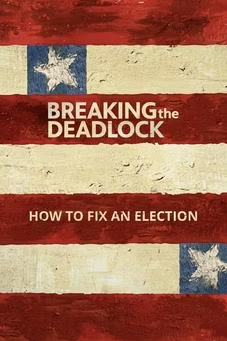
 New Episode
 New Episode

 New Episode
Support for PBS provided by:
Governors' Perspectives with Kent Manahan is a local public television program presented by NJ PBS