
Health is Wealth
Season 7 Episode 1 | 26m 46sVideo has Closed Captions
Dr. Lois Greene, University Hospital in Newark, talks about her career in health care.
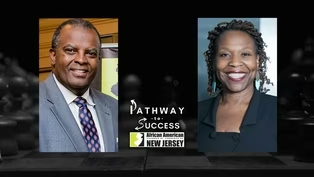
Host John E. Harmon, Sr., Founder & CEO of the AACCNJ, talks with Dr. Lois Greene, Senior VP Wellness/DEI at University Hospital in Newark, talks about her long career in health care and her dedication and passion to help people. Pathway to Success highlights the African American business community.
Problems playing video? | Closed Captioning Feedback
Problems playing video? | Closed Captioning Feedback
Pathway to Success is a local public television program presented by NJ PBS
Health is Wealth
Season 7 Episode 1 | 26m 46sVideo has Closed Captions
Host John E. Harmon, Sr., Founder & CEO of the AACCNJ, talks with Dr. Lois Greene, Senior VP Wellness/DEI at University Hospital in Newark, talks about her long career in health care and her dedication and passion to help people. Pathway to Success highlights the African American business community.
Problems playing video? | Closed Captioning Feedback
How to Watch Pathway to Success
Pathway to Success is available to stream on pbs.org and the free PBS App, available on iPhone, Apple TV, Android TV, Android smartphones, Amazon Fire TV, Amazon Fire Tablet, Roku, Samsung Smart TV, and Vizio.
Providing Support for PBS.org
Learn Moreabout PBS online sponsorship- Support for this program was provided by Horizon Blue Cross Blue Shield of New Jersey.
- Welcome to Pathway to Success.
I'm your host, John Harmon, founder President, CEO of the African American Chamber of Commerce in New Jersey.
Today's special guest is Dr.
Lois Green.
Dr.
Green, welcome to Pathway to Success.
- Thank you.
Thank you so much for having me.
- We are extremely delighted to have you today.
And wanna just kick it off, just get to know you a little bit where you're from.
Big family, small family.
- So I was born in London, England.
I am one of two.
My mom, I grew up in England, came to America when I was six years old, came to Mountclair, New Jersey.
So we, it was me, my mom, my grandma, and my brother for a few years.
And then my mom's husband came.
So I guess my time in Montclair was where I really learned about America.
Yeah, A lot of my formative years were really close family.
My grandmother was one that you would never leave my house and not eat something, right.
She would feed people she knew, people she didn't know.
It was a, a form of love.
So I feel like I grew up in a really well nurtured family and really understood how important community is.
- Any person that influenced your life in a big way that you can speak to.
- I think there were people, older people that I met and they would kind of pour into me or encourage me and I'll just never, never forget there was a man's name, Mr.
Pennick.
And he was like, you're special.
You're gonna be something.
And just the way that he poured into me, that's really important to, to touch people's lives when you see something in them.
- I think that's fantastic.
You know, where did you decide to go to be educated?
- Sure.
So when I, I went to Montclair High School, go Mounties.
And after I left Montclair, I was sort of searching.
I didn't know exactly what I wanted to do in school.
So I actually went to a Bible school.
I went to where Life Bible School for one year after I left high school.
And then I realized that, you know what?
I wanna do something in health.
I enjoyed, I was in all kinds of clubs when I was in school, German club, french club, field hockey, basketball.
So I did a lot of things.
- So you were athletic as well?
- Yeah, absolutely.
I enjoyed, I enjoyed the activity.
So when I decided to go to school, I first started out knowing that I liked medicine, I liked the science of it.
I started out at Seton Hall as a medical technology student.
And I, you know, when I went to my first intro to med tech class and realized that I would spend most of my life look in, looking into like machines, counting cells, I, I thought I will have to change my major or I will be on some anti-psychotic medication for most of my life.
So I met a person, my mom was a nurse, I'm gonna tell you, I didn't wanna do nursing because I said I don't want to do this shift work with the three to 11, always being away from your family on weekends.
So I said I didn't want that, but I met a person, her name was Bernadine Manners, and she told me about nursing and told me about all the different, you know, things we do and things that, you know, ways to care for people.
And I said, you know what, I'm gonna try it.
I took my first nursing class and it was like, I went through with ease.
I just got it.
The science of it I understood.
And the caring for people was really something that just resonated with me.
So I went to Rutgers Nursing school, it was amazing.
Just an amazing education.
I remember standing in line because I want, there was a critical care class that was being offered in nursing students at that time.
Really didn't get to go into critical care.
So five o'clock in the morning I'm in line to get into Dr.
Norman's critical care class.
I got in and I loved it.
I thought being able to manage people's health so systematically, you know, looking at systems and helping them get from one point to another, it just, it resonated with me.
It filled me up to be able to care for people.
So nursing was my, my venture.
So I did ER nursing first.
I actually started at St.
Mary's, St.
Mary's Hospital in Orange when I passed my board.
So I went from being a CNA to A CNO in my nursing career.
It was amazing.
So I tell people, listen, you just have to envision what you see.
Don't depend on other people to define you, but to realize that your desires are divine.
The things that you wanna do are divine.
So go after them.
You know.
So that was Rutgers.
Then I went to, then I decided, I did nursing for a lot of years.
Started in the ed, which was, you know, amazing.
Went to leadership.
I was directing a home care center.
We did contracting in for the military.
So I actually did some home care and some acute care staffing.
And then I went into education.
Education was another passion I discovered.
I really love having people get it.
So nursing education was, I went into oncology education, med surg ER education and did that while I was, while I got married to a wonderful man.
And got to do sort of a, a controlled lifestyle for a while.
You know, - Lifestyle, - Meaning that, you know, it's, - Is there such a thing?
- Well, in nursing it can get crazy, right?
Yes.
Because you're doing shift work, 7:00 AM to 7:00 PM you're doing nights and weekends when you're in, you can do like a little bit more Monday through Friday, you can schedule your, you know, so I can make, I can make the games, I can go to dance rehearsal with my kids.
I had a little more of a controlled life, but I also just enjoyed teaching.
Loved that.
- Give us just a, a glimpse of what it's like to be in the emergency room.
- I started my nurse, my er, nursing career at University Hospital.
Oh wow.
Yeah.
So it was trauma, it was peds ob, every single aspect.
I say I took care of people from before birth to beyond the grave, right?
Organ transplants happen at University Hospital.
So the ER was just a really interesting place, I'm gonna say to be, so, you know, we're a trauma center.
We had what we call shock trauma.
So we could actually do surgeries in the, in the trauma space.
So you could have a, a case come in that's, you know, mild chest pain and then, you know, they need to be rushed upstairs or you could have a, a case come in where they need surgery immediately.
And I remember working in the ED and it got to the point where I was testing myself like, I can get this gunshot wound to the abdomen upstairs within 10 minutes because you just do what you have to do and you know that they're gonna need to get to the OR to be healed.
Then I started to stretch myself.
I wanted to, I wanted to help.
'cause I realized you see things in the ed, it really taught me who was in the community and what were the needs of that community.
You'd see people, right, that have high blood pressure, stop taking their medication and they come to the ER with a full on stroke and now it's a crisis, you know, and I, I began to see these things, you know, there were so many things that I saw that really are preventable.
And so I'm like, that community needs some education.
So I learned a lot in the ED around what are the issues of health that end up causing, you know, a lot of distress - In, in a city like Newark, the population is largely black and brown people.
Let's talk a little bit about chronic disease and social determinants of health.
- You know, that's a great question.
Social drivers or the social determinants of health are the factors that influence health outcomes that may not be directly related to the disease.
Like housing, transportation, your income.
You know, if you can't get to your appointments, that's going to impact how well you can manage your disease.
If you are not, if you don't have the educational level to understand the instructions that were handed to you, that's going to impact your outcomes.
Not just what's your blood sugar level, what's your high blood, what's your, what are your numbers?
It's who are you and what is the situations that you live in?
I've been looking at needs assessments for the past many years, and heart disease is the number one killer.
It hasn't changed in all the years that I've been looking at it.
Chronic disease, diabetes, cancer, things that really, there's been a a lot of progress in are still persistent.
And unfortunately it's disproportionately impact in cities like Newark.
And some of it I think is from lack of information.
Some of it is from, I think people not seeing themselves as healthy.
You know, if we realize that if you managed your blood pressure and kept it within normal limits, you could have the same life expectancy as someone who didn't have high blood pressure.
Same thing with diabetes, you know.
And so it's not about not having the disease, it's about realizing I can live well and I can be healthy even though I might have this, this, this challenge.
And so a lot of what we learned is that in order to manage your disease, you have to understand the, the con the entire person.
So we say, okay, you know, the doctor gave you a prescription for a or an antibiotic and then you come back 10 days later or five days later and the infection is worse.
They did not collect the information that, you know what, you don't have insurance, you don't have a home, you don't have a place, a support system so that you would continue to take your medication.
And for years and years and years of healthcare, we just was like, oh, it's really sad.
People could just keep coming back to the hospital.
We did not recognize that the social determinants of health actually are 80% more predictive of your health outcomes than the amount and how well we treat you.
And now how we treat you is important.
And they've realized that.
So there's information that we need to give the community.
We need to empower people so that they understand if you manage your diabetes, if your blood sugar stays within a certain level, and I'm gonna tell you that's important that they even understand what blood sugar is.
I've had patients have come and tell me, oh yeah, I have diabetes, but I, I don't take my medication when I drink.
Not understanding that alcohol is a sugar.
So there's a lot of misinformation and a lot of understanding.
And the social determinants of health are something that we weren't even collecting.
So I'm really proud that now at University Hospital we actually ask the questions because when you know any of the social determinants of health, then you can empower the patient and, and have better outcomes.
And that's really important.
'cause it's all about living well.
- The significance of preventative care, - Preventative maintenance is, is critical.
I think that when individuals don't understand who they are and what they need, I think it's important that people understand that your body is designed to heal itself, but you need to give it what it needs, right?
And to take care of it.
I think it starts with really a mindset.
I think when, you know, people say, oh, but hypertension runs in my family.
And you could say, well, no one runs in your family, right?
Because we don't have a lifestyle.
You can't, you can't say whether it's the, you know, genetics or the lifestyle that's impacting.
But certainly if you have genetics impacting it, you should choose a healthier lifestyle as a way of just living well and preventing, preventing illness.
- Some solutions.
If you could kinda speak to that.
- Sure.
So I think some solutions are really us having a mindset that we can be healthier, that we can live well.
So once you begin with that, then how do you do it?
And it doesn't, it's not cookie cutter.
Everyone doesn't have the same, have to do the same thing, but you've gotta seek health for you.
Meaning that it does not help.
If you are a woman over 40 years old and you've never had a mammogram, go and see if you have a family history of something.
Go and get your checkups.
Making sure that you find a provider that you respect and that you know, honors who you are as a person so that you can find the information.
So engage in your health.
Like it matters to you.
I always say, why do people expect other people to take better care of them than they're willing to take care of them?
- I think this is a good place to take a break to engage in your health as if your life depended on it.
So we're gonna break right now.
We will be back in a moment.
- For more information, please visit our website.
- Welcome back to Pathway to Success, and we're gonna continue our conversation with Dr.
Lois Green from University Hospital in Newark, New Jersey.
So Dr.
Green, you know, let's talk a little bit about your career in the health space.
Let's talk about that trajectory from, let's say the baseline to getting that Dr in front of your name.
- So after nursing, one of the things I realized is that healthcare is a business.
And I had never, as a nurse, took any business classes.
So I went to the University of Phoenix and embarked on a bus m an MBA, which was for a clinician, one of the most challenging degrees I've ever gotten.
But it was, it was important because I understood how important it is to communicate to my finance team and my clinical team and sort of bridge the gap of understanding how an, how a financial investment could be, have a major impact on health.
So it was an important degree for me to get, once I got the MBAI really, it took on some director roles.
I led cancer centers, really understood and learned a lot from how to manage resources for people who had very, very little, again, I wanted to learn more.
So I, I took a doctorate in health administration to really understand the entire ecosystem.
How do, how do you make an impact?
'cause I didn't wanna go into health just to make money.
I really wanted to see the outcomes, the, the health of the improve from my efforts.
So the MBA and the DHA, the doctorate in health administration were really important to my, what I do now.
- You know, I, I summed that up as a desire, passion, and intentionality.
So the university hospital, it's mission, - Ah, I love University Hospital because it's founded on a commitment to the community.
The space where it sits is on land that was owned by the community.
And when they put the medical school and the hospital there, the commitment was we are going to provide services to the community.
So our, our mission is to provide excellent care to every patient, every time.
And it's fostered on the values of stewardship, teamwork, integrity, reliability, respect, and that's infused through the care that's provided there.
- You know, a few years ago we had something occur across the United States called COVID.
What was the environment like at University Hospital during that time?
As you recall?
- It was one of the most challenging times of my life and my career.
I got to see people at university hospitals set up and sort of shift like you, they were building the plane as we were flying it.
The amount of devastation that we saw, the amount of, you know, illness that we saw and how we had to set up ICUs sometimes, like just extra beds within the hospital was just amazing.
And I got to see the grit and the determination of people, even our IT department, they, you know, you could, every bed has to be defined.
You can't just pull a floor together like that.
They did it.
I got to see people who, if you came into healthcare for the money you left in 2020, there was more levels of stress during 2020 for the providers and for the people caring for people as well as the families.
Can you imagine during that time, families were not able to come into the hospital.
So having a loved one who is dying and or ill and not being able to see them, it was very challenging.
But I got to see some of the most powerful energies, like people that are in it because they care.
- No, that's fantastic.
Speak about strategic integration and population health.
- Sure.
One of the things I think COVID taught us is that you need your population to be strong and healthy.
I think the perspective prior to that was like, you know, come to us, we'll give you a heart transplant, we'll give you this, we'll give you that.
If you didn't have a strong constitution, when you went into that pandemic, that was a, a large portion of the people that we lost.
So there became a value for recognizing that we need to keep people healthy.
You know, the payer models are changing so that the better we do health outcomes, the more money that we'll make.
So that became sort of a shift in recognizing how important maintaining health.
So it means being strategic.
Don't just wait till the hypertensive come to you.
Like actually learn what's pre hypertension, what's pre-diabetes.
Let's get catch people before they get to that stage.
- So, you know, you kind of led us to this question here.
Discuss your work and initiatives at University Hospital that have measurable impact on patient outcomes or staff wellbeing.
- One of the things that we realized during COVID and and after is that if you're not taking care of the caregivers and listening to the caregivers, then you're gonna have a lot of turnover.
Our nursing team has set up, you know, unit-based councils where the people who are on the floor actually get to make decisions and, and be a part of.
How does this hospital run?
I think those are some measurable outcomes.
Are we listening to our patients?
I can give you a, you know, an organizational chart and say, this is what you should be eating, but you've gotta listen to the culture.
If you don't include my AC and SAWFISH in my diet, I'm not eating it.
You know, it's important.
- Yeah.
Am I Yeah, you - That you understand.
So we have to listen to the patients and make realistic plans.
What are the things that they can do to modify so that they can manage their health outcomes, but still enjoy the family barbecue or the Christmas, Christmas meal.
So there's a lot of involving patients in their healthcare that leads to better outcomes.
- I I love that you can do good and do well at the same time.
But what, what do, what do you sense is going on in the industry, in the healthcare space as it relates to de and I, - You know what you can call it whatever you want.
Diversity, equity, inclusion, belonging.
I think what's really important is that people need to understand other people.
We, we come to the space, any space with a perspective, if we understand each other.
If you are taking care of a culture where you are the doctor, and because you are the doctor, you are absolutely right.
And I'm gonna say whatever, but I'm gonna say yes to whatever you say, you have to understand that, right?
So that you don't just ask a yes or no question.
So did you understand everything I said?
Culturally, some people are going to just say yes.
So we've employed, we've taken up stance that, you know what we need to do something called teach back.
I'll give you one example.
You can, we, we have a black and brown community.
So if I'm taking care of people and I say, listen, I want you to take it once a day and I'm gonna write it out ONCE, we've taken care of a Hispanic population.
What is ONCE in Spanish 11.
Oh wow.
So you could think - Overdose.
- Yes, you could think that you're being clear, you know, but you're coming from an English perspective, right?
But not understanding that a, a word in another culture could cause a tragedy.
So it's really about diversity, understanding who are we and what's our culture and asking questions.
It's about realizing that respect for me is not respect, not the same as respect for you.
You know, we have some people that's like, oh, they didn't look me in the eye.
I don't trust them.
In some cultures it's absolutely respectful for me not to look you in the eye.
So it's more really about learning.
How do we, in a melting pot of different individuals in as a healthcare institution, we're taking care of and working alongside other people.
How do we make sure that we're clear, that we understand each other, that we have, that the communication has happened.
- Because, because when it comes to medication, clarity is key.
It absolutely, but you serve internationally.
Kenya, Peru, Jamaica, contrast - Those experiences.
I'm an ER nurse, so I've never been in the or, but when I went to Peru, I was assigned to be a circulating nurse, which is where, you know, you manage everything that's in the room and you're, you know, making sure that the surgery goes on safely and that the people that are doing the surgery actually have what they need.
So in America, you know, everything is sterile, you know, everything's packaged.
One of my instruments in Peru was a fly swatter because the, the or windows were open, right?
And you wanted to make sure that the, the field didn't get contaminated.
You know, being able to provide healthcare is to provide the best that you can do with the resources that you have and not just come from the perspective of like, oh, we can't do these surgeries.
It's, you know, the windows are open, we're gonna do, we, we did 200 surgeries in a two week period, and it was absolutely about strategy coordinating, making sure that we had good assessments and we had teams that were able to do what we did.
And it was, it was amazing adapting to the, the environment and finding the, the main thing, the one thing I learned as an ER nurse is you have to prioritize A, B, C. So they have an open airway, are they, breathing is a circulation, but prioritizing the needs is really important.
And so I find from country to country, you have to look at what the needs are and see where you can have the best outcome.
- So Dr.
Green, what does a typical day look like?
If there is such a thing at University Hospital, - That's the one thing that is, is great about University Hospital.
It's not a typical day, but there is structure.
So we start off our mornings with what we call a safety huddle.
All of the leaders really come together and report out if there are issues that need to be escalated in order for us to be safe today.
- Everybody on the line, - Everybody on the line with issues and, and it's about resolving them as soon as possible.
So that's, that's important.
And then the rest of the day or the day, the, the rest of the day is not as defined, but it's certainly, you know, it's about meetings to intentionally plan whatever initiative is, is going on.
- I asked you what, what's a typical day like?
What is a rough day?
- We're a trauma center, so you can imagine there are days where we have multiple deaths that our pediatric and or situations that are just a, a huge impact to the community.
So a rough day is when the emotions are.
It's not just work, it, it's humanity.
- You know, since we represent businesses throughout the state of New Jersey, is there some advice you may want to extend to a small business owner?
- Well, I would say that every small business owner needs to understand that health is wealth.
So learn more about how you can grow your business, but also learn how can I be healthier.
- Well, doctor Lois Green has been an amazing experience with you today.
Thank you for joining us on Pathway to Success.
- Thank you for having me.
I appreciate it.
It was a great time.
- Until the next time on your Pathway to Success, thank you for joining us today.
We just had a great conversation with Dr.
Lois Green from University Hospital in Newark.
And, you know, she emphasized health as well.
A lot of serious health situations could be avoided by some preventative care measures.
You know, stay on top of your diet, exercise a little bit and go in and get screenings for high blood pressure, heart disease, diabetes, but stay on top of your game.
In addition, we're in an environment today where we talk about affordability.
And this is why you need to be very intentional about your careers.
Get education, get get a trade, get something where you can take care of you, your family, and have a life with options where you can travel, where you can see the world, where you go out and, and select where you want to d and on occasion just have a good time.
You can not do that without good health.
What is incumbent upon you to take responsibility for your life Health is well, thank you.
- Support for this program was provided by Horizon Blue Cross Blue Shield of New Jersey.
Video has Closed Captions
Preview: S7 Ep1 | 29s | Dr. Lois Greene, University Hospital in Newark, talks about her career in health care. (29s)
Providing Support for PBS.org
Learn Moreabout PBS online sponsorship
- News and Public Affairs

Top journalists deliver compelling original analysis of the hour's headlines.

- News and Public Affairs

FRONTLINE is investigative journalism that questions, explains and changes our world.












Support for PBS provided by:
Pathway to Success is a local public television program presented by NJ PBS