One-on-One
How can we support independent adults living with autism?
Clip: Season 2026 Episode 2912 | 11m 6sVideo has Closed Captions
How can we support independent adults living with autism?
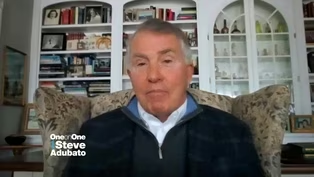
Steve Adubato talks with Michele Adubato, CEO of The North Ward Center and Founder of The Center for Autism, about the services The Center for Autism provides to help adults with autism live independently, build careers, and improve emotional well-being.
Problems playing video? | Closed Captioning Feedback
Problems playing video? | Closed Captioning Feedback
One-on-One is a local public television program presented by NJ PBS
One-on-One
How can we support independent adults living with autism?
Clip: Season 2026 Episode 2912 | 11m 6sVideo has Closed Captions
Steve Adubato talks with Michele Adubato, CEO of The North Ward Center and Founder of The Center for Autism, about the services The Center for Autism provides to help adults with autism live independently, build careers, and improve emotional well-being.
Problems playing video? | Closed Captioning Feedback
How to Watch One-on-One
One-on-One is available to stream on pbs.org and the free PBS App, available on iPhone, Apple TV, Android TV, Android smartphones, Amazon Fire TV, Amazon Fire Tablet, Roku, Samsung Smart TV, and Vizio.
Providing Support for PBS.org
Learn Moreabout PBS online sponsorship(upbeat music) - She's back by Popular Demand.
Michele Abubato, CEO of the North Ward Center, one of our longtime underwriters and partners, and also the founder of the Center for Autism.
Hey, my little sister, younger sister Michele.
Who do we have with you?
- This is the famous Buddy who's just passed out.
- (laughs) Did I bore?
- He just literally passed out.
I don't know, Steven.
It could have been you 'cause he literally just passed out.
- He's not the first family member that fell asleep on me.
Hey Michele, let's do this 'cause I wanna talk about a few different things.
Tell everyone what the Center for Autism is and why it matters and then we'll talk about Buddy 'cause Buddy's very much connected.
- Yeah, so the Center for Autism, I founded over 10 years ago in Newark.
It's a program for adults with autism and it's an overall program.
And what happens after 21 when you know school is over?
And a lot of times what happens there is what they call people fall off the cliff.
There's no services, especially in Newark.
So we provide those much needed services for adults with autism.
- Let me ask you this, Michele, the center is a state-of-the-art facility, that matters.
Some will say state-of-the-art.
Okay, so it's modern?
No, it's state-of-the-art specifically designed for specific reasons.
- Oh, absolutely.
- Go ahead.
Talk about that.
- We have a sensory room, we have wide open spaces.
We have lights that make sense for people with autism.
We're very autism sensory friendly.
It is modern, it is new.
We're actually adding a technology center to the Center for Autism.
And you know, it is a state-of-the-art facility.
- Creating a pathway to independence is, again, sounds like a slogan to some people, but you and your team live it every day.
Talk about that.
- Well, you know, when you think about adults and what happens to people once they finish high school or even college, there is a pathway, whether they take it or not is a different story.
For adults with autism, that pathway some, many, many times is shaded by, you know, uncertainty.
What happens?
Okay, school is a given, school is a given, but adult programs are not.
And so oftentimes unemployment is sky high for people with autism.
It doesn't mean that they can't work.
It means that many of them just cannot find employees, employers that are willing to understand what someone with autism needs in terms of employment.
So the employment rate for adults with autism is anywhere between 40 to 60, sometimes even 80%.
- You know, Buddy, let's reintroduce Buddy.
- Yeah, so buddy, buddy is sleeping.
Buddy.
- Buddy's sleeping.
- I can't, I can't.
- Don't wake Buddy up.
Hold on a second.
A therapy dog versus a service dog.
What is Buddy and what's the difference?
- Buddy's both.
Buddy's a service dog and a therapy dog.
So a service dog deals with primarily doing something for someone with a disability.
So Buddy is a service dog for Sebastian and- - Tell everybody who Sebastian is.
- So Sebastian is my wonderful grandson.
He's eight years old.
He happens to have autism.
And actually Sebastian is the reason why Buddy's here because we were doing everything in our power to figure out how to connect with Sebastian when we first found out, you know that at Sebastian at autism, probably a year and a half years old, you know, and we, I thought about therapy dogs and I'm like, maybe this could help 'em.
And you know, the realization of it just hasn't helped Sebastian and Buddy has helped so many people.
I mean, so it's opened up the door.
So Sebastian is the reason why I decided to do Buddy Treats.
- Okay, let's talk about Buddy Treats because we're also, we'll be broadcast on many outlets, distributed on many outlets, traditional as well as digital streaming outlets.
I don't think there's a problem with this because Buddy Treats- - Yeah.
- You usually we don't show product.
Oh, you gave, you gave me one of the first ones.
I didn't throw it away.
I still have it.
Tell everyone what it is because it is not a moneymaking deal.
It is a social, social enterprise.
- This is a social enterprise.
It's hope realized.
That's what Buddy Treats- - Talk about.
- Is about.
So I have always had in my mind the idea of how do you exact change.
So it's wonderful to have programs.
It's wonderful to have the Center for Autism.
It's, you know, opening up our second group, permanent home for adults with autism.
- Hope House 2, Hope House 2.
- Hope House 2 has opened.
- Be free to go any further, Michele, let me clarify.
Folks, all not-for-profit organizations, I just wanna be crystal clear, all non-profits.
Go ahead, Michele.
- Yes, and Buddy Treats is under Reimagine Ability, which is a non-for-profit.
It's a new non-profit that I have and 100% of the proceeds are going to the Center for Autism, along with a local dog shelter that helps dogs in need.
So it's 100% profits to social service.
And it also provides employment for adults with autism because the people who are packaging it are adults with autism.
- You know, I'm fascinated by this for a couple of reasons, but mostly because as not-for-profit leaders, which you are, I am, we are a not-for-profit media production company.
We're affiliated with public broadcasting and people don't need me to tell you the history of public broadcasting right now.
If you head up a nonprofit and you are not thinking about and actively engaged in finding new ways to bring in revenue to support your programs and affiliated programs, then you're not doing your job.
Our dad, our late dad, Steve Senior who founded the North Ward Center, Michele is brought it to where it is today and expanded, obviously our dad was not creating a center for autism, Michele has.
How important is it that as a not-for-profit leader, you're constantly thinking about social enterprise activities?
- It's the same.
It's our tagline.
Made by people who think differently.
In this world that we're living in right now, you need to think about how you become the group that can create profits for what you believe in.
If you're waiting for government to provide the money and get upset because now you don't have a program because a grant is over, that's not being effective.
And so that's really, so Buddy Treats is so much more than about a treat.
Although it's a wonderful treat and it's very healthy and we really worked hard on it.
It's about what I said was hope realized and taking nonprofit, I'm hoping what this does is to take nonprofits in a new era to say we can go into business for ourselves and we then can create that revenue that helps our nonprofit programs continue.
Because as we can see, you cannot rely on just so Medicaid, they're being, everything is being cut.
Does that mean that, you know, programs are gone and that's what's been happening.
Not to the North Ward Center, not to the Center for Autism.
And certainly by bringing Buddy Treats in, we believe that, and I think people feel good about it.
So it's a way for people to say, not only can I give my dog this wonderful treat, I can provide by doing that, I can give to these wonderful services.
- Michele, in the couple minutes we have left, Hope House.
Describe Hope House.
And on January 15th, Hope House 2.
- Yeah.
- We're taping this a little bit after that.
It'll be seen later.
- Yeah.
- What is Hope House and now Hope House 2.
Go ahead.
- I mean Hope House and Hope House 2, I don't like to use the term group home because it's so much more than that.
Hope House 1 was four young women and Hope House 2 is four young men who now have permanent housing in the city of Newark, in a wonderful neighborhood.
This is their home.
We have changed their stars, we have changed their families and how this is again, hope realized.
You have to do something.
Hope is a verb.
So we have now provided for young men with a beautiful home.
It's been, it's been the last couple of weeks, it's been very interesting.
The parents have cried, you know, like they say, listen, this is it.
They're crying for joy, they're crying for, we couldn't, can't believe this is happening.
And they never thought that this could happen for them.
And not only is it happening for them there, our four young men are thriving.
So I'm very, very proud of that.
- Speaking of proud, I know our mom who watches religiously.
- She does?
- She only... (Michele chuckles) I'm not even gonna talk to you about that.
She likes how we get along on the air, but more importantly, the work that you're doing every day.
She's not the only one proud of you.
Our dad who is no longer here, I have a sense he's somehow looking down and really proud as well.
Michele Abubato, she's not my little sister, she's my younger sister doing important work.
She's the CEO of the North Ward Center and the founder of the Center for Autism.
Their websites have been up throughout the segment.
Log on, find out more.
Hey Michele.
Good stuff.
For my sister Michele, who's heads up the North Ward Center and the founder of the Center for Autism.
Buddy, Buddy Treats and our entire team thank you Michele for joining us.
Well done.
- Thank you.
- Look, she's gonna plug one more time.
Buddy Treats.
- That's right.
- You got it.
See you next time.
- Treats with a purpose.
- [Narrator] One-On-One with Steve Adubato is a production of the Caucus Educational Corporation.
Funding has been provided by The Turrell Fund, a foundation serving children.
The Adubado Center for Media Leadership.
RWJBarnabas Health.
Learn More at RWJBH.org.
Horizon Blue Cross Blue Shield of New Jersey.
Johnson & Johnson.
Valley Bank.
The Russell Berrie Foundation.
PSE&G.
And by Robert Wood Johnson Foundation.
Promotional support provided by CIANJ, and Commerce Magazine.
And by lNJBIZ.
- (Soft music) - (Softly)Is that?
- Wow.
(Children laughing) - (Softly) It’s gonna be okay.
 New
NewAuthor Jack Ford commemorates the journalist Lee Carson
Video has Closed Captions
Clip: S2026 Ep2912 | 15m 40s | Author Jack Ford commemorate the journalist Lee Carson (15m 40s)
Providing Support for PBS.org
Learn Moreabout PBS online sponsorship
- News and Public Affairs

Top journalists deliver compelling original analysis of the hour's headlines.

- News and Public Affairs

FRONTLINE is investigative journalism that questions, explains and changes our world.











Support for PBS provided by:
One-on-One is a local public television program presented by NJ PBS