
"Investing in Employees is Good Business"
Season 7 Episode 3 | 26m 48sVideo has Closed Captions
Jason Cardenosa, from J. Fletcher Creamer and Sons talks about his firms "Family Culture".
Host John E. Harmon, Sr., Founder & CEO of the AACCNJ, talks with Jason Cardenosa, Director, People Services and Marketing for J. Fletcher Creamer and Sons, about how his firm treats employees like family to create a culture of support and loyalty, where workers are individuals rather than numbers. This approach is their secret for employee retention and long-term success in a competitive market.
Problems playing video? | Closed Captioning Feedback
Problems playing video? | Closed Captioning Feedback
Pathway to Success is a local public television program presented by NJ PBS
"Investing in Employees is Good Business"
Season 7 Episode 3 | 26m 48sVideo has Closed Captions
Host John E. Harmon, Sr., Founder & CEO of the AACCNJ, talks with Jason Cardenosa, Director, People Services and Marketing for J. Fletcher Creamer and Sons, about how his firm treats employees like family to create a culture of support and loyalty, where workers are individuals rather than numbers. This approach is their secret for employee retention and long-term success in a competitive market.
Problems playing video? | Closed Captioning Feedback
How to Watch Pathway to Success
Pathway to Success is available to stream on pbs.org and the free PBS App, available on iPhone, Apple TV, Android TV, Android smartphones, Amazon Fire TV, Amazon Fire Tablet, Roku, Samsung Smart TV, and Vizio.
Providing Support for PBS.org
Learn Moreabout PBS online sponsorship- Support for this program was provided by Horizon Blue Cross Blue Shield of New Jersey.
- Hello, this is John Harmon, founder, president, and CEO of the African American Chamber of Commerce of New Jersey.
Welcome to Pathway to Success.
Today's guest is Jason Cardosa.
He is an amazing individual who worked for one of the transformational companies in the state of New Jersey.
Welcome to Pathway to Success, Jason.
- Thanks, John.
Great to be here.
- Good.
So, we'll, we'll get into a, in a moment, the company you work for, the things you do, but we wanna talk a little bit about you, my friend.
- Let's - Have it.
- Yeah.
So originally from Jackson, New Jersey.
I'm married for 18 years to my beautiful wife, Serena.
I got three children born and raised here in New Jersey, not going anywhere, - So, so how is tennis going for Serena?
- So, Serena, she's not a tennis player.
She was a canoe in her younger years and we still kayak in some of the rivers right over here.
Jackson's got Prosper Town Lake outside of great adventures.
So we enjoy kayaking.
- That kayaking is some serious stuff, man.
'cause the water could be calm and then all of a sudden it just, just could go in a whole nother direction.
So how long you been doing that?
- About I would say about seven years now.
Yeah.
My, my oldest got his first kayak and each, each child after that, we've, we've added a kayak.
Rosalyn doesn't have her own kayak yet, so she sits in the kayak with me.
Okay.
And every now and then she, she switches over to Serena's Kayak, but yeah, about seven years with the kayaking.
- That's fantastic.
So what was it like growing up in Jackson?
The, the land of great adventure as we know it today?
- Well, back then it was more adventurous.
It's definitely more populated now, but back then there was, there were a lot of woods.
We were able to get our dirt bikes and, and ride through the trails back there.
There were old chicken coops that we used to play paintball in a lot of fun.
I'm, you know, Jackson is still a great town, but it is definitely going through transformation and, and, and is growing.
So, which is a good thing for, for the town and for the state.
- Did you, did you participate in any athletics?
Were you involved in any leadership roles in the community?
- Yeah, so played baseball.
I was a Jackson Memorial Jaguar baseball player at, at one time.
I also played golf for, for the high school there.
Also got connected to local church in Jackson and, and that's kind of where I was deeply rooted with my spiritual walk, becoming a, a youth pastor at an early age, we were latchkey kids.
- Okay.
- So my, my, my parents worked all day.
My dad was a state trooper, flew the medevac helicopter for the state police.
My mom was in banking, so they, they worked long days and, and that left kids to play manhunt and flashlight tag throughout, throughout the evening.
- You know, talk about your connection, your spiritual connection at a young age and how that is, I guess, better part of your foundation.
- Yeah.
So one of the more traumatic experiences for me growing up was when my parents made the decision to separate and divorce at a young age, I really didn't understand the implications that had on me.
And as I grew, I always had this inner question, one of inadequacy at a young age, I questioned what did I do to make the, or cause my mom and dad to separate, but I will say, John, that that inadequacy feeling drove me and, and gave me the passions to really grow in a, a lot of areas.
When we talk about Jackson Memorial High School, at the time, there was no Christian group.
And so I asked one of my English teachers if I could start a Christian group for the, the kids in the school.
We started that and then I asked if we can do prayer at the poll.
Wow.
And, and the first time I thought it, it was gonna be taken as a joke.
And I, I turn around, I come out and there are 150 young kids Wow.
At the, the flag flagpole ready to pray for the town, for the school year, for the administration.
And so I've just always had this passion to help individuals around me just better understand themselves, what kind of motivates them internally.
Not, not to solve the problems, but to just recognize them and remember that that's part of their story.
It's part of their testimony and it's who it's, it's what drives them to be who they are.
And so, at a very young age, I, that, that inadequacy drove me to be, become a manager of McDonald's.
My first job I started at 15, I became a manager at 16.
From there I worked with Delphia Cable and my inadequacy drove me to being one of the top top producers where they asked me to go to Massachusetts and be part of more of a divisional team from Massachusetts down to New Jersey.
From there, I used that inadequacy sense and, and again, I didn't realize what was driving me, but from there, I, I got in, I came back to New Jersey and I worked in the underground utility market for marking out utilities in construction.
That's really what grounded that, that's been, that was my foundational introduction to construction was the underground utility.
And, and when I started there at 21, it, my, my passion and my drive drove me to become a regional leader for the underground utility mark company.
And then from there I was asked by Jay Fletcher Kramer to join their organization, help grow that, that market and, and, and some other really pivotal, pivotal decisions in my career.
Through the years, John, I watched the people around me and just really my passion is to help them better understand what makes them passionate and what they strive for and, and helping them realize it's okay to go in those directions.
I'm working right now with New Jersey Pathways.
It's a, it's a program here in New Jersey and we're trying to help remove the stigma at the high school level.
That the trades are a second class.
That if you don't get into a four year college, your only solution is, is a lower income career or is going into the trades.
And that's not the reality there.
The trades are, are extremely important.
We, we need more young adults to get into the trades, whether that's mechanics, whether that's pipe fitting, welding, electrical trade, carpentry, trade dock, building trade.
And so we're trying to help the high school levels remove that stigma.
Same thing with a two year college.
Some students feel like moving into a two year college is, is a lesser status than going directly into the four year college.
And so this, it kind of motivates me to help the younger generation just recognize like, where's your passion?
And then let's go after that passion.
And, and whether it's a trade or two year college, four year college, or maybe no college, John.
I did, I started at Mercer County College at a young age, but then after that, I didn't get my bachelor's degree in psychology until I was 42 years old because I went right into that underground utility mark out construction world.
And, and I just started working.
I got a lot of life experience.
So I think I answered your question.
I hope I did.
- No, I think you did just fine.
That is great.
But talk a little bit about psychology.
Why was that your choice?
- And again, it really wasn't my choice until later on in life.
And so as I was engaging in work from, again, that 15 to 20 to 25 to 27 to 30, then I started to really just pay closer attention to the individuals that I was working with and around paying closer attention that to their happiness and their unhappiness, their disgruntled behaviors versus their joyful and peaceful behaviors.
And so it wasn't until later in life where I actually wanted to go into psychology to better understand the spiritual aspect of psychology and how the science compliments the spiritual, how the science of psychology, the makeup of who we are compliments the creators bigger plan for, for who we are as individuals.
And when I started to understand psychology, when I got into it a little bit more, I, it just fascinated me as to how it really applied to the people that we work with every day.
We could miss the individual who's standing right next to us, who is happy or who's not happy, who is motivated or is demotivated.
And so psychology really helped me better understand the, the emotional side of individuals, which, you know, studies are showing now that your EQ or, or your empathy is far more powerful than your iq.
While IQ compliments the individual, it is the emotional intelligence that that drives us and, and is our force behind who we are.
- You know, you talk about empathy, empathy unlocks the person that you are and potentially the person you can be.
Let's talk a little bit about, you know, the work culture.
Speak to that.
- One of the key elements is making sure that not only are we learning about the individual's skillset, right, are they right for the role?
But what is far more powerful and far more important to our leadership team is are they a good culture fit?
We go out of our way to make sure that we are a family, to make sure that we have a meal together regularly.
The service center has a meal together every week where they come around the table and they break bread.
We bear one another's burdens.
We had one team member whose car was stolen.
And so we, we, we rallied together the organization, you know, Marty, the president of the company, went out of his way to make sure that that team member had finances to purchase an another vehicle.
And so when we're talking to the individuals, we're, we're really listening to who they are and, and, and aligning the culture fit to make sure that they're individuals, that desire family, that desire community, that go and be above and beyond.
A lot of what we do is underground.
And when the public wakes up the next morning, it's paved over and, and they don't see it, but they have water and they have heat because of the gas lines and the electric lines that, that were repaired or, or newly installed.
And so just that community outreach, the philanthropic motivator that drives us as individuals to just make each other's lives a little bit better.
So while we understand, we, we come together to, to do a task to, because we have goals as an organization, those goals are, are drafted and, and they're drafted in our, our bigger commitments to self, to each other and to the community around us.
- So we're gonna take a break.
We'll be back in a moment.
- For more information, please visit our website.
- Welcome back to Pathway to Success.
We're gonna resume our conversation with Jason Cardosa.
So Jason, talk a little bit about the origin of Jay Fletcher Kramer.
When did they start?
- Yeah, so the organization started in 1923.
Fletch II started it with just one truck.
And then shortly after that, in the 1930s, the organization supported the construction of the George Washington Bridge.
Oh wow.
And they continue to expand in the utility construction space.
So Jay Fletcher Kramer and Sun is a heavy civil infrastructure organization.
We are pretty diverse in what we do.
So we do projects from building bridges to underground utilities, installing var, Verizon, conduit, PSE, and G, electric lines, gas lines, water mains.
Some of our biggest projects are on water mains.
You're driving down the Garden State Parkway or the New Jersey Turnpike, and you'll see our guide rails that we install or the various sign structures.
So we've been very diverse in, in what we do and that that's somewhat of a business strategy.
Market instability.
When one area starts to kind of dry up, we pivot to another area.
Majority of our team members are trained on the various lines of business that we perform.
So that if there is an area that we see less work, we don't lay those people off, we just adjust what projects they're on.
- You guys alike to some degree, although we see the tan trucks all over the state, like a hidden figure.
A lot of the work you do is at night, if you will, but what is it like being a part of a company that the work that you do is so tangible and so connected to how we get around - It is extremely inspiring.
You know, John, you mentioned a lot of our work is at night and a lot of it's underground.
You may have recently heard in the news earlier this year, Patterson experienced a great turmoil when a few of their water mains broke and hundreds of thousands of people were out of water.
And so a lot of our work is underground.
A lot of our work is unseen.
But when the homeowners come out and they have smiles on their face because they can drink water, they can turn the electric on, they can turn the heat on.
That is that interconnection with us that we pride ourselves on.
- Talk about some of the, the longevity of the staff.
- You know, we have an unusually high tenured here at the organization.
It's not uncommon to see team members 57 years, 42 years and that, but, but conversely, on the other side, John, one of our healthiest pipelines of talent right now is our internship program.
There is a population of young adults who can't afford four year college.
So they find themselves at these two year colleges, but they also find themselves somewhat overlooked because organizations may be going directly to the four year colleges and we're in, we're giving them an opportunity as an intern, our internship program is very robust.
It's very hands-on.
And, and then what the organization offers if they become a full-time team member is tuition reimbursement where we reimburse 100%.
- Well, let's talk about the - Expense - Of - Retaining - An employee.
- Yeah, John, the average onboarding expense anywhere between 15 and $18,000.
That's from interview to day one onboarding.
So it's extremely important to us that we do a, a, a decent job in getting to know the future family members of our organization and, and also to put a little extra out on the front end.
Things like our engagement experiences.
We, again, going back to the lunches that we have, we, we have devoted engagement budgets for each of the areas of the organization.
Where as a team you go and enjoy an experience with, with your fellow team members, whether that's a meal.
We've had some teams go to concerts together, some teams go to see Broadway plays together, other teams.
Our our operations team went deep sea fishing together and we put that extra cost out there because we understand of how expensive turnover can be.
- You talked about the family oriented culture, but you also mentioned that there was a merger or an acquisition that took place with API And how has that impacted the traditions of the organization?
- At, at first, it, there were some ripple effects, ripple effects of worry as to what will this now family run organization look like now that the corporation has purchased as API group has over 33,000 team members around the world.
And so there was this ripple as to, well, what will that do to the family culture?
Our team has worked very diligently from the executive leaders down to our mid-level leaders, down to the leaders at the lowest level to make sure we stay a family environment, a family culture.
Our API group company, they, they have made it a point to allow the operating companies to run and function as they always have.
They're there for leverage, maybe buying power, leverage relationships, but they have done very little when coming in to change the culture.
They've also enhanced our culture.
John, one of the ways they enhanced our culture is they have this slogan of building great leaders.
And that goes hand in hand with our organization, the Joseph T. Walsh Training and Development Center in, in memory of our former president located in wall, New Jersey.
One of the, one of the larger driving forces of our organization are the field members, the union team members, whether it is from local 4 72 or 8 25 or you know, the, the, the electrical unions that, that makes up the largest population of our team members.
And so we wanted to make sure that they knew that they were family as well.
And so we have created a training program where a laborer can go down to our Joseph T. Walsh training and Development Center and gain knowledge, gain training, gain experience so that there is a pathway for them to eventually move to the foreman level and then move to other areas of the organization that they, they thought maybe at one time was not available to them.
So this model of building great leaders, which came from the acquisition of API group, has woven itself into our narrative because it's who we are as an organization.
- I think that's a phenomenal story.
Couple more questions here.
Let's talk about philanthropy and your support for veterans healthcare and housing stability and community wellness.
Speak to that now we're talking external versus internal.
- And so we do all kinds of philanthropic activities from the Audrey Hepburn Children's Hospital up in Hackensack, New Jersey to the, the specialized, the Children's specialized hospital in New Brunswick.
We just held a cornhole tournament at the end of October.
It was our second annual cornhole tournament.
We're hoping that this will start to gain traction as there is.
- Do you play cornhole?
- I do play cornhole, yes.
I - I'm hit and miss on corn hole.
- Are are you more of a pickleball fan, - John?
Neither.
- Neither.
Okay.
Neither.
Yeah.
So we, it was our second annual corn hole tournament and 100% of the proceeds go to the Audrey Hipper and Children's Hospital of Hackensack and, and also our veterans.
Every year we have team members that actually make hand handmade blankets.
And so we go to different veterans hospitals and we just, we just love on the veterans that are, that are in these hospitals.
These are pivotal individuals who have secured our liberties here in, in this great country.
And so we need to honor them and we need to honor them.
Well, - So, so Jason, what is a typical day like for you?
- Yeah, so that's another aspect of my job or my career that I really enjoy because John, I could find myself in a studio having an interview with you, or I could find myself on a job site.
We were just at MetLife stadium, we're putting up a pedestrian bridge in preparation of the World Cup in 2026.
Or I could be at a local college having the opportunity to talk to the next generation of team members who are going to bring our organization into 20 30, 20 40, and 2050.
And so that's, I I love what I do because of the diversity of what I do.
I also have a number of certifications that I, I find myself completing, one of which is the Intercultural Development Inventory.
Yeah.
So the Intercultural Development Inventory is a self-assessment.
It, it, it, it is a, a proven assessment because it will show you what you believe your interaction with different cultures and ethnicities is, and then it will show you what you actually are.
And again, it is to just give you some self-awareness.
And when you're done taking the inventory, what it'll do is it'll give you some tangible steps that you can do in order to work on the way in which you interact and understand different cultures.
- Talk a little about your outreach efforts to find diverse talent.
- Working with organizations such as yours is pivotal.
It it is one of many organizations that we work with in the state of New Jersey.
Workforce development is another one to find diverse entrepreneurs to help, to help our projects as well as to find diverse talent all throughout the state.
And that, that we operate in here, we work with small businesses to help us in areas that we are not experts in.
- Well Jason, thank you for joining us today on Pathway to Success.
- Thanks, John.
It was a great being here.
I really appreciate it.
We'll get you on the pickleball court before you know it.
- No, I look forward to it.
Until the next time on your Pathway to Success, this is John Harmon, founder, president, and CEO of the African American Chamber of Commerce of New Jersey.
Thank you.
Today's message is access to compete.
You know, as we approach the 250th anniversary of these United States, we can reflect on the good and bad about this amazing country, all the contributions that men and women have made, both at the local level, county level, state and federal level to make the state, country, county, or municipality better.
So we're gonna be celebrating that soon, but as we celebrate, let's also reflect on what we've done or what we have not done or what we could have done.
So I would encourage you, as we approach this, this milestone birthday, let's find a way to celebrate something we've done or celebrate something we've helped others to do to make society better.
This, this pushback on, on de and i and pushback on diversity in general.
It was about the value proposition.
It's not about the nomenclature.
It is about allowing people access to compete.
We need fairness and inclusion.
You need access the resources, opportunities, and information to fairly compete to win for the greater good of society.
That's what we, that's what we hope to obtain here in New Jersey.
There's a number of best practices where people have deployed policy with accountability, with transparency, and the resulting outcomes were good.
So let's try to find a way to coexist for the betterment of society and celebrate this birthday together.
- Support for this program was provided by Horizon Blue Cross Blue Shield of New Jersey.
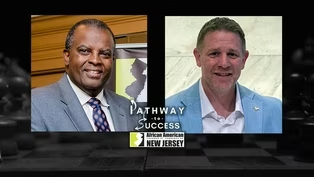
"Investing in Employees is Good Business"
Video has Closed Captions
Preview: S7 Ep3 | 30s | Jason Cardenosa, from J. Fletcher Creamer and Sons talks about his firms "Family Culture". (30s)
Providing Support for PBS.org
Learn Moreabout PBS online sponsorship
- News and Public Affairs

Top journalists deliver compelling original analysis of the hour's headlines.

- News and Public Affairs

FRONTLINE is investigative journalism that questions, explains and changes our world.












Support for PBS provided by:
Pathway to Success is a local public television program presented by NJ PBS