
One-on-One
Jessica Jenkins; Bryan Felt; Emmie Bleznick
Season 2026 Episode 2950 | 27m 58sVideo has Closed Captions
Jessica Jenkins; Bryan Felt; Emmie Bleznick
Jacqui Tricarico speaks with Jessica Jenkins, Wife of an Organ Donor at the NJ Sharing Network's 5K Celebration of Life about the impact of organ donation. Steve Adubato and Mary Gamba discuss the NCAA's transfer portal with Bryan Felt, Athletic Director at Seton Hall University. Jacqui returns to speak with Emmie Bleznick, Wife of a Tissue Donor, about honoring her husband's life.
Problems playing video? | Closed Captioning Feedback
Problems playing video? | Closed Captioning Feedback
One-on-One is a local public television program presented by NJ PBS
One-on-One
Jessica Jenkins; Bryan Felt; Emmie Bleznick
Season 2026 Episode 2950 | 27m 58sVideo has Closed Captions
Jacqui Tricarico speaks with Jessica Jenkins, Wife of an Organ Donor at the NJ Sharing Network's 5K Celebration of Life about the impact of organ donation. Steve Adubato and Mary Gamba discuss the NCAA's transfer portal with Bryan Felt, Athletic Director at Seton Hall University. Jacqui returns to speak with Emmie Bleznick, Wife of a Tissue Donor, about honoring her husband's life.
Problems playing video? | Closed Captioning Feedback
Where to Watch One-on-One
One-on-One is available to stream on pbs.org and the PBS app.
Providing Support for PBS.org
Learn Moreabout PBS online sponsorship- [Narrator] Funding for this edition of One-On-One with Steve Adubato has been provided by New Jersey Sharing Network.
Hackensack Meridian Health.
Keep getting better.
EJI, Excellence in Medicine Awards.
A New Jersey health foundation program.
Horizon Blue Cross Blue Shield of New Jersey.
PSE&G.
Powering progress.
Robert Wood Johnson Foundation.
Working to create a future where health is no longer a privilege, but a right.
The Russell Berrie Foundation.
Making a difference.
NJM Insurance Group.
Serving New Jersey’s drivers, homeowners and business owners for more than 100 years.
And by The Center for Autism Promotional support provided by Meadowlands Media.
A print and digital business news network.
And by Insider NJ.
- This is One-On-One.
- I'm an equal American just like you are.
- The way we change Presidents in this country is by voting.
- A quartet is already a jawn, it’s just The New Jawn.
- January 6th was not some sort of violent, crazy outlier.
- I don't care how good you are or how good you think you are, there is always something to learn.
- I mean what other country sends comedians over to embedded military to make them feel better.
- People call me 'cause they feel nobody's paying attention.
_ It’s not all about memorizing and getting information, it’s what you do with that information.
- (slowly) Start talking right now.
- That's a good question, high five.
(upbeat music) - Hey, everyone, Steve Adubato here.
Welcome to a very special interview that you're about to see with my colleague, Jacqui Tricarico, who is our Senior Correspondent.
Jacqui, you attended the June 7th 5K Celebration of Life, if you will, for the New Jersey Sharing Network.
Tell folks what they're about to see.
- Well, New Jersey Sharing Network is an organ and tissue procurement organization here in New Jersey, and the event was all about honoring those that we have lost that were organ and tissue donors, remembering their lives, and also bringing awareness to those who are still waiting for organ and tissue donations.
So many people, 4,000 here in New Jersey, are on the waiting list for a lifesaving organ.
So this event was just so impactful in its 16th year.
16 years, it's been going on.
It's a huge event in New Providence, New Jersey, and I was lucky enough to be there.
Again, I've been doing this over a decade, and I get to go there every year to share their wonderful, impactful, important stories.
Yeah, it's 4,000 in New Jersey waiting, 100,000-plus in the United States.
Important, compelling, powerful interviews.
Here's one of Jacqui's right here.
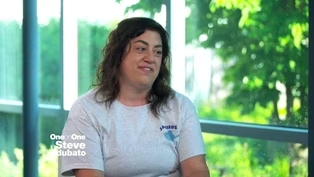
- Hi, I'm Jacqui Tricarico on location at the New Jersey Sharing Network's Celebration of Life here in New Providence, New Jersey.
I have the opportunity to speak with so many incredible people here today, honoring and celebrating the gift of life, organ donation.
One of those people is Jessica Jenkins.
She is the wife of organ donor, Jay Jenkins.
It's so great to have you with us.
- Thank you.
- Thank you for sitting down with us.
First, I want you to tell us about your husband, Jay.
What was he like as a husband and as a father to your son, Tommy?
- He was wonderful.
He just, you know, supported me in everything I did and he was my best friend.
He was a great dad, unfortunately, not for very long, but, you know, the little time that he had spent, he got to spend it all with Tommy, so it was great.
- So in 2020.
- Yeah.
- At the height of COVID, the unimaginable happens.
You have a six-week-old baby and Jay suffers a fatal brain aneurysm.
First, I'm so sorry that, you know... You never think something like that would happen to your loved one.
- [Jessica] No.
- Having the six-week-old baby at the same time, I can't imagine what you were going through.
- It was a lot.
- Yeah.
But talk about when you were approached about organ donation, because Jay was a registered donor, right?
- Yeah, so I didn't have to make that decision because he checked the box, which is very important because they listen to what you want personally.
And I was approached, I mean, immediately they had said that he was an organ donor and that they were going to donate his organs and you know, it was just like a no-brainer because he was able to.
And really you have to kind of die like a specific way to be able to donate your organs.
It's not just anybody can do it.
So once, you know, he was able to, the Sharing Network put everything into action and took over and did all of the things that needed to get done for it.
- What was it like working with the Sharing Network during that time and also what was it like for you emotionally knowing you were honoring what Jay wanted?
- I mean, the only thing I could do was hold onto that hope of honoring him and wanting everything that he wanted to do and give and be able to show to my son and show to him, you know, that his dad's a hero.
And just from the very beginning, the Sharing Network was just so supportive.
I have a cousin who works for St.
Joe's and she actually is part of the Sharing Network organization for that hospital and she really was the one who kind of took over and did all of the things because it was really hard with the baby and everything to be able to do all of that.
So they really just supported me and did it and handled it all.
- That family support's so important.
I'm sure the Sharing Network became another family for you and yours as well.
- Absolutely.
Absolutely.
- So talk about, discussing organ donation prior to Jay passing.
I know he was a registered donor but was it a conversation that you had?
Had you already checked the box?
- I mean, the box is checked now.
- Okay, so it wasn't checked before.
- It wasn't.
- Okay.
- You know, it was not something that you really talk about or think about.
It's not something that... You know, I mean, Jay had just done it and he wanted to do that.
We had discussed a few things here and there, but I mean, we were young, so he was only 34, so it wasn't something that was on the forefront of our minds, but because he checked it and I knew that that's what he wanted, it was like a no-brainer to do it.
Now knowing more about it and knowing that we do need to tell everybody to do it because it just helps and it saves so many lives.
- It really does.
And also who was impacted?
How many lives did Jay impact saving lives with his organs and impacting those who needed tissue donation?
- So he was able to donate his eyes and his heart and bone marrow.
So the bone marrow is hundreds of people.
His liver, yeah, so a lot of people.
There is a way that I can find out through the Sharing Network, they have all the information.
I haven't gotten that far yet.
- Part of your grieving journey.
- Part of the grieving journey and, yeah, I mean, it's... I've met recipients here at the walk and just seeing them and then they come up to you and they say, you know, thank you and this is amazing.
And seeing them, you know, be able to live their lives to the fullest because of things that like my husband did, Jay.
- Talk about a little bit more about being here at the 5K event, especially with Tommy.
How important is it for you to show him and be here with your family?
You have a big team, Team Jay Birds, right?
- [Jessica] We do.
We do.
- [Jacqui] Talk about the team a little bit being here and honoring Jay in this way.
- Everybody that shows up is, it makes my heart so big because I know it's for me and for Tommy and for Jay and to just keep his memory alive.
And it's a day that is for him and I get to remember him and I get to, be with all of my people remembering him.
The Sharing Network... The first year that we did the Sharing Network, it was actually virtual.
We did it two months after Jay passed and- - That must have been really difficult.
- It was, but because it was virtual, it was just us.
So we were just walking around the streets of Chatham and doing it and it kind of got me into it because that was a really hard time so to just, baby steps into it.
Then the next year when everything finally opened up and we got to see like what it was really like, it was just so incredible.
And then every year since then I've just wanted to get more people and make our team bigger and really just, you know, have a good time.
- Yeah, and how has that helped you with your grieving process?
Building this team, coming here every year, having a specific event each year that's really dedicated to Jay?
- It gives me a purpose and it gives me, you know, hope, you know, that I can spread as much as I need to to help anybody that needs to have any of the information.
I mean, this foundation is just truly remarkable and you know, to even just to support them and you know, raise money for them and all of that is really special.
- And how does Tommy do when he's here?
- Oh, he's great.
Mr.
Social.
- Oh, I love that.
Yeah.
- He's so great and he runs around and he looks forward to it every year.
And, you know, we say all day that my dad's a hero.
- Yeah.
Finally, how has Jay's gift really influenced the way that you look at life loss and helping others?
- So you know, just having such a tragedy happen so fast and at such a young age, just to know that he was able to help has given a lot of comfort in the grieving process.
Knowing that he was able to do something, you know, it's helped me move forward.
And then every year coming here, it's just a celebration that that's what he did, a celebration of life.
- It really is.
Thank you so much for sharing his story to help us spread the message of organ and tissue donation, how important it is and have an amazing time here today.
- We will.
Go Jay Birds!
- Thank you so much.
- Thank you.
- [Narrator] To watch more One on One with Steve Adubato find us online and follow us on Social media.
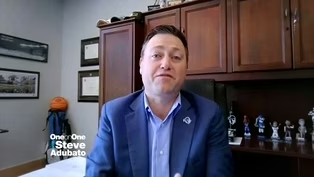
- Recently, my colleague Mary Gamba, on our sister series, "Lessons in Leadership," sat down with Bryan Felt, who's the director of Athletics and Recreational Services at Seton Hall University.
College athletics.
Student athletes.
Are they always students?
We know they're athletes.
Are they professionals?
They're getting paid.
Name, image, and likeness.
Getting paid for that.
The transfer portal.
Some kids going to four different colleges in four years because some other school offers them more money.
Complex, changing time.
And what is the role of the federal government right now?
Congress is dealing with this issue and may take a strong hand in regulating what's going on in college athletics.
Mary Gamba and I talking with Bryan Felt.
Check it out.
- Good to see you, Bryan.
- Good to see you.
- All right, so... Describe your job as the athletic director in a world that is constantly swirling and changing every minute.
- Well, it's different than the one I started.
You know, it certainly has changed and morphed into something else.
Well, I mean, I think the most fundamental change is how we treat or, really, utilize a lot of our student athletes today in terms of, you know, listen, they're now, you know, able to be paid.
So these are, you know, they can be looked at as, you know, a lot of different things.
You have people out there.
There's a camp that wants to call them employees.
There are some that wanna keep them as student athletes.
But, at the end of the day, they're partaking in the portion of the athletic department's revenue.
So we are revenue sharing with student athletes.
Without question, the biggest change in college athletics.
And that's just one of many.
- So teams that, schools that Have big quote, "NIL money," name, image, and likeness money, to pay their athletes for their name, image, and likeness, they have a certain advantage.
And there's a thing called a transfer portal.
Can you explain that, Bryan?
Why that's so incredibly impactful to intercollegiate athletics.
- I think more than anything, Steve, what it is that it makes it so impactful is that the revenue sharing and the transfer portal play off each other in such a perfect storm, if you will.
And many would agree, not perfect.
But to my point.
So you can revenue share with your student athletes.
You can now, because it used to be, the old rule was, if I wanted to transfer, I would have to sit a year residence wherever I went.
So I lost a year of eligibility while I sat before I could play.
Now, you can transfer whenever you want as many times as you want.
So what that does is, because of revenue sharing, again, we're talking about football and basketball specifically here being the sports that are really, really driving these numbers.
- Because of revenue sharing, what happens is these student athletes can go into this portal every year.
And it really becomes like, you know, they're going shopping, in a sense, right?
The market for the costs of these players, and these student, again, student athletes that are getting to transfer every year just continues to keep rising and rising and rising at really, at paces that it's really almost gonna be difficult to sustain in the long run.
- Absolutely.
Mary, jump in.
- Yeah, Brian.
Talk about the wellness of these students though.
I mean, obviously, they are still in their transformative years.
It's hard enough.
I had two kids that did competitive ice hockey, club hockey.
We traveled all over the East Coast.
The finances involved, and the pressure, and the strain.
Then they get to college.
And it's now compounded by this additional factor.
How are you ensuring at Seton Hall and how are other universities ensuring their wellness throughout this entire process and helping them to balance this huge demand that's put on them now?
- Well, I would remind everyone that our business, my business, my job is those 270+ student athletes that are here at Seton Hall, my job is to ensure that they have a tremendous collegiate experience.
Granted, wins and loss play a part in that.
They always will.
But education has got to be the top of the list.
We're trying to ensure that they get educated.
That they, obviously, come here.
And, to your point, they're taken care of so that mom and dad know they're sending them to the right place.
Or anytime you're gonna send your student, your child to a college, as you mentioned, I have two in college, you know, you're worried about their wellbeing.
Same goes for our student athletes.
I mean, mental health is become more and more critical every year.
We spend a lot of time and our resources to ensure that we have all of that available.
All of those resources available to our student athletes.
And, I mean, when you look at a student athlete's, you know, experience in four years, their time in our athletic training space with our sports medicine staff is crucial.
So that's where our focus always has to remain.
And I think that's what we have to remind ourselves sometimes, is that we talk about all of the chaos with the business right now.
And there's no business, I think, that's changed more dramatically in the last couple years than college athletics.
But what, at the end, our business is is ensuring young people have tremendous collegiate experiences and go on to graduate college.
That's what is at the core of what we do.
- You know, I was mentioning, excuse me, to Bryan earlier that I was watching a business program on CNBC.
And Senator Ted Cruz.
This isn't about politics at all.
It's about the fact that Senator Cruz and a Democratic colleague of his have introduced bipartisan legislation to address a lot of the issues Bryan's talking about.
More specifically, and Brian, I'm not gonna go into it, and if you want to find out more, go on to Senator Cruz's website to find out.
But one piece of the legislation, which is not a law, it's being discussed in the United States Senate and Congress, is to change this issue of the transfer portal, saying that, instead of having an athlete, a student athlete go to potentially four schools in four years, every year go to different school, because they're getting more money from that school, whatever it is, that Senator Cruz is proposing that you get one transfer.
And the only way you can get a second transfer is if there's some sort of hardship.
Or the coach leaves, right?
To what degree do you believe that government, in this case the feds, jumping in to regulate the transfer portal and putting some caps on it makes sense?
Or should they just stay out of it?
- You know what, Steve?
I think if you'd asked me this two years ago, I would have probably said, why get involved in politics and government, right?
Shouldn't we be able to figure this out on our own?
- It's not their business.
It's not their business.
- But, quite frankly, we haven't been able to do it.
And I think we need federal support here.
- Really?
- Because you have too many different state laws around it.
You know, there's too many different laws.
Like a New Jersey law regarding NIL is much different than the law in Georgia, or Tennessee, or wherever it might be.
There are different factors at play here where I think it's going to be incredibly important to get something done in Washington.
And I know that, sometimes, that takes time.
But there was a previous act called the SCORE Act that was introduced.
Now, we have this new one that comes from Senator Cruz and Senator Cantwell from Washington.
- That's right.
- A Democrat and a Republican.
- Which is the best thing I see about this bill, is it's bipartisan.
So it gives me tremendous, it gives me hope in, sometimes, a very, you know, hopeless place.
But the Protecting College Sports Act is what it's called.
And it's gonna be critical to see where this can go.
Because you mentioned the most incredibly important point of where we are right now.
And that is the transfer portal.
Because I believe the transfer portal is really at the root of a lot of our issues.
And if we can help kind of curtail where that is going, I mean, listen, again, we just talked about all these great things in college athletics, right?
You know, Mary, you asked a great question about what was- - The college experience.
Four schools, four years?
- Four schools, four years.
Guess what's not happening?
You're not graduating.
The ultimate goal of what we're trying to do.
You're not gonna graduate.
- You're saying a high percentage of student athletes, and the word student here is now getting shaky if it's four schools in four years, a high percentage of them do not graduate?
- Steve, when you transfer, you are never gonna be able to transfer with the amount of credits you had.
You're always gonna kind of lose some credits.
It's just natural.
It's just part of the process because some of them are always not gonna transfer to the next institution.
So, yeah.
Many of these young people are gonna go to four schools in four years.
Make no real connections.
Really, you know, really lack having that experience.
And I know the fan's frustrated by this.
They don't get to witness the growth of a student athlete, right, when they see somebody wearing the jersey every year is different, right?
Well, that student athlete doesn't really, I don't think gets to experience that growth either, you know, because they're not in that one place.
They're not coached by the same individual.
Or they don't have the same support system around them all the time.
And then, at the end of the day, the worst thing is what you just said.
They're not gonna graduate.
- Ouch.
- Yeah.
- Yeah, we'll talk more about this, I promise, Bryan.
It's an ongoing issue, not just in New Jersey, but across the nation.
Bryan Felt.
Director of Athletics and Recreational Services at Seton Hall University.
As always, Bryan, thanks for joining us.
We appreciate it.
- Great to be with you.
- You got it.
Stay with us.
We'll be right back.
- [Narrator] To watch more One on One with Steve Adubato find us online and follow us on Social media.
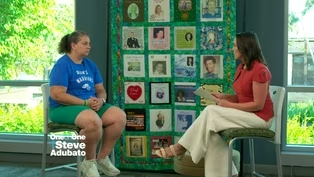
- Upbeat Music - Hi, I'm Jacqui Tricarico, Senior Correspondent for "One-on-One," and I'm here at the New Jersey Sharing Network 5K Celebration of Life in New Providence, New Jersey, here to honor all those impacted by organ and tissue donation.
I'm so pleased to be joined now by Emmie Bleznick, who is the wife of organ donor, Adam, and captain of the team, Adam's Warrior.
So great to have you with us, Emmie.
- Thank you so much.
- Thank you.
Well, first, please tell us about your husband, Adam, and how he was as a husband and a father.
- Adam was an incredible guy.
He never met a stranger.
He was super outgoing, super friendly.
He just connected people, and that was, like, one of his superpowers, and I loved that about him.
And he loved our son, Noah, endlessly.
He was such a great dad.
He was super fun and sweet.
- And how long ago did we lose Adam?
- Two years ago, so June 2nd, 2024.
- Okay, so take us back to that time for you and your family.
Obviously I'm so sorry for your loss.
Can't imagine what you were going through, the thoughts, the emotions.
And then you're presented with this idea of organ and tissue donation.
Talk about that journey for you and your family and everybody making sure that was a decision to honor Adam.
- Yeah, so we lost Adam very suddenly.
It was cardiac arrest.
And so kind of in a blink, I became a single mom and a widow, and navigating that was really, really challenging.
I know about The Sharing Network, because I'm actually a physical therapist at University Hospital.
So I have been working with donor recipients, liver transplant recipients specifically, and donor families in the setting of working in the trauma unit and in the surgical ICU for almost my entire career, almost 15 years.
And I knew about this 5K, even though I had never participated in it.
I always knew it was in early June, and it just was so automatic, considering how generous in spirit Adam was and what a special way this would be to honor him.
And also to have something tangible for our son, Noah, to do every year around the anniversary of his dad's passing and something so positive to help remember his dad.
- So did Adam have that box checked?
- He did, absolutely.
- He did, and you did too.
- Absolutely.
- Because of these conversations that you had together.
Those are difficult conversations to have.
- Yes.
- We talk about it as dinner table conversation, right?
To making it more real to be able to be a dinner table conversation with your family members.
What's your message to people hesitant to talk about something that can be really painful or uncomfortable?
- It is a really challenging topic and it can be hard, but you just have to think about what a gift that you're giving so many different people.
Adam was mainly a tissue donor.
He wasn't really able to donate organs, and I think that's something that sometimes is underrepresented.
As a physical therapist, I know that impact every single day, that is an ACL that lets somebody run, that's a bone graft that lets somebody walk.
Eyes, maybe giving somebody the gift of vision.
And so just taking a step back and thinking that, whatever you have in this life, you can't take it with you.
And so making sure that you can give that gift to somebody else in the wake of a tragedy has been so important for me.
And I think that's probably the best way to go about it.
- Yeah, and the tissue donation, like you said, it is underrepresented a little bit, but we're talking about millions and millions of people that need tissue grafts for lots of everyday surgeries that people are doing to improve their quality of life.
What do you think Adam would think, looking down now at what he was able to accomplish being an organ and tissue donor?
Because even though you check that box, you personally are probably thinking, "Oh, that probably won't ever be me."
But what do you think he's thinking?
- He would just be so proud.
He just, he was a people person.
Like I said, he never met a stranger.
He was so outgoing and so kind.
And I think that this gift of kindness would be a way that he would feel very represented and really that he knows how important it would be.
And I know that he's looking down and he's really, really proud.
- And Noah being here, like you said, how are you making sure Noah is honoring his dad in this way?
Obviously, today is a big day for him, but every day and keeping Adam's spirit alive in your home.
- I mean, first of all, I mean, you see pictures of Noah, and you see pictures of Adam, it's the same picture.
He's just the sitting image of his dad.
- [Jacqui] So you see him every day in Noah.
- [Emmie] Absolutely, his smile, and even the fact that he is, he's five, and he's got glasses already, just like Adam had.
And he just, it's an incredible reminder, for me, of Adam every single day.
And we talk about his dad all the time.
We talk about the things he loved, the Mets, the Giants, all sorts of sports.
He was really interested in wine and spirits.
That was his industry for a really long time.
And even just in kindness and being friendly to people in his smile.
That's a way that we continue to honor Adam every day through Noah.
- Being your second year at the 5K, like we talked about, walking around, give people a sense, who haven't been here who are watching, give people a sense of what it feels like to be out there with thousands of people who have similar journeys and experiences.
- [Emmie] It's everything.
This is a really, really special day for me.
His anniversary was just five days ago, and grief is quite a journey.
And that day felt different than last year, which was the first year.
I'm sure it'll feel different for me every single year.
But this event, for me specifically, really, really helps me remember, helps me honor Adam, and it's really important to share that with other people, those stories.
We had set up our tent yesterday, and I was the first one here, and we were next to another family, and they had a bar, and I started chatting with them, and they poured me a cocktail, and I was able to listen to their story.
And it's just amazing.
It's a really hard way to be connected to people, but it's a really important way to be connected to people.
It's like an instant bond.
And this event brings everybody together, and that's really, really important.
- How are those stories what helps bridge everybody together, but also get that messaging out to people who just don't quite understand or know that they could even check that box for themselves and make that decision?
- I think that's why the Sharing Network organization itself is so important.
This walk sheds light on these issues that can be really challenging to talk about.
And every single time someone is able to share their story through a medium like this, through social media, it gets the story out there, it gets the message out there that organ and tissue donation is such an important and impactful thing that you can do.
And it really is life-changing for so many people.
- It really is, and Adam gave such a beautiful gift, and thank you so much for letting us honor him here while you're honoring him every single day, you, and Noah, and your entire families.
Thank you so much.
- Thanks, Jacqui.
- Thank you to our Senior Correspondent, Jacqui Tricarico, and for Jacqui and our entire team here at "One-on-One," we thank you so much for watching.
See you next time.
- [Narrator] One-On-One with Steve Adubato is a production of the Caucus Educational Corporation.
Funding has been provided by New Jersey Sharing Network.
Hackensack Meridian Health.
EJI, Excellence in Medicine Awards.
A New Jersey health foundation program.
Horizon Blue Cross Blue Shield of New Jersey.
PSE&G.
Robert Wood Johnson Foundation.
The Russell Berrie Foundation.
NJM Insurance Group.
And by The Center for Autism Promotional support provided by Meadowlands Media.
And by Insider NJ.
- NJM Insurance Group has been serving New Jersey businesses for over a century.
As part of the Garden State, we help companies keep their vehicles on the road, employees on the job and projects on track, working to protect employees from illness and injury, to keep goods and services moving across the state.
We're proud to be part of New Jersey.
NJM, we've got New Jersey covered.
 New
NewAthletic Director at Seton Hall discusses the NCAA portal
Video has Closed Captions
Clip: S2026 Ep2950 | 10m 25s | Athletic Director at Seton Hall discusses the NCAA portal (10m 25s)
 New
NewWife of organ donor shares impact of organ donation
Video has Closed Captions
Clip: S2026 Ep2950 | 8m 31s | Wife of organ donor shares impact of organ donation (8m 31s)
 New
NewWife of tissue donor describes the impact of tissue donation
Video has Closed Captions
Clip: S2026 Ep2950 | 8m 5s | Wife of tissue donor describes the impact of tissue donation (8m 5s)
Providing Support for PBS.org
Learn Moreabout PBS online sponsorship New Episode
- News and Public Affairs

Top journalists deliver compelling original analysis of the hour's headlines.
 New Episode
- News and Public Affairs

Today's top journalists discuss Washington's current political events and public affairs.
 New Episode
 New Episode
 New Episode
 New Episode
 New Episode
 New Episode
 New Episode
 New Episode
Support for PBS provided by:
One-on-One is a local public television program presented by NJ PBS