One-on-One
Jillian Crane; Saad Ehtisham, DHA, FACHE; Carol Losos
Season 2026 Episode 2943 | 27m 50sVideo has Closed Captions
Jillian Crane; Saad Ehtisham, DHA, FACHE; Carol Losos
Jillian Crane, President & CEO of the 1st Responders Children’s Foundation, explores how they support families of fallen first responders. Saad Ehtisham, President & CEO of Atlantic Health, explains the importance of human-centered care and trust in public health. Carol Losos, Executive Director of GlassRoots, discusses how to use glassblowing for collaboration, creativity, and confidence.
Problems playing video? | Closed Captioning Feedback
Problems playing video? | Closed Captioning Feedback
One-on-One is a local public television program presented by NJ PBS
One-on-One
Jillian Crane; Saad Ehtisham, DHA, FACHE; Carol Losos
Season 2026 Episode 2943 | 27m 50sVideo has Closed Captions
Jillian Crane, President & CEO of the 1st Responders Children’s Foundation, explores how they support families of fallen first responders. Saad Ehtisham, President & CEO of Atlantic Health, explains the importance of human-centered care and trust in public health. Carol Losos, Executive Director of GlassRoots, discusses how to use glassblowing for collaboration, creativity, and confidence.
Problems playing video? | Closed Captioning Feedback
Where to Watch One-on-One
One-on-One is available to stream on pbs.org and the PBS app.
Providing Support for PBS.org
Learn Moreabout PBS online sponsorship- [Narrator] Funding for this edition of One-On-One with Steve Adubato has been provided by EJI, Excellence in Medicine Awards.
A New Jersey health foundation program.
Horizon Blue Cross Blue Shield of New Jersey.
The Turrell Fund, a foundation serving children.
Rutgers University Newark.
The Burke Foundation Newark Board of Education.
PSEG Foundation.
The New Jersey Economic Development Authority.
And by The Fidelco Group.
Promotional support provided by NJ.Com.
Keeping communities informed and connected.
And by BestofNJ.com.
All New Jersey in one place.
- This is One-On-One.
- I'm an equal American just like you are.
- The way we change Presidents in this country is by voting.
- A quartet is already a jawn, it’s just The New Jawn.
- January 6th was not some sort of violent, crazy outlier.
- I don't care how good you are or how good you think you are, there is always something to learn.
- I mean what other country sends comedians over to embedded military to make them feel better.
- People call me 'cause they feel nobody's paying attention.
_ It’s not all about memorizing and getting information, it’s what you do with that information.
- (slowly) Start talking right now.
- That's a good question, high five.
(upbeat music) - Hi everyone.
Steve Adubato.
We kick off the program talking about something that is incredibly important, important every year, but this year more important than ever.
25th anniversary of 9/11.
And one of the folks who's committed to helping family members, those who are surviving, those who are lost.
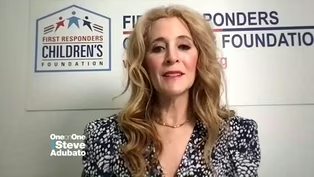
Jillian Crane, President and Chief Executive Officer of the First Responders Children's Foundation.
An honor to have you with us, Jillian.
- It's an honor to be here, Steve.
Thank you so much.
- You know, first, the website's up.
Tell folks what the foundation is and the children that you and your colleagues have been helping for a long time.
- The First Responders Children's Foundation is the only nonprofit that is focused solely on the children of first responders.
It started after 9/11 in a response to the 800 children who lost a first responder parent that day.
And it has grown now to be in 48 states, where our programs are available in every state.
And we support the children of law enforcement, firefighters, that includes volunteer firefighters, EMTs, paramedics, and 911 dispatcher families.
- So it goes beyond 9/11 family members?
- Yes.
Obviously you know this, but, you know, more than double first responders have died since 9/11 who died on 9/11 from 9/11 related illness.
So we still continue to help those families.
But yes, we were started in the aftermath, and now 25 years later, we just had our 25th anniversary gala on Saturday.
We are in all the states with our programs because we believe first responders are running into danger for us everywhere and their children should be supported, and that's what we do every single day.
- You know, as the website's up right now, Jillian, help folks understand if they wanted to be helpful, what could they do?
- We would love for them to go to our website.
Just come and send us a note, get involved, make a donation, big or small.
Everything helps all of our programs.
And, you know, we have events around the country.
We have a lot of community engagement programs.
It's part of our mission.
So please get involved with us.
We will promise to make you feel very welcome into the First Responders Children's Foundation family.
- Why the children?
- Because if you ask a first responder what the number one most important thing is to them, they're going to say their family.
If something were to happen to them, they want to know their family's taken care of.
And some of them in smaller cities and towns in the country don't make a great, you know, amount of money, right?
So knowing that we have programs for their children, active duty police officers, firefighters, EMTs, paramedics, 911 dispatchers, knowing that you are helping their families helps them do their job better, helps them feel supported and cared about.
- Let's be even more specific.
I don't think, you know, the first instinct that many of us would have is, oh, financial help to support them go to college if they choose to.
I got it.
But what about mental health services?
- Steve, it's such a great question.
And I'll just go back on the scholarships.
It's for trade school or graduate school and it's up to four years.
- Whatever it is.
- You know how expensive it is.
We all get that.
But here's what's important about mental health.
Think about since 2020, of course, all of the issues with children in general, right, with the COVID-19 and all the anxiety kids are dealing with.
The anxiety and the mental health of children of first responders and veterans, it's different.
It's much greater.
There's a transfer of PTSD.
The culture is different.
So we looked at this in 2021 and said, kind of listened to the community and said, "What do you need?"
And we saw that their children were really struggling.
So we've now provided almost 5,000 hours of short-term counseling with culturally competent therapists.
Our program is free.
It's confidential.
You don't have to have insurance.
And they get a phone call within 72 hours with someone who can help their child either in person or virtually.
And we see that that's the largest growing program that we have.
- How'd you get involved?
- It's a great question.
My background is in the entertainment business, but I was here on 9/11 just by chance.
I had come back from Los Angeles to work on a project.
- Here, you meaning in New York City?
- New York City.
I was living in Los Angeles, and I flew back to New York on the 9th of September 2001 to work at New Dramatists in New York City to do an internship.
And I was living, staying in a loft on West Broadway between Duane and Reade, which is fairly close.
- That's way downtown.
- Yeah.
It was just some blocks.
- That's close.
- Yeah.
And I woke up that morning, and I'd really never thought about first responders.
I don't know about you, Steve.
I'm sure you remember where you were, but like I had never had any experience meeting a first responder.
I didn't really understand what they, you know, I understood the police come when call them.
I just didn't have any real to life experience with them.
And of course that morning I was evacuated, but more importantly, I looked out the window and I saw all of these people screaming and running away from the World Trade Center and downtown.
And people running, like officers and firefighters on foot running towards it and vehicles going toward it.
And then I was here in New York in the aftermath of that and saw what happened.
So 12, maybe 13 years later, when I heard about this organization and was asked if I'd like to join the board, it was just etched in my mind.
These are people who risk their lives for us.
I have to join.
And I was part of the board, and it was a very small board in New York.
And I thought, "Where are the women?
Why aren't we honoring more women?
Let's diversify."
It was called the National Law Enforcement and Firefighters Children's Foundation, Steve.
And I thought, "We need a name that's maybe a little more easy to say with children in it."
So I kind of spearheaded a name change, brought in some more board members, and I thought they were going to kick me off.
I was like, "That's it.
They've had enough of me."
And instead they made me president of the board.
- That's what you get for leading the First Responders Children's Foundation.
25th anniversary of 9/11.
This organization goes well beyond helping the children of first responders on 9/11.
So many others that Jillian talked about.
Go on the website.
We'll put it up one more time.
Find out more.
Ask yourself beyond thanking people for their service and family members who have lost loved ones for the service of their loved ones, ask yourself in these, yes, very challenging times, economically and otherwise, what you can do, what I can do, what we can do to make a difference.
This is part of our "Making a Difference" series.
Jillian, thank you.
And I promise you we'll continue the conversation with you in the future.
All the best.
- Thank you so much and please stay safe.
- Same to you.
I'm Steve Adubato.
That's Jillian Crane.
We'll be right back.
- [Narrator] To watch more One on One with Steve Adubato find us online and follow us on Social media.
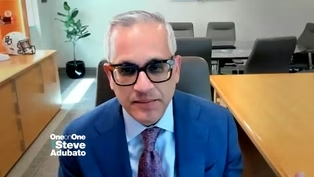
- We are honored to be joined for the first time by Saad Ehtisham, who is the President and Chief Executive Officer over at Atlantic Health, one of our longtime underwriters and healthcare partners.
Good to see you, Saad.
- Nice to see you, Steve.
Thank you for having me.
- You got it.
And by the way, for those who don't know Atlantic Health, describe the organization.
Please, Saad.
- Yeah, Atlantic Health's been here for 20+ years.
Some of our hospitals, you may recognize, Atlantic Health Morristown Medical Center, Atlantic Health Overlook Medical Center.
We also have our regional hospitals in Chilton Medical Center, and then out on the western side of North Jersey, we have Hackettstown and Newton Medical Center.
And we also have a partnership in Freehold with CentraState Medical Center.
So 24,000 employees, team members.
We have six hospitals.
We got about 1,000 physicians.
We got 50 sites of care.
We got a big, strong GME, graduate medical education program.
We train about 360 odd residents each year.
We got close to a couple of hundred medical students coming through.
We have a partnership with Jefferson Medical School as well.
So a little bit about Atlantic Health.
- How did you come into and why did you come into healthcare, please?
- You know, the journey for me to healthcare started really in Fort Worth.
So watching my grandmother go through ovarian cancer surgery.
I was 13 at that time.
And the way the care was delivered, my brother, older brother, we witnessed that and we talked to the grandmother, you know, "How is all this?
How do you feel?"
And she was just kind of blown away with the personalized care and the compassion that was shown to her.
And at that point, we decided this is a great profession, we want to pursue healthcare.
At that point, we both wanted to be physicians.
And well, one of us achieved that goal, my older brother.
I went a different direction.
(laughs) - What's his specialty?
- He's a neurointensivist.
He's double boarded.
- Wow.
Well, thank you for his service and all the clinicians, the physicians and the nurses and all the other folks on the clinical side who make a difference every day.
So let me try this with you, I'm curious about this.
I often ask people who are in top level leadership positions what their most significant challenge is, and what is the most significant leadership challenge you face?
And is it a healthcare-related challenge or just being a leader in any industry?
- You know, I'll give you a lot of respect.
I think the biggest challenge being in this seat, you know, we've all held different leadership seat, but when you sit in this seat of running an organization, I think the biggest challenge is making sure that your team knows that you care about them.
You gotta get that message to them.
They gotta feel it.
The authenticity has to be there, that you care about them, you care about their wellbeing, and your day is consumed with how am I making their life better or am I making their life worse?
I think the key success for any leader is if he or she can do, create an environment where people go home and they're excited to come back, especially on a Sunday, are they dreading coming back or are they excited to come back?
I think that's the challenge that is before us.
- In terms of challenges, Saad, to what degree do you see artificial intelligence, AI, as a significant challenge and/or a threat?
- I see that as an opportunity, not the challenge to me, it's an opportunity.
It's because for me, it's not about the shiny object or the new thing, it's not about the headline we're gonna get that Atlantic Health is deploying AI.
Well, no, it's not about that.
We gotta know what problems are we trying to solve?
And so if we know what problem we're trying to solve and there's a solution and that happens to be an AI solution, we need to bring that in and then embed that in our workflow.
And at the end of the day, we're bullish on AI when it comes to back office functions, agentic AI, when it comes to ambient AI, which we're about to deploy, we deployed agentic AI for scheduling to reduce friction.
We also want to develop AI assistants to work alongside our leaders who can do the mundane work off processing a lot of information and then just giving it to the leader who will make them scale a little bit faster and bigger and make them more available to be there in front of their team to talk to them and connect with them instead of sitting in front of a computer.
So that's where I think the value of AI really is.
I am cautious about using AI in making clinical decisions because you got to have a cognitive decision-making person, physician, clinician in between the patient and the technology.
- In the effort to keep costs down, particularly when there are so many questions about federal funding and where money is coming from, state funding, federal funding, reimbursement, all of it, how the heck, Saad, do you keep costs down?
You're laughing, why?
And still do the personal human touch and be as caring for patients and their families as you just described, and I know it's so important to you.
How the heck?
- Yeah, I'm laughing because it's easy to say, "Well, what's the biggest component of your expense structure?"
Well, salaries, wages are gonna come up, they're gonna be anywhere from 45% to 55, someplaces 60% off your expense line item, right?
Then you got supplies.
So it's like, "Well, that's costing you a lot of money, should we focus there?"
I tell you what, your frontline is your bottom line.
You start focusing there, you've already lost the battle, right?
You need to think about how you enable your team to think differently.
This is where technology also comes in, right?
And part of our iteration is going to be using Lean Six Sigma in reducing waste within the organization.
There's a lot of waste in most organization.
There's duplication that happens within the organization.
What do I mean by that?
Specialist comes in, cardiologist orders a test.
Here's another one, specialist comes in, they order another test.
Two similar tests being done, money going testing.
And so that's where we're gonna focus on.
We're gonna focus on access as well.
There's a lot of, you know, can we get the patients when they wanna be seen by a clinician in the clinic office, physician office in a timely manner?
You're having some chest pain, your wife, you know, my wife nags me every time something happens, she's like, "Hey, you need to go see a doctor."
I don't wanna go see a doctor.
- (Steve laughs) (Saad laughing) - But she makes me go see a doctor.
So I make an appointment and I can't get in, in a timely fashion, yes, I'm going somewhere else, and so we gotta fix those type of things.
So I think for any leader, think about what you're doing and how you're operating and focus on those things.
Reduce the friction between the patients, consumers and us.
Take care of your team.
If you're having to come to your team at the end of the day and there's a lot of headlines.
I just saw a headline in our own state, in our backyard, 1,000 people the other day going to be downsized.
I just think that's just a wrong direction.
Atlantic Health, really proud to say during pandemic when you saw all those headlines of workforce reductions, we did not do any of those.
- None?
- None, zero.
We focus on our culture a lot here and you can get a lot more done.
So my goal is, you talked about AI.
My goal is, so let's think about this for a second, they're working at 100% capacity right now, that's causing some burnout too, right?
Can we bring technology to support our clinicians where they work at now 90% off their current capacity?
Not 100%, but produce 150%.
I think that's possible.
And when you do that, you enable a resilient workforce and you don't have to think about laying anybody off because you're getting more production out of them.
- Saad, I cannot thank you enough for joining us.
We appreciate it.
- Thank you, Steve.
Appreciate it.
I look forward to the next conversation.
Take care.
- You got it.
Stay with us, we'll be right back.
- [Narrator] To watch more One on One with Steve Adubato find us online and follow us on Social media.
- Hi, I'm Jackqui Tricarico, Senior Correspondent for "One-on-One".
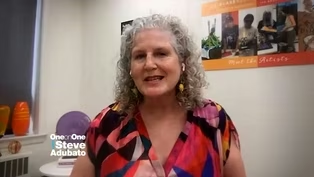
And joining us now is Carol Losos who is the executive director of an incredible nonprofit located in Newark called GlassRoots.
It's so great to have you with us, Carol.
- Thank you, Jacqui.
I'm so excited to be here.
- Well, first, just describe GlassRoots for us.
And the organization was started 25 years ago?
- We are really excited to be celebrating our 25th anniversary this year, started in 2001 with the dream of marrying teaching Newark youth, glass art skills and business skills along with life skills.
And 25 years later, we're still here.
We started with a little afterschool club at the Boys and Girls Club with two torches.
And today we have large furnaces, a full scale glass arts studio, and serve 6,000 young people a year.
- Wow, and when we're talking about the people that you're serving, I know that it's a wide range of ages, eight to all the way up to 80, but let's start with that the younger population that you serve, those young kids, because we know that arts in general is just so good for our youth in just understanding themselves and the world around them.
But talk specifically about glass making and how you've seen that putting that together and creating glass in the way that you're teaching them really impact the young people coming through your doors.
- Sure.
There's something really wonderful about glass.
Totally agree with you, arts makes such a difference in everyone's lives and young people and can teach so many skills far beyond the art skill that they're learning.
Here's the magic, as I like to call it, the magic of fire and glass.
We hand fire to tweens and teens and young adults and we say "yes" and "create".
This is not your normal circumstances.
This is not your normal art class.
This is something different, unusual, risky, exciting, thrilling, all of the above.
And through it, young people learn teamwork, they learn resilience, they learn problem solving, they learn creativity, and they learn, yes, yes, I can do this.
And it's really this just tremendous mix of adding fire to it.
Think what we all know also in today's world, we all know glass breaks, right?
I drop a drinking glass to my kitchen floor, it's going to shatter.
So it's something we all understand.
And so one of the really powerful things we teach, I don't want to call it failure, we teach resilience.
We teach young people that after something breaks, you go back, you try again, you figure out what was wrong.
And they innately understand that they see their teachers doing it.
And it's just a really powerful tool that teaching glass allows us to share with our young people.
- I imagine teaching vulnerability too sounds like a big part of it.
- It does.
- Yeah.
Yeah.
And when you said the safety or the risk factor, I imagine for me, if I came into your studio, I would be probably a little intimidated and I'm, you know, an older person.
Be intimidated by the machinery and the heat and the glass.
I think I would be intimidated.
Are people coming in initially intimidated and how do you work with them to get them over that like initial fear of touching the equipment and working with the equipment?
- Sure.
Of course you're intimidated.
And, you really should be, right?
Because we're talking about standing in front of a furnace that is set to 2,000 degrees of heat.
That's the temperature at which glass exists in a molten state.
We are naturally intimidated and that's not, the 10-year-old is intimidated, the 80-year-old is intimidated and everybody in between.
So first, what we do is we acknowledge that straight up with everyone.
Yes, you're going to be afraid.
And secondly, you can do it.
We're by your side and we are going to safely instruct you and show you how you can gather the glass and not burn your hands, how you can shape it and not burn your arms.
We're just going to just guide you and be with you along the way.
And fairly quickly really almost everyone gets over that fear.
That’s just so empowering For everybody and so very important for our young people.
- And they might come in and be a little nervous about the safety or getting hurt, but at the end of the day, what you're doing located in an urban community, you're creating a safe and supportive environment for these young people.
How are you making sure that's something that they feel at when they walk through the doors there?
- Sure, and that's something that our young people have said for years.
If we, you know, run our surveys, we talk with them afterwards and they describe what was it about GlassRoots that really made it such an important place?
And they say it was a safe place.
And that's through our staff.
I'm just gonna have to say that we employ an amazing group of artists who all have the title teaching artists 'cause that's the core of what we do.
And it's by being beside them, acknowledging that this is scary, acknowledging that this is difficult.
Listening is of course really big.
And I think it's also because it is a little bit risky and it's new to everybody that people, your colleagues don't come in with the expertise so that it's this understanding you can be vulnerable and everybody kind of starts at the same place that allows young people to become comfortable.
All of that's true.
I guess I'm gonna repeat.
At the end of the day, it's the staff here that create a sense of a safe place for our young people from Newark.
- Yeah, that's amazing.
And in terms of the space, there is a new space opening.
Tell us about that and the move that's happening.
- Sure.
It has been... So we've been in downtown Newark for 25 years.
And it's been a dream of GlassRoots for the past 10 to move to a bigger space so that we could reach more people with more programs, more opportunities, and more in-depth programs as well.
It's taken us a little while to get there to find the space, to raise the funds and all of the above, but we're just about to move into a space that's twice our size.
So we're going from 5,000 to 10,000 square feet.
It is being entirely built out for GlassRoots.
So every space has in mind a glassblowing studio, a flame shop, a place where you can make mosaics and stained glass.
It's all designed for us.
We're really excited.
It's on one floor on ground level with these big windows.
So as you walk by us still in downtown Newark you can just peer in the windows and watch glass being blown from the sidewalk.
- See the magic happening in real time.
- That's incredible.
And finally, real quick we know nonprofits, the way that we continue to operate and especially after 25 years, is through the support of the business community, other nonprofits.
How important has that support been in Newark for you and the organization?
- Oh, vital, that is we're a nonprofit and while we have programs we do earn money.
We have classes.
By the way, Jacqui, if Glassblowing was on your bucket list, we have a class for you.
- I'm adding it.
I'm adding it.
- All right.
Please do.
Come for date night if you'd like as well.
- Perfect.
- Bring anybody along with you.
So we do have a lot of programs where we earn money, but more than half of our income comes from fundraising.
And we are really dependent on our state's arts organization.
We're dependent on the city of Newark and the generosity through city funds and through really our corporations in Newark that make such a vital difference to the lives of nonprofits.
We are really excited that Horizon has been a supporter for a long time and has helped us build a new program that's just two years old called Prism, which is a program for LGBTQ teens and young adults.
And that's new to our offerings.
Thanks to Horizon, Prudential, we can go down the list and also our local nonprofits like the Victoria Foundation as well.
- That's incredible, and I cannot wait to come down and check out your new location on Bleeker Street later this summer.
Thank you so much, Carol, for joining us and giving us more insight about this incredible organization, thank you.
- Thank you, Jacqui.
- For Steve Adubato and myself, thanks for watching.
We'll see you next time.
- [Narrator] One-On-One with Steve Adubato is a production of the Caucus Educational Corporation.
Funding has been provided by EJI, Excellence in Medicine Awards.
A New Jersey health foundation program.
Horizon Blue Cross Blue Shield of New Jersey.
The Turrell Fund, a foundation serving children.
Rutgers University Newark.
The Burke Foundation Newark Board of Education.
PSEG Foundation.
The New Jersey Economic Development Authority.
And by The Fidelco Group.
Promotional support provided by NJ.Com.
And by BestofNJ.com.
- At the Turrell Fund, we know that all New Jersey families deserve access to affordable, high quality childcare.
Early childhood education supports healthy brain development and provides essential support to power the economy, enabling parents to work, businesses to operate, and communities to thrive.
The Turrell Fund is proud to be part of Start Strong NJ, a statewide initiative to put affordable, high quality childcare within reach of all New Jersey families.
Learn more at TurrellFund.org and StartStrongNJ.org.
 New
NewCEO of Atlantic Health examines trust in public health
Video has Closed Captions
Preview: S2026 Ep2943 | 9m 59s | CEO of Atlantic Health examines trust in public health (9m 59s)
 New
NewExploring the First Responders Children's Foundation
Video has Closed Captions
Clip: S2026 Ep2943 | 8m 40s | Exploring the First Responders Children's Foundation (8m 40s)
 New
NewHow glassblowing can change lives and empower creative minds
Video has Closed Captions
Preview: S2026 Ep2943 | 9m 47s | How glassblowing can change lives and empower creative minds (9m 47s)
Providing Support for PBS.org
Learn Moreabout PBS online sponsorship New Episode
- News and Public Affairs

Top journalists deliver compelling original analysis of the hour's headlines.
 New Episode
- News and Public Affairs

Today's top journalists discuss Washington's current political events and public affairs.
 New Episode


 New Episode
 New Episode
 New Episode


 New Episode
Support for PBS provided by:
One-on-One is a local public television program presented by NJ PBS