One-on-One
Larry Abrams; Gillian Ober; Catherine MacManiman
Season 2026 Episode 2906 | 27m 36sVideo has Closed Captions
Larry Abrams; Gillian Ober; Catherine MacManiman
Larry Abrams, Founder and Executive Director of BookSmiles, discusses his innovative approach for reducing book waste. Gillian Ober, 2025-2026 New Jersey State Teacher of the Year, discusses advocating for students who often go unheard. Catherine MacManiman, Chair of the NJEA Convention Committee and Teacher at Holly Hills Elementary School, talks about the value of teacher collaboration.
Problems playing video? | Closed Captioning Feedback
Problems playing video? | Closed Captioning Feedback
One-on-One is a local public television program presented by NJ PBS
One-on-One
Larry Abrams; Gillian Ober; Catherine MacManiman
Season 2026 Episode 2906 | 27m 36sVideo has Closed Captions
Larry Abrams, Founder and Executive Director of BookSmiles, discusses his innovative approach for reducing book waste. Gillian Ober, 2025-2026 New Jersey State Teacher of the Year, discusses advocating for students who often go unheard. Catherine MacManiman, Chair of the NJEA Convention Committee and Teacher at Holly Hills Elementary School, talks about the value of teacher collaboration.
Problems playing video? | Closed Captioning Feedback
How to Watch One-on-One
One-on-One is available to stream on pbs.org and the free PBS App, available on iPhone, Apple TV, Android TV, Android smartphones, Amazon Fire TV, Amazon Fire Tablet, Roku, Samsung Smart TV, and Vizio.
Providing Support for PBS.org
Learn Moreabout PBS online sponsorship- [Narrator] Funding for this edition of One-On-One with Steve Adubato has been provided by The Russell Berrie Foundation.
Making a difference.
Holy Name.
NJ Best, New Jersey’s five-two-nine college savings plan.
Kean University.
Where Cougars climb higher.
PSE&G.
Powering progress.
EJI, Excellence in Medicine Awards.
A New Jersey health foundation program.
The Fund for New Jersey.
Horizon Blue Cross Blue Shield of New Jersey.
And by The Fidelco Group.
Promotional support provided by NJ.Com.
Keeping communities informed and connected.
And by BestofNJ.com.
All New Jersey in one place.
- This is One-On-One.
- I'm an equal American just like you are.
- The way we change Presidents in this country is by voting.
- A quartet is already a jawn, it’s just The New Jawn.
- January 6th was not some sort of violent, crazy outlier.
- I don't care how good you are or how good you think you are, there is always something to learn.
- I mean what other country sends comedians over to embedded military to make them feel better.
- People call me 'cause they feel nobody's paying attention.
_ It’s not all about memorizing and getting information, it’s what you do with that information.
- (slowly) Start talking right now.
- That's a good question, high five.
(upbeat music) Hi everyone, Steve Adubato with my co-anchor and colleague Jacqui Tricarico.
Jacqui, let's set this up.
People are about to see a series of interviews that we did down in Atlantic City at the New Jersey Education Association Convention.
Let's tee it up.
- Yeah, three interviews that we did down in Atlantic City.
Some are yours, some are mine.
Just great people that we got a chance to speak with about why they were there, why they were attending, and some of the work that they're doing to support educators and as well as the citizens of New Jersey.
So many nonprofit leaders that we had a chance to speak with as well.
So you're gonna see that up in this next half hour.
- So if you wanna know what goes on at the teachers convention, the NJEA Convention, Atlantic City, this is just a taste of some of the folks who are down there, more than 10,000 this year, and the important conversations that took place.
Let's check it out.
- Hi everyone, Steve Adubato at the New Jersey Education Association Convention in AC, Atlantic City.
We're here with Larry Abrams, who is the executive director and founder of a great organization called BookSmiles.
Good to see you again, my friend.
- It is so good to be back, Steve.
- For the, by the way, go back and look at steveadubato.org.
You'll see past interviews we've done with Larry.
For those who don't know, while the website's up, tell everyone what it is.
- So what we do is obsessively collect children's books, used kids' books, so that we can give them away to kids in need.
No child in New Jersey should grow up with lack of access to books.
- How'd you get into it?
- Came from being a teacher and having a conversation with one of my students who, when I asked her, what are you reading to your baby?
She replied, "I'm not reading to her."
And when I inquired further, she just said, "Mr.
Abrams, that's just not part of my culture."
Instead of lecturing her, I went onto Facebook, did a book drive, 1,000 books rolled onto my front porch I gave to my student, who eventually started reading to her baby girl, and then her two boys behind.
And those kids are all reading on grade level and beyond grade level in the district where I taught.
- I remember we, you haven't been teaching for a few years.
You've not been teaching.
- It's been three years since I retired.
- So this organization, which started with an idea, a need, you address it.
Right, Larry?
Has grown tremendously.
Describe its growth.
- Well, we are growing because we help fix two dumb problems we have in this country.
The first dumb problem is people don't know what to do with their used kids books.
They take them to a big box thrift, they let them molder and fester and age in tubs in their basement.
There is a better alternative.
We are that bridge of books where people give us their books, used books, both grownup and kids books, and we get them into the homes and hands of kids in need.
The other dumb problem we have in this nation.
- Why do you call it a dumb problem?
- Because it is a dumb problem.
The fact that we are throwing away used children's books, they go into landfills, and that is wrong, because people don't know what to do with them.
- Okay, but right now someone watching.
- Right.
- They're inspired by your work, they're impressed.
"Wow, that's terrific, Larry's doing this."
What do they do with their books like right now?
- So what they have is what I call book-wealth.
I made that term up, book-wealth.
They get onto our website at BookSmiles and they will learn how to donate their kids books and their grownup books.
I have found out how to turn grownup books, tons of adult books, each week into kids books.
I trade them.
I trade tons of grownup books for tons of kids books.
I trade them with online book sellers who only want the grownup books.
- Hold on, back up.
- Yeah, yeah, yeah.
- So I've got, in my work, obviously, a lot of books.
You interview authors, I've got some doubles.
I don't need the other one.
I like to keep the original, got a nice little library.
I bring my adult books where to get turned into children's?
Explain that to me.
Where do I bring it?
- So you bring them to BookSmiles and what we do is we take those doubles, we take those grownup books, we put them on a big pallet, and what we then do each week, we trade those big pallets of grownup books for used children's books.
I trade with online booksellers.
- Well, where am I bringing it?
- You're bringing it to the book bank in Pennsauken or you're calling us.
- Do the calling thing, 'cause I'm in northern New Jersey.
It doesn't matter where you're watching right now.
You call the number, the number's on the screen right now.
What happens?
- And what we will do is, if there are enough books, we'll dispatch a truck and we will pick them up.
I am mobilizing teachers here at the NJEA to collect books also in their garage, that way, if we have someone in Montclair collecting books in their garage, once they get literal tons of books, adult books and kids books, I will dispatch our truck to pick them up.
That's how we're going to make it happen.
- I'm curious about this.
I'm a student of leadership.
I'm a student of people who see a problem and decide they're not simply gonna complain about it.
They're gonna do something about it.
When you decided to quote, "Do something about it," when you were confronted with, "It's not in our culture."
- Right.
- By a student or a parent.
- It was a student.
- A student.
- 17-year-old student with a baby.
- Wow, that really puts it in perspective.
Did you ever imagine that BookSmiles would be what it is today compared to, I wanna help out.
- Right, so that's a good question.
So I was a career teacher, but before that I was a Kinko's manager, and I've always dreamed of starting my own business.
- Being an entrepreneur.
- Being an entrepreneur.
And I kind of ran my classroom serving my students with the same kind of passion and vigor and enthusiasm that I used in retail when I ran a Kinko's.
By taking that and putting it into the classroom, I think I became a better teacher.
But lo and behold, this passion project, where I'm just collecting books and giving them away to kids who need them, that ended up snowballing and becoming this wonderful thing that we have today where we are now at the point of being the largest book bank of our kind in the nation.
We are rapidly- - In the nation.
- In the nation, we are rapidly approaching the four millionth book given away since I started this in 2017.
We will have, by the end of this year, we will have distributed 1.3 million books.
So we've distributed in one year a quarter of the books that we've given away since I started in 2017.
Our growth is unbelievable because we're fixing a problem using innovation, taking children's books, and grownup books that would've gone to the dump, gone to landfill.
And the other dumb problem is, why are we tolerating having children in the ninth grade reading at third, fourth, and fifth grade reading levels?
It's because of lack of access to books.
- Before I let you out, how rewarding, one to 10?
- It's definitely a 15.
I look forward to going into work every single day.
I'm surrounded by incredible people.
I have an amazing staff, I cannot do this on my own.
But also the joy of working with my fellow teachers and non-profits is just extraordinary, and every day is amazing.
- This is Larry Abrams, excuse me, executive director and founder of BookSmiles.
We started talking to Larry a few years ago.
I didn't imagine that it would ever get this big.
That BookSmiles would be what it is, the impact that it has.
He's doing important work.
Some people complain about it, other people do something about it.
Thanks, Larry, well done.
- Thank you so much.
- You got it.
Stay with us, we'll be right back.
- [Narrator] To watch more One on One with Steve Adubato - I'm so pleased to be joined now by Gillian Ober, who is a ESL teacher in Freehold Borough and the 2026 New Jersey State Teacher of the Year.
Congratulations.
- Thank you.
I'm still letting that sink in.
- Still absorbing the information.
Well, it's funny because I know the NJEA is notorious for surprising their state teachers of the year.
So bring us back to that day.
It was just a few months ago.
- Yeah.
- Even last month.
What was that like finding out that you were selected?
- It was incredible.
I was just like teaching a lesson in my classroom and my superintendent, she has a really good sense of humor, she comes in, she's like, "Excuse me, you know, I heard, so there's something happening in here.
There's loud noises.
Like, is everything okay?"
And I'm like, "Oh no, we're good, we're good."
And then all of a sudden the commissioner walks in, everyone from the DOE.
- Did you know right away when you saw those faces or were you still confused?
- I like had the moment of like, what's happening?
And then I was like, "Oh my God, this is it.
It's happening."
- Oh my goodness.
Okay, so you find out and then what do you realize right after that?
What is your next steps as New Jersey State Teacher of the Year?
I know you're gonna be, go on a sabbatical.
- Yeah.
- I know you don't know what that looks like quite yet, but what are the next steps?
What does it really mean to be the state teacher of the year?
- I think it's just, like in that moment it dawned on me like the opportunity that I'm gonna have this year.
And like, I think what's so important about this role is that I got chosen, but like, I'm gonna be the voice for all of these teachers in New Jersey that I know are doing amazing things.
And that's really like, that's the responsibility I feel.
I feel like I have to represent everyone and my students because a lot of my students don't have a voice and they need it to be amplified, or they have voices, but I want to make them heard.
So I'm just so excited.
I have no idea what opportunities are gonna present themself, but to be the one to be able to kind of catapult things for multilingual learners, for immigrants, I'm just really lucky to get to have that microphone.
- Talk about that, talk about your students.
You're in seventh grade now teaching seventh year classroom.
Talk about the students that you're seeing every day.
What kind of challenges are they facing?
- So I work with a lot of our newcomers, so those are students that just came to the United States.
- First generation.
- Yeah.
And a lot of my students have interrupted, like formal education are, you know, they're navigating a new language, a new culture.
So I always, what I say about my students who I'm always just like in awe of them, is they have to be so brave every day.
Like all of our students in New Jersey are amazing, but these kids have to come to school every day and have that bravery to try to learn a new language.
Like that takes a lot, it's scary.
And they're navigating things outside of school that a lot of adults haven't gone through in their life and they're 12, 13 years old.
So they just really, they inspire me.
They're amazing.
- And New Jersey is such a melting pot.
How are you able to really like take each student individually, because like you said, they're coming from all different walks of life and really make sure that you're able to connect with them individually to help with their specific needs?
- Well, what I say is, you know, like I think when you're working with multilingual learners, the biggest thing you can do is you have to build like, relationships with your students.
Because if I don't have their trust, the learning's just not gonna happen.
In multilingual education, we talk about the effective filter, and it's essentially if your anxiety is high, it's impossible to learn a new language.
That language acquisition, it's not gonna stick.
So getting your students to trust you and just feel safe, like if I've done that, I'm like, okay, the academics can come, it's important, but for my students that they feel a connection, that they feel that they have a place they can come to and be themselves, then, I feel like I've done my job.
- Give us one of the biggest challenges you've had to face as an educator and how you were able to overcome it.
- I think the past few years, what's been really tough for a lot of my students is just the immigration experiences that they're facing outside of school.
I've had a lot of families that are in our extremely complicated court system, you know, trying to get residency or green cards, and that's a lot for a kid to be navigating while also just trying to be a kid.
So I try to advocate for my students.
I try to help with that outside of school, if I can help families in any way, you know, during their experience with immigration court.
You know, I always, I'm not a lawyer, but I've done a lot of work to try and help families know their rights and just feel like they're supported and they're not alone in it, 'cause that can be a very isolating experience.
It can be scary to ask for help.
It's scary to navigate a system that's very complicated and that oftentimes families feel like the world is working against them.
- How do you personally not take all that home with you?
We know teachers are not just, your job's not done when you're out of the classroom and there's so much that goes into it.
How are you able to also think about yourself and your own mental health and wellbeing?
- That is a work in progress, because if you ask my family, it's really hard not to take it home because a lot of these kids become like my babies.
Like they, I feel like they're my family that's in my classroom.
With my co-teacher when I was in fifth grade, we would always say we're a family, somos una familia, and you know, that is kind of our guiding principle throughout the year.
Like, we don't all have to be best friends all the time, but we're gonna love and respect each other so that learning can happen here and we can support each other every day.
And it just, I don't know, when you have that at the base of your class, things that happen are very cool and inspiring.
- You have done a lot with the STEM fields too.
I know that's been a passion of yours.
And Fort Dix especially, there was a program that you did at Fort Dix.
Describe that program because I found it really interesting.
- Yeah, so my superintendent, one of her very lifelong friends is actually the director of STARBASE.
And it's a lab that they have on the military base.
It's basically a STEM lab for fifth graders and they come and do a series of field trips.
So I was our fifth grade team leader.
So Asia Michael, my superintendent came to me, and she's like, "Let's make this happen."
And it was actually, it ended up being 40 field trips throughout the school year because each of our fifth grade classes got to go five times.
- Wow, what were the takeaways for those students being able to see something like that hands on?
- Well, I think something that, like, what I noticed was it gave the opportunity to some of my students that might not have traditional success in the classroom.
My students that are struggling readers, my students that might have interrupted formal education, they could do the hands-on experiments and labs.
Like we were doing coding, we were doing robotics, and it was a really great opportunity for those kids that might not always shine in the academic sense.
They were rock stars when we were there.
Like it was so cool seeing them have that moment of like, they were the ones getting the coding and then explaining it to their classmates.
It was really amazing.
And the director also worked with us.
We had some engineers come in and some of them were multilingual learners, so it was really cool for my students to see people that looked like them, people that sounded like them, that spoke another language in this job where they're, you know, helping defend our country and doing all of these crazy engineering projects.
That was like a powerful thing to see.
- Opening their eyes to so much more outside of the classroom.
That's wonderful.
Lastly, your, some of your colleagues have said things like, "You're fun loving.
You recognize the various types of learners and really are able to hone in on that and you build strong relationships with your students."
What has it felt like for you to have this recognition, the spotlight on you and your work and you as an individual?
- I think I'm still getting used to it a little bit.
I'm not used to the spotlight, but I think it's been really humbling to have that support around me and it just kind of validates what I've been doing.
I'm just gonna keep doing what I'm doing and making those connections.
But I think that's what's been really beautiful about this whole experience is people commenting on, like, it's the connection that I make with the kids because that's what matters the most to me.
So the fact that other people are seeing that and it got me here to state teacher of the year.
- Yeah.
- I'm like, you know what?
The universe has a plan for me and I'm just gonna keep being me and being my authentic self, because I think that's what makes me, when I come as me to my students, it gives them the freedom to also be themselves.
- Well, you're doing incredible work representing so many great teachers across our state.
Thank you for joining us and good luck on this next journey, this sabbatical for you.
- I know it's gonna be great.
- It really is.
We can't wait to catch up with you afterwards.
We'll be right back after this.
- [Narrator] To watch more One on One with Steve Adubato find us online and follow us on Social media.
- Hi, I am Jacqui Tricarico on location at the NJEA Convention here in Atlantic City.
So pleased to be joined now by Cathy MacManiman.
She's the chair of the NJEA Convention Committee here this year and the kindergarten teacher in West Hampton, New Jersey.
- Yes.
- Great to have you with us.
- Thank you.
- Good morning.
So talk about being the committee chair for the convention here this year.
What does that mean?
- So, I chair a committee that represents someone from every county.
We also have a representative from higher ed, our aspiring ed and our retirees.
So we get all those people together a few times a year, and we talk about the feel of the convention, the vision for convention, what went well this year, what we need to fix for next year, and we bring all those opinions together.
They get information from their counties to share with us.
They take information back to their counties.
So it's really a lot of collaboration.
We work with our staff, Dr.
Chrissy and Vicky and Krista who do the heavy work of this convention, but we get a piece of it, which is great.
- And for people who haven't been, this convention is massive.
There are I think estimated 10,000 educators, support professionals, all types of people coming in and out of these doors over the two days.
What were you most excited about for this year specifically?
- So our keynote, Malala Yousafzai, goodness, when her name came out, it's shocking to us, and we knew that that was a possibility, but the buzz we heard from members around the state about seeing her in New Jersey and hearing her and being in the same room with her.
So that was amazing.
The shift over the past few years, really focusing on our social justice side of our union because we do all the important work of contracts and contract enforcement and supporting our educators so they can support our students.
But giving a nod to that social justice side with some of our exhibits and some of our presentations really is exciting and seeing that happening in real time while we're down here is great.
- Yeah, it's such a diverse community here.
All walks of life.
You walk around the convention, you're gonna find anything from, you know, baby chicks over there that you can hold, (Both laughing) to a drag queen exhibit right behind you.
It's just really fun.
But you and your team are walking around in bright colored shirt.
- We are.
- Saying, you know, ask me a question if you have it.
How important was that rule for you and what are some of the questions you've been asked over the last few days?
- So let's say the most interesting questions, gosh, somebody asked me the capital of Idaho last year when I had my ask her.
I'm not sure that I did.
I think I gave a really tentative guess.
But you know, that just to be funny and just to be silly, but we're asked where things are all the time.
- Like I said, it's big, it's hard to navigate.
- Yeah and oftentimes we had that line from Malala yesterday and it was so far back and people were saying, how do we get to the Malala's line?
And for a while it was that way, and then it was, oh my gosh, it's right here.
It's wormed its way all the way around.
- Yeah.
And that line was long yesterday.
I poked my head over there it was completely filled to the brim.
They couldn't let anybody else in.
How do you see this convention kind of as a reset for teachers.
We're in November.
I mean, teachers just got back into the classroom, but let's be honest, teachers work year round, right?
How do you see it as a reset for them to kind of all come together under the same umbrella?
- Well, I think that's a really important part of it because we start in September, some teachers, these two days are their first days off from teaching.
Some don't have any holidays in the early months.
And you get to be here with people who know you and know your job and know what your struggles are.
I said when I was on the phone with Chloe, that my husband, I've been married now for 30 years, and so I've been a teacher all those years and there are still things he just doesn't get about my job and about my day-to-day.
And here we know we are finding like people, these are our people.
And while we come from different places in the state, physically or geographically, and we have different backgrounds, we all know what it is to go in and face our students, whether we're a bus driver or cafeteria worker, teacher, a classroom aid, we all have that shared common language and it is a reset.
It is, these are my people, this is where I need to be.
- This is the community.
Bringing everybody together.
30 plus years in the classroom, where do you continue to get the energy and just the passion to keep going?
- I have great teacher friends at school and great colleagues at school, which makes the day so much better.
But in kindergarten especially, they're just so new.
We often say like, you weren't here five years ago, you weren't even on the earth, you know?
And here they are and they're so much ahead of them.
So how can we bring them into school and soften them and give them that great start to their education because it's a long process to get where they need to be as adults.
So that's what motivates me.
And just their little faces and their little enthusiasm and just what can I do to help make their experience and their start of school a great one so they love to be here, you know, have it be a really warm place to move them on to their next learning.
- Yeah, propel them for a lifelong learning journey, really.
What is a piece of advice that you would give a newer teacher just starting out on this journey that you've learned along the way?
- I think find your people.
That's a big one.
Find the right people.
And that takes some trial and error because you have to find the people that feed you and they help make your day better.
They'll listen to you and not judge you when you just need to vent a little bit.
And take your time.
When I started, that really wasn't anywhere in anybody's mind about take time for yourself, let alone for educators.
So that is a big thing, but you also have to do what helps your day go by.
So if I get there early before school and other people don't, that's okay because that's what helps my day get going.
And they have to find that spot too.
You can't take everything in.
You can't be Marsha Brady signing up for every club.
You have to, you know, do some trial ana error and find your people and balance your life.
- And what I've learned, it does seem like it's really difficult to do that as a teacher because you're bringing so much home with you of what you're learning from your students and different trials and turbulence that the students are feeling that they're bringing into the classroom and you're taking on for them.
So it's really, I think, like you said, so important for self-care.
Mental health, number one.
- And sometimes shutting things off because especially too, we talk about social media and it's impact on our students and our children, but we are getting social media posts of how to teach this better, how to do this right and you're doing this wrong.
And sometimes educators, we have to shut that off too and do what works for us and for our students because the best practices are the best practices and there are things we can go towards, but it doesn't always work in our own classroom with our particular students.
So that's part of it too, is shutting off all the outside influences at times and sifting through what works and what we want to try and what we're saying, not this year.
- Yeah, that outside noise.
- Yeah.
Really.
- Well, Cathy, thank you for dedicating so much time.
to our youngest students here in the state and thank you for helping our teachers and all the other folks attending today navigate this beautiful convention.
It was great to speak with you.
- Thank you to our senior correspondent Jacqui Tricarico, and for Jacqui and our entire team here at One-on-One we thank you so much for watching.
See you next time.
- [Narrator] One-On-One with Steve Adubato is a production of the Caucus Educational Corporation.
Funding has been provided by The Russell Berrie Foundation.
Holy Name.
NJ Best, New Jersey’s five-two-nine college savings plan.
Kean University.
PSE&G.
EJI, Excellence in Medicine Awards.
A New Jersey health foundation program.
The Fund for New Jersey.
Horizon Blue Cross Blue Shield of New Jersey.
And by The Fidelco Group.
Promotional support provided by NJ.Com.
And by BestofNJ.com.
- (Male narrator) Ready for anything?
That ought to be our state motto.
All hustle, no nonsense, never backs down.
So when it comes to strengthening the grid and uplifting our communities, we do it our way.
Because storms don’t care what exit they hit, and talking doesn’t fix the grid.
Fixing it does.
Around here, we make our own future.
Because ready is who we are.
PSEG.
 New
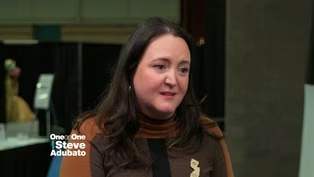
New2025-2026 NJ Teacher of the Year highlights creating trust
Video has Closed Captions
Clip: S2026 Ep2906 | 9m 58s | 2025-2026 NJ Teacher of the Year highlights creating trust (9m 58s)
 New
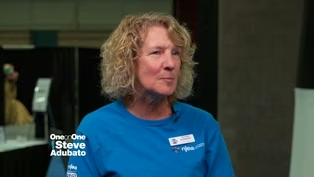
NewAdvice to fellow educators about teacher collaboration
Video has Closed Captions
Clip: S2026 Ep2906 | 9m 2s | Advice to fellow educators about teacher collaboration (9m 2s)
 New
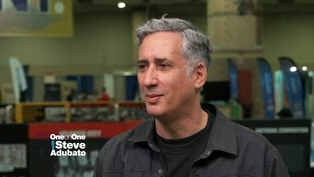
NewHow this non-profit is reducing waste, one book at a time
Video has Closed Captions
Clip: S2026 Ep2906 | 8m 11s | How this non-profit is reducing waste, one book at a time (8m 11s)
Providing Support for PBS.org
Learn Moreabout PBS online sponsorship
- News and Public Affairs

Top journalists deliver compelling original analysis of the hour's headlines.

- News and Public Affairs

FRONTLINE is investigative journalism that questions, explains and changes our world.











Support for PBS provided by:
One-on-One is a local public television program presented by NJ PBS