One-on-One
Marques; Frugé Starghill and McDonough; Duncan
Season 2026 Episode 2916 | 27m 14sVideo has Closed Captions
Sandra Marques; Catherine Frugé Starghill, Esq. and Michael McDonough; Jade Duncan, DDS
Sandra Marques, Assistant Superintendent, Newark Public Schools, discusses supporting students with diverse needs. Catherine Frugé Starghill, VP at NJ Council of County Colleges & Michael McDonough, President of Raritan Valley Community College, talks about pathways to fill labor market needs. Jade Duncan, Senior VP of Dental Services at Zufall Health, talks about connecting veterans with care.
Problems playing video? | Closed Captioning Feedback
Problems playing video? | Closed Captioning Feedback
One-on-One is a local public television program presented by NJ PBS
One-on-One
Marques; Frugé Starghill and McDonough; Duncan
Season 2026 Episode 2916 | 27m 14sVideo has Closed Captions
Sandra Marques, Assistant Superintendent, Newark Public Schools, discusses supporting students with diverse needs. Catherine Frugé Starghill, VP at NJ Council of County Colleges & Michael McDonough, President of Raritan Valley Community College, talks about pathways to fill labor market needs. Jade Duncan, Senior VP of Dental Services at Zufall Health, talks about connecting veterans with care.
Problems playing video? | Closed Captioning Feedback
How to Watch One-on-One
One-on-One is available to stream on pbs.org and the free PBS App, available on iPhone, Apple TV, Android TV, Android smartphones, Amazon Fire TV, Amazon Fire Tablet, Roku, Samsung Smart TV, and Vizio.
Providing Support for PBS.org
Learn Moreabout PBS online sponsorship- [Narrator] Funding for this edition of One-On-One with Steve Adubato has been provided by Delta Dental of New Jersey.
We love to see smiles.
Johnson & Johnson.
EJI, Excellence in Medicine Awards.
A New Jersey health foundation program.
Atlantic Health System.
New Jersey Manufacturing Extension Program.
NJ Best, New Jersey’s five-two-nine college savings plan.
PSE&G.
Powering progress.
The Center for Autism And by The Fund for New Jersey.
Promotional support provided by NJBIA.
We put business at the center.
And by Insider NJ.
- This is One-On-One.
- I'm an equal American just like you are.
- The way we change Presidents in this country is by voting.
- A quartet is already a jawn, it’s just The New Jawn.
- January 6th was not some sort of violent, crazy outlier.
- I don't care how good you are or how good you think you are, there is always something to learn.
- I mean what other country sends comedians over to embedded military to make them feel better.
- People call me 'cause they feel nobody's paying attention.
_ It’s not all about memorizing and getting information, it’s what you do with that information.
- (slowly) Start talking right now.
- That's a good question, high five.
(upbeat music) - Hi everyone.
Steve Adubato.
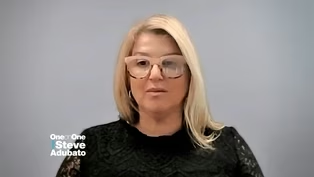
We kick off the program talking about Newark Student Leaders of Tomorrow with Sandra Marques, who's Assistant Superintendent of Newark Public Schools, East and Central School Leadership team, part of our partnership with the Newark Public Schools.
Good to see you, Sandra.
- Thank you Steve.
Thank you for having me.
- You got it.
You've been with the Newark Public Schools for how long?
- This is my 26th year in the district, and I started as a student teacher.
So if you count that, that's 27.
- Why teaching?
Why education for you?
- So, when I became a parent, I needed to have a little bit of a understanding what the educational system was about for my son.
And that really sparked an interest in the teaching career that I began at Hawkins Street School.
- At Hawkins Street School, I know it well.
As a student who went through the Newark Public Schools back in the day.
Why is bilingual education so important to you and why do you think it's so important to your students?
- So, I'm trilingual myself.
I was raised in a household that we spoke Portuguese, and having started kindergarten, not knowing English, even though I was born in this country, led me to value both what I was able to do at home, speak a second language, as well as learn how to speak English with my teachers and my peers.
I think that students who are newcomers into the country, they come with an educational system and they have an understanding and background, and our job is really to provide them with the language and the resources so that they can become successful.
So supporting our bilingual students as well as all of our other students is crucial for our school system.
- Sandra, in the post pandemic as we do this program, we're approaching six years that COVID became such a painful reality for so many, especially students.
There are many challenges academically for our students, but in Newark and other urban communities, talk about the mental health struggles and the social and emotional challenges our students face.
'cause you told our producers this is incredibly important.
You wanted to talk about it, go ahead.
- Sure.
So I think post COVID, everyone needs some sort of supports with the social-emotional needs and wellbeing, whether it be, you know, being more active and engaging in physical activity or the mental health services.
All of our schools provide those in school services for our students, there are guidance counselors and social workers that provide support.
We have curriculum that supports social emotional needs.
We use reThink, which is one of our resources for our students.
So I think in general, it's something that we cannot just, you know, ignore.
And I think that we're doing a really good job of supporting our students and making sure that the resources are available to them.
- Let me ask you this, I'm curious about this.
We talked to Roger León, your superintendent about this.
This series again called Newark Student Leaders of Tomorrow.
Graphic will come up so people can go on our website, which will be also put on the screen.
You can find previous interviews featuring Newark Student Leaders of Tomorrow.
What is it that you see in your students that causes you to be so optimistic about their leadership potential with all the challenges they face?
- So I believe that all students can learn, and it's our job to tap into those abilities and motivate our students to do better.
In my role as CTE director for the district.
- CTE?
- Career and technical education.
- Yep.
- Was the role that I had previous to this role.
I got to experience education in just a different lens where we're not only preparing them for current education, but we're preparing them for the workforce and we're preparing them for their futures.
And we have programs that are preparing all our students.
We have carpentry programs, we have the trades, we have biomedical programs for students that are interested in pursuing medical career, allied health programs.
So the geniuses that I saw in all of those settings and the motivation that students had to succeed just, you know, is motivating to an adult doing the job, that they have interest, they have a skillset beyond the skillset that we have when it comes to technology, robotics, eSports, there's just so many venues and places where they can excel, and it's just affording them those opportunities, and I believe that that's what we do.
Our 10-year strategic plan, our high school redesign is intentionally designed to do that.
And our high schools are excelling.
- Let me ask you this, Sandra, you're very committed to helping people better understand what autism is and our students who are dealing with it.
I know you work with the Center for Autism.
My sister Michele, who will actually be recording with us today, founded the Center for Autism.
We've worked with them in greater, creating greater public awareness around autism.
You're working with the Center for Autism.
Talk about that work and why it's so significant to many of your students who are dealing with this.
- Sure.
So in 2016, I was appointed the principal of Salome Urena, which is the old First Avenue building.
And at the time we had a population of students with autism as well as general education students.
And there was a community resource right there that were the experts, and we took full advantage of it.
We did outreach and we were, your sister was very supportive and she provided my staff and myself with some professional development resources.
We were able to visit the autism center and experience some of what it does on a daily basis, and how those young adults that are there are succeeding.
I had a population of students in pre-K through eighth grade, so it really gave my teachers a lens of what, you know, adulthood and older teenager, the success that they have.
So it was really a great partnership at the time, and I feel like it excelled our program, and we're really grateful.
- Yeah.
Check out those interviews on the Center for Autism with my sister Michele.
Sandra, cannot thank you and Roger, and the team, and look forward to continuing to feature Newark Student Leaders of Tomorrow.
All the best, Sandra, thank you.
- Thank you.
I appreciate your time.
- You got it.
Stay with us, we'll be right back.
- [Narrator] To watch more One on One with Steve Adubato find us online and follow us on Social media.
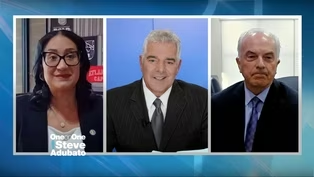
- We are honored to be joined by two leaders in the world of community colleges in the state of New Jersey and the nation.
First, Catherine Starghill is Vice President and Chief Workforce Innovation Officer for the New Jersey Council of County Colleges, and our colleague Mike McDonough, who's president of Raritan Valley Community College.
Catherine and Mike, thank you so much for joining us.
- Pleasure.
- Thank you for having us.
- We have you on because we wanna talk about, first, this initiative called NJBioFutures.
What is NJBioFutures, Mike?
We'll put up a website so people can find out more.
What is it and why is it so important to the pipeline of professionals in this field, particularly as it relates to gene therapy?
- Sure, so it's an innovative effort to do exactly what you said.
There are emerging critical labor market needs in New Jersey.
How do we respond?
How do we train our learners to enter those professions?
So NJBioFutures is a dynamic collaboration between three community colleges, Middlesex, Raritan Valley and Mercer, and leading pharmaceutical industries.
It began with Johnson & Johnson.
And so it is this effort at scale to meet this incredible labor market demand.
- So when you say it began with Johnson & Johnson, Johnson & Johnson's providing the dollars for this initiative.
- They did.
They reached out initially to tell us about this emerging field, their need for highly trained, highly skilled entry level workers, and how might we help?
And so that conversation took place over a number of years and here we are today with a new training center on our campus with Johnson & Johnson providing this collaborative effort and yes, money, expertise, and knowledge.
- And Catherine, before I go to you, let me disclose that Johnson & Johnson, a long-time underwriter of public broadcasting and our production operation.
Catherine, let me ask you, the role of the New Jersey Council of County Colleges in this initiative, A, and we're talking about the industry that Mike talks about or the field is gene therapy.
Explain to folks what that means and why it's so incredibly important for people who depend upon the discoveries connected to gene therapy?
- Sure, so first of all, cell and gene therapy is what's gonna cure us all of many different diseases, like cancer and other diseases.
And so really being able to staff Johnson & Johnson and other pharmaceutical companies with entry level clean room technicians who are trained in the aseptic processing, in clean room behaviors, in good manufacturing practices is very important because it's a very precise technology and therapies that literally cures and saves lives.
- Mike, as I listen to Catherine, to me, I keep thinking about this, is it largely about creating a qualified pipeline of professionals to go into the field, Mike?
- Yes, absolutely.
It is developing a recruiting effort to bring those learners in.
Whether those learners are leaving high school or returning adults who want a different career path, it's providing them with those stackable credentials.
It's providing them with those competencies and those skills that the pharmaceutical companies are looking for and then moving them immediately into those sustainable wage paying jobs.
- Catherine, lemme follow up with you.
Why the community colleges as a platform, as a group of folks who are engaged with students who are a potential pipeline of these professionals going to the field, Catherine?
- Sure.
The New Jersey Community Colleges serve about 250,000 students and adult learners every year as of last year.
And that is because, as the name states, these colleges are in the community.
They make higher education and workforce development training accessible to high school graduates, adult learners who maybe went straight to the workforce and did not pursue higher education, and the colleges have 45 campuses and just like this initiative, NJBioFutures, it was very easy to pull together three community colleges to work as one collective to deliver this curriculum, created really and refined by the industry to be the answer to train, you know, our residents for these very important high paying jobs that are so critical to this technology.
- Mike, let me complicate it for you.
Artificial intelligence and its connection to this effort as it relates to NJBioFutures to expand the pipeline because there is a shortage right now of professionals in the field, what does AI have to do with this, if at all, Mike?
- Probably has a great deal to do with it.
If I were smart enough, I'd be able to map that out for you.
But what I can tell you, and it goes back to your critical question, why community colleges?
Because we are agile, because we are innovative, and because at scale we can adapt to emerging technologies.
Absolutely.
AI will change all entry level work, but you will still need entry level work to then deal with the complications of AI.
That's why you have community colleges.
- You know, Cath, let me ask you something.
My wife went to a community college up in Bergen before she went to a state university, Montclair State University, and I have great respect for your community.
I have great respect for the faculty, the staff and your students.
But let folks understand, not that there's, if someone says, who's your, I never liked that question, who's your typical student?
Because I'm sure it's a very diverse population of students, but why is your sector?
How many students, Catherine, again, are we talking about?
- It's over 200,000.
- 250,000.
- Why are community colleges so incredibly important for so many young people in those two years?
It's a two-year program, right, Catherine?
- Yes.
- Why is it so incredibly important for the future of those young people?
- One, because community colleges are viewed as accessible to them.
It's not as daunting maybe as entering a four-year college or university.
It is in their community.
So maybe individuals, residents have had the opportunity to attend different programs at the community college and they can go, leave, come back.
We make it very easy for individuals to really participate at whatever level, whenever in their life it's convenient to do so.
And we, one really seminal concept of community colleges, as President McDonough said, are stackable pathways.
So you can go to a community college, you can get some workforce development training, obtain credentials that then stack into a credit program leading to an associate's degree, which like your wife, Steve, can then be transferred to a four-year college or university.
So it's just very accessible.
There is no greater staff or faculty than at our 18 community colleges and we make sure that all residents in the state have opportunity.
Mr.
President, last question on your part.
The partnership here between state government, Governor Murphy, outgoing Governor Murphy, and his administration involved in this, Johnson & Johnson you mentioned, and the community colleges, those three, that partnership, is that the kind of potential model we need moving forward?
- It is critical that we understand the changing nature of both work and the changing nature of higher education.
Only that collaborative model is going to, I think, make our institutions sustainable and let us meet those labor market demands that are certainly going to challenge us in the next few years.
- Well said.
To you, Mike, and to you Catherine, cannot thank you enough and especially to the 250 plus thousand students in our community college.
Wish you all the best as you move forward, and thank you for the work you're doing.
We appreciate it.
We'll continue to learn more about NJBioFutures.
We'll follow this story.
Thanks so much.
- You're welcome.
Thank you.
- Thank you.
- You got it.
Stay with us, we'll be right back.
- [Narrator] To watch more One on One with Steve Adubato find us online and follow us on Social media.
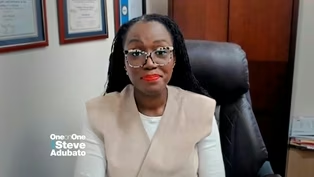
- Hi, I am Jacqui Tricarico, Senior Correspondent for "One-on-One," and so pleased to be joined now by Dr.
Jade Duncan, who's the Senior Vice President of Dental Services at Zufall Health.
So great to have you with us, Dr.
Duncan.
- So great to be here.
Thank you so much, Jacqui.
- Well, this is part of our overall series honoring our veterans, and really looking at ways that we can support our veteran community.
And I know you at Zufall Health, as well as our partners at the Delta Dental Foundation, are doing just that.
First, I wanna talk about access, or lack thereof, for dental care for our veterans.
Why is there such a gap?
- So, dental care has historically been excluded from the core health benefits in many of our public programs.
At the VA, Comprehensive dental services are limited to veterans who meet very specific eligibility criteria, such as service-related injury, prisoner of war status, or certain financial restrictions.
So the average veteran isn't eligible to receive any sort of covered care or any compared to dental services, unfortunately.
- So that leaves so many of our veterans not going to the dentist and getting dental health services for so many years.
And as we know, or I'll have you explain a little bit, the overall connection of dental health to our overall health.
How important is that?
- So oral health is directly linked to overall health.
So untreated dental disease is associated with heart disease, diabetes complications, adverse pregnancy outcomes, chronic pain, and infection.
We know the mouth isn't separate from the rest of the body, right?
So ignoring dental care leads to higher medical costs and poorer health outcomes over time.
And we've seen that over and over.
- So you all at Zufall Health, as well as the Delta Dental Foundation, created this event every year called "Smile for Our Heroes."
Talk about that event, and how many people are you seeing come in to look for the services that you're offering?
- So that event has been going on for quite a number of years, and it has been one of the ways we're able to help.
Right?
You know, we are an FQHC health center where this is our mission to do this, but it's expensive.
Dental care is expensive to operate as well as to receive, right?
So with our partnership with Delta Dental, we're able to have a one-day event where we're able to do pre-visits and post-visits for these veterans where they can come before.
So we're not just doing x-rays and cleanings; we are doing full comprehensive treatment.
We're talking dentures, crowns, root canals, bridges.
Right?
Something, you know, substantive for the veterans.
And so this year, we usually have it in a warm time.
So this year we're gonna have it on June 13th at our West Orange location with our community partners, especially Delta Dental, and so many other great vendors and partners that are gonna partner with us.
We'll have food, we'll have events where we'll have music.
We're gonna have a partnership with a Boy Scout group that's coming.
And so it's really interesting, and it's a very fun time.
- And it makes getting dental care a little bit more fun, which so many people don't love.
But it's this one-day event, but it's not just about that one day.
Because how important is it to follow up and follow through with some of these patients that you're seeing that need a little bit more of that extensive care you're talking about?
- So while the event is sort of like a linkage to us and our services.
Right?
And at that event, we continue to link them to anything that they need, not just oral health services, but we're able to help them get enrolled in insurances, check to see what they're eligible for.
So many of the veterans who may have met us at this event continue on with us insured, which helps them, you know, be able to have more, you know, control and power in seeking health without having to only be able to, you know, get free services whenever those are limitedly available.
- Can you give us an example of a veteran that you saw personally, or one of your colleagues, that benefited, maybe this was even like a lifesaving event for them to receive the dental care that they needed that they put off for 10-plus years?
- Oh boy.
I guess one of the best examples would be one of the veterans who received dentures.
Right?
Complete dentures.
So just imagine, you know, having to smile and no teeth, right?
You know, the whole facial structure droops.
Right?
And you're not able to eat, you know, you're not able to get your nutrition.
You know, so we did have this one particular veteran who was able to receive dentures, and his feedback was it changed his life.
Literally changed his life.
So we aren't just, you know, giving free services, we're changing lives.
And I think this is a very important work that we do.
- You really are.
And what do you feel needs to be done more on the state and federal level to make sure that our veterans are getting the access to care that they so desperately need, and that dental service isn't just something that's on the wayside, but first and foremost in their healthcare through the VA or other services?
- Yeah, I would like to see dental care be treated as essential healthcare, primary care, right?
Across all federal programs.
This includes expanding VA dental benefits to all veterans in general, fully integrated adult dental coverage in Medicare and Medicaid, and investing in community-based preventative care programs.
You know, community health center funding, voting on that, voting yes.
And expanding that.
And those of us who are primed and able to meet the veterans where they are can do that.
- Dr.
Duncan, why is this such a calling for you?
You can just see how passionate you are about this work that you're doing.
- Well, dentistry is my life, right?
I've wanted to be a dentist since I was three years old.
It's all I've ever wanted to be.
This has been the only thing that I've been passionate about at this level.
And to be able to serve in this way, it's a calling, right?
You know, so it's something that I have to do.
So I wish I could have a better explanation, but I have to do this work.
- Well, your passion is creating such important change.
So thank you so much for the work you and your colleagues are doing at Zufall Health.
And thank you for taking the time to tell us a little bit more about the programs that you're offering.
- Thank you so much, Jacqui.
- Thank you, Dr.
Duncan.
We appreciate your time.
For Steve Adubato and myself, thanks for watching.
We'll see you next time.
- [Narrator] One-On-One with Steve Adubato is a production of the Caucus Educational Corporation.
Funding has been provided by Delta Dental of New Jersey.
Johnson & Johnson.
EJI, Excellence in Medicine Awards.
A New Jersey health foundation program.
Atlantic Health System.
New Jersey Manufacturing Extension Program.
NJ Best, New Jersey’s five-two-nine college savings plan.
PSE&G.
The Center for Autism And by The Fund for New Jersey.
Promotional support provided by NJBIA.
And by Insider NJ.
Hey, kids, PBS Kids and Delta Dental want you to have a healthy smile.
So here are some tips for you to remember.
Number one, eat plenty of crunchy fruits and vegetables.
Number two, brush your teeth after eating sugary snacks or drinking sodas.
And number three, drink lots of water to wash away food particles.
When your teeth are happy, all of you is happy.
From PBS Kids and Delta Dental.
Have a healthy smile.
 New
NewHow the community college route can solve critical needs
Video has Closed Captions
Clip: S2026 Ep2916 | 10m 55s | How the community college route can solve critical needs (10m 55s)
 New
NewHow the district is supporting students with diverse needs
Video has Closed Captions
Clip: S2026 Ep2916 | 8m 45s | The importance of supporting students with diverse needs in Newark, NJ (8m 45s)
 New
NewHow Zufall Health is connecting veterans to dental care
Video has Closed Captions
Clip: S2026 Ep2916 | 8m 10s | How Zufall Health is connecting veterans to dental care (8m 10s)
Providing Support for PBS.org
Learn Moreabout PBS online sponsorship
- News and Public Affairs

Top journalists deliver compelling original analysis of the hour's headlines.

- News and Public Affairs

FRONTLINE is investigative journalism that questions, explains and changes our world.











Support for PBS provided by:
One-on-One is a local public television program presented by NJ PBS