One-on-One
Neal Shapiro celebrates his long-standing career in TV
Clip: Season 2026 Episode 2910 | 14m 51sVideo has Closed Captions
Neal Shapiro celebrates his long-standing career in TV
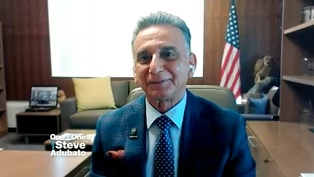
Neal Shapiro, President & CEO of The WNET Group, joins Steve Adubato, to celebrate his long-standing career in television and to discuss the next era of public independent media.
Problems playing video? | Closed Captioning Feedback
Problems playing video? | Closed Captioning Feedback
One-on-One is a local public television program presented by NJ PBS
One-on-One
Neal Shapiro celebrates his long-standing career in TV
Clip: Season 2026 Episode 2910 | 14m 51sVideo has Closed Captions
Neal Shapiro, President & CEO of The WNET Group, joins Steve Adubato, to celebrate his long-standing career in television and to discuss the next era of public independent media.
Problems playing video? | Closed Captioning Feedback
How to Watch One-on-One
One-on-One is available to stream on pbs.org and the free PBS App, available on iPhone, Apple TV, Android TV, Android smartphones, Amazon Fire TV, Amazon Fire Tablet, Roku, Samsung Smart TV, and Vizio.
Providing Support for PBS.org
Learn Moreabout PBS online sponsorship(upbeat music) - We are honored to be joined by our longtime friend, a colleague, and a leader in public broadcasting all around here, and one of the most significant leaders around the country, Neal Shapiro, President and CEO of the WNET Group.
Good to see you, my friend.
- You too.
- So we've done so many interviews over the years, Neal, about media leadership, and this will be part of a series that we created called Media Matters, the graphic will come up, in cooperation with the new center.
I didn't even tell you this, Neal.
We created the center called the Adubato Center for Media Leadership funded privately, with our, it's a family foundation dedicated to media leadership.
I don't know of anyone who cares more about media, media leadership than you.
Why does media matter more, particularly public media, more than ever before, Neal?
- I think it matters more because, A, the world's of a confusing place.
The news cycle's gotten faster and faster.
I think people are looking for places that they can trust, places where they get information.
At the same time that we're locked in this kind of three-dimensional chess game, right?
Where, so even in the world where I started in media 45 years ago, it's changed so much so that now viewers have so many choice about where to watch or get information, how to watch it.
What do I trust, what do I not trust?
And I think the challenge for managing all that has quintupled.
So it's not just the battles to manage people, which is hard enough.
It's the battle to manage technology, it's the battle to manage changing consumer influences, the battle to manage information that comes at you at lightning speed.
All those things I think make leadership even harder than it's ever been.
- The other piece that I think about a lot, I talk about independent.
I use the word independent.
But Neal, listen, I'm gonna be super candid because there's no reason to be anything other than that.
The word independent media should come with an asterisk.
And I'll tell you what I mean by that and I won't get on my soapbox.
To act like we don't care that you haven't had responsibility.
And by the way, Neal is stepping down as, sometime in 2026, as the leader, as the President and CEO of the WNET Group.
But for many years, Neal has, and Neal and I have had countless conversations about economics, about financing, about paying the payroll every two weeks.
Healthcare benefits, and I'm not complaining, but the fact that independent journalism exists outside of an independent from economics is absurd, Neal.
Your turn, go ahead.
- But it's exactly right.
And if you travel around the rest of the world, you'll see in most Western countries that media is supported in a much more healthy way first by government and then by other people so that people do not spend all their time constantly trying to raise money to balance the budget and actually get to worry about journalism.
But in our role, the public media, you spend so much time just trying to keep the lights on.
It is a miracle that we do what we do.
It's a miracle that there's so much great journalism and great television in public media space, but it's way too hard.
It should be easier.
- So with the Corporation for Public Broadcasting going away as the entity that was established many, many years ago as the buffer, Neal, is a good way to say it, buffer in between the federal government directly funding public broadcasting, PBS, but that's the entity that's supposed to be an independent entity, then the dollars come from there.
With it no longer being in play, Neal, what do you believe it means?
Because PBS public broadcasting, we're not going away.
There's gonna be a New Jersey station, which by the way, I've said this, I know you're probably embarrassed when I say this and I don't care, Neal.
There would be no NJ PBS if not for Neal Shapiro and the decision he made as the leader of WNET for the WNET Group to take the responsibility for public broadcasting in the state in 2011, when Governor Christie defunded what was then the public television station.
It will continue to exist, but on July 1st, there'll be a new operator.
It's my long-winded way of getting to this, Neal.
The Corporation for Public Broadcasting is out of the picture.
What do you believe that means for those of us involved in public broadcasting?
'Cause there's always been fundraising challenges, and now what?
- Yeah, well, you know, what it is, I haven't talked about that giant sucking sound when money went away.
But that's, you know, $500 million has gone from public media like that.
250 from television, $150 million from radio across the country.
And that will have, has had huge effects.
New Jersey's one of 'em where it becomes even harder to run NJ PBS.
Some states are just going away entirely.
Programs are being canceled, jobs are being lost and that's happening across the country.
And it's not done yet because there's a bridge fund.
Some foundations have stepped up to provide funding for a year or two, but they've made it clear that's an emergency fund.
So I think we could see the repercussions of this going on for much longer.
- Yeah.
- I don't think public media is gonna go away, because as you said, people care about it.
But I think it's not gonna be as robust as it once was unless people really rise to the challenge.
- Yeah.
Neal, let me ask you this.
The term, the expression enemy of the people is used a lot.
What was your visceral reaction to it?
- You know, it's used a lot by bad guys to demonize a free press that they disagree with.
And it is frightening in a democracy that anybody talks about reporters as enemies of the people when reporters are really the fourth estate.
Reporters' job, broadcast, television, radio, whatever, is to be your eyes and ears.
They're the ones who can be at the courts when you can't be.
They're the ones who're at city hall when you can't be.
They're the ones doing in-depth interviews.
when you don't have the time or the expertise to do it.
They're out there as your eyes and ears to make sure you know what people are doing in your name with your tax dollars in the name of public policy.
It's vitally important.
It is why when governments fall and bad guys take over, what do they do?
They seize the banks and the TV stations and the radio stations and the newspaper.
Because when you have money and information, you have everything.
So it is so important and it is a shame for anyone to believe what I think is a noble profession.
I think people do what we do, do it because it's a calling.
It's not a path to millions of dollars and huge riches.
For the most part, it's people just battling to do their job, but they're motivated by something pure about serving the public.
And that's what's great about it.
- You know, how many years have you been the President and CEO of WNET Group?
- Nineteen.
- You're also previously the president of another, NBC News, right?
- Yeah, that's right.
- And worked at ABC as well as a topic... I've said this to you before.
At the core, you're a producer.
Listen, you're a business person, you're a media leader, all those things.
At the core, are you a producer?
- Yeah, I think I am- - And what does that mean?
Explain to folks what that means.
- You know, people ask me why I think, I think producing is a great skill to have actually for anybody.
What producing teaches you how to do is at the end of the day, you have something you need to get done.
You have a certain amount of time, you have a certain amount of resources, and you have to decide how you deploy all those things to get things done in the best time and form you can.
If you're covering a story, it's to make sure the story turns out well.
If you're producing a program, it's to make sure the program plays well.
If it's running a station, it's to make sure that everybody, things happens on time and everything gets done.
And it's a little bit of engineering to make sure it happens right.
It's a little bit of showmanship to make sure when you do things, you do it in the right sequence.
I mean, I could tell you a story one way or another way, and one way is super interesting, another way is really boring.
Obviously better to tell it the first way.
That's part of producing too, is making sure you understand how to make sure an audience is engaged in what you're talking about.
- Yeah, let me ask you this about media leadership moving forward.
If I'm not mistaken, my memory is gonna fail me.
Neal, were you teaching a course in journalism at a major institution, higher ed institution in Manhattan a few years back?
- Yes, I taught- - Was it Columbia?
Was it Columbia?
- Yeah.
- Yeah.
Well, you mistakenly invited me to the class and- - Is that right?
- No, you didn't mistakenly, you invited me.
I'm making a joke, Neal.
Nobody gets my- - Yeah, it's like, I totally remember that, okay, yeah.
- Yeah, and here's where I'm going with it.
- Yeah.
- There are several producers on our team who were students that I've had in the past 'cause I've taught at Montclair State University, other places, but we have, I believe three, if not four producers that I met at different times teaching.
But teaching and helping to develop the media leaders of tomorrow was one thing X number of years ago.
What do you think that looks like today?
- Today, I think it's more complicated than ever because I think to be a good producer is always hard.
And producer, I have to say, not just because I'm looking at some of the people on the screen here, producing is like the unsigned, unappreciated talent.
But for all the people on camera who do great work, the army of people behind them is vitally important, right?
You can only do so much.
Even when you're an involved guy like you, you can only do so much.
So to have people behind you whose job is to worry about the logistics and the information and making sure it's easily for you to digest in the time you need it, and then make sure you can trust them to edit in the way you wanna edit it.
All those things are what a producer does.
I think that's gotten more complicated because the technology's gotten more complicated.
You can do much more, you're expected to do much more.
Once upon a time, when I started in television, if you were covering the story, you worried about getting on the evenings and that was it.
Now you worry about constantly, making sure it's on all social media, make sure there's reaction to media.
Are you updating your story?
How many different platforms does it go on?
I think that has gotten much more complicated over time.
And we expect, we're expecting people to do more and more with less time and often with less resources.
So it's gotten harder and harder.
- And the advice you have for young people going into our universe, media and journalism universe?
- You know, on the other hand, for having said that, I think it's a calling.
There's nothing as rewarding as doing a good job and knowing that you've helped someone in some way.
Whether it's to find the information they need to make them a better voter, to connect them in some way, to move them or make them think about something they never thought about, to put pictures and words together in some way, which are more powerful.
I think that's, and when you do it well, you get an incredible feeling.
- AI gonna replace all of us or what?
- No, AI is not gonna... AI's gonna take out some of the mundane things, which is good, and some of the things that could be done over and over again by rote.
But I think the intelligence of how to put things together and examine them, the innate curiosity, the ability to think about how to move an audience and know what that's about, the ability to shape programs, that's not gonna be done by AI.
That's gonna be done by human beings.
- 19 years as our president.
Ridiculous question.
You're most proud of... - Gosh, that's like, you know, which of your children you love the most.
- Who's your favorite?
We could, you and I, okay.
Neal is an obsessive in a healthy way.
Yankee, who's your favorite Yankee?
- Once again.
Right, you know, I would say those guys I actually saw play, Derek Jeter.
- Okay, I'm going Mickey Mantle.
By the way, check out Neal and I, we did a week, Yankee week.
A One-on-One, put up the website, check us out.
You're proud of a whole bunch of things.
Name one that just comes to mind right now.
By the way, Metro Focus would not have happened without you.
That's just one of many things.
- Well, no, 'cause I'm here, I will say I'm very proud of that New Jersey did not go dark and that it could have.
I'm very proud that, and it wasn't just me, it was a bunch of people who all made this work.
But, you know, it would've been too easy.
It could have happened.
I mean, and I'm proud it didn't.
- I've said this to you off the air, and I just wanna be super clear.
For us, for those who, when people say, who are you?
Like, don't you work for public broadcasting?
And the answer is, we're partners with public broadcasting.
We have our own separate 501(c)(3), which is a not-for-profit entity.
We've created this new center on media leadership I talked about.
Neal, for those of us who are involved in public broadcasting and partners, that you allowed us to be a part of that partnership in creating NJ PBS and the programming, independent program, NJ PBS, it was a highlight of my broadcast career.
I'm anxious and somewhat nervous about the future.
But I just really wanna say thank you.
Not just for that, but for all the guidance and the leadership, the media leadership, and the personal connection for all these years.
And we've enjoyed a few Yankee games.
And you'll have a little more time down the road once you move to the next chapter to see more games.
- So, you know, maybe a good way to wrap up with is this thought.
You asked me about producers.
You know what's great about television as opposed to print that it's a team sport.
The best thing about TV is it takes a lot of people working together.
When everybody works together, you get something which is often better than the first idea you had.
But everybody helps shapes it and improve it.
And that's always been true working with you and everything we've done together.
So I'm honored to consider you a teammate.
- You're a great partner, great teammate.
That's Neal Shapiro, the President and CEO of the WNET Group.
This has been part of a series we call Media Matters produced in cooperation with the new center we created on media leadership.
Neal, wish you and your family all the best, go Yankees.
- Take care, Steve.
- Okay.
We'll see you next time, folks.
That's Neal Shapiro.
- [Narrator] One-On-One with Steve Adubato is a production of the Caucus Educational Corporation.
Funding has been provided by Horizon Blue Cross Blue Shield of New Jersey.
The New Jersey Economic Development Authority.
Congress Hall.
The New Jersey Education Association.
Holy Name.
Valley Bank.
Johnson & Johnson.
The Adubado Center for Media Leadership.
And by New Jersey Board of Public Utilities.
Promotional support provided by ROI-NJ.
And by NJBIA.
- (Narrator) New Jersey is home to the best public schools in the nation, and that didn't happen by accident.
It's the result of parents, educators and communities working together year after year to give our students a world class education.
No matter the challenge, because parents and educators know that with a shared commitment to our public schools, our children can learn, grow and thrive.
And together, we can keep New Jersey's public schools the best in the nation.
 New
NewPresident, Rowan University, talks partnerships in higher ed
Video has Closed Captions
Clip: S2026 Ep2910 | 26m 34s | President, Rowan University, talks partnerships in higher ed (26m 34s)
Providing Support for PBS.org
Learn Moreabout PBS online sponsorship
- News and Public Affairs

Top journalists deliver compelling original analysis of the hour's headlines.

- News and Public Affairs

FRONTLINE is investigative journalism that questions, explains and changes our world.












Support for PBS provided by:
One-on-One is a local public television program presented by NJ PBS