One-on-One
Nicholas Ferroni; Stefanie Lachenauer
Season 2026 Episode 2905 | 27m 53sVideo has Closed Captions
Nicholas Ferroni; Stefanie Lachenauer
Nicholas Ferroni, Creator, Executive Producer, and Host of "Historically Correct" and Teacher at Union High School, explores New Jersey’s crucial Revolutionary War landmarks. Stefanie Lachenauer, 2024-2025 New Jersey State Teacher of the Year and Author of "Let the Glitter Settle: Mindfulness for Teens," talks about bringing social-emotional learning into classrooms.
Problems playing video? | Closed Captioning Feedback
Problems playing video? | Closed Captioning Feedback
One-on-One is a local public television program presented by NJ PBS
One-on-One
Nicholas Ferroni; Stefanie Lachenauer
Season 2026 Episode 2905 | 27m 53sVideo has Closed Captions
Nicholas Ferroni, Creator, Executive Producer, and Host of "Historically Correct" and Teacher at Union High School, explores New Jersey’s crucial Revolutionary War landmarks. Stefanie Lachenauer, 2024-2025 New Jersey State Teacher of the Year and Author of "Let the Glitter Settle: Mindfulness for Teens," talks about bringing social-emotional learning into classrooms.
Problems playing video? | Closed Captioning Feedback
How to Watch One-on-One
One-on-One is available to stream on pbs.org and the free PBS App, available on iPhone, Apple TV, Android TV, Android smartphones, Amazon Fire TV, Amazon Fire Tablet, Roku, Samsung Smart TV, and Vizio.
Providing Support for PBS.org
Learn Moreabout PBS online sponsorship- [Narrator] Funding for this edition of One-On-One with Steve Adubato has been provided by The New Jersey Education Association.
Hackensack Meridian Health.
Keep getting better.
NJ Best, New Jersey’s five-two-nine college savings plan.
Kean University.
Where Cougars climb higher.
PSE&G.
Powering progress.
EJI, Excellence in Medicine Awards.
A New Jersey health foundation program.
The Fund for New Jersey.
Horizon Blue Cross Blue Shield of New Jersey.
And by The Fidelco Group.
Promotional support provided by NJ.Com.
Keeping communities informed and connected.
And by BestofNJ.com.
All New Jersey in one place.
- This is One-On-One.
- I'm an equal American just like you are.
- The way we change Presidents in this country is by voting.
- A quartet is already a jawn, it’s just The New Jawn.
- January 6th was not some sort of violent, crazy outlier.
- I don't care how good you are or how good you think you are, there is always something to learn.
- I mean what other country sends comedians over to embedded military to make them feel better.
- People call me 'cause they feel nobody's paying attention.
_ It’s not all about memorizing and getting information, it’s what you do with that information.
- (slowly) Start talking right now.
- That's a good question, high five.
(upbeat music) Hi everyone, Steve Adubato with my co-anchor and colleague Jacqui Tricarico.
Jacqui, let's set this up.
People are about to see a series of interviews that we did down in Atlantic City at the New Jersey Education Association Convention.
Let's tee it up.
- Yup.
Just great people that we got a chance to speak with about why they were there, why they were attending, and some of the work that they're doing to support educators and as well as the citizens of New Jersey.
So many nonprofit leaders that we had a chance to speak with as well.
So you're gonna see that up in this next half hour.
- So if you wanna know what goes on at the teachers convention, the NJEA Convention, Atlantic City, this is just a taste of some of the folks who are down there, more than 10,000 this year, and the important conversations that took place.
Let's check it out.
- Hi everyone, Steve Adubato at the 2025 New Jersey Education Association Convention in Atlantic City.
We're here with our good friend, Nicholas Ferroni.
How long have you been teaching?
- It is my 23rd year, yes.
I've been in Union High School pretty much more than I've been alive.
- Love it, and teaching history, loving history.
- Yes.
- And because you love history, and we're gonna show information about this here, the creator, executive producer, and on-air host of a series called "Historically Correct."
Five part series, historically correct about what?
- So "Historically Correct" is in collaboration with the American Battlefield Trust.
We have America's 250th birthday coming up, and we wanted to think of a fun way to not only engage the locations, but to highlight all the amazing history that's around the state of New Jersey.
I mean, we have so much history right under our feet, and most people drive by it every day and have no idea.
So, I want to do what I do in the classroom, try to make history as entertaining, engaging, and just informative as possible, but do it on location, so that way, people see these spots, and then they want to go there after.
And then obviously, in true teacher fashion, I do give pop quizzes on the spot.
- Yeah, I failed.
By the way, there's a pop quiz.
You'll see some video in a second about "The Battle of Princeton," which is one of the five episodes in this series.
And I was trying to do well on the pop quiz.
You'll do it as well, and trust me, it's hard.
So let's set this up.
This is one of five, "The Battle of Princeton."
What the heck is the Battle of Princeton?
Why does it matter in the Revolutionary War and in the creation of the United States of America?
- Well, the irony is New Jersey's revolutionary story starts in Fort Lee.
Washington was stationed in Fort Lee.
Cornwallis sails across the Hudson.
He has the decision to stay and fight or retreat.
He decided to retreat, which broke his heart, upset him, but he then went across New Jersey and got to Pennsylvania.
So from there, he's gonna launch into the Battle of Trenton.
What makes Princeton so important is it's a back-to-back victory.
So we think back-to-back Super Bowls are big, but this kind of started the whole momentum shift.
'Cause up until that point, we weren't doing well, Steve.
We were not doing well.
The Army was struggling.
We were losing battles.
We were not doing well.
So, we needed some major victories to show not only Congress, but the country that we can obviously stand a chance against the British.
- And the Battle of Princeton is a victory.
- It is a victory.
- But it's complex, a lot going on here.
You're gonna meet General Hugh Mercer, wonder where Mercer County comes from?
You'll find out there.
Washington is involved.
Mercer, as I said, is involved, a whole range of interesting folks.
You'll see the pop quiz, and we'll talk to Nick on the back end of this.
Remember, this is a series called "Historically Correct" on YouTube right now?
- It is on YouTube right now, yes.
So it's on the American Battlefield Trusts YouTube channel.
- Well, it's gonna be more than that, because the more folks find out about this, yes, our colleague at PBS, Ken Burns, has done a great documentary on the Revolutionary War.
Nick Ferroni and his team, they've done an incredibly compelling job as well.
Check out "The Battle of Princeton."
(dramatic music) - Washington didn't just win one battle.
He pulled off the first back-to-back upset in American military history.
And unlike most movies, this time, the sequel was even better than the original.
Everybody's still talking about Trenton.
(guns blasting) But the real ones know George Washington didn't just stop there.
Welcome to Princeton, where the encore hit harder than the original.
(upbeat music) It's January 3rd, 1777, just days after shocking the world in Trenton, Washington pulls a fast one, sneaks past the British undercover of darkness and boom, (guns blasting) surprise attack in Princeton.
His risky gamble pays off again.
This wasn't just a win, it boosted morale, forced the British to retreat to New Brunswick, go Scarlet Knights, and show the world that the Continental Army wasn't messing around.
Meet Clark house, a humble farmhouse turned emergency room.
(dramatic music) Soldiers from both sides were treated here, including the mortally wounded General Hugh Mercer.
During the battle, Mercer was separated from his troops and surrounded by the British.
He refused to surrender, fought back with his sword and his sacrifice inspired the American troops to rally.
Mercer was then carried to Clark House where he died nine days later from bayonet wounds.
Clark House was like ER, both no anesthesia, no antibiotics, just pain, gauze, and a lot of blood.
(chalk scratching) Now let's see who's an AP student and who may have brain rot.
(upbeat music) Pop quiz time.
You ready?
- I don't know.
- Are you ready?
- Yeah.
- You ready for a pop quiz?
- Sure.
- Okay, I'm taking you back to high school with this.
- Oh yeah.
- When was the last time you took a pop quiz?
- A good couple months.
- A couple months?
- Oh God, maybe 30 years ago.
- Couldn't have been that long.
All right, you'll nail it.
First question, which battle happened first in chronological order, the Battle of Saratoga, the Battle of Princeton, Battle of Yorktown, or the Battle of Gettysburg?
What battle do you think happened first?
- I'm gonna say Yorktown.
- Saratoga?
- Is it Princeton?
- Princeton.
- No.
- Oh, it's, oh, is it where I- - It's where we currently are, Princeton, yeah.
If you said Gettysburg, I would have to talk to your history teacher, all right?
That's all right.
Shout out to Miss Hugadin.
All right, great job.
All right, what famous building served as a field hospital here, literally right here?
Nassau Hall, Clark House, White House or Connecticut Farms Church?
- Clark House?
- I don't know.
I have a feeling it might be Clark House?
- I'm gonna say Connecticut Farms Church.
- Well that would be the Clark House.
- Incredible, two for two.
It is Clark House.
Right on, yeah.
Clark House saved lives before urgent care was a thing.
Pulled right up.
They took care of you.
Probably not well, but they took care of you, okay?
- They tried their best.
It's okay.
- Last question.
Which general was mortally wounded during this battle, meaning the Battle of Princeton?
Charles Cornwallis, Hugh Mercer, Benedict Arnold, or Henry Knox?
- I'm gonna say the first one.
- Charles Cornwallis?
- Charles Cornwallis.
- British General Charles Cornwallis?
- Yeah.
- So we live in Mercer County.
I think it's Hugh Mercer.
- I'm gonna have to say Mercer.
- Which general was mortally wounded during the Battle of Princeton?
- That would be General Mercer.
- And that is correct?
- Yes.
- Yeah, Hugh Mercer, a local hero and a county with his namesake.
- And the camp that I served in in Korea was named after Hugh Mercer as well.
- Really?
Oh, so you already knew the answer going in.
All right, thank you so much.
Great job.
Great job.
Thank you very much.
Your AP teacher should be very proud.
- Dude, I'm sure she is.
- Are you gonna major in history in college?
- No, I'm majoring in film.
- Okay.
Great job.
Thank you.
All right, I won't share this with your history teacher.
I promise, okay.
- Yeah, he's gonna be mad.
(playful music) (chalk scratching) - Washington didn't just attack, he vanished, slipped past Cornwallis during the night while leaving fires burning in camp to fake 'em out.
And it worked.
Washington's troops marched all night to reach Princeton undetected.
Think "Oceans 11," both muskets and knee breaches.
And not all heroes are celebrated in our textbooks.
Oliver Cromwell, a free Black soldier (gun blasting) from Burlington County, fought heroically at Trenton and Princeton and even earned a discharge signed by Washington, himself.
Cromwell lived to be 100 and was buried with full military honors.
Wanna see where Washington pulled off one of his smartest moves?
(upbeat music) Come visit Princeton Battlefield State Park, tour the Clark House, walk the field, explore the Revolution with the Liberty Trail NJ app, and visit the libertytrail.org for stories, maps, and trivia, and support the American Battlefield Trust.
They protect our history before it's gone.
Next time, we're turning up the heat, literally, where soldiers fainted, and a jersey girl became a pop culture icon.
- So there it is, "The Battle of Princeton."
First of all, how much fun is that to do?
- As a history teacher, it's the best experience, 'cause I teach about these places.
But to teach about 'em from the location, so I'm standing right by the Mercer oak tree where Hugh Mercer, again, a Scottish born immigrant, comes here, fights, becomes a patriot.
I mean, his story is like he inspired the shift at the battle, because he literally sacrificed himself and like standing in that spot, it gives you chills.
And then seeing the Clark House, that was the field hospital.
It's just there's so many locations like this across the state where you get to stand where, again, we would not be sitting here if these people did not do what they did at these locations.
- Yeah, I heard you say that you'd be doing it for the British.
- Yeah, yeah.
You know, "God Save the Queen" would be our national anthem.
You know, it's like I'd be teaching British history.
- We take a lot for granted, don't we?
- We do.
We do.
And I think you- - That's not good.
- You really appreciate what you don't have to earn.
You know, I always say it's like I'm living off the sacrifices of my family, my father, my grandfather, so I try hard to appreciate that.
And I think as we get older, we appreciate our history, but you know, our history is a part of American history.
- So talk about the 250th, Nick.
What do you believe in 2026, 250th anniversary of the founding of our nation.
This series, "Historically Correct," attempts to help us understand a little bit better the struggle, the fight.
What do you believe it should mean?
- The one thing I love about this series is I get to highlight all the stories, history storytelling.
Ken Burns, I love how he's such an amazing storyteller.
He talks about every person, their decision, their perspective.
And when we think about the Revolution, we think about it as Patriots versus Red Coats.
It was a civil war.
New Jersey was torn, half was like people- - Whoa, whoa, back up, back up, back up, back up.
New Jersey was what?
- New Jersey, and Ken Burns will back this up, New Jersey was one of the worst states to live in during the Revolution, because it exchanged hands so many times.
Neighbors, again, everyone's like, "Now we're very divided."
It's like people have always stood by their principles.
And so the Revolution is so much more than just British versus America, it was Americans against Americans.
It was who thinks the best path forward is the way to go.
- Hold on, are you saying that a significant number of New Jerseyans sided with the British?
- Absolutely.
- Based on what?
- I always tell my students, "If you're getting an A in my class, "would you want a new teacher to come in?
"Would you want a new system if you're doing well?"
A lot of Americans were doing well.
And again, I may not agree with their opinion, but I understand it.
- Was it geographic?
- It was based on- - Was it a North/South thing is what I'm trying to get at.
- It wasn't as much North/South as much as individual situations.
- By the way, hold on one second, you hear background?
(people speaking indistinctly) We are at the New Jersey Education Association 2025 Convention.
There's a lot of enthusiasm.
We're talking about the Revolutionary War, the establishment of the United States of America with great Nick Ferroni, who made this "Historically Correct" series possible with some colleagues.
Divided, some folks think it's better with the British in control, 'cause their lives are okay.
But then what brings us together, and do we ever really come together?
- I mean, right after the Revolution, we came together for a common cause for the most part.
But once we got rid of our outside enemy, we always turn on each other to... Because again, everyone thinks they have the best idea to move forward.
And it's so interesting to read the stories of everyone's... Again, the Founding Fathers, it's called "they were frenemies".
It's like everyone thought they had the best interest or what was the most important thing or the best thing to do to move forward.
And again, when you humanize these Founding Fathers, we put 'em on pedestals, and we give them monuments, but they were human beings.
They were hypocrites, you know?
- What do you mean?
- I was just at Patrick Henry's house in Virginia.
It's like he, the guy who said- - Patrick Henry, "Give me liberty or give me death?"
- He was a slave owner, and he knew his hypocrisy.
He called it out.
A New Jersey Quaker called him out publicly and said, "How dare you say those words "when you, yourself, are an oppressor."
And he knew the hypocrisy and he said, "But we have to start somewhere."
And that's why it's like people now, we have a lot of revisionist history of people coming back and trying to cancel certain figures, but it's like Washington, if not for George Washington, we would not be sitting here right now.
- Oh, but a flawed human being.
- Yeah, he is imperfect.
His principles were contradicted.
But if anybody else- - What do you mean his principles were contradicted?
- Well again, the same man who argued for independence, for liberty, for freedom, also enslaved a large number of people, also did not free them upon it, you know- - And Jefferson.
- And Jefferson as well.
And it's like their lives depended on it.
And again, I'm not justifying that, but there are so many- - You're not judging, are you?
- Well, I'm trying to look at it from an objective perspective, and I... But that's why I want to tell the whole story, 'cause you have to tell those sides.
Everyone has a sun.
Everyone has a moon.
So we have to tell both those stories to give the three-dimensional person.
- Well, let me ask you something.
A, where did the idea come from?
B, where does the money come from?
- So, the idea came from how I teach.
I will make this argument all the time.
If you could entertain teenagers, you could entertain anybody, and I'm sure you know- - Okay, go ahead.
Okay, so go from that.
Where the heck does... Your passion for history is clear.
Where's the idea for this come from and then the... - And the money.
- Well, I have the luxury of having a background in TV.
I was an actor before a teacher.
I realized I was not good.
But then I became a teacher, and I realized that requires more performance than acting actually did, 'cause it's a whole different level.
So I worked with a few different organizations, like history.com, on creating some content to try to make history engaging for young people who may not find it so fascinating.
And then I ended up connecting with the American Battlefield Trust.
- Who is that?
- The American Battlefield Trust is a nonprofit.
It's been around for over 30 years.
It originally started off as the Civil War Trust.
They oversee all the battlefields across the country.
And their goal is to preserve them, to provide monuments in those locations and to encourage visitation, basically to keep our landscapes and our history alive.
- And you had to sell them on this?
- And I sold them on the idea for the 250th, but they also knew my work, so they were very confident.
Again, anyone to give you money to do anything, there's some confidence and also some insecurity on my end.
'Cause now- - Join the club.
- Yeah, now I have to deliver, yeah.
- Okay, I'm always fascinated by the combination of the appearing to be contradictory, confidence and self-doubt.
- Absolutely.
- You have it too?
- All the time.
Once somebody gives you a check, now it's like, damn, now I have to actually do it, yeah.
- I love it.
- Yeah, but it's definitely- - So, they bought into you.
- They bought into me, and they bought into my platform, and they bought into what I shared with them.
And the goal is to show these locations in a way that they've never been shown before, that, as amazing as Ken Burns's documentary is, this is definitely more focused on getting kids and getting educators excited about it.
- Okay, before I let you go, you got the Battle of Princeton, the Battle of Trenton, Fort Lee, gimme some others.
- Morristown.
- Morristown.
- The Battle of Connecticut Farms where I grew up.
We ended the season in my hometown where a patriot preacher's wife, Hannah Caldwell, was supposedly killed by a British soldier.
That image is actually embodied in the Union County Seal.
So if you look at the Union County Seal, it's an image of a Red Coat holding a gun towards a colonial- - That's where it comes from?
- That's where it comes from.
- That's wild.
- Yeah.
So we ended, I mean, that was such great homage to my hometown.
- This is Nick Ferroni.
He's not just a great history teacher at Union High School, he's the creator, executive producer and host of "Historically Correct."
We will continue to show excerpts from this great series.
Right now, website up one more time.
People can find it on YouTube.
Cannot thank you enough, Nick.
- Thank you, and I wanna know how everybody does on the quizzes.
- On the quizzes, yeah.
I'm not gonna post my grade.
I'm Steve Adubato.
That's Nick.
Stay with us.
We'll be right back.
- [Narrator] To watch more One on One with Steve Adubato find us online and follow us on Social media.
- Hi, I am Jacqui Tricarico, on location at the NJEA Convention here in Atlantic City.
And so pleased to be joined now by Stefanie Lachenauer, who was our previous New Jersey State Teacher of the Year from last year.
You're also a bestselling author now on Amazon, with your new book, "Let The Glitter Settle."
I love it.
It's beautiful.
So great to have you with us.
- Thank you.
- We're meeting for the first time.
- Yeah, in person, yeah.
- We've talked, yeah, we've talked previously.
You can check out our previous interview with Stefanie on our website, talking about just going on this year of a sabbatical, as the State Teacher of the Year.
Bring us back to this past year, because I know you said... I saw this recently that you said, "This past year has stretched me in every direction, and grew me in someone I'm still getting to know."
Tell us what you mean by that.
- Oh, wow.
So stepping into the State Teacher of the Year role is... it's huge.
It really feels like you're stepping into something just greater than what I've ever known myself to be.
And so this past year I got to speak in schools all over.
I got to do really cool interviews with like you, and on Pix 11.
So that was really big and outta my comfort zone.
And then just representing all these incredible teachers in New Jersey.
Like when you meet other teachers across the country, and then you recognize what we have in New Jersey, it's breathtaking, it's awe-inspiring.
And being able to help represent the incredible things that we do in our state is, gosh, it's just the truest honor.
- Give us an example of that.
Who's really inspired you along this journey so far this past year?
- So I think knowing all the county teachers has been super inspiring.
We have a lot of honored educator networks.
And then actually Jillian Ober, our new State Teacher- - New Jersey, yep.
This year, State Teacher of the Year.
- Is so inspiring, and I'm so grateful that I get to partner with her, and I'm one of her mentors this year.
And I know that it's always a two-way street, right?
Mentorship, like you always learn from each other.
So I'm grateful for that.
- So something that you've really just been a true proponent of is this mindfulness, social emotional learning.
You've brought it into your school district, it's something that you've been really putting out there throughout the state.
Talk about that and how you've really seen those skills impact students firsthand.
- Yeah, it's so interesting.
Things always feel so much more challenging and then all of a sudden it's like the new normal.
So bringing mindfulness in, like no one at the time knew what that even meant.
It was like this... - It's kind of this buzzword that people hear.
Yeah, but what does it really mean?
- Mindfulness, really it's present moment awareness, right?
So being present right here and now and it's paying attention to what's happening right here and now.
And so when we explain it that way and talk about it that way, I think kids get more of a buy-in because people tell them to pay attention all the time.
But I always ask them, has anyone ever taught you how to pay attention?
What does that mean?
So that's where it gets a little bit more, I think, interesting.
And it means something to them 'cause they're like, "Oh, that's how I... that's how I can use it."
- It's hard for us adults to do that, to be in the moment.
Do you think it's easier to teach the kids that when they're more impressionable to really just take that time to be in the moment?
- Absolutely.
And I think like younger kids you'll see are... they're naturally better at that.
They're naturally more present.
And I think middle school, which is the area of the grade level I work with, I think that's when you start to see that transition start to happen where their attention gets pulled and they have a harder time just being fully present with what is.
And so I get to teach all the skills that I wish that I had in middle school.
- And you're bring that, you worked with the Department of Ed specifically this past year.
Talk about that relationship and what you were able to build together.
- So part of being Teacher of the Year is getting that sabbatical.
So you have six months at the DOE, and I was really fortunate that I got to partner on a couple of really cool projects.
But the coolest one was working with social emotional learning group.
And we have some really great things on our website.
And now mindfulness is on our website.
So there are handouts from resources for teachers to use, there's videos.
And it was just really exciting to be a part of that process and helping to create those materials and being a full part of it.
Just the timing was perfect.
- And the tools are accessible for teachers across the state to use and implement in their classrooms.
What is your advice for teachers though, starting to implement those, the mindfulness, the, you know, social emotional learning?
What's the easiest way to get started with that with your students?
- That's a great question.
I think the best thing that we can do for ourselves is to use those tools for ourselves first, to practice ourselves, because we are wired to be together.
Our neurology, it's connected.
And so when teachers are regulated and they're feeling good and they're healthy and well, that impacts our students.
So if they pick one strategy that they wanna use, even the things that are on the DOE website or there's even things on my website that are free.
Try those strategies and then later on if you wanna implement it with your students, great.
If not, it doesn't matter.
Because when you are taking care of yourself, the students are feeling that.
- How important is that now than ever before?
Because we're seeing a teacher shortage, we're seeing teacher burnout.
It's talked about all the time.
Often teachers are working way outside those classroom hours, right?
Because so many of them are just so passionate about the work.
How important is it now, more than ever?
- Absolutely.
Definitely now more than ever.
And I think it's something for me, I have to practice too, like, you know, making sure that I take time for myself to let my own glitter settle.
But the truth is, if I know for myself, when I push myself past my limit, I'm not good to anyone.
So if I can really take care of myself, then I know that I'm supporting my students.
- Let the glitter settle.
So tell us, what does that mean?
What does it mean to let the glitter settle?
- So do you know glitter jars?
- Yes, I've heard but explain.
I've heard the glitter jars.
I have two young kids.
- And if you haven't heard about glitter jars and you're listening, I'm about to change your life.
So glitter jars are jars that have glitter in them and some water and you shake 'em up and then that glitter falls and you just watch it.
But it's a great analogy because a jar is like our mind, and then that glitter, it's like our thoughts, feelings, emotions, and stuff happens that shakes our jar, right?
It can be bad stuff like traffic.
It can be running late, spilling your coffee, not getting coffee in the morning, right?
Your jar's shaking.
It can be good things like you're excited before a holiday, right?
And it's hard to stay focused.
The jar is shaking, but when we stop and we pause, we can let that glitter settle and the glitter's still there.
Those feelings, thoughts are still there, but we can see clearly.
And that really is kind of like how our minds work.
When we name it, we tame it.
- Yeah, I love that.
I love that.
Tell us the process of writing this book, because obviously you've been very busy, you've been traveling, now back to teaching, it was a process for you, but this was a passion project for you.
Talk about it.
- Yeah, I started writing it in 2016, so this has been a very long process.
And right when I was like, you know what, I think I'm finally ready to like put this out there 'cause it's hard to feel like you're ever finished, right?
So I was ready to put it out there, and that's right when I got named, and I was like, all right, we're just gonna have to slow down a little.
We're just gonna... I've edited that book for like years.
- You had to let the glitter settle and see clearly had to get to the finish line.
(both laughing) - And I had to let it be okay.
Like, this is enough and this is okay.
Like nothing's ever gonna feel perfect.
And it's about progress over that perfection.
And this book has taught me that.
- I love that because we have perfectionism in our family.
I understand that very much.
Lastly, what is your advice for, we talked about her before, Jillian Ober, our new State Teacher of the Year.
Piece of advice for her.
- Jillian's amazing.
I know she's gonna do an incredible job and I'm lucky that I get to walk alongside her and part of her journey.
And so my advice to her is to just keep being her amazing self and to continue to be a voice for the students that she works with and the teachers in New Jersey.
- Love that.
- And the rest is all her.
- Yeah, love that.
Well, we can't wait to see what you do next.
You're always getting to the next project and doing amazing things, so we can't wait to see what you do next.
- Thank you to our senior correspondent Jacqui Tricarico, and for Jacqui and our entire team here at "One-on-One," we thank you so much for watching.
See you next time.
- [Narrator] One-On-One with Steve Adubato is a production of the Caucus Educational Corporation.
Funding has been provided by The New Jersey Education Association.
Hackensack Meridian Health.
NJ Best, New Jersey’s five-two-nine college savings plan.
Kean University.
PSE&G.
EJI, Excellence in Medicine Awards.
A New Jersey health foundation program.
The Fund for New Jersey.
Horizon Blue Cross Blue Shield of New Jersey.
And by The Fidelco Group.
Promotional support provided by NJ.Com.
And by BestofNJ.com.
- (Narrator) A cancer diagnosis changes everything.
- So does where you go for treatment.
- (Narrator) Where other cancer centers offer radiation, at Hackensack Meridian, John Theurer Cancer Center, We’re utilizing the world's most advanced precision radiotherapy... - That can pinpoint and destroy your cancer.
- (Narrator) Some performed clinical trials, but we have one of the nation's most rapidly growing drug discovery programs... - Providing hope with the medicine of tomorrow.
New Jersey's best cancer center.
Know the difference.
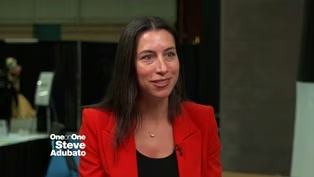
2024-2025 NJ Teacher of the Year talks about mindfullness
Video has Closed Captions
Clip: S2026 Ep2905 | 8m 55s | 2024-2025 NJ Teacher of the Year talks about mindfulness (8m 55s)
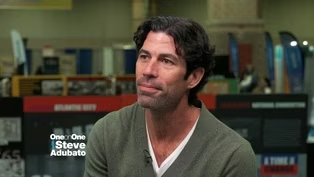
Nick Ferroni explores the legacy of crucial NJ landmarks
Video has Closed Captions
Clip: S2026 Ep2905 | 17m 33s | Nick Ferroni explores the legacy of crucial NJ landmarks (17m 33s)
Providing Support for PBS.org
Learn Moreabout PBS online sponsorship
- News and Public Affairs

Top journalists deliver compelling original analysis of the hour's headlines.

- News and Public Affairs

FRONTLINE is investigative journalism that questions, explains and changes our world.












Support for PBS provided by:
One-on-One is a local public television program presented by NJ PBS