NJ Spotlight News
NJ Spotlight News: February 18, 2026
2/18/2026 | 26m 46sVideo has Closed Captions
Watch as the NJ Spotlight News team breaks down today’s top stories.
We bring you what’s relevant and important in New Jersey news and our insight. Watch as the NJ Spotlight News team breaks down today’s top stories.
Problems playing video? | Closed Captioning Feedback
Problems playing video? | Closed Captioning Feedback
NJ Spotlight News is a local public television program presented by THIRTEEN PBS
NJ Spotlight News
NJ Spotlight News: February 18, 2026
2/18/2026 | 26m 46sVideo has Closed Captions
We bring you what’s relevant and important in New Jersey news and our insight. Watch as the NJ Spotlight News team breaks down today’s top stories.
Problems playing video? | Closed Captioning Feedback
How to Watch NJ Spotlight News
NJ Spotlight News is available to stream on pbs.org and the free PBS App, available on iPhone, Apple TV, Android TV, Android smartphones, Amazon Fire TV, Amazon Fire Tablet, Roku, Samsung Smart TV, and Vizio.
Providing Support for PBS.org
Learn Moreabout PBS online sponsorship♪♪ >> From NJ PBS Studios, this is "NJ Spotlight News" with Brianna Vannozzi.
>> Hello, and thanks for joining us tonight.
I'm Joanna Gaggis, in for Brianna Vannozzi.
A few stories we're going to get into later in the broadcast.
We talk with Assemblyman Ravi Bala about his controversial bills responding to recent ICE actions in New Jersey.
And service disruptions continue for NJ Transit riders as Amtrak switches service from the old Portal Bridge.
We talk to frustrated rail commuters.
And later, is the drinking water in Trenton safe?
We'll take a look at the ongoing issues at Trenton Water Works.
But first, a few of our top headlines.
The The Gateway Development Commission announced today that it's received the full $205 million from the federal government for the Gateway Tunnel Project.
That's the amount that a judge ordered to be released immediately in the court case brought by the states of New Jersey and New York, although it's just a fraction of the total $15 billion that it'll still take to complete the project.
The Gateway Development Commission said in a statement that it's now working with contractors to get the project restarted as quickly as possible and that it's expected to resume next week.
Workers have been laid off for more than a week after the funding ran out on February 6th.
But this $205 million payment doesn't mean that all is well for the project.
President Trump has continued to criticize it this week, saying it "requires proper planning to avoid insurmountable cost overruns."
And U.S.
Transportation Secretary Sean Duffy is expected to file an appeal of the court ruling soon.
Governor Sherrill has pointed out that halting the project has only added to the overall costs, which she says were on time and on budget before the work stoppage.
The Diocese of Camden has reached a $180 million settlement agreement with a group of sexual abuse survivors who suffered at the hands of clergy.
The survivors are all now adults, many who came forward after New Jersey passed a law extending the time that they could file a claim of abuse against the church.
Those claims were submitted under the New Jersey Independent Victims Compensation Program, which was created by the state's five Catholic dioceses for people who want to come forward without pursuing a lawsuit.
The large number of survivors from the Camden diocese forced it to file bankruptcy in 2020, but church officials in Camden say they've set up a trust to ensure that each person receives compensation.
But how much of the 180 million they each receive will be decided by a U.S.
bankruptcy court judge, according to their attorneys.
Now, the current Camden bishop, Joseph Williams, addressed the survivors in a letter thanking them for coming forward, calling what happened to them a grave sin and saying, "We believe you, we are sorry, and we are committed to walking into court."
The landmark corruption case brought by the Murphy administration against South Jersey Democrat, John McCartney, is the only case in the U.S.
that has been brought to court.
The judge said, "We are committed to walking a different path with you going forward."
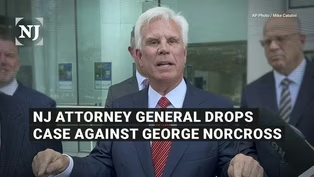
The landmark corruption case brought by the Murphy administration against South Jersey Democratic power broker George Norcross is over.
On Tuesday, the office of the Governor Sherrill's acting Attorney General Jennifer Davenport said it will not appeal the case to the state Supreme Court.
Now, that decision comes after an appeals court upheld the lower court's decision to toss the charges a few weeks ago.
The case was first brought in 2024 New Jersey Attorney General Matt Plattken, who accused Norcross and five co-defendants of running a criminal enterprise to enrich themselves with money from tax incentives meant to benefit the city of Camden.
Alleging that Norcross used extortion by threatening a local real estate developer to sell property for less than it was worth, and then use the property to obtain millions in state tax incentives.
But the lower court ruled that Norcross's actions did not amount to extortion or criminal coercion.
Davenport's office explained why it wouldn't pursue the case, saying that its "resources would be best spent on other matters."
Norcross is now expected to file suit against Platkin, alleging malicious prosecution, and he's pushing for an investigation into the state's case against him, according to his Coming up, we talk with Assemblyman Ravi Bala about a package of bills he's proposing that he says strengthen the state against ICE actions.
But will the legislature agree?
That's next.
Funding for NJ Spotlight News, provided by the members of the New Jersey Education Association.
Making public schools great for every child.
And RWJBarnabas Health.
Let's be healthy together.
Many lawmakers here in New Jersey have expressed concern over the way that immigration enforcement officials have carried out their duties.
In response, one week ago, Governor Sherrill signed two executive orders meant to rein in ICE operations in the state.
One of them bars any operations on state property without a judicial warrant, which ICE officials have called legally illiterate in a statement in response.
But some members of the legislature are now taking steps to codify that order into law, and newly elected Assemblyman Ravi Bala, who's the former mayor of Hoboken, has recently introduced three new bills that he says will strengthen New Jersey's protections against ICE.
He joins us now to talk about them as part of our Under the Dome series.
Assemblyman, so great to have you with us.
Thanks for taking a minute.
Sure.
Thanks for having me.
Now, some of the recent ICE enforcement that we've seen has impacted residents of Hoboken, where you were formerly mayor.
You've introduced this package of bills.
I want to start with the first one that would tax private detention profiteers, as you word it.
Help us understand what you're proposing there.
Sure.
What we're seeing nationwide not just in New Jersey in places like Roxbury and other locations is an effort to inject large investments into mass incarceration of largely Latino communities.
We've seen this before in the history of the United States, where African Americans were subjected to mass incarceration.
You are seeing another iteration of that in this current moment, where the federal government is trying to engage in mass incarceration of immigrant communities across the country through the creation of these detention centers.
So we're trying to do everything we can to resist that type of inhumanity, that type of injustice, and making sure that if you go ahead and do that, then we are going to impose a tax on any gross receipts, and we're going to reinvest that money into an immigration protection fund that would appropriate those dollars directly into funding immigration services.
Let me ask you this question, Devil's Advocate.
Someone might say, look, this is New Jersey simply taking the opportunity to profit itself off of where, you know, all this money is being spent federally and these investments being made into these detention facilities.
What do you say to that?
I say we should not profit from inhumanity.
We shouldn't profit from conduct that directly contravenes our beliefs and values as Americans.
What the federal government is doing here is un-American, it's inhumane, it's unconscionable, and it has to stop.
And we have to do everything we can by way of the levers of government, whether it's litigation, whether it's legislation, or whether it's ordinary residents taking to the street to say, we will not tolerate what is going on.
We will do everything we can to fight back.
And we are not in this for profit.
We are in this for people.
>> This immigrant protection fund, we have seen time and time again that money that is allocated for these particular funds often gets sucked up into the black hole of the state budget unless there is some type of constitutional amendment.
Do you think the voters in New Jersey, one, would have the appetite to vote for a constitutional amendment and two, do you think that would be necessary if this bill were to pass?
>> If required, the polling shows that there is overwhelming opposition to what is happening with respect to the escalation of immigration enforcement in New Jersey and the rest of the country.
So whether the appetite is there, if necessary, the answer is yes.
I believe it is there.
We'll take the process as it comes.
See if a constitutional amendment for that direct appropriation to make sure that the funds are guided towards that purpose requires that measure.
And if we do need to take that that that route we'll do so in due course.
A second bill that you've introduced would protect crime scenes from ICE intervention.
Explain what that means and why you think a bill like that is needed.
Sure.
That bill is really born out of what we had seen in Minneapolis where local police departments in Minneapolis were deprived of access to the crime scene of Alex Pretty.
They were deprived of access to evidence, very critical evidence, in determining whether or not a violation of state law occurred in that incident, we already have under our books a law that makes it a criminal violation to hinder access to a crime scene.
And this bill that we've introduced clarifies that when you have a crime scene that is under the jurisdiction of local law enforcement, local law enforcement should, by way of our statutes, have access to evidence and have access to the crime scene itself to make sure that what happened in Minneapolis with Alex Pretty does not happen, God forbid, here in New Jersey.
It would also impose criminal penalties on any federal immigration officer if they were to in fact impede local law enforcement in performing their duties in accessing evidence and investigating potential crime by federal immigration officers.
And of course, how and whether or not a federal immigration officer can be prosecuted by local or state officials has played out in the courts in some complicated cases.
We're not going to get into that right now.
But I do want to take a minute to talk about your third bill, which would ban ICE officials, anyone employed by ICE right now, from becoming a New Jersey state employee, a teacher, a local government official.
Some might say that these are folks who are -- they are public workers right now.
They're out there trying to keep the public safe.
What do you say to that?
I say that's false.
ICE agents are not keeping the public safe.
They are scaring children, they are scaring families, they are scaring communities.
They are disrupting the quality of life of hard-working residents in the state of New Jersey.
And if you sign up for that, if you sign up for that type of employment, we don't want you near our children.
We don't want you as teachers.
We don't want you in public employment serving our communities and our local police departments.
So it sends a very clear message.
If you decide to sign up to be an employee of this rogue enforcement agency that's violating the constitutional rights of everyday New Jerseyans and everyday Americans, then you are simply not welcome to be in close proximity to vulnerable communities and people in New Jersey, such as children, such as local communities in the positions of authority, such as police officers or teachers.
With just a couple seconds left, do you think that a law like that could open up New Jersey to discrimination lawsuits?
We don't think that being an ICE agent under New Jersey law is a protected class.
That does not fall under any form of discrimination statute that would give them sort of heightened status as a protected class.
So we intend to move forward to protect our communities from ICE agents.
We don't want them in sensitive positions with direct interaction.
taken on employment by ICE in the view of this legislation and its supporters, we don't think you're qualified.
We don't have confidence in your ability to interact with vulnerable communities such as school children.
Assemblyman, we have to leave it there.
I'm sorry to cut you off, but I thank you so much for coming and taking the time to talk with us today.
Assemblyman Rob Ibala in the 32nd Legislative District, thank you.
Under the Dome is made possible in part by the Corporation for Public Broadcasting, a private corporation funded by the American people.
Riders are feeling the pain on NJ Transit as service has been cut back by about half.
That's because Amtrak is transitioning its service from the old portal bridge to the new one, a process that will take about a month to complete.
But the cutover will end in mid-March and the new bridge is expected to significantly improve NJ Transit's service once it's finished.
Until then, riders remain frustrated, as they shared with Raven Santana, who was at a Hoboken station earlier today.
A month of service disruptions is now underway as Amtrak shifts trains from the aging Portal Bridge to the newly built span over the Hackensack River.
The roughly 50 percent service cuts began Sunday, with trains limited to a single track between Newark and Secaucus, triggering cancellations, delays and revised schedules.
Phase one is expected to last about a month, and for many riders, the start has been anything but smooth.
It was horrible, I'm not going to lie.
It was very like, ugh.
It was congested with the people, and it just sucked.
The real scary part and the thing that people should really keep in mind is this is a tiny little taste of what would happen if the broader connection to Manhattan was disrupted.
Zoe Baldwin of the Regional Plan Association notes the old portal bridge was built in 1910 and has long been deemed structurally deficient.
It's a notorious source of delays on the Northeast Corridor.
What would happen is it was a movable bridge and it would open for waterway traffic to get through and then get stuck open and so literally unpassable for sometimes hours at a time.
Some of this infrastructure is so old that it needed actual people to go out and bang it into place.
It's a physically unfreeze the bridge because these are mechanical moving parts that had kind of frozen.
Despite the urgent need, securing federal funding took years after the first Trump administration refused to fund the larger gateway project over political disagreements with the states, much like the current lawsuits over the Hudson River rail tunnels.
with the gateway project.
We've been talking mostly about the tunnels recently because that's what's under construction.
But major components of that project include Penn Station renovation and expansion as well as portal North Bridge, which is what we're dealing with right now.
To ease the disruption and a transit is cross honoring tickets on path New York waterway ferries and select bus routes.
riders to allow extra t you can 20 people are hol We target obviously all t that you know, there's a going through the main op We direct customers to th the ferry, the path and o the 126 and we assist th have questions interrogati to get to their final dest transit already has a lot this to now cause even mo make the workday the comm so much harder.
I work fi the sea.
So imagine doin week.
It's just a lot to easy, but we'll see you o on our way back.
Might b the new bridge constructi be pretty bad.
All the tr new york Penn Station, the not even on the schedule.
I got here.
I went to pic six in the morning.
So wh were workers holding up s about it.
I don't, I don' like it really made any s too much.
And while it ma for riders and J transit a more reliable service.
important to remind them as this effort can feel p it's a long commute for a is for the greater good.
New bridge has been built and we're just switching tracks now.
And so what we can hope for the future is better reliability, right?
New tracks, new signal systems, new canary wires for a better experience overall.
Regular schedules are expected to resume March 15th, pending final safety testing.
A second round of service changes tied to the project is planned for the fall and is also expected to last about a month.
I'm Raven Santana.
Controversy has swirled over the water quality and sustainability of Trenton Waterworks, a utility that serves water to more than 200,000 people in Trenton, Hamilton, Ewing, Lawrence and Hopewell townships.
The companies come under fire from state officials for failing water quality standards and for submitting fraudulent samples.
Meanwhile, there's also an ongoing struggle over who should maintain control of Trenton Waterworks and whether it should be governed by a regional authority.
Jeff Pillitz is a freelance reporter for the Jersey Vindicator who's been following the story and is with us now.
Jeff, so great to talk to you.
Thanks for coming on.
Obviously, Trenton Waterworks has been a struggling utility for a while now, but they just released a $763 million capital improvement plan.
What can you tell us first about this plan and what they're intending to do?
They're going to do what they should have done over the last 20 to 30 years in terms of capital maintenance.
The most important thing I think is they are going to upgrade their reservoir.
The reservoir is an uncovered reservoir.
It does not meet state or federal standards.
Microbes breed inside the reservoir at times.
So they are going to take that reservoir and they are going to drain it into tanks nearby.
They are going to build a tank field.
So we are going to be we will finally be in compliance.
That was the issue that triggered a lot of the recent issues with the state.
The fact that the reservoir wasn't in compliance.
That's the main thing.
There was also lead pipe replacement.
They're going to finance through this and a whole host of other improvements in the filtration plant on the Delaware River.
Yeah one of the things about that reservoir that was interesting that came out last year was the former D.P.
commissioner Sean LaTourette actually made a surprise visit there and found a whole host of non compliance issues including water quality issues.
Just what can you tell us a little bit about what he discovered then.
Well he discovered electrical panels that were rusting.
He discovered standing water on the floors.
He discovered other areas that were tanks that were rusting out, machines that weren't working.
He his surprise inspection very much very much angered Trenton Water.
But they've responded and they've actually painted some of these areas.
They've improved some of that area.
It's still a long way to go but they certainly got their attention with that.
A new report though Jeff shows that at least a dozen people in Hamilton have died from Legionnaires disease connected to the water that comes from Trenton Waterworks.
Have they made enough repairs to make that no longer a safety concern or is that ongoing still?
Uncertain.
The Legionella outbreak is continuing in Hamilton and in the surrounding area.
Legionella primarily affects people in the warmer weather but it is still occurring and that outbreak is still going on according to local health officials.
It's very hard to tie specifically to a water utility but some cases officials believe are tied to Trenton, are tied to Trenton water because it came in, it was coming in the cold water side of their treated water.
So that's very much still an issue and this is one thing that the state really wants to try to fix through its dealings with Trenton water.
I attended a city council meeting where commissioner, former commissioner LaTourette addressed the city council, told them that they simply did not have the financial security or the bandwidth to continue running this utility on their own.
There was a whole lot of pushback from the city council who said, this is our utility, we're not giving it up, you're trying to take it away from us.
How then do they go from what the commissioner painted as a very unstable financial future and existence to laying out $763 million in investments?
Where does this come from?
Well they're borrowing the money from the state.
The state has an infrastructure bank.
It's a long term, it's not going to happen all at once.
They're going to borrow it over time over a period of years in different trenches.
But Trenton basically pushed back and said, you know, we beg to differ with you.
We have the means to control our own fate here.
We can raise the money through selling the water.
The water is a valuable asset.
We don't want to lose control of it.
So they're claiming that they can, they do not need regional control of it.
But the state has concluded and multiple experts have concluded that they've just had enough chances that they need to get the expertise that a regional authority and the financial stability that a regional authority could provide.
Yeah, economically speaking, I'm just I want to take a look at who they serve.
They have said that rate increases would be a part of this.
I don't know that I saw specifically what those rate increases would be.
But what impact would that have on Trenton residents who are very much struggling?
Many live below the poverty line, although certainly they serve more affluent communities as well.
They've started the process to raise prices already to raise water rates in in the service area, which is, as you mentioned, is Trenton and four other nearby communities.
The rates, even with the increase, I think they're talking like a 15 or 20 percent increase.
They'll still be among the lowest rates in New Jersey, and they will also be lower than many private companies who provide water.
So the rate increases are going to come.
And the real question is, why haven't the rate increases -- why weren't they put in place years ago?
Because the rate has been the same for quite a while now.
So, once again, they're trying to improve now, under the pressure that the state brought on them.
They're trying to improve.
They're moving quickly.
They are improving.
But they're so far behind that they have these issues that are continuing.
Do you believe that this plan that they've laid out one is feasible.
What impact does it have on water that's being served to the residents.
I'm going to ask you a multi-part question.
So let's start with the first part.
Let's start with what impact will it have on the residents.
I think it potentially if they can make it work as it has a big impact on the residents because the water the water will be more water service will be more dependable.
When we turn the tap on we know the water will be coming out.
In recent days we've there was questions about that because the water level dipped very low because there were 30 main breaks throughout the city of Trenton and the reservoir had dipped to a level of one day supply.
So if they do these fixes it will have a tremendous impact.
And I think that the city of Trenton is willing the residents despite their economic hardships that you mentioned they're willing to pay the extra for the water service because it's of course it's so important.
And with just a little bit of time that we have left do you think that they Trenton has made the case for why they should maintain control of their utility.
Not yet.
Not yet.
They haven't continue to have these hiccups.
These recent setbacks.
The state, even now as we speak, the state is doing an update every day on the levels of water in Trenton.
So they've made a good start.
The mayor seems committed.
The new council seems committed.
The officials, and there are some very good officials in the water works, they've made their case.
They've started to make their case, but they've got a lot farther to go.
>> All right.
Well, we'll keep following it.
Jeff Pillitz, freelance reporter for the "Jersey Vindicator," appreciate all the insight that you brought to us today.
>> Thank you so much.
>> That's going to do it for us tonight.
I'm Joanna Gaggis for the entire team here at "NJ Spotlight News."
Thanks for being with us.
We will see you right back here tomorrow.
>> NJM Insurance Group, serving the insurance needs of residents and businesses for more than 100 years.
>> NJM Insurance Group has been serving New Jersey businesses for over a century.
As part of the Garden State, we help companies keep their vehicles on the road, employees on the job, and projects on track.
Working to protect employees from illness and injury, to keep goods and services moving across the state.
We're proud to be part of New Jersey.
NJM, we've got New Jersey covered.
Look at these kids.
What do you see?
I see myself.
I became an ESL teacher to give my students what I wanted when I came to this country.
The opportunity to learn, to dream, to achieve.
A chance to belong and to be an American.
My name is Giulia Torriani-Crompton and I'm proud to be an NJEA member.
[Music]
 New
NewCamden Diocese agrees to pay $180M in sexual abuse settlement
Video has Closed Captions
Clip: 2/18/2026 | 1m 15s | Bishop apologizes to 300 survivors, whose monetary awards will be up to a bankruptcy judge (1m 15s)
 New
NewNJ drops racketeering case against power broker Norcross
Video has Closed Captions
Clip: 2/18/2026 | 1m 36s | Acting attorney general says office's resources 'would be best spent on other matters' (1m 36s)
Providing Support for PBS.org
Learn Moreabout PBS online sponsorship
- News and Public Affairs

Top journalists deliver compelling original analysis of the hour's headlines.

- News and Public Affairs

FRONTLINE is investigative journalism that questions, explains and changes our world.












Support for PBS provided by:
NJ Spotlight News is a local public television program presented by THIRTEEN PBS