NJ Spotlight News
NJ Spotlight News: January 15, 2026
1/15/2026 | 26m 46sVideo has Closed Captions
Watch as the NJ Spotlight News team breaks down today’s top stories.
We bring you what’s relevant and important in New Jersey news and our insight. Watch as the NJ Spotlight News team breaks down today’s top stories.
Problems playing video? | Closed Captioning Feedback
Problems playing video? | Closed Captioning Feedback
NJ Spotlight News is a local public television program presented by THIRTEEN PBS
NJ Spotlight News
NJ Spotlight News: January 15, 2026
1/15/2026 | 26m 46sVideo has Closed Captions
We bring you what’s relevant and important in New Jersey news and our insight. Watch as the NJ Spotlight News team breaks down today’s top stories.
Problems playing video? | Closed Captioning Feedback
How to Watch NJ Spotlight News
NJ Spotlight News is available to stream on pbs.org and the free PBS App, available on iPhone, Apple TV, Android TV, Android smartphones, Amazon Fire TV, Amazon Fire Tablet, Roku, Samsung Smart TV, and Vizio.
Providing Support for PBS.org
Learn Moreabout PBS online sponsorshipGood evening and thanks for joining us on this Thursday night.
I'm Brianna Vannozzi.
Tonight a few stories we're digging into later in the broadcast.
A Trenton think tank says the Sherrill administration is about to inherit a budget time bomb.
What are they and what's the solution?
Then a conversation with outgoing DEP Commissioner Sean LaTourette on his biggest environmental wins and challenges.
And later, another public school district is staring down severe budget issues and potential cuts.
Why parents are urging lawmakers to step in.
First though, a few of today's top headlines.
Officials in Roxbury Township are confirming representatives from ICE were on the ground Wednesday morning to scout out a potential location for an immigration detention center.
A massive, nearly half a million square foot warehouse on Route 46.
Town officials say they met with representatives from ICE and the owner of the warehouse, expressing concerns and asking for more transparency from the feds.
The ICE proposal faced swift backlash since it was first reported on Christmas Eve by the Washington Post, including Roxbury in a list of locations nationwide where the government is looking to convert warehouses into processing and detention centers.
Residents and advocates have come out in droves to protest, including over the weekend.
The site visit came just a day after the town council unanimously passed a resolution opposing any ice processing facility within the township's borders.
And as three Democratic Congress members have sent a letter to DHS Secretary Kristi Noem urging her to quote "immediately cease any efforts to establish new detention facilities in New Jersey," calling the move unconscionable.
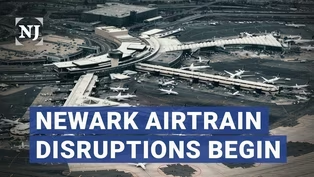
Also tonight, Newark Airport is finally getting a new air train, but it won't come without some sacrifices by travelers.
Port Authority is suspending weekday air train services between the airport rail station and the P4 stop between 5 a.m.
and 3 p.m.
while construction work is carried out starting today.
P4, by the way, is the stop serving daily parking.
The Port Authority says courtesy shuttles will run every 4-5 minutes during times when air train service is disrupted.
Travelers are urged to allow an extra 15 minutes in their plans to account for any problems.
The air train disruptions will pause on weekends.
There'll be no disruptions during the peak travel season between Memorial and Labor Day.
The service disruptions will begin again though in the fall before another break for next winter's holiday season and then still more disruptions in 2027 and 2028.
The air train replacement project will cost the Port Authority $3.5 billion and it's expected to be completely finished by 2030.
And in a dramatic late move by the Murphy administration, the state is moving to take over the Lakewood Public School District, citing years of fiscal and operational mismanagement.
In legal papers filed this week, the Department of Education argued the district failed to provide students with a constitutionally required, thorough and efficient education.
If approved by the State Board of Ed, local control would be suspended and the state would appoint new leadership to oversee spending, staffing and academics, making it the first takeover in New Jersey since Camden back in 2013.
But Lakewood has a unique situation.
Fewer than 5,000 students attend the public schools, while more than 50,000 attend private religious schools, creating massive transportation and special education costs required by law.
Local leaders say they are open to state intervention.
You can read more from our education reporter, Catherine Carrera, on our website, njspotlightnews.org.
And coming up, the Murphy administration claims the state is stronger and fairer, but policy analysts argue incoming Governor Mikey Sherrill is inheriting a state budget full of fiscal threats.
That's next.
Major funding for NJ Spotlight News is provided in part by NJM Insurance Group, serving the insurance needs of residents and businesses for more than 100 years.
A new analysis from the left-leaning think tank New Jersey Policy Perspective warns that Governor-elect Mikey Sherrill is about to inherit a state budget that looks strong on paper, but it's packed with hidden fiscal risks.
More specifically, a budget minefield.
While New Jersey has healthy reserves and solid revenues now, New Jersey Policy Perspective says at least $3 billion in new costs and shortfalls are set to hit the budget.
For more, I'm joined by New Jersey Policy Perspective senior analyst Peter Chen.
Peter, good to much for joining us.
So you call them budget time bombs.
There's a few of them.
Which are the most concerning to you heading into this new budget cycle.
So one of the biggest is the the time bomb that's already there which is the structural deficit.
You know the state does not bring in enough revenue to pay for all the programs and investments that it currently funds.
And so that means we're already dipping into our savings account basically to the tune of one and a half billion dollars just to pay the bills for this fiscal year.
And the other big one is stay and J. State New Jersey is a property tax credit program that sends checks to homeowners over age 65.
And that program only costs 300 million dollars in this budget.
But that's going to balloon to one point two billion dollars in next year's budget with no additional funding coming our way.
Let me stay on say NJ.
What's the major problem in your mind and in the organization's mind with how that's structured.
And I wonder if something like maybe tightening eligibility lowering you know the income cap would ease some of these concerns.
Maybe it's a program that she can keep but has to tweak.
Yeah you know NJPP has produced some research suggesting tweaks to the program that can keep the bulk of the benefit for most recipients while limiting the amount of money that's going to already wealthy individuals people who are earning over two hundred fifty thousand dollars a year or people who are you know in the very expensive homes.
Right.
That we don't necessarily need to be sending money their way if the goal is to improve affordability for seniors and senior housing.
I'm curious too about the structural deficit.
There has been talk about it.
I would say you know a lot of talk about it but not much may be done.
How did we get there when revenues have been so strong.
Well I think there's a few things.
One of them is another time bomb that we identified which is the expiration of pandemic era federal aid and some other programs like the debt defeasance fund which helped to patch over budget holes when they appeared.
And that money is now gone.
Right.
So with the expiration of those programs you know it's increasingly difficult to pay for the commitments the state has already made some of which are critical.
You know pension payments school funding.
These are not only important because they're good things to do but also for the state's fiscal health in order to keep the credit rating high and ensure that the state can meet its other obligations.
Yeah I mean that school funding we know is a major expense in every state budget.
But now with as the report points out extra security safety and mental health mandates those are driving up costs.
What are some of the suggestions or recommendations that the administration could do to try to curtail that?
What I think there's been a lot of conversation about taking a closer look at the formula and really getting a sense of what it costs to educate kids given the mandates that exist for for education and for schools across the state.
We're already hearing about layoffs and cuts in districts across the state just to meet the current level of cost let alone any additional cost increases that are coming down the road whether it's in health benefits or in the cost of materials or in you know in salaries for staff when you have to add more staff for stuff like security mental health supports for students which are all critically important and I think the big question here is is the state willing to commit the kind of resources that are necessary to fund the level of services that people expect from schools from municipalities from communities you also point out federal funding and the loss of it we've already seen what happens when that money runs out per New Jersey Transit perhaps as a great example.
What are the next big cliffs coming if we are to see more federal funding pulled back.
So we already know because of H.R.
1 that there will be some immediate costs that are passed on to the state.
The administration of SNAP of Medicaid work requirements those are going to be costs the state is going to have to bear in this coming fiscal year.
But the big concern is about what happens when people start getting disenrolled from Medicaid when the work requirements start kicking people off of insurance and people might get sicker.
People might use the emergency room or charity care more.
And those costs are going to fall on the state to have to carry.
I mean what is that cost looking like by your estimation as you crunch the numbers.
So we don't know exactly how it's going to hit the state budget because those effects are going to be down the road.
But we do know that the amount of cost to or overall federal cuts to the state based on Department of Human Services calculation are upwards of $3 billion.
And those are dollars that the state may have to make up in some way.
We're also seeing with the expiration, for example, of the marketplace health insurance tax credits that without additional federal funds, people are just going to lose health insurance.
They won't be able to afford to pay for health insurance on the exchange.
And there's real concern about people being bumped off and those costs being further passed on to the state.
Again, without knowing exactly how many people will lose coverage, it's hard to estimate where those costs are going to hit the state.
But it's undoubted that they will.
Very quickly then, bottom line, how urgent is this?
Does the governor-elect, soon-to-be governor, have time, or do these decisions need to be made quickly?
As we know, her budget address will come in just another month, roughly, or so.
These are hard decisions.
And the translation from campaigning to governing is a difficult one for all governors.
But there's no delaying some of these issues.
And kicking the can down the road by dipping into the rainy day fund when there's no rain is only going to make things harder in fiscal year '28 and '29.
So these decisions have to be made now.
And most importantly, because we don't know what will happen at the federal level, there's chaos all around.
There's funding freezes here and cuts there and lawsuits.
If the state wants to insulate itself from that chaos, it's going to need to raise more revenue and stash that money away to ensure that it can meet the high costs that are going to come down the road.
New Jersey policy perspectives.
Peter Chen.
Peter, thanks, as always, for your insight.
Thanks.
Thanks for being here.
Well, as Governor Murphy prepares to leave office, so is one of his most forward facing and influential cabinet members.
Department of Environmental Protection Commissioner Sean LaTourette helped steer New Jersey through a time of intensifying climate threats, rolling out some of the nation's toughest rules on flooding and clean water, and leading historic pollution crackdowns.
But his tenure was also marked by high profile battles over environmental justice and fossil fuel development.
Commissioner Lauterette joins me now in studio to talk about what's next for New Jersey's environmental future and for your own.
Commissioner welcome.
I should say the governor elect Mikey Sherrill has not yet made an announcement on her Department of Environmental Protection Commissioner.
Are you staying on.
I will conclude my time as Commissioner of Environmental Protection for our great state next Tuesday at noon.
Coincident with the governor's term.
And so what's next for you.
Can you share that with us.
I'm sure that there's a lot in the works.
A lot of offers on the table.
There are.
But the first thing that I am going to do is get a good night's sleep.
Because I've been sleeping five inches above the bed as we confront increasing risks of flooding, wildfire, major infrastructure breakdowns in our water systems.
And I'd love to spend some more time with my family who sometimes has taken a backseat to me standing up for so many others.
Yeah, such as the life of public service.
I want to talk about the environmental justice law which was recently upheld in the courts.
A few major projects have gone through the new approval process.
Would you say it's working?
What are some of the changes that you can point to on the ground?
So first of all, New Jersey is leading the country in furthering the promise of environmental justice with the most empowering EJ law in the nation.
And the court thankfully got it right.
Right.
They said unequivocally the work here is to right historic wrongs for folks in black and brown and low income communities that have borne a greater degree of the pollution that we all together create.
And like any environmental law it's going to do greater and greater good over time.
We've only had three matters that have really gone through the law so far.
Some might say or have been a chilling effect on business.
No, it hasn't been.
It's just that the law applies only to very highly polluting facilities.
And we haven't seen many of those seek to be cited in New Jersey recently.
And the law has done a great job so far at when such facilities do come before us, we're finding opportunities to reduce baseline levels of pollution in communities that are already overburdened.
Yeah, well, let's talk about those communities.
Newark, specifically the Ironbound, is where a lot of the organizing for the EJ law happened.
And yet advocates there have criticized saying, you know, that they feel betrayed by the approval specifically of the new gas power plant for the PVSC sewage facility.
How do you square that project with the spirit of this law?
So first of all, I want to say that the work that we've done with the Ironbound Community Corporation -- actually, before coming here, I just got off the phone with Maria Lopez Nunez, who is a fierce advocate.
We worked together on that law, sharing with her the news that I'll be departing DEP.
And I deeply understand the concerns of the ironbound community about the location of a backup power generating facility.
The reason that the law has worked in that particular matter is because, as originally proposed, that backup power facility wouldn't have been a backup power at all.
It would have been a continually generating facility that made revenue for the PVSC.
But we didn't just only ensure that it is used for backup purposes exclusively but also use the E.J.
law to identify other opportunities within that whole facility to reduce other sources of emissions.
And so even with the backup power facility which is needed to prevent overflows of sewage into the waterways and streets even with that baseline levels from that facility will improve.
There will be less daily pollution from it than there is today.
One of the main concerns as you know about projects like that is how they fuel global warming and what they add or detract from the environment which we're obviously seeing.
We talked about a bit at the top especially with sea level rise, intensifying of rain storms.
You pushed for aggressive flood resilience, the real rules, despite intense pushback to that.
What do you think naysayers misunderstand about the real risks facing New Jersey and our region really, and how the next administration should tackle it?
So I think there are some folks in trade organizations or other parts of our economic environment that fear the unknown of a new regulatory scheme.
And that's understandable.
And so there is a projection that occurs that somehow an additional layer of protection is going to make our ability to build new things impossible.
But quite the opposite is the case.
You know all around the country we're seeing a retreat in our insurance markets and we're seeing an investment marketplace that is expecting us to do better as we construct further out our built environment.
And so that building things that will stand the test of time amidst a changing climate whether that means elevating or flood proofing it is going to increase the value of assets in the long term but it's not until we get to doing this on the ground that folks are going to really see that and believe that I wonder about another area where you will have left a mark to cut pollution and greenhouse gases under your leadership the state rejoined Reggie the regional greenhouse gas initiative also pushed EV adoption 11000 cars to 250000 EVs on the road in the last decade.
There's a lot of reversals at the federal level a lot of threats to do more reversals from the Trump administration.
Are you worried about those efforts being undone and being undone very quickly.
So I'm not so much concerned about the federal level.
New Jersey has a long, strong, proud and bipartisan history of always going above and beyond where the federal government sets the floor.
That's never been acceptable to us.
Just because this administration under Donald Trump is lowering that floor into the basement doesn't mean New Jersey is going to lower its standards.
That would be anathema to us, you know, regardless of party.
And I think we'll continue our participation in the regional greenhouse gas initiative.
Any attempt to leave that would be an absolute mistake.
Why.
Because we have invested hundreds of millions of dollars from Reggie in clean technology solutions that improve quality of life and reduce air pollution all across our communities.
DEP alone has invested 300 million in those very endpoints improving air quality in port communities and in our local school districts with electric school buses for example.
Final thoughts in 30 seconds of what you'd like to see this administration take the torch and run with.
I think this coming administration has to focus on is our water infrastructure.
In 2018 Governor Murphy proposed a water infrastructure bond to help replace lead service lines, confront the scourge of PFAS synthetic chemicals and so forth.
And we need to carry that through.
We didn't get to it because of COVID.
But as we see federal retreats of funding, it is going to become incumbent upon this incoming administration to invest deeply in our water systems through a water infrastructure bond in order to maintain the affordability of water for people all across New Jersey.
We have great ideas that we've put forward and great reflections in Better Than We Found It, which is a retrospective on our time the last eight years at dep.nj.gov/better.
I'd suggest everybody check it out.
And I know from my work with Congresswoman Sheryl that she is a fighter for our infrastructure and this is a battle to choose.
- Well, Commissioner Sean LaTourrette, thank you.
- Thank you, it's been a pleasure to cover the administration and the department.
Thank you for coming in and thanks for your insight.
- Thank you so much.
- And in our Under the Dome coverage tonight, public schools in Jefferson Township are facing severe budget issues squeezed by rising costs, shrinking state aid, and limits on local tax growth.
Parents reached out to NJ Spotlight News with grave concerns that their kids will feel the brunt of any cuts made to the district.
But as senior correspondent Joanna Gagas reports, both educators and local leaders say they're running out of options and they're urging lawmakers to step in before the problems become permanent.
It's time for New Jersey to really rally and pay attention to the people that are asking for help.
That's us.
We've been asking for help.
We've been doing our part.
our kids to be the best t their help.
Megan Grissy Jefferson and a mom of tw also in the district.
Jef faced year over year cuts the start of S. To the Sch in 2018 and this year the million dollar shortfall cuts to programs and serv at increasing class sizes at reducing elective offe staff, which would have a school.
And we are also l athletics program.
They' courtesy bussing, which dangerous conditions for distances on busy roads w On top of that, the distr 24 staff positions, includ gifted and talented progra with other core subject a health professionals.
For my biggest concern is the elementary level.
It's a miss out of even things d grader is also a mom of t worries about her fifth their academic support.
T of the basic skills progr language and the other on they've been in it for th and their scores have imp those subjects.
But they help.
We're at our breaki What else can we do?
It's It is.
Um, my dad grew up back here.
I love this to teachers in this district and we're at a point where we might lose some of the good ones and that hurts.
Jefferson Superintendent Jean Howe has testified before the legislature for years warning the district is nearing a fiscal cliff, losing 60% of their funding even though their student population has only decreased by 29%.
She and Republican Assemblywoman Aura Dunn say the district is also hampered by the Highlands Preservation Act that prevents development in the Highlands region in order to protect the drinking water for millions of New Jersey residents.
There's very little buildable land in Jefferson.
So while neighboring districts are able to build communities and increase their enrollment, Jefferson is not able to do that.
And we have aging in place.
So there' homes in Jefferson, which an impact on our wealth f these factors, Jefferson like other high need dist I have worked on legislat districts that fall under the Highlands Act or preserved by the Highlands Act into the School Development Authority district classifications because we too are burdened communities.
We basically protect and ensure that there is clean, safe drinking water for millions of New Jerseyans.
As a matter of fact, I think eight out of every ten school child that's in an SDA district that receives equalized aid benefits from the drinking water that we protect out this Without immediate aid or a financial restructuring, the Jefferson District is out of moves.
They've already closed two elementary schools and are planning to sell their administrative building, but those profits would go to replenish their reserves that'll be close to depleted by the end of the school year.
Assemblywoman Dunn made this plea to incoming Governor Mikey Sherrill who once represented Jefferson in her congressional district.
Hold these schools harmless.
Until we can get this formula right, hold these schools harmless.
A plea that'll be echoed by countless parents and teachers at a community forum next Tuesday night.
In Jefferson, I'm Joanna Gagas, NJ Spotlight News.
Under the Dome is made possible in part by the Corporation for Public Broadcasting, a private corporation funded by the American people.
That's going to do it for us tonight.
I'm Brianna Vannozzi.
For the entire team at NJ Spotlight News, thanks for being with us.
We'll see you right back here tomorrow.
New Jersey Education Association, making public schools great for every child.
And RWJBarnabas Health.
Let's be healthy together.
[Music]
Service disruptions on Newark Airport AirTrain
Video has Closed Captions
Clip: 1/15/2026 | 1m 18s | Shuttles will run during years of construction (1m 18s)
Providing Support for PBS.org
Learn Moreabout PBS online sponsorship
- News and Public Affairs

Top journalists deliver compelling original analysis of the hour's headlines.

- News and Public Affairs

FRONTLINE is investigative journalism that questions, explains and changes our world.












Support for PBS provided by:
NJ Spotlight News is a local public television program presented by THIRTEEN PBS