NJ Spotlight News
NJ Spotlight News: March 25, 2026
3/25/2026 | 26m 46sVideo has Closed Captions
Watch as the NJ Spotlight News team breaks down today’s top stories.
We bring you what’s relevant and important in New Jersey news and our insight. Watch as the NJ Spotlight News team breaks down today’s top stories.
Problems playing video? | Closed Captioning Feedback
Problems playing video? | Closed Captioning Feedback
NJ Spotlight News is a local public television program presented by THIRTEEN PBS
NJ Spotlight News
NJ Spotlight News: March 25, 2026
3/25/2026 | 26m 46sVideo has Closed Captions
We bring you what’s relevant and important in New Jersey news and our insight. Watch as the NJ Spotlight News team breaks down today’s top stories.
Problems playing video? | Closed Captioning Feedback
How to Watch NJ Spotlight News
NJ Spotlight News is available to stream on pbs.org and the free PBS App, available on iPhone, Apple TV, Android TV, Android smartphones, Amazon Fire TV, Amazon Fire Tablet, Roku, Samsung Smart TV, and Vizio.
Providing Support for PBS.org
Learn Moreabout PBS online sponsorship♪♪ >> From NJ PBS Studios, this is "NJ Spotlight News" with Brianna Vannozzi.
>> Hello, and thanks for joining us tonight.
I'm Joanna Gagas.
Brianna Vannozzi is off.
Coming up in the broadcast, U.S.
Senator Andy Kim joins us to discuss whether Democrats and Republicans are any closer to a deal on DHS funding.
Plus, more clean energy is coming online, but is your bill any lower yet?
And the chaos in the U.S.
Attorney's Office might be coming to an end.
What does it mean for the cases on the docket there?
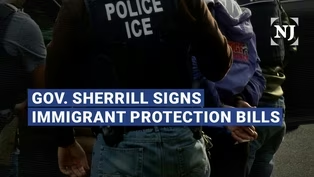
But first, Governor Sherrill has signed three controversial bills into law to protect the rights of immigrants here in New Jersey.
This comes after years of debate over the legislation and intense objection from Republicans in the legislature.
Governor Sherrill hadn't indicated publicly before today whether she'd sign the bills, even as calls grew louder for her to do so amid growing criticism over ICE and its tactics.
But she did sign them today, flanked by Democratic legislators and immigration advocates who fought for their passage.
the first bill codifies the immigrant trust directive into law, restricting local and state police from assisting federal immigration officers unless they have a criminal warrant.
the second bill limits how government and health care entities can collect and share personal information, including immigration status.
and the third bans local and federal officials from wearing masks when performing their duties.
the bill's passage comes amid several legal battles over immigration policy.
the sherrill administration filed a lawsuit with roxbury township to stop dhs from turning a warehouse into an immigration detention center.
and the trump administration has sued new jersey over an executive order barring ice from using state property to carry out enforcement operations.
Governor Sherrill says this trio of bills will limit the Trump administration's overreach and keep New Jersey safe.
New Jersey law enforcement should enforce New Jersey laws.
We shouldn't use New Jersey resources to do federal agents' jobs.
At the same time, we're not going to allow mass federal agents to terrorize our state.
We've all seen them in videos.
Unknown, unnamed, unaccountable, chasing after citizens.
Again, not here.
- Well, your rail and bus commute could look a lot better in the coming months.
By the start of the summer, NJ Transit riders can expect to see some improvements.
On Tuesday, Governor Sherrill signed an executive order giving NJ Transit a June 22nd deadline to make changes that'll provide a safer, cleaner, and more reliable ride.
For starters, addressing common complaints like broken elevators, poor lighting and dirty stations.
They also have to address public safety, including cameras and law enforcement presence at NJ Transit stations and stops.
The executive order also includes a requirement to improve the real-time reliability of NJ Transit's website and mobile apps that tell passengers when to expect their next bus or train.
Sheryl's order gives them 45 days to come up with a plan and another 45 to enact it.
The head of NJ Transit, Chris Calori, says he'll work with the governor to meet the deadline.
Coming up, U.S.
Senator Andy Kim holds nothing back when it comes to the stalemate over DHS funding and the partial government shutdown.
We'll hear from him next.
Major funding for NJ Spotlight News is provided in part by NJM Insurance Group, serving the insurance needs of residents and businesses for more than 100 years.
As the partial government shutdown enters its sixth week, Republicans and Democrats in Congress seem nowhere near an agreement to fund the Department of Homeland Security.
Even as TSA agents go without their second paycheck, and airports across the country see hours-long security lines.
The negotiations appear to have stalled as of today, as Democrats stand firm on their refusal to fund ICE or Border Patrol without reforms, and Republicans are refusing to separate funding for those agencies in a compromise to fund TSA and FEMA.
New Jersey's junior U.S.
Senator Andy Kim has been an outspoken member of the Homeland Security Committee, pressing the newly confirmed DHS Secretary Mark Wayne Mullen on some key issues during his recent confirmation hearings.
He joins us now to discuss all of it.
Senator, thanks so much for talking with us today.
Thanks for having me on at the time that we are talking right now.
Where do Democrats stand on negotiations to fund or not.
DHS.
Well we're fully ready to fund the parts of DHS that haven't been funded.
And that includes TSA.
We need to move forward.
I mean we're seeing huge lines at Newark Airport and elsewhere.
This is something that the American people are demanding.
Let's move forward.
Fund TSA.
We're in the middle of this Iran war.
We should have the cybersecurity efforts that we need.
FEMA is so important to New Jersey.
Coast Guard is so important.
Senator what are the stipulations tied to that funding for your party.
For those parts of DHS.
No continue.
There's nothing contingent.
You know we're willing to move forward with full funding to those aspects of DHS that aren't getting paid.
You know who is getting paid right now.
ICE is getting paid right now.
They're getting paid because of the reconciliation bill.
So why in the world is there are the Republicans holding up funding to those federal officers and agents when it comes to TSA and others.
Why are they holding their pay because of ICE when ICE is already paid through the reconciliation makes no sense to me.
So do you want to see a complete severing of funding in this bill for ICE and CPB or is it contingent upon reforms that Democrats have been calling for like body worn cameras like masks coming off other things like that.
Well the reforms the negotiation of the reforms are still far apart.
You know this is something that's been ongoing.
And so look I'd still like to see those negotiations continue on because that's what the American people are demanding, are reforms.
But since that's going to take some time, let's move forward and fund the parts of DHS that we can agree on.
What I'm asking for the Republicans is the same thing that they did with us a couple of weeks ago, which is we said we still have negotiations about DHS.
Let's fund the rest of the U.S.
government and focus in on what we still have outstanding agreements on.
That's the same thing I'm saying here.
Why don't we now zoom in on DHS fund what we do agree on and zoom in on and focus on that which we have disagreement on.
So they will do this when it came to the broader government funding.
Let's just do that within DHS now.
If there is no agreement to split off that ice and CPB funding and as I understand it also payment for the secretary.
Do you then leave these TSA agents without a paycheck even further.
At what point does there have to be some compromise from your party as well as from Republicans.
Yeah I look and we have come to that compromise.
You know we have put forward that we're willing to fund these different entities.
We've done that in the past.
We can and should do it now.
And look, it is absolutely wrong for these TSA agents and others to have to work without pay.
You know I was a federal civil servant before.
I worked through multiple shutdowns without getting paid.
It's wrong.
It should be illegal.
This should not happen.
And that's why we need to be able to remedy this as quickly as possible.
Make sure all who are not getting paid get paid.
And like I said, ICE officers are getting paid right now.
I think that that's wrong that they're able to get paid and the rest are not.
So let's just move forward and pay everybody.
It's a scene that we see in airports as ICE agents are there standing alongside TSA workers who are not getting paid.
The president has said that he wants any deal tied to passage of the Save America Act.
Is that something that Democrats would be willing to compromise on at all?
Republicans say this is common sense to ensure the security of our elections.
Democrats have been opposed to it.
Is there any room for compromise on that bill?
Yeah, the president's idea of holding TSA hostage for the Save America Act is just a stupid idea.
It's one of the stupidest ideas I've ever heard him say when it comes to these negotiations.
And I know a lot of Republicans in Congress also think that this is just a huge tactical mistake.
The American people are in lines three, four hours long.
You know, we got spring break coming up for so many families around our country and so much other business that needs to be done.
The idea that he wants to hold that up for this very controversial bill that would essentially, I mean, there was just an amendment that was at, you know, that that's being considered that would essentially cut all mail-in ballots in this country that would affect so many seniors and so many others that are affected.
There's so many implications to this that the American people need to learn about and be able to understand as we're having this debate.
The idea that he's gonna hold up something so urgent like TSA, the fact that we're at a war because of him, because of Trump, without Congress's and the American people's approval, and yet we're not funding fully our cybersecurity agency.
you know, these are the things that the president is deeply out of touch with.
I really couldn't believe that he said something that was so idiotic.
I shouldn't be concerned.
I shouldn't be surprised, given that we've certainly seen that from him in so many other ways, too.
You pressed the new Secretary of Homeland Security, Mark Wayne Mullen, on the Roxbury detention center that's coming, that's already in the plans here in New Jersey.
He had said to you, if he can't explain why it's there, then that's a different story, when you asked him whether or not it should be there.
Have you heard whether or not he will be visiting that site, whether he will try to explain the justification for that site moving forward?
Well, he did make that commitment in his confirmation hearing to come to Roxbury, and I'm going to hold him to that.
I've had multiple conversations about this, but I thought it was important and telling that in the confirmation hearing, Mullen did say that he thought it was wrong that ICE move forward without engagement and agreement with the local officials and leadership.
He also pointed out that yes, there are huge problems when you're trying to convert a warehouse the size of three football fields into something that is meant to hold nearly 2,000 people between detainees and staff.
And as Governor Sherrill said, with only four toilets, right?
Yeah, exactly.
I mean, this is something that is enormously problematic, and it's incredibly expensive.
I mean, the US government spent $130 million of taxpayer dollars just to buy the warehouse.
They're telling me it could cost upwards of $160 million or more just to retrofit it into a detention facility, and then another $160 million for wraparound service.
So we're talking about half a billion dollars just to be able to get -- before even detainees can be in this building.
I mean, I can certainly think of a lot better things that we can be doing for New Jersey with half a billion dollars.
-Just very quickly, you also asked him about a policy that former Secretary Christy Noem had put in place where she had to approve anything through FEMA over $100,000.
Are you satisfied with his response there, that he would revoke that policy?
-Yes, I'm going to hold him to that as well because that policy of Noem's also goes in the Hall of Fame of stupid ideas, because it's just something that was holding back on the important need to families struggling after disasters.
It held up funding to Texas, for instance, after that tragic flood incident last year.
So this needs to change.
It needs to change immediately, especially before we get into hurricane season in New Jersey.
So I am going to hold him to that.
I, at this point, do have confidence that that will go away, but I've come to understand, you know, I'm not going to take anything for granted.
I'm going to make sure we're pressing to have that formally revoked as it comes into position.
And for the record, you did vote no on his confirmation hearing, but we do have to leave it there.
Thank you, as always, for your time today, Senator, U.S.
Senator Andy Kim.
Thank you.
On her first day in office, Governor Sherrill signed one executive order freezing energy rate hikes in the state and another one directing the Board of Public Utilities to open up solicitations for new solar and storage power generation.
The goal, to bring down the price of electricity.
So what's happened since then and is it having any impact on your wallet?
We're joined now by the President of the Board of Public Utilities, Christine Goul Sadovy.
President Goul Sadovy, great to have you with us.
Thanks for taking a few minutes to talk.
What can you tell us about the new solar and storage projects that have come online since that executive order was signed?
Thank you, Joanna.
Thanks so much for inviting me.
I'm very happy to be here and talk about these initiatives that the BPU is taking on under the leadership of the Governor Cheryl's administration.
So as you noted in executive order two, the Governor Cheryl signed on her first day, expanding generation, particularly in-state electricity generation is a big priority.
This has been a big priority for the BPU for the last several years, and we were able to effectuate that first day executive order by awarding projects in the competitive solar incentive program and in the Garden State energy storage program, the battery storage program.
Those are both such important programs for helping to bring more generation resources online and to help reduce long-term costs for customers and for families in New Jersey.
So we awarded projects around the state in solar and storage, and we also opened additional capacity for another storage solicitation to continue to bring battery storage capacity into New Jersey in the near future.
Just for folks who don't really understand kind of the nuance of how all of this works.
Battery storage is so critical for renewable energy energy options.
Why.
So thank you.
It's actually critical for for all electricity and for reducing electricity demand and providing opportunities to stabilize electricity demand.
So electricity resources whether they come from solar or fossil or nuclear there may be times that electricity is being produced that it's not needed.
So if it's a sunny day but it's not very hot.
So there are not a lot of cooling needs.
Then solar panels are producing a lot of electricity.
But we might not need that level of electricity in that moment.
So having battery storage particularly connected to solar but really connected to the grid as in the Garden State Energy Storage Program is so important to be able to harness those that electricity capacity and use it at a time that we need it more or that we have higher electricity needs like when it's very, very high.
The governor signed legislation also this week that would extend a deadline for you to be able to bring more projects online.
What do you expect could come online before the end of the year?
So we are looking at how we can expedite all ways to bring new electricity online, not just storage.
And I know that the governor is taking on government efficiency and permitting efficiency to bring projects on more quickly.
We expect solar and solar projects to be coming on routinely throughout the rest of the year.
And again we're looking to award additional battery storage projects before the end of the year.
And those projects the important point that I can talk about more in more detail is the battery storage projects and their ability to bid into the PJM capacity market and to help stabilize some of the capacity prices.
And that have really driven those bill increases that have we have seen over the last couple of years.
It's an interesting point that you raise.
But I have to ask this question.
When we look at the battery storage it's about three hundred fifty five megawatts between the three projects that were approved for solar.
It's about 24.
That goes into the grid.
It's a fraction of what we need here in New Jersey.
And we're part of this interconnected grid that services 13 states.
Right.
So how much of that actually ends up bringing down prices for residents here in New Jersey.
So we you know what we say is every megawatt counts bringing in additional megawatt resources through solar and through storage help to contribute to rate stabilization in the near term and the long term.
So bringing in those kinds of not you know not just the solar and storage but any additional megawatt capacity even on the demand side.
So reducing energy through energy efficiency programs like the triennium programs that are overseen by the BPU helps to stabilize costs and has a long term price suppression effect in those capacity markets.
But as you noted Joanna we are not alone.
We are impacted not just by the additional resources that come online in New Jersey and in other states but the higher demand that we see from things like data centers that are being built outside of New Jersey and implicate the rates in New Jersey.
You teed up my next question.
They're not just being built outside of New Jersey right.
Also here in New Jersey.
It's actually first hard to find the numbers in terms of how many I see 68 I see 80 potentially up to 100.
First do you have that data.
How many data centers are here or in the process of being built.
So we have made requests to our electric utilities to get interconnection data for things like data centers.
I think the challenge particularly with data centers is that we know some of that is speculative and sometimes data centers proposals are being proposed in different jurisdictions.
So we might see the same data center being proposed for New Jersey as as for Pennsylvania.
And we are working to through data requests with our utilities and through our work with PJM to ensure that we are not counting for those speculative data centers when we do projections for load growth because those projections feed into the capacity market and do have an impact on prices for everyone.
Right.
If you're going to have to meet this higher demand because you're counting the same data center twice the projected costs go up.
I want to look at Vineland in particular because as they're building as this data center built by data one partnership with Microsoft down in Vineland is coming in they say that they're going to produce 85 percent of their own energy needs.
I'm just curious what the balance means for New Jersey customers and if there are if there's any quantitative data around how much that could cost.
Is that going to increase our energy bills.
So I'm not to comment on specific proposals or projects.
I just want to start by saying data centers are really important.
They're important for national security.
They're important for technological advancement.
Obviously I has a host of possibilities and potential.
And so they are important.
And we want to see data centers supporting that kind of national security and economic growth needs in New Jersey and outside of New Jersey.
But data centers use a very significant amount of both electricity and also water which is not what we're talking about today.
But I think it's important to know.
And as a result when we have large scale data centers in particular or you know an aggregate of smaller data centers we are going to see that those implicate the cost of electricity.
It's really it's a supply and demand issue.
And we have seen a very significant increase in demand over the last couple of years in particular.
And we need to make sure that supply keeps up.
There are some considerations out there for, you know, bring your own generation, like you mentioned, with, you know, with some of the electricity that Vineland is using.
We want to make sure that there's not just an affordability, that affordability is being addressed, but that also capacity is being addressed.
We can't have a situation where we don't have enough electricity.
I'm sorry to interrupt you, but we've got to leave it there.
Christine Golosadovi, president of the BPU.
Thank you so much.
Thank you, Joanna.
Thanks so much for inviting me.
Robert Frazer has been named New Jersey's new U.S.
attorney.
He assumes the role after months of chaos and confusion over who was in charge.
It started with Alina Haba's appointment by President Trump, then her removal by a panel of judges after she failed to be confirmed by the U.S.
Senate.
The Justice Department later fired her replacement and put Haba back in the role.
She later resigned and was replaced by a trio of attorneys, which the courts also ruled unlawful.
Well, Fraser's appointment brings an end to this bitter battle, and with it, maybe, some clarity.
I'm joined now by Jacob Elberg, a former assistant U.S.
attorney and a professor at Seton Hall Law, to talk about what it all means for the cases that come out of this office.
Jacob, great to have you with us.
Thank you for having me.
What can you tell us just about Robert Fraser to begin in terms of his work as a career prosecutor?
So he is, as you said, a career prosecutor.
He's someone who's been in the U.S.
Attorney's Office in New Jersey for more than 20 years and a state court prosecutor before that.
So he is a true public servant and somebody who's dedicated his career to being a prosecutor.
And he's someone who is known as being hardworking and particularly focused on issues of drugs, gangs, violent crimes, things of that nature.
He's handled some of the most difficult and important cases in that area that this office and really any office has had over that time.
We've gotten into the politics of this office so much because it's been so unprecedented in terms of who's in charge.
But what typically are the cases that do come out of the U.S.
Attorney's Office?
So the office handles a wide range of cases.
So there are things that are closer related to violent crimes, things like gangs, guns, drugs, things of that nature.
Also issues of white collar crime that can involve things like financial crimes, health care fraud, political corruption.
And of course, the office also handles issues of immigration, which have been a particular focus of this administration.
What can you tell us about the impact on some of the cases that have been brought by the U.S.
Attorney's Office during all of this chaos and all the confusion around who was in charge?
Has there been an impact on those cases?
Well, there's been a real impact over the course of these issues, and it's been to a real detriment to the functioning of the office and its ability to handle cases.
But the expectation is that now we'll see a move out of that.
In terms of the cases that have happened in the past, we were about to be headed to some significant argument and hearing from a judge regarding whether those cases needed to be thrown out.
- Interesting-- - One man in particular, right, tried to challenge his case.
He was facing drug charges.
What's happening there?
What happened there?
Well, one of the things that's happened, there have been a few different groups of cases.
And as to the one where the judge said, look, I need to look at whether I need to throw these cases out, DOJ this week, with Rob Frazier's appointment, has said, actually, judge, please give us some time.
We're going to go back and try to fix those cases.
And so they're talking about basically redoing the work in that case and others, going and re-indicting defendants who had already been indicted in some cases to try to fix any problems that happened as a result of folks being in charge who didn't have the lawful authority to be in charge.
Essentially starting over?
On those cases, I wouldn't say quite starting over because they'll have investigative aspects that they have done, but there are some parts that will have to be redone.
And that's obviously at a loss of other work that those folks would be doing, but there is at least a hope now of moving forward.
When there was this triumvirate of three attorneys who were leading the office, there was a lot of admonishment from a couple of different judges, federal judges here in New Jersey.
What can you tell us about what Judge Karashi in particular said to them in terms of some cases that they were bringing forward, deals, plea deals that they were making?
Well what this really comes down to and has come down to from the beginning is the judges holding the administration to following the law.
And so there are rules in place, there's statutes, there's the Constitution that govern how it has to work for somebody to have the authority.
And the administration wasn't getting what they wanted and the judges were essentially saying, "Look, you don't have a choice.
We're gonna hold you to it.
That the rule of law matters and you follow it.
And what Judge Koreshi said most recently was that he wasn't going to be okay with moving forward in a case when there are some real doubts about whether the authority was coming from an acceptable place.
And then just finally is there any indication that the changes here at the top could have an impact on the case that's pending against Congresswoman LaMonica McIver?
Well, that all I think remains to be seen.
We have now new leadership in the office and an expectation that the person leading the office will do that in a not political way.
What happens with each of the cases moving forward I think is something we'll have to look forward to seeing.
>> All right, Jacob Ellberg, professor at Seton Hall Law and former assistant U.S.
attorney, thanks for your time today.
>> Thank you for having me.
>> And that's going to do it for us tonight.
I'm Joanna Gaggis.
For the entire team here at "NJ Spotlight News," thanks for being with us.
We'll see you right back here tomorrow.
>> New Jersey Education schools great for every child.
♪♪ Great for every child.
?
?
[Music]
 New
NewSherrill signs immigration bills to counter Trump enforcement
Video has Closed Captions
Governor turns limits on police interaction into law (1m 58s)
Providing Support for PBS.org
Learn Moreabout PBS online sponsorship
- News and Public Affairs

Top journalists deliver compelling original analysis of the hour's headlines.

- News and Public Affairs

FRONTLINE is investigative journalism that questions, explains and changes our world.












Support for PBS provided by:
NJ Spotlight News is a local public television program presented by THIRTEEN PBS