State of the Arts
Omar Edwards: Tapping Into Expression
Clip: Season 44 Episode 8 | 5m 44sVideo has Closed Captions
Omar Edwards: Tapping Into Expression
Omar Edwards is an award-winning tap dancer whose “foot music” has taken him to over 20 countries and stages from Broadway’s Bring in ‘da Noise, Bring in ‘da Funk to the Apollo and the White House. We met the performer, choreographer and mentor in his studio in Englewood, NJ. Omar views tap as both rhythm and storytelling, sharing that philosophy through performance and community arts programs.
Problems playing video? | Closed Captioning Feedback
Problems playing video? | Closed Captioning Feedback
State of the Arts is a local public television program presented by NJ PBS
State of the Arts
Omar Edwards: Tapping Into Expression
Clip: Season 44 Episode 8 | 5m 44sVideo has Closed Captions
Omar Edwards is an award-winning tap dancer whose “foot music” has taken him to over 20 countries and stages from Broadway’s Bring in ‘da Noise, Bring in ‘da Funk to the Apollo and the White House. We met the performer, choreographer and mentor in his studio in Englewood, NJ. Omar views tap as both rhythm and storytelling, sharing that philosophy through performance and community arts programs.
Problems playing video? | Closed Captioning Feedback
How to Watch State of the Arts
State of the Arts is available to stream on pbs.org and the free PBS App, available on iPhone, Apple TV, Android TV, Android smartphones, Amazon Fire TV, Amazon Fire Tablet, Roku, Samsung Smart TV, LG TV, and Vizio.
Providing Support for PBS.org
Learn Moreabout PBS online sponsorshipEdwards: Many years that I focused on tap-dancing being music, not dancing.
I don't even hear in rhythmic patterns.
When my feet are going, "Sigga digga digga digga digga digga digga," I hear, "Mmmmmmmm, mmmmmmm."
Which is being powered by -- [ Foot stomping ] But in my head, in order to get to "Zigga digga digga digga digga digga digga digga digga digga," I think, "Mmmmm."
It's just my imagination.
That's what imaginations are for.
Your imagination is so you can see God.
So you can hear music out of things that aren't presented as music.
And that's where I'm at.
My general personality has always been that of an expressionist.
I'm an idea man.
Where do I see going with tap-dancing?
Anywhere my mind can go.
My name is Omar Anthony Edwards, although you could call me "Chief."
I was born in Brooklyn, raised in far Rockaway, Queens.
And then, one day, I think my grandmother took me to the family reunion.
And that was the first time I met my cousin, Savion Glover.
[ Cheering ] Savion is in a show called Black and Blue.
I hopped a train to the Minskoff Theatre one Saturday afternoon, and I sat there, and my mind was blown.
I wasn't supposed to be on Broadway, but somehow, I got in that game.
Because I didn't know how to do choreography.
I knew how to tap-dance, sure.
So, fast-forward a little bit.
Now I'm about 16, and Danny and I have created this tap-dance group called Toe Jamm.
Danny and I would tap, I'd do some flips, we'd do some splits, have -- stand on our toes and do the whole shim-sham on our toes.
And there was a show called "Star Search."
We went 13 times, and I had booked Black and Blue.
Remember Black and Blue, the show that closed on Broadway?"
My dream show.
Now, I heard it was going on tour.
And so now I'm traveling the world.
It was really more schooling.
Glover: On tenor taps, we have Omar Edwards.
Yeah, O!
[ Applause ] Edwards: After all of that, I turned 50 years old.
And -- [ Laughs ] Yeah, that's right -- [muffled] 50 years old.
I've been to 22 countries.
I have four children now.
And the dance is pure for me.
And I'll always be in my lab, and I'll always go out and do special projects.
I have a company called Dance Medicine.
You were able to come by and see one of our holiday shows, where we got a chance to spend time with the veterans.
It was a pleasure to give them my art form and to bring my band, New York Jazz Gypsies.
Dance Medicine is about the veterans homes, juvenile detention centers, jails, hospitals, cancer wards, AIDS wards, using music, song, and dance as a healing, a radiation of healing energy.
Woman: [ Singing ] All alone, I sit home by the phone.
Edwards: I'm quite busy, enjoying the dance even more than ever.
Because you can't wave a dollar in front of my face to make me dance 'cause I don't do it to survive anymore.
I do it because I love it, and I want to know more about what I can do to contribute to it.
And if a student comes around who really wants to learn, I will dedicate and be pure with them.
I'm like a martial-arts instructor.
We're going to learn a lot about a lot of it.
Gonna learn as much as I can give you from my experience, as much as I can give you from my curiosity, as much as I can give you from the tradition of it, I just really can try to make a tap dancer, which is really just an expressionist.
Tap-dancing is just tap-dancing, but expression inside of tap-dancing makes it special.
Tap-dancing can end up anywhere.
Anywhere.
I've tap-danced at the White House, at palaces, in the park, on the street.
I've tap-danced before royalty, before Black activists.
Tap-dancing, it took me a while to figure out what the dance was for me and what it wasn't for me versus influence.
Because in America, tap-dancing has very serious racial connotations.
There was times when these Black men were on stage, smiling, when they were going through hell.
African Americans are so displaced that all of their culture is all mixed up.
And on top of that, there was a whole initiative to subdue the learning about their self and their culture.
Tap-dancing is not Black, but it is Black.
The progenitors, the forefathers are totally Black, but you can't leave out Steve Condos.
But you can't leave out Fred Astaire.
You might think I might have sold my soul because I'm a tap-dancer who smiles.
But I'm really an Omar who smiles.
Tap-dancing will die, 'cause it always dies.
But storytelling will not die.
And the tap-dancers that pay attention to the musical aspect and the storytelling aspect will live on, forever.
Even with AI, you're still going to need somebody -- some body -- to tell that story with their body, with their mouth, with their spirit, with their pain, with their joy, with their love.
That's where I come in.
So that's what I'll be doing.
 New
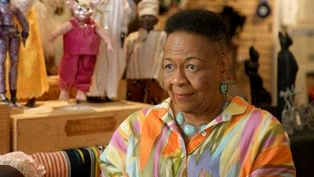
NewKimberly Camp: Dollmaking Fine Art at Play
Video has Closed Captions
Clip: S44 Ep8 | 5m 31s | Kimberly Camp brings joy to the three-millennia-old art form of dollmaking. (5m 31s)
 New
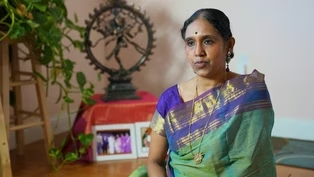
NewRamya Ramnarayan: Bharatanatyam, Tradition & Change
Video has Closed Captions
Clip: S44 Ep8 | 6m 4s | Ramya Ramnarayan connects students to a living tradition of the Bharatanatyam dance form. (6m 4s)
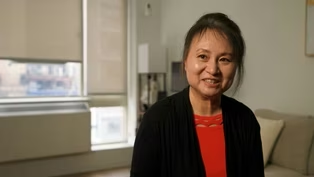 New
NewVideo has Closed Captions
Clip: S44 Ep8 | 6m 29s | Yang Yi, master of the guzheng, passes the ancient tradition down to her students. (6m 29s)
Providing Support for PBS.org
Learn Moreabout PBS online sponsorship

- Arts and Music
The Best of the Joy of Painting with Bob Ross
A pop icon, Bob Ross offers soothing words of wisdom as he paints captivating landscapes.












Support for PBS provided by:
State of the Arts is a local public television program presented by NJ PBS