State of the Arts
Yang Yi: Guzheng Energies
Clip: Season 44 Episode 8 | 6m 29sVideo has Closed Captions
Yang Yi, master of the guzheng, passes the ancient tradition down to her students.
For over 2,500 years, the guzheng has been a symbol of Chinese cultural tradition and artistry. In Princeton, through the Yang Yi Guzheng Academy and Ensemble, master musician Yang Yi passes on that legacy, teaching students the history, discipline, and evolving possibilities of the 21-stringed instrument while creating space for both traditional and contemporary performance styles.
Problems playing video? | Closed Captioning Feedback
Problems playing video? | Closed Captioning Feedback
State of the Arts is a local public television program presented by NJ PBS
State of the Arts
Yang Yi: Guzheng Energies
Clip: Season 44 Episode 8 | 6m 29sVideo has Closed Captions
For over 2,500 years, the guzheng has been a symbol of Chinese cultural tradition and artistry. In Princeton, through the Yang Yi Guzheng Academy and Ensemble, master musician Yang Yi passes on that legacy, teaching students the history, discipline, and evolving possibilities of the 21-stringed instrument while creating space for both traditional and contemporary performance styles.
Problems playing video? | Closed Captioning Feedback
How to Watch State of the Arts
State of the Arts is available to stream on pbs.org and the free PBS App, available on iPhone, Apple TV, Android TV, Android smartphones, Amazon Fire TV, Amazon Fire Tablet, Roku, Samsung Smart TV, LG TV, and Vizio.
Providing Support for PBS.org
Learn Moreabout PBS online sponsorshipYang: The fascinating part of this instrument is, you can be yourself, but you're not yourself.
Art is actually connecting to the spiritual world.
At that moment, I'm not me.
I forgot myself.
I just bring the energy, the emotion.
Everything feels so natural.
So I'm playing the nature, I'm playing the mountain, I'm playing the emotion and my thoughts and going through my body and reflecting.
I like to experiment.
For me, experiencing different sounds, mix, and to reflect the music.
It's just bringing my energy to the world.
[ Guzheng plays ] I'm Yang Yi.
The Chinese name is Yang Yi.
The English name is Yi Yang, but the way that we Chinese pronounce it is last name first.
I'm a musician on the art form called guzheng.
"Gu" means "ancient."
"Zheng" means "the instrument" that has at least 2,500 years of history.
It's a Chinese zither.
The traditional one has from five string to today's 21 strings, and it's been played by professional world in this shape at least since 1960s.
The instrument itself is very close to another Chinese instrument, which is already gone, but that one is more in the court.
This one is more in regular life.
[ Guzheng plays ] I started to play guzheng since I was 5 1/2.
My preschool teacher recommended me.
Actually, the number one Chinese children's performing arts group.
I was just fascinated about the sound of this instrument.
I had to do the petition to get the privilege to play this instrument.
From there, I started my career in the performing-arts group.
I collaborated with multiple orchestras, including Chinese National Broadcasting and Beijing Music and Dance Company and multiple Chinese national-level orchestras.
I moved to New Jersey in 1991.
In America, I found myself with a huge stage.
At first, I thought I had no market.
But it's amazing.
Here, I see I'm standing on a bigger stage, even though I'm always being asked, "What is this instrument?"
So I become pretty much an educator or advocating for this instrument.
I've gone through hundreds of colleges to introduce the instrument and also workshops, and I started this group called Yang Yi Guzheng Academy and Ensemble, mostly for teaching the art form in a very professional format.
in Princeton area, in New Jersey.
Deng: I think it has the characteristics of a horizontal harp, but the way that you interact with the strings is also like a guitar.
It's very bright and pure.
So I started learning the guzheng when I was 8, and I had no idea what it was in the beginning.
You start with numbers, so one, two, three, five, seven, one.
It's a pentatonic scale, which is traditional to a lot of Chinese music.
There's 21 strings, so essentially, four full pentatonic octaves.
The right hand is what actually creates the texture.
So, you can do, like, glissando, or you could just pluck, and then the left hand, it's more for pressing down on the string to create vibrato or to create new pitches.
I think that it definitely helps me stay in touch with my heritage.
It played a multidimensional role in coloring the ancient Chinese society.
It's beautiful that, through Professor Yang, that craft can kind of transcend time and transcend place, as well.
[ Guzheng plays ] Yang: Throughout the years, I've been playing so many times with different musicians, but the most memorable ones were that Chinese lute player Tang Liang-xing.
He's like a grandmaster on the pipa.
He was also the 1997 National Heritage Fellowship.
The performance was for the Chinese Lunar New Year, year of horse.
We played three songs, mostly for the traditional and the festival music.
For me, the most important thing is the root, because without the root, this instrument doesn't even exist.
It's been at least 2,500 years of history.
We do any invention, but it has to be from that point.
I'm always okay, and I'm always welcoming different way of showcase the instrument.
Chinese say... Like, "There's no sound, but that means way more than with the sound."
So it means how you can articulate it.
What do you want within that space?
Going through all these years of performance, I know both Chinese music world and the Western instrument world.
They all changed because of the possibilities.
We're collaborating, we're challenging each other, we're articulating ourselves, and the end result is always beyond what we originally thought it could be.
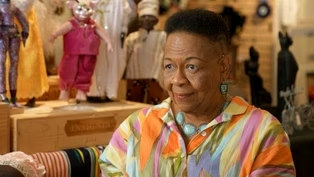 New
NewKimberly Camp: Dollmaking Fine Art at Play
Video has Closed Captions
Clip: S44 Ep8 | 5m 31s | Kimberly Camp brings joy to the three-millennia-old art form of dollmaking. (5m 31s)
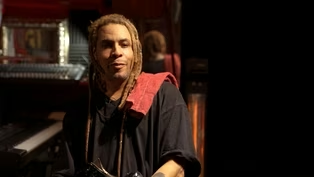 New
NewOmar Edwards: Tapping Into Expression
Video has Closed Captions
Clip: S44 Ep8 | 5m 44s | Omar Edwards: Tapping Into Expression (5m 44s)
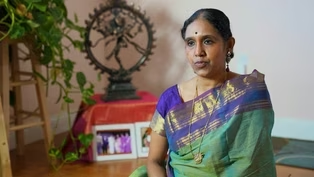 New
NewRamya Ramnarayan: Bharatanatyam, Tradition & Change
Video has Closed Captions
Clip: S44 Ep8 | 6m 4s | Ramya Ramnarayan connects students to a living tradition of the Bharatanatyam dance form. (6m 4s)
Providing Support for PBS.org
Learn Moreabout PBS online sponsorship

- Arts and Music
The Best of the Joy of Painting with Bob Ross
A pop icon, Bob Ross offers soothing words of wisdom as he paints captivating landscapes.












Support for PBS provided by:
State of the Arts is a local public television program presented by NJ PBS