One-on-One
Petal Robertson; Maximilian Rodio; Rodney Salomon
Season 2026 Episode 2904 | 27m 30sVideo has Closed Captions
Petal Robertson; Maximilian Rodio; Rodney Salomon
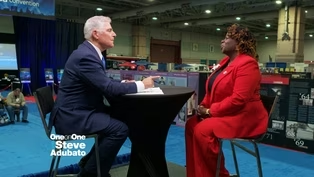
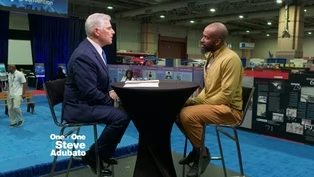
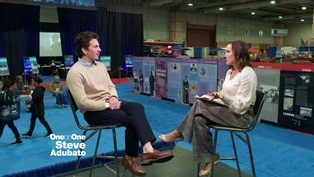
On location at the NJEA Convention, Petal Robertson, VP of the NJEA, talks about the intersection of labor unions and politics. Maximilian Rodio, President of Hammonton Pride, discusses the organization’s mission to unite and uplift the queer community. Rodney Salomon, Co-Founder of Konscious Kyds, examines the role of holistic practices in supporting youth mental health.
Problems playing video? | Closed Captioning Feedback
Problems playing video? | Closed Captioning Feedback
One-on-One is a local public television program presented by NJ PBS
One-on-One
Petal Robertson; Maximilian Rodio; Rodney Salomon
Season 2026 Episode 2904 | 27m 30sVideo has Closed Captions
On location at the NJEA Convention, Petal Robertson, VP of the NJEA, talks about the intersection of labor unions and politics. Maximilian Rodio, President of Hammonton Pride, discusses the organization’s mission to unite and uplift the queer community. Rodney Salomon, Co-Founder of Konscious Kyds, examines the role of holistic practices in supporting youth mental health.
Problems playing video? | Closed Captioning Feedback
How to Watch One-on-One
One-on-One is available to stream on pbs.org and the free PBS App, available on iPhone, Apple TV, Android TV, Android smartphones, Amazon Fire TV, Amazon Fire Tablet, Roku, Samsung Smart TV, and Vizio.
Providing Support for PBS.org
Learn Moreabout PBS online sponsorship- [Narrator] Funding for this edition of One-On-One with Steve Adubato has been provided by NJ Best, New Jersey’s five-two-nine college savings plan.
Stockton University.
Johnson & Johnson.
Bergen New Bridge Medical Center.
The North Ward Center.
Robert Wood Johnson Foundation.
Working to create a future where health is no longer a privilege, but a right.
Horizon Blue Cross Blue Shield of New Jersey.
The Fund for New Jersey.
And by United Airlines.
Promotional support provided by NJ.Com.
Keeping communities informed and connected.
And by BestofNJ.com.
All New Jersey in one place.
- This is One-On-One.
- I'm an equal American just like you are.
- The way we change Presidents in this country is by voting.
- A quartet is already a jawn, it’s just The New Jawn.
- January 6th was not some sort of violent, crazy outlier.
- I don't care how good you are or how good you think you are, there is always something to learn.
- I mean what other country sends comedians over to embedded military to make them feel better.
- People call me 'cause they feel nobody's paying attention.
_ It’s not all about memorizing and getting information, it’s what you do with that information.
- (slowly) Start talking right now.
- That's a good question, high five.
(upbeat music) Hi everyone, Steve Adubato with my co-anchor and colleague Jacqui Tricarico.
Jacqui, let's set this up.
People are about to see a series of interviews that we did down in Atlantic City at the New Jersey Education Association Convention.
Let's tee it up.
- Yeah, three interviews that we did down in Atlantic City.
Some are yours, some are mine.
Just great people that we got a chance to speak with about why they were there, why they were attending, and some of the work that they're doing to support educators and as well as the citizens of New Jersey.
So many nonprofit leaders that we had a chance to speak with as well.
So you're gonna see that up in this next half hour.
- So if you wanna know what goes on at the teachers convention, the NJEA Convention, Atlantic City, this is just a taste of some of the folks who are down there, more than 10,000 this year, and the important conversations that took place.
Let's check it out.
- Hey, everyone.
Steve Adubato in Atlantic City.
Why?
Because it's the 2025 New Jersey Education Association Convention.
We are here, with the Vice President of the NJEA, Petal Robertson.
By the way, the reason you're looking at people is 'cause you got people (Petal laughs) all around here waving to you, - I do.
- giving you high-fives.
- I do.
It's the best time of the year.
- Tell us why this convention.
By the way, you've been to a few?
- I have been to a few.
- Why is this one with over 10,000 people so exciting for you?
- So for me, because we're coming off a really big NJEA win, our endorsed candidate for governor just won the gubernatorial seat.
- Governor Mikie Sherrill.
- So congratulations to Governor-elect, Mikie Sherrill.
So our members organized, and they rallied.
So them coming in and being able to celebrate that big win together.
And it's always a great time at convention.
So this is just my favorite time of year.
- So let's talk about that.
Because I was talking to Steve Beatty, to your president about that as well, about the NJEA involved.
And I'll disclose again, the NJEA, a longtime supporter of public broadcasting and of our programming as well.
Why is it so important for those who go, "Why are you involved in politics?
Why are you involved in campaigns?"
It's important that people understand that.
- Well, I think that everyone- - By the way, we're at a convention.
That's how you know stuff's going on around here.
(Petal laughing) Go ahead.
- Well, I think everyone should be involved in politics.
Everyone should be a participant in politics.
And we know that politics is heavily involved in education.
So educators, that is just a natural place for us to fit.
And as a union, we wanna make sure that we're empowering our members so that they can also get involved in politics and the communities around them.
- Along those lines, it's not so much politics, but it's government decisions, which, political.
The "Break in Service" law.
- Oh, this makes me happy.
- What the heck is it?
I talked to Steve about this as well.
- Yes.
- Explain to folks what it is and why it matters.
- So I'll give you a really, a simple breakdown of it.
So in 2011, the law changed, and it made it so that people who took more than two years out of the classroom got bumped out of their original retirement tier and bumped into tier five.
- So hold on.
Teacher takes a break.
- Teacher takes a break.
- Two years, you're out?
- Yeah.
I can give you a perfect example.
We had a teacher go on maternity leave, and on their maternity leave they found out that their child had special needs.
- Mm.
- So they decided to extend that maternity leave, and it extended past two years.
They go back to work thinking, "I'm still in tier one, I can still retire."
- Tier one means... - Means that I can retire at 55 with a good retirement savings.
And they think everything's good, and "I'm coming back to this classroom that I love, and I'll be able to retire."
But because of the law that changed in 2011, they were bumped out of their tier, and they were put into tier five, which means you can't retire until you're 65 years old for significantly less money than you originally planned.
And this we found, disproportionately affected women in our organization who had left to take care of children, themselves, some recovering from cancers, all of those things.
So we really rallied, we pushed hard, and we're so grateful to Governor Murphy for signing this bill into law because this now will restore the proper retirement for so many of our members.
- Petal, thank you.
First, thank you for laying that out.
But I'm curious about this.
For you, and I wanna mention, 'cause you understand this very well.
I'm gonna ask you a little bit about why education for you, but also the 2025 '26 "Teacher of the Year" is Gillian Ober.
- Yes.
- From Freehold?
- Yes.
- Why did, why a teacher for you, A and B, why is that so exciting for you to recognize Gillian?
- So one, Gillian is fantastic.
Like, you can feel her energy as soon as she comes into the room, and you can tell how passionate she is about her students.
But in this day and age, why I think Gillian is such a great example for us to uplift, is because Gillian works with many families who have just come to this country, and she works with many children who are just learning our language, and just getting to understand their communities.
And the level of patience that she has, the inclusivity that she teaches with, she's a gift.
- She's a gift.
- So she's got the passion.
- She, oh, she's got the passion.
- Now talk about yours.
- So- - How many years teaching?
- Oh my goodness.
I have been teaching since 2001.
- Okay.
- So I'm, I'm over two decades in, but I've been wanting to teach since I was five years old.
- Because... - Because I come from a line of teachers.
My mother was a teacher in Guyana, my family's from South America.
My grandfather opened a school in Guyana.
They actually just named a street after him.
- After your grandfather?
- After my grandfather.
That's awesome.
- Frederick Robertson.
Yes.
And so education has always been so important to us, and it's just been such a key to unlock so many doors for myself and my family, and for so many immigrant communities.
So I just feel very passionately about ensuring that every child has an equitable education.
- That's personal for you?
- Yes, very.
Very much so.
- Is it also personal on some level beyond the professional satisfaction of being the vice president- - Yeah.
- of the organization?
How much of that is personal for you?
You didn't go into this to become a leader?
- Oh no.
- And an officer in the organization.
- I tell people all the time, someone said, "Oh, did you, you know, when you were a kid, did you know that you would be the vice president of the union?"
And I said, "What kid dreams about being in a union?"
(Steve laughing) I was worried about quicksand.
But- - Wait, hold on.
(Petal laughing) You just can't say that.
Quicksand where you grew up?
- I thought quick... No, I just as a kid, I thought quicksand would be something that I would have to figure out how to maneuver out of.
I've never seen quicksand, Steve.
- Okay.
I just wanna clarify that.
But being a union leader- - But being a union leader- - not on the bingo card.
- Not, not on the bingo card at all.
But I realized that I am a big mouth, I am an activist, and I really love fighting for marginalized people and marginalized voices.
So it sort of naturally placed me in this position.
And I'm honored because I get to be the first black woman to ever serve as vice president of the NJEA.
And I hold that with pride.
- It is our honor and pleasure- - Thank you.
- to be here at the NJEA convention.
It's, again, you could hear what's going on around us.
- Yes.
- But the vibe here, before I let you go, I gotta tell you, the vibe here is awesome.
- Isn't it?
- And the keynote speaker, was it Malala?
- Yes.
- Malala... Yousafzai.
- Oh.
- Malala.
Tell everyone, one of the two keynote speakers.
- Yes.
- "She was awesome because..." - She was awesome because she gave the room hope.
And she let the room know that activism isn't about age, it's about passion, about your beliefs.
- But she's young.
But by her background, - Yes.
- Let folks know.
- She, so Malala started her activism for young girls, fighting for young girls to get an education.
And she was shot at 11 years old by the Taliban.
And she, and she never let it deter her.
As a matter of fact, it's forced her to push harder.
And she is now working in several countries ensuring that young girls are, are enabled an opportunity to receive an education.
And so her story, her humor, her warmth, all of those things were the reminder that we still have really great people in this world, and that we can be those really great people that we need.
- Inspiring.
- Oh, she was amazing.
She was amazing.
- This is Petal Robertson.
She's the vice president of the NJEA.
She knows how to navigate quicksand, apparently.
(Petal laughing) - I'm a pro.
- You're a pro.
I cannot thank you enough.
- Thank you so much, Steve.
- We appreciate you and your colleagues.
- I always enjoy it.
- And again, - Thank you.
- let me disclose again, the NJEA, a long time supporter of our programming and public broadcasting.
You may have heard of it.
(Petal laughing) Still pretty important.
I'm Steve Adubato.
We're in Atlantic City for the NJEA convention.
Stay with us.
We'll be right back.
- [Narrator] To watch more One on One with Steve Adubato find us online and follow us on Social media.
- Hi, I am Jacqui Tricarico on location at the NJEA convention here in Atlantic City, and so pleased to be joined now by Max Rodio, who's the President of Hammonton Pride and also the co-creator of a beautiful exhibit right behind you actually.
It's called Drag is Not a Crime.
I had the pleasure of already walking through over there.
- Yeah.
- It's beautiful, thank you for joining us.
- Thank you for having me.
- So I wanna start though with Hammonton Pride because you created this organization in your hometown, born and raised in Hammonton, which is not too far from where we are in Atlantic City, South Jersey town.
Tell us why it was a passion for you to create this organization in your hometown.
- Absolutely.
So having been born and raised in Hammonton, I kind of got to the point where I felt like I needed to create a sense of community for the queer community in Hammonton, 'cause I knew that it existed.
And I think that in cultivating that it would've helped myself in my more formative years to have seen that community and you know, be an inspiration for those younger kids as well as adults too.
- Yeah, and we were talking before we started this conversation about just being in the South Jersey area.
There is a mix of different types of people, and I'm wondering what has been the reception from community members in and around Hammonton about the organization?
- Yeah, a mix is a good way to describe it.
Yeah, we've received a lot of support, a lot of silent support as well.
But we've also received a good amount of backlash as well, kind of, especially with drag, you know, especially nowadays, it's become such a hot button topic, realistically for no reason.
And that's why we're here today and in past exhibits to break down those misconceptions and hopefully, you know, encourage those people who maybe once gave us backlash to learn a bit more.
- I wanna get into that in just a minute, but tell me a little bit more about what the organization is doing outside of creating this, and really setting this whole Drag is Not a Crime exhibit up here and it was previously at the Noyes Museum- - Correct.
- Part of Stockton University here in South Jersey.
But tell me what else the organization is doing.
- Yeah, so we kind of started out with just pop-up events, you know, whether it's open mic night.
We've had panel discussions to learn more about our trans brothers and sisters and educate people on that.
But our marquee event every year is our annual Miss Hammonton Pride Pageant, where we crown a new Miss Hammonton Pride every November.
And a lot of their stuff is exhibited here today.
- So you brought up trans, the trans community as well and drag and often, which is not correct, people kind of put those two identities into the same basket.
Why is that harmful to both trans folk and to people who decide to do drag?
- Yeah, so the trans community deals with a whole different set of issues in today's world than even, you know, the drag community does.
Both of them obviously face terrible things than your average person, but you know, you can be trans and participate in drag, or if you participate in drag does not automatically, you know, have anything to do with your sexual or or gender identity.
So the two are very different, but like you said, they also coincide quite a bit.
- So drag is something like you said before, lots of controversy around it, especially when it's presented to children.
There's a lot of backlash about that.
What are you hoping people take away today from the exhibit itself?
- I'm hoping to break down those barriers and misconceptions about drag, especially surrounding children.
I was actually really surprised with the amount of children that are here today at the convention.
I was not expecting that.
And they've just been absolutely in awe of the exhibit and the sparkles and the crowns and the queens and, "Oh, can you sign this for me?"
And that's really what it's all about is that it's just a pretty person all dressed up and sparkly or you know, it's really not that deep.
It can be, but it's not that deep of an issue.
We're just all here to have a good time and celebrate, look great and share what artistry, you know, drag is and at every single age level.
- Well let's take a little history lesson, because drag here in Atlantic City, when you walk through your exhibit, you're seeing those details about where did drag come from, what is the history here in South Jersey?
Give us a little bit about that.
- So I mean, drag actually goes back centuries.
I mean you have masquerade, you have theater, you have community space events.
I mean, drag has been an art form for like I said, centuries.
Locally here in Atlantic City there was a thriving, you know, Gayborhood back in the day with so many different nightclubs and hotels and it really became a hotspot for the queer community in South Jersey.
Unfortunately in the, you know, mid I'd say '60s or '70s a mysterious fire burnt down basically a whole section of New York Avenue and we lost that.
We're starting to see that come back now, especially here in Atlantic City.
But yeah, drag has always been rooted here in South Jersey.
- So people are walking through this exhibit.
What are they seeing?
Who are they seeing and give us a little bit more of a taste of what they're experiencing.
- Yeah, so we have different vignettes throughout the exhibit.
When you first walk in we have a gorgeous handmade American flag/Pride flag gown made by Dallas Dubois, our Miss Hammonton Pride 2023, which really embodies the Drag is Not a Crime message, especially today in America.
You know, we can be queer and we can be American.
You know, we're entitled to those rights.
We also feature a lot of anti-drag rhetoric that has been shared throughout the last, you know, few years especially 'cause we're not here to sugarcoat anything and what exactly our community's dealing with.
But they also see the full drag room where you can see exactly what it is that goes into getting into drag and the layers and wigs and makeup and outfits and all of that.
Plus we include some of Atlantic City's history, like we mentioned as well.
As well as a little bit of Hammonton's, you know, now that we're adding to that crowns and scepters and a lot of gowns from our pageant that we host.
And all of it is handmade by our Miss Hammonton Pride title holders.
So it all literally comes from their heart and their hands.
And we also have a ribbon dress, so we're encouraging all the attendees here today to share with us their intentions for the exhibit and for the convention here.
And they're all tacking that onto the dress.
So we'll have a brand new dress by the time we're done here.
- That's beautiful.
Now if we're talking to some of the drag queens that are there today, what is it that inspires them and makes them want to go on this artistic adventure of doing drag?
What is usually the driving course?
- Usually sometimes it happens accidentally, whether, you know, you're working in a club or a bar and someone throws you into drag and then you run with it.
I know that's happened actually for two of our Miss Hammonton Pride title holders.
They kind of fell into it, always have appreciated drag, but then once you get into it, it's almost like a superpower.
Almost intoxicating to become this other person.
But it's actually really a piece of you that you're sharing on stage with the ultimate amount of confidence and glitz and glamour.
And so yeah, the two of them, they kind of fell into it, but other people, whether you nowadays have grown up watching shows like "RuPaul's Drag Race," that's opened the door to a lot of baby drag queens as they call them.
So a lot of different ways to kind of get into it for sure.
- What are your hopes for the next chapter of this, of the Drag is Not a Crime exhibit as well as what's going on with Hammonton Pride?
- So I would love to continue to expand the exhibit or take it to different places.
Maybe one day we'll have a permanent installation somewhere.
But we have enjoyed sharing it, like you said, with Stockton University.
We had that actually on display for over three months and now here today at the NJEA, which is an amazing honor.
And Hammonton Pride as a whole will continue to grow our pageant and be, you know, a force here in South Jersey, but hopefully also reach beyond that and show people that even in conservative areas such as South Jersey, you know, we can bloom where we're planted.
- Well we can't wait to see what you do next then.
- Thank you so much.
- I mean we're gonna be showing a lot of video of the exhibit 'cause it's just gorgeous.
It's really beautiful, well done.
- We're happy to share it with you.
- Well done.
Thank you so much for joining us.
We appreciate it.
- Thank you.
- And thank you for watching, we'll be right back.
- [Narrator] To watch more One on One with Steve Adubato find us online and follow us on Social media.
- We're honored to be joined by Rodney Salomon, who is co-creator of Konscious Youth Development and Service, otherwise known as KYDS, K-Y-D-S.
Rodney, good to have you with us.
- Oh man.
Thank you for having me here.
- You got the website's up right now.
Tell us what KYDS is.
- Oh man, so we are a nonprofit organization where our mission is to transform youth schools and communities through holistic wellness practices.
Really focusing on giving students, educators and parents tools to transform their physical, mental, and emotional wellbeing.
- There's a lot going on there.
- Yeah, yes, yes, yes, it is.
- Let's talk about youth mental health.
There's a lot of jargon around it.
People say, "Yeah, youth mental health, it's a problem."
- Yeah.
- But you see it firsthand.
What are younger people, from your experience, dealing with that your organization, in fact, helps them with?
- It's kinda like when you think about physical health, right?
You're talking about you gotta eat good, go to the gym, take care of your body.
But when we talk about mental health, there's not a lot of tools that support the mental strength.
And we live in this age where there's so many tools of distraction that is not allowing that mind to develop the skills that are necessary, in order to have a stable mental health.
And that could be something just focus and concentration, right?
Where the ability to actually be here and be present, where these kids have technology from cell phones, tablet, TV, is constantly stimulating them, making their mind jump all over the place.
- Why is that a problem?
- So when you're able to realize peace comes from clarity, peace comes from- - Say that again.
- Peace comes from clarity.
Peace comes from calmness.
And if my mind is constantly jumping past, present, future.
When I don't have the opportunity to actually develop the skills to pause all the noise, to turn down all of the stimulation, it's gonna be difficult for me to navigate in a situation when things are troubling or challenging, if that makes sense.
- It makes a lot of sense.
But in reading about you and your colleague, you started this.
- Yes.
- Tell folks who that is.
- Brother Michael Mills.
Soul brother.
- How'd you connected to do this?
- So I was working at Asbury Park High School as a youth development specialist.
He was working at the food bank now called, Fulfill, as a food resource manager.
And I would bring my students to a soup kitchen once a month.
He would actually volunteer, 'cause he was servicing them, providing food, and helping sure they were all organized.
And we would talk every month.
My kids were there, he would be there.
And we just talk about all the issues, the challenges, the poverty, the early pregnancy, the violence.
And we were like, we don't wanna complain about.
And we were on our own journey of transforming ourselves and recognizing as men, although we didn't have tumultuous lives, we realized there was a lot of trapped emotion.
There was a lot of trauma that we didn't process.
And we started changing our diet, started becoming more present in holistic tools like meditation and yoga.
And we started to realize like I was becoming a better person.
Like I was a football player, just violent and energetic.
And that was my therapy.
But when football ended my career, I had no outlet to express myself.
And I realized I had to do things differently.
And that's when I started to see the power and potential of these tools and making an impact, not just in myself, but those that we serve.
- Let's talk about this.
It's so fascinating to me, your work, your colleague, Michael?
You used the term mindfulness.
- Yeah.
- Our daughter's 15.
The phone is the phone.
And any parent watching right now, you know exactly what I'm talking about.
How the heck do we help our kids?
- Yeah.
- The kids in public schools and our own kids, right, as parents, how do we help them understand what they don't understand which is that that phone, and by the way, it's for all of us, not just them.
- Oh man, adults too, yeah.
- It makes it so hard to be mindful and present, but they don't know that because they never experienced this thing called mindfulness.
So they think that's the way it's supposed to be.
Scattered all over the place, checking your clicks, going on social media, posting constantly, that's their norm.
- Ding, ding, ding, ding, ding.
Yeah, I think it's powerful.
And one thing that when we work with schools or with parents, the first thing we say is like, "Hey, yes, we're here to support your students.
We're here to support your child.
But the journey begins with you."
As educators, as leaders, our parents in our household, our embodiment is the first curriculum.
Our presence in how we're navigating these spaces, how we're navigating these tools is subconsciously is helping that child, that youth understand, whether it be called mirror neurons or co-regulation, but our presence and energy is laying the foundation and beginning the curriculum before I even teach that child anything.
- Explain your role here at the convention?
- So today we have been working with NJEA for the past four or five years, and they've been integrating wellness into the space.
And this year we are integrating a new aspect of wellness.
We opened up a community wellness center about a year and a half ago in Asbury Park.
And our vision is to be a safe space where the youth have a space to develop these skills of mental, emotional wellbeing.
The educators have a space to recharge, to support their wellbeing, and so can the parents.
And how we're doing that today is we believe that technology plays a pivotal role in supporting us in developing these skills.
Right, I'm not a monk.
I'm not a yogi, so I don't have the time to meditate 10 hours a day.
But when you use a tool like a PEMF mat, post electro- - A what?
- A post electromagnetic frequency mat, it is a tool that helps us just melt stress away.
It is a mat that you could lay down on for 10, 15 minutes.
Regulates your nervous system, helps the mind quiet the chatter and allows the heart to drop the weight.
And it has a lot of physical benefits, but our primary focus is on the mental and emotional wellbeing.
So as a teacher and educator, when I step into that classroom, that first curriculum is my presence, is my peace.
And if I'm burnt out, if I'm dealing with my bills and the challenges of being a human being, and then I gotta come into a classroom of 20 plus kids who got their own challenges, a dysregulated adult will never regulate a dysregulated child.
So our focus is to help educators see various ways that they can stabilize and regulate themselves from the inside out.
- You have a podcast as well?
- Yes.
- Talk about that.
- So we do a lot of staff developments in schools.
And teachers always said, "I would love to hear your voice beyond this hour, PB."
And you know, in this world of media and tech- - PD, professional development?
- Yes, staff development, professional developments.
And we realize, how do we bring this beyond just us coming to your school for hour, two hours?
How can we provide constant resources around these messages that are gonna impress upon your consciousness?
So we do a conscious educators, the Heart Center classroom.
It's for educators and anyone that works with you.
And we go through our foundation of embodiment, transformation and awakening, which talks about self-awareness, self-regulation.
(indistinct) talks about trauma, healing informed tools, and also talks about the spirit of education.
Dr.
Lisa Miller's work from Columbia University around how spirituality, not religion is a crucial and necessary component to support the wellbeing of students who are dealing with mental health, suicide, or any kind of addictions in their work.
- Before I let you go, one to 10, how passionate are you about your work you do and the young people you serve and the educators you serve?
How passionate?
- I say 10,000 like this is grassroots.
Me and Mike, we left our job like we just did this first just to give from our heart.
But seeing the impact, seeing the possibility, but seeing the transformation in myself and how that's been rippling out into the classroom, into assemblies, into our community, we realize it's more than just a job.
This is our purpose being lived in real time in a physical space.
- Well done.
Keep it up.
- Oh, thank you.
- Thank you Rondney, wish you all the best.
- Appreciate you.
Have a good day.
- This is one of the many important leaders here at the 2025 New Jersey Education Association Convention here in Atlantic City.
I'm Steve Adubato, that's Rodney Salomon.
We'll see you next time.
- [Narrator] One-On-One with Steve Adubato is a production of the Caucus Educational Corporation.
Funding has been provided by NJ Best, New Jersey’s five-two-nine college savings plan.
Stockton University.
Johnson & Johnson.
Bergen New Bridge Medical Center.
The North Ward Center.
Robert Wood Johnson Foundation.
Horizon Blue Cross Blue Shield of New Jersey.
The Fund for New Jersey.
And by United Airlines.
Promotional support provided by NJ.Com.
And by BestofNJ.com.
- Energetic music
Examining the intersection between labor unions & politics
Video has Closed Captions
Clip: S2026 Ep2904 | 8m 48s | VP of the NJEA discusses the intersection of labor unions and politics (8m 48s)
The role of holistic practices in supporting mental health
Video has Closed Captions
Clip: S2026 Ep2904 | 9m 2s | The role of holistic practices in supporting youth mental health (9m 2s)
This organization’s mission to uplift the queer community
Video has Closed Captions
Clip: S2026 Ep2904 | 9m 28s | This organization’s mission to uplift the queer community in South Jersey (9m 28s)
Providing Support for PBS.org
Learn Moreabout PBS online sponsorship
- News and Public Affairs

Top journalists deliver compelling original analysis of the hour's headlines.

- News and Public Affairs

FRONTLINE is investigative journalism that questions, explains and changes our world.











Support for PBS provided by:
One-on-One is a local public television program presented by NJ PBS