One-on-One
President, NJEA, examines how public policy impacts teachers
Clip: Season 2026 Episode 2908 | 9m 31sVideo has Closed Captions
President, NJEA, examines how public policy impacts teachers
On-location at the New Jersey Education Convention (NJEA) in Atlantic City, Steve Beatty, President of the NJEA, joins Steve Adubato to examine how local, state, and federal policies on education impact teachers in New Jersey.
Problems playing video? | Closed Captioning Feedback
Problems playing video? | Closed Captioning Feedback
One-on-One is a local public television program presented by NJ PBS
One-on-One
President, NJEA, examines how public policy impacts teachers
Clip: Season 2026 Episode 2908 | 9m 31sVideo has Closed Captions
On-location at the New Jersey Education Convention (NJEA) in Atlantic City, Steve Beatty, President of the NJEA, joins Steve Adubato to examine how local, state, and federal policies on education impact teachers in New Jersey.
Problems playing video? | Closed Captioning Feedback
How to Watch One-on-One
One-on-One is available to stream on pbs.org and the free PBS App, available on iPhone, Apple TV, Android TV, Android smartphones, Amazon Fire TV, Amazon Fire Tablet, Roku, Samsung Smart TV, and Vizio.
Providing Support for PBS.org
Learn Moreabout PBS online sponsorship(upbeat music) - Hi, everyone, Steve Adubato.
More importantly, we are in Atlantic City for the NJEA 2025 convention.
I don't know, we've been here for so many years, and we're here with the president, Steve Beatty, who is the president of the NJEA.
Steve, good to see you.
- Good to see you, Steve.
- Why is this convention so particularly exciting?
It's your first as president.
- First as president.
- Other than that, why is it so exciting?
- It's exciting for a couple things.
First of all, we have got a great vibe.
I mean, to get thousands and thousands of educators here together in the same space, like-minded people, it's always a good vibe.
Also, Mikie Sherrill won.
People are in a great mood because they know what that means.
- Oh, was there an election?
- There was (laughing) an election on Tuesday.
- Hold on.
Full disclosure.
Two disclosures: the NJEA is a longtime underwriter of public broadcasting and of our education programming, and we're taping this two days after- - Two days, yeah.
- Mikie Sherrill was elected governor.
By the time this airs, she'll be governor, governor-elect, the whole bit.
Why is that exciting as it relates to education and educators?
- Yes, I mean, we run our process and we talked to the candidates, and we talked to Congresswoman Sherrill and, you know, screened her.
Jack declined to come in, but we had a great conversation.
We align on so many issues.
In her time in Congress, she's consistently earned an A from NEA, when we've endorsed her in her seat as well.
So she's always been a proven supporter of education, unions, and we're convinced she'll do the same.
- Name a couple of the issues you said you align with the new governor on.
Prioritize them, Steve.
- Yeah, well first and foremost right now, we're, you know, being in the fight of hopefully not by now already, our Tier 1 for Everyone, which we wanna make sure that the- - Oh, oh, oh, not everyone, tier one, explain that.
- Tier one.
So right now, we have a system of five tiers in the state pension system and including DCRP, so really six.
I'm in tier one, which means I can retire at 55 with a, you know, good pension.
Someone that starts now or a few years ago has to work 'til 65 to get basically a savings account.
And if you're in DCRP, which affects most- - Whoa, whoa, whoa, a lotta acronyms here.
- Yeah.
- What is D?
- DCRP is Defined Contribution Retirement Plan.
- Why is that relevant?
- It's relevant because we have a lot especially of our low-income wage earners, our ESPs, our Essential Support Professionals, that are in those positions, and they are not making minimum wage at best or less in some cases, health benefits, they can't afford- - They're members as well?
- And they're members as well.
We have tens of thousands.
And when they're in DCRP, they really, they earn very, very little out of the system after putting in for many, many years.
We wanna make sure everyone can be in tier one, retire with dignity.
- But isn't there an issue having to do with, if you stop teaching for a period of time, you somehow lose?
- Yeah, yep.
- What's happened with that?
You lose your pension, but now it's changed?
- We've done it.
- What is it?
- The Break in Service Bill, as we call it.
- Break in Service Bill.
- So if you left the district, had a break in service, more than two years, you are no longer an employee of the district.
If you decide to come back years later, you have to go back into the now present tier.
So you may have left in tier one, but may have come back years later now being in tier five.
And that difference is huge in terms of 10 years added on to your teaching timeline, your education timeline, and of course, a much diminished benefit as well.
So what this bill did was expand that period of time between 10 or 15 years, depending on your status.
So you can have a break in service for a much longer period of time.
'Cause mostly it affects disproportionately, right, we're a mostly female-driven profession, and women mostly leave for maternity leaves and then rear their children.
And they're gone for five, six, 10 years, and they've been hit hard by that.
- See, talk about that.
You talk about who is teaching.
Do you have any numbers?
60/40?
- Yeah, no, it's definitely it's 65%, close to 65%.
- Women?
- Women, yep.
- Okay.
- In the profession.
Do you believe as we move into 2026, It'll be seen then, that there is a teaching shortage, a teacher shortage?
- Yes, we have a teacher shortage.
We have an ESP shortage of yeah, skilled staff.
Because- - How's that being confronted?
- A number of ways.
I mean, first and foremost, let's talk about salary and benefits.
As a union, that's what we're about.
You have to have competitive salaries.
You can't tell someone they're gonna come in to do a job and make $60,000, and then in year two, 62,000, 63,000, 64, and we have to have, again, the pensions, that people know that it's a job that they can live in the community where they work, and they can retire with dignity.
But there's other things too, things that don't cost money, like the evaluations that we're dealing with now, testing, all the paperwork.
- Well, why is that, whoa, whoa, whoa, hold on one second.
Why is that an issue?
Someone might say, "Well, we're all evaluated."
- Yeah, sure.
- "Why is it any different for a teacher?"
- Listen, educators are never afraid to be evaluated.
Some of the best conversations I've had when I was in the classroom for 25 years was with a skilled supervisor, understanding the paradigm of what we're doing.
What we have now is more of a system where it's checkboxes.
You have various systems where there's just rote systems that come in and we have these things called SGOs, which thankfully we're getting rid of, Student Growth Objectives, which we have just basically again are checkbox elements to see how you're doing, not really looking at teaching in a holistic manner, what we need to ply our craft and having conversations about how we reach students.
- That's being changed?
- It's being changed right now.
- Let me push back a little bit.
For those who say, "Wait a minute.
There's a teacher's union.
There's a professional association for teachers, the New Jersey Education Association.
What are you doing being involved in politics?
What are you doing engaged in campaigns?
And you lobby."
And there are people who will argue, who are watching right now, who say, "Yeah, I don't get it.
I don't understand why they have to do that."
Let them know.
- We do that for the greater good.
I mean, we're educators and I say, most times, we know best, and of course, the stock answer is, every decision that's made that affects our terms and conditions, our classrooms, the environments in which our kids learn, is divined by someone that's elected somewhere: at a local board level, municipal level, the state level, or federal level.
So we know that those decision-makers, many times they're us, and we encourage our members, in fact, we just got a few elected in this last race here in the Assembly, that should be in those spots.
And of course, lobbying, right?
We need to make sure that politicians understand our perspective.
They'd never make a law that affected lawyers without having the American Bar Association involved.
Why would they not have the NJEA educators coming in the room and helping craft the best legislation.
- Let me try this.
Let me try this.
- Yeah.
- You're talking about state policy?
- Yeah.
- But a fair amount of what's going on in education, including, forget about state, Steve- - Yeah.
- But on the local school board level is being influenced by Washington.
What is the position of the organization vis-a-vis the Trump administration's education policies, including the prospect of, and I don't even know if it's on the table anymore, "We're gonna dismantle the federal Department of Education?"
Is that an issue in and of itself?
- Sure.
- How so?
- Well, first of all, they're welcome to keep their tests, that's fine, their mandates.
But listen, the Trump administration has been just cruel in terms of when it comes to education and education policies, trying to dismantle what we know is fact and true history and all the things that we know that we have that students need to understand in curriculum, but also funding.
And right now, we're in the midst of, they have the shutdown still, but here it is- - Well, by the way.
- Yeah, sorry.
- Please, if you're seeing this a month or two from now, (Steve B. Laughing) Steve, it's the sixth of November when we're taping, 'cause they know there was the election.
- There's still a shutdown.
- If there's still a shutdown.
- We're all in trouble.
- Okay.
Assume there's not.
- Right.
- But what does the shutdown mean, 'cause it'll happen again unfortunately, by the way, to education?
- Well, directly we know the SNAP benefits are the worst and cruelest part.
And we've taken strides, the NJEA, to do food banks and partners with a lot of other groups.
I know principals and supervisors, other kinds of educators and stakeholder groups, because kids rely on SNAP benefits.
I think it's over 600,000 getting benefits.
- How do you learn if you haven't had something to eat?
- Listen, exactly.
Kids are coming to school with the baggage that they have, and they have to be ready.
I could be the greatest teacher in the world.
If they're not ready to learn, there's nothing going on there.
So the Trump administration's policies around education is just another cruel attempt to remake the world in a perverted way that doesn't do our communities good.
And we're happy to stand in.
We know that we have to be involved at boards of education, in town councils, on the legislative level, state, federal, everywhere.
- Steve, we'll continue engaging in substantive conversations about issues around education, educators, and ultimately how it impacts our kids.
Thank you Steve.
- Thank you, Steve, always a pleasure.
- All the best with the convention.
- Yeah, thank you.
- I'm Steve Adubato.
This is the president of the NJEA.
Be back, I can get this.
I went to public schools.
(Steve B. Laughing) (laughing) This will be.
Don't edit that out.
We'll be back after this.
(Steves laughing) - [Narrator] One-On-One with Steve Adubato is a production of the Caucus Educational Corporation.
Funding has been provided by NJM Insurance Group.
NJ Best, New Jersey’s five-two-nine college savings plan.
Stockton University.
Hackensack Meridian Health.
PSEG Foundation.
The Turrell Fund, a foundation serving children.
Robert Wood Johnson Foundation.
Delta Dental of New Jersey.
And by The Fidelco Group.
Promotional support provided by NJBIA.
And by Insider NJ.
- (Narrator) A cancer diagnosis changes everything.
- So does where you go for treatment.
- (Narrator) Where other cancer centers offer radiation, at Hackensack Meridian, John Theurer Cancer Center, We’re utilizing the world's most advanced precision radiotherapy... - That can pinpoint and destroy your cancer.
- (Narrator) Some performed clinical trials, but we have one of the nation's most rapidly growing drug discovery programs... - Providing hope with the medicine of tomorrow.
New Jersey's best cancer center.
Know the difference.
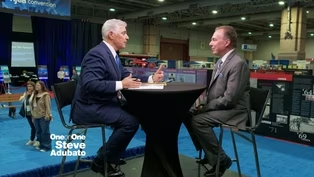
CEO of Teen Arts New Jersey talks about art education
Video has Closed Captions
Clip: S2026 Ep2908 | 8m 55s | CEO of Teen Arts New Jersey talks about the importance of art education (8m 55s)
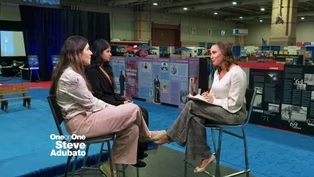
NJEA Student Panelists discuss goals for the future
Video has Closed Captions
Clip: S2026 Ep2908 | 9m 19s | NJEA Student Panelists discuss goals for the future (9m 19s)
Providing Support for PBS.org
Learn Moreabout PBS online sponsorship
- News and Public Affairs

Top journalists deliver compelling original analysis of the hour's headlines.

- News and Public Affairs

FRONTLINE is investigative journalism that questions, explains and changes our world.











Support for PBS provided by:
One-on-One is a local public television program presented by NJ PBS