One-on-One
Steve Beatty; Anuvaa Shah and Stella Cunha; Kevin Ciak
Season 2026 Episode 2908 | 27m 58sVideo has Closed Captions
Steve Beatty; Anuvaa Shah and Stella Cunha; Kevin Ciak
Steve Beatty, President of the NJEA, examines how policies on education impact teachers. Anuvaa Shah and Stella Cunha, Students and NJEA Student Panelists with Keynote Speaker Malala Yousafzai, discuss their experiences speaking with the Nobel Peace Prize Laureate. Kevin Ciak, Executive Director & CEO of Teen Arts New Jersey, explores how access to arts education contributes to long-term success.
Problems playing video? | Closed Captioning Feedback
Problems playing video? | Closed Captioning Feedback
One-on-One is a local public television program presented by NJ PBS
One-on-One
Steve Beatty; Anuvaa Shah and Stella Cunha; Kevin Ciak
Season 2026 Episode 2908 | 27m 58sVideo has Closed Captions
Steve Beatty, President of the NJEA, examines how policies on education impact teachers. Anuvaa Shah and Stella Cunha, Students and NJEA Student Panelists with Keynote Speaker Malala Yousafzai, discuss their experiences speaking with the Nobel Peace Prize Laureate. Kevin Ciak, Executive Director & CEO of Teen Arts New Jersey, explores how access to arts education contributes to long-term success.
Problems playing video? | Closed Captioning Feedback
How to Watch One-on-One
One-on-One is available to stream on pbs.org and the free PBS App, available on iPhone, Apple TV, Android TV, Android smartphones, Amazon Fire TV, Amazon Fire Tablet, Roku, Samsung Smart TV, and Vizio.
Providing Support for PBS.org
Learn Moreabout PBS online sponsorship- [Narrator] Funding for this edition of One-On-One with Steve Adubato has been provided by NJM Insurance Group.
Serving New Jersey’s drivers, homeowners and business owners for more than 100 years.
NJ Best, New Jersey’s five-two-nine college savings plan.
Stockton University.
Hackensack Meridian Health.
Keep getting better.
PSEG Foundation.
The Turrell Fund, a foundation serving children.
Robert Wood Johnson Foundation.
Working to create a future where health is no longer a privilege, but a right.
Delta Dental of New Jersey.
We love to see smiles.
And by The Fidelco Group.
Promotional support provided by NJBIA.
We put business at the center.
And by Insider NJ.
- This is One-On-One.
- I'm an equal American just like you are.
- The way we change Presidents in this country is by voting.
- A quartet is already a jawn, it’s just The New Jawn.
- January 6th was not some sort of violent, crazy outlier.
- I don't care how good you are or how good you think you are, there is always something to learn.
- I mean what other country sends comedians over to embedded military to make them feel better.
- People call me 'cause they feel nobody's paying attention.
_ It’s not all about memorizing and getting information, it’s what you do with that information.
- (slowly) Start talking right now.
- That's a good question, high five.
(upbeat music) Hi everyone, Steve Adubato with my co-anchor and colleague Jacqui Tricarico.
Jacqui, let's set this up.
People are about to see a series of interviews that we did down in Atlantic City at the New Jersey Education Association Convention.
Let's tee it up.
- Yup.
Just great people that we got a chance to speak with about why they were there, why they were attending, and some of the work that they're doing to support educators and as well as the citizens of New Jersey.
So many nonprofit leaders that we had a chance to speak with as well.
So you're gonna see that up in this next half hour.
- So if you wanna know what goes on at the teachers convention, the NJEA Convention, Atlantic City, this is just a taste of some of the folks who are down there, more than 10,000 this year, and the important conversations that took place.
Let's check it out.
- Hi, everyone, Steve Adubato.
More importantly, we are in Atlantic City for the NJEA 2025 convention.
I don't know, we've been here for so many years, and we're here with the president, Steve Beatty, who is the president of the NJEA.
Steve, good to see you.
- Good to see you, Steve.
- Why is this convention so particularly exciting?
It's your first as president.
- First as president.
- Other than that, why is it so exciting?
- It's exciting for a couple things.
First of all, we have got a great vibe.
I mean, to get thousands and thousands of educators here together in the same space, like-minded people, it's always a good vibe.
Also, Mikie Sherrill won.
People are in a great mood because they know what that means.
- Oh, was there an election?
- There was (laughing) an election on Tuesday.
- Hold on.
Full disclosure.
Two disclosures: the NJEA is a longtime underwriter of public broadcasting and of our education programming, and we're taping this two days after- - Two days, yeah.
- Mikie Sherrill was elected governor.
By the time this airs, she'll be governor, governor-elect, the whole bit.
Why is that exciting as it relates to education and educators?
- Yes, I mean, we run our process and we talked to the candidates, and we talked to Congresswoman Sherrill and, you know, screened her.
Jack declined to come in, but we had a great conversation.
We align on so many issues.
In her time in Congress, she's consistently earned an A from NEA, when we've endorsed her in her seat as well.
So she's always been a proven supporter of education, unions, and we're convinced she'll do the same.
- Name a couple of the issues you said you align with the new governor on.
Prioritize them, Steve.
- Yeah, well first and foremost right now, we're, you know, being in the fight of hopefully not by now already, our Tier 1 for Everyone, which we wanna make sure that the- - Oh, oh, oh, not everyone, tier one, explain that.
- Tier one.
So right now, we have a system of five tiers in the state pension system and including DCRP, so really six.
I'm in tier one, which means I can retire at 55 with a, you know, good pension.
Someone that starts now or a few years ago has to work 'til 65 to get basically a savings account.
And if you're in DCRP, which affects most- - Whoa, whoa, whoa, a lotta acronyms here.
- Yeah.
- What is D?
- DCRP is Defined Contribution Retirement Plan.
- Why is that relevant?
- It's relevant because we have a lot especially of our low-income wage earners, our ESPs, our Essential Support Professionals, that are in those positions, and they are not making minimum wage at best or less in some cases, health benefits, they can't afford- - They're members as well?
- And they're members as well.
We have tens of thousands.
And when they're in DCRP, they really, they earn very, very little out of the system after putting in for many, many years.
We wanna make sure everyone can be in tier one, retire with dignity.
- But isn't there an issue having to do with, if you stop teaching for a period of time, you somehow lose?
- Yeah, yep.
- What's happened with that?
You lose your pension, but now it's changed?
- We've done it.
- What is it?
- The Break in Service Bill, as we call it.
- Break in Service Bill.
- So if you left the district, had a break in service, more than two years, you are no longer an employee of the district.
If you decide to come back years later, you have to go back into the now present tier.
So you may have left in tier one, but may have come back years later now being in tier five.
And that difference is huge in terms of 10 years added on to your teaching timeline, your education timeline, and of course, a much diminished benefit as well.
So what this bill did was expand that period of time between 10 or 15 years, depending on your status.
So you can have a break in service for a much longer period of time.
'Cause mostly it affects disproportionately, right, we're a mostly female-driven profession, and women mostly leave for maternity leaves and then rear their children.
And they're gone for five, six, 10 years, and they've been hit hard by that.
- See, talk about that.
You talk about who is teaching.
Do you have any numbers?
60/40?
- Yeah, no, it's definitely it's 65%, close to 65%.
- Women?
- Women, yep.
- Okay.
- In the profession.
Do you believe as we move into 2026, It'll be seen then, that there is a teaching shortage, a teacher shortage?
- Yes, we have a teacher shortage.
We have an ESP shortage of yeah, skilled staff.
Because- - How's that being confronted?
- A number of ways.
I mean, first and foremost, let's talk about salary and benefits.
As a union, that's what we're about.
You have to have competitive salaries.
You can't tell someone they're gonna come in to do a job and make $60,000, and then in year two, 62,000, 63,000, 64, and we have to have, again, the pensions, that people know that it's a job that they can live in the community where they work, and they can retire with dignity.
But there's other things too, things that don't cost money, like the evaluations that we're dealing with now, testing, all the paperwork.
- Well, why is that, whoa, whoa, whoa, hold on one second.
Why is that an issue?
Someone might say, "Well, we're all evaluated."
- Yeah, sure.
- "Why is it any different for a teacher?"
- Listen, educators are never afraid to be evaluated.
Some of the best conversations I've had when I was in the classroom for 25 years was with a skilled supervisor, understanding the paradigm of what we're doing.
What we have now is more of a system where it's checkboxes.
You have various systems where there's just rote systems that come in and we have these things called SGOs, which thankfully we're getting rid of, Student Growth Objectives, which we have just basically again are checkbox elements to see how you're doing, not really looking at teaching in a holistic manner, what we need to ply our craft and having conversations about how we reach students.
- That's being changed?
- It's being changed right now.
- Let me push back a little bit.
For those who say, "Wait a minute.
There's a teacher's union.
There's a professional association for teachers, the New Jersey Education Association.
What are you doing being involved in politics?
What are you doing engaged in campaigns?
And you lobby."
And there are people who will argue, who are watching right now, who say, "Yeah, I don't get it.
I don't understand why they have to do that."
Let them know.
- We do that for the greater good.
I mean, we're educators and I say, most times, we know best, and of course, the stock answer is, every decision that's made that affects our terms and conditions, our classrooms, the environments in which our kids learn, is divined by someone that's elected somewhere: at a local board level, municipal level, the state level, or federal level.
So we know that those decision-makers, many times they're us, and we encourage our members, in fact, we just got a few elected in this last race here in the Assembly, that should be in those spots.
And of course, lobbying, right?
We need to make sure that politicians understand our perspective.
They'd never make a law that affected lawyers without having the American Bar Association involved.
Why would they not have the NJEA educators coming in the room and helping craft the best legislation.
- Let me try this.
Let me try this.
- Yeah.
- You're talking about state policy?
- Yeah.
- But a fair amount of what's going on in education, including, forget about state, Steve- - Yeah.
- But on the local school board level is being influenced by Washington.
What is the position of the organization vis-a-vis the Trump administration's education policies, including the prospect of, and I don't even know if it's on the table anymore, "We're gonna dismantle the federal Department of Education?"
Is that an issue in and of itself?
- Sure.
- How so?
- Well, first of all, they're welcome to keep their tests, that's fine, their mandates.
But listen, the Trump administration has been just cruel in terms of when it comes to education and education policies, trying to dismantle what we know is fact and true history and all the things that we know that we have that students need to understand in curriculum, but also funding.
And right now, we're in the midst of, they have the shutdown still, but here it is- - Well, by the way.
- Yeah, sorry.
- Please, if you're seeing this a month or two from now, (Steve B. Laughing) Steve, it's the sixth of November when we're taping, 'cause they know there was the election.
- There's still a shutdown.
- If there's still a shutdown.
- We're all in trouble.
- Okay.
Assume there's not.
- Right.
- But what does the shutdown mean, 'cause it'll happen again unfortunately, by the way, to education?
- Well, directly we know the SNAP benefits are the worst and cruelest part.
And we've taken strides, the NJEA, to do food banks and partners with a lot of other groups.
I know principals and supervisors, other kinds of educators and stakeholder groups, because kids rely on SNAP benefits.
I think it's over 600,000 getting benefits.
- How do you learn if you haven't had something to eat?
- Listen, exactly.
Kids are coming to school with the baggage that they have, and they have to be ready.
I could be the greatest teacher in the world.
If they're not ready to learn, there's nothing going on there.
So the Trump administration's policies around education is just another cruel attempt to remake the world in a perverted way that doesn't do our communities good.
And we're happy to stand in.
We know that we have to be involved at boards of education, in town councils, on the legislative level, state, federal, everywhere.
- Steve, we'll continue engaging in substantive conversations about issues around education, educators, and ultimately how it impacts our kids.
Thank you Steve.
- Thank you, Steve, always a pleasure.
- All the best with the convention.
- Yeah, thank you.
- I'm Steve Adubato.
This is the president of the NJEA.
Be back, I can get this.
I went to public schools.
(Steve B. Laughing) (laughing) This will be.
Don't edit that out.
We'll be back after this.
(Steves laughing) - [Narrator] To watch more One on One with Steve Adubato find us online and follow us on Social media.
- Hi, I am Jacqui Tricarico on location at the NJEA convention here in Atlantic City.
I'm so pleased to be joined now by two Montgomery High School students, Stella Cunha and Anuvaa Shah So great to have you both with us.
- Thank you.
- Thank you.
- Well this morning you were part of a panel discussion here with the keynote address who was Nobel Peace Prize winner Malala Yousafzai.
For people who don't know, Malala is when she was a young girl she was shot in Pakistan for speaking up for girls' rights for an education and she's been doing lots of press lately.
We've seen her kind of all over the place promoting a new book, but she's really such a bold, known global activist.
I wanna start with you Stella.
When were you introduced to Malala's story and what kind of resonated with you?
- I started following her story when I was like probably seven or eight years old.
My mom bought her book, "I Am Malala" and I read it in like a couple days and I've just always been super passionate about civil rights and stuff and I found it really amazing and encouraging that there was a woman or a girl at that time who was only 11 years old and was going through like a terrible attack and something that no one ever should, but she found so much strength through it and ever since then I've just been a huge fan of hers and admirer.
Anuvaa you both were selected to be part of this panel.
I mean that's a huge honor.
Why were you and how were you selected?
Who introduced you to this?
- Yeah, so we were both in Ms.
Stefanie Lachenauer classes at one point during our middle school years.
So Ms.
Lachenauer actually reached out to us saying like, I have this amazing opportunity, you'll have to apply for it, but if you're interested like I can definitely get you all set up.
So we had to send in like our bios, our headshots and like a little bit about ourselves.
So like an informal resume almost.
And then we found out we were selected about a month later.
- That's incredible.
Stefanie Lachenauer was actually the last year in New Jersey state teacher of the year, Montgomery teacher.
She's really doing amazing things.
So tell me about your experience today up on that stage.
I poked my head in.
There were so many people in the crowd.
Was that overwhelming?
- It was definitely overwhelming.
I've done public speaking for like student government and stuff, but that's just like in front of the school with like people I know.
But it was a little nerve wracking but I think I got adjusted well.
- What was the most important question that you had that you wanted to ask her?
- I really wanted to focus on advice because I think right now, especially with the state of our government and our country and our world, I think there's so much chaos and controversy surrounding difference of opinions and just everything recently.
So the most important question to me was when I asked her how she found strength to move through such a tremendous part of her life and like where she found that strength.
And she had told me that just like love and kindness wins over anything else.
And I think that really resonated with me because that's something that's extremely overlooked, especially in politics and all of this stuff.
And it was really special.
- It was a beautiful message.
What about for you Anuvaa?
- For me, I think a big question that I wanted to ask her was about her storytelling especially 'cause I feel like as youth like Stella said, we're often, you know, maybe not taken as seriously because you know, we're still in those teenage years, we're transitional, our frontal lobes are still developing all of that stuff.
So I think like as kids we're always told, oh like it's a story, it's a fable, it's a myth.
And I think it really used that like it was her story, it was her life and she started out storytelling and then like, look where she is now.
We're interviewing her on a massive stage.
It was incredible.
- And Stella, I know part of what you're advocating for is mental health of your peers and that's something that we hear a lot about now because it is more at the forefront for so many educators and people like the NJEA, there's a whole area here all about mental health for youth.
How are you making sure, or just working towards making sure in your school that mental health is at the forefront for your friends and peers?
- Yes, so outside of school I'm a part of Montgomery's Youth Action Board, actually led by Miss Lachenauer and we work directly aside our municipal alliance.
So we do like tables at many events.
We do like the color runs in our town we have tables at and we are primarily on social media because we've realized that that's how we kind of connect with our youth the most.
And I think just ending the stigma and making it more of a casual thing, like mental health is real and everybody goes through it.
I mean like, I was like shaking today.
Like it's real and it's common and I think just ending the stigma about it through social media for my peers has been really, really special to me.
- Anuvaa for you, how are you going to use this experience for your own activism?
Tell us what you're really focusing on right now.
- So for me, I really do wanna go into international law.
That's something I've been like pretty much set on.
I've always wanted to, you know, go to the United Nations, speak to people and for me I think this is really like my starting, this is my stepping stone.
Like this is what got me here and I'm gonna use her story.
I'm gonna start building up, you know, my resume, myself, honestly my character and just getting far.
- How proud are your parents of you?
I met them earlier.
Tell me about your family dynamic and just how proud your parents are of you.
- So I have a twin brother, his name is Santino.
And then I have my mom, Glenda and my dad Bruno and my family, like they're just my best friends.
They've been there for me through everything.
Like I said, my mom's the one who bought me Malala's book in the first place.
They're just my biggest supporters.
And not just that, like they're my best friends.
I tell my parents everything.
I'm also really close with my grandparents so they're some of my biggest supporters.
They were texting me all day.
So, yeah.
- Yeah, family's just so important.
What about for you Anuvaa?
Because I know you are a first generation US citizen, correct?
- Yes I am.
- So tell me how that kind of plays into this overall experience for you.
- I think a big thing for me is like my parents coming from India here and like starting over, that really did give me like a sense of I need to succeed and I need to do well for them, for myself.
Like to end the stigma around what immigrants do and why we are here.
Like they're here to build a life for themselves and they've given me so many opportunities that I want to give back to them and like build myself up in the process.
- What's next for you Stella?
What do you envision for the next couple years 'cause you're both juniors, college is on the horizon.
What's your biggest goal?
- I really want to go into political science and I'd like to be in politics and government and I definitely wanna study abroad because with our Belize trip a couple years ago, like I realized that seeing the difference of cultures has been able to make me learn the best.
And like Malala today, like I'm from Hispanic and Portuguese descent, and I think that like the difference of cultures is really amazing and I think that's how we kind of are able to grow as a community in a world.
- Yeah, and what's next for you Anuvaa?
What are your plans?
- Eventually, so obviously I wanna do undergraduate.
I wanna get my master's.
I do wanna continue my education almost as far as I can.
I do wanna go to law school.
That's something that's like really big for me.
I definitely want to go to law school.
- Practice what kind of law?
- I'm actually debating.
So far I've been set on international law, but I also learned about corporate law recently from an like international perspective, which I think would be really cool.
And same, I like need to study abroad.
Like for me that has to happen.
At least once.
- I could see that happening 'cause you've already done that trip to Belize with Stefanie Lachenauer.
I'm sure that like, you know, put the bug in you to wanna travel and see so many places.
Well we can't wait to see what you both do next.
Thank you so much for taking the time to talk with us today about your experience here today with Malala and with the NJEA convention.
Great to have you both with us.
- Thank you so much.
- Thank you so much.
- Thank you, we'll be right back after this.
- [Narrator] To watch more One on One with Steve Adubato find us online and follow us on Social media.
- Hi everyone.
Steve Adubato at the New Jersey Education Association Convention in Atlantic City.
We are thrilled to be joined by Kevin Ciak who is the executive director and CEO of a great organization called Teen Arts New Jersey.
Did I get that right?
- You got that right.
Thank you Steve.
It's a pleasure to be here.
- Tell everyone what it is.
- So Teen Arts New Jersey is a 501(c)(3) nonprofit.
We've been in existence.
- That's a tax code, if you will.
501's, let everyone know.
We are as well.
- Okay.
- Okay, so you go to the IRS, it's a 501(c)(3), which means you're a nonprofit, which does not mean, by the way, that you don't have to raise money.
- Correct.
And it also does mean that people can donate to us, which we would always welcome to support our mission.
- The mission of the organization is?
- So we inspire artistic creativity in students and provide them with opportunities that they wouldn't normally get in a traditional high school setting or middle school setting.
- [Steve] Because.
- Because the arts are so important.
And as you look at students, you know, after they graduate and they move on to different careers, it's the creativity piece that we instill that will make them a success later on in life and just add more beauty and more meaning to their lives.
- And for those who are convinced or have convinced themselves that arts, the arts, that's extra.
It's nice, but not necessary, talk to them.
- I would say it's even more necessary today than it has been in the past, especially when you look at things like generative AI.
- Yeah, I was gonna ask you about AI and the arts.
- Because when you look at the AI piece, that's gonna be doing all of the mechanical functions.
What we need students and what we need adults to be is creative.
So the arts and our programs that we offer give students the opportunity to think outside the box and develop that creativity, to really bring value to not only the world, but their future employers.
- So, talk about AI, those who think artificial intelligence will do the art.
Are they right?
- Listen, they're right, I think, to an extent that it can create art.
It can certainly do that.
- It can create a broadcast as well.
- It can create a broad, it can replicate you and me.
- Don't you dare go there, okay?
They could try.
But what's missing?
- What's missing is the human element.
And when you talk about AI, what people forget is, you know, ChatGPT, the G stands for generative.
It's taking information, programs, data tables, that it's been fed and just reassembling it and generating it in new ways.
What it's not providing is the human connection.
And that's what art is.
Art taps into our human emotions, our human experiences, the way that we interpret things as humans, that AI just simply can't do.
Because no matter how good it looks on the screen, it's not human.
- Talk about your connection here to the convention.
- So the New Jersey Education Association has been a long time partner of our organization because they see the value of the arts and the creativity and the need to teach students to think outside the box.
So they've not only been a funder of our organization and a supporter, but they've been an incredible partner.
Every single year when we do our State Teen Arts Festival, which features.
- What is that?
- It's a three day gathering at Middlesex College and it features the best student artwork from all 21 counties.
Not only, you know, the art that you're gonna see at our booth here at the convention, but also large instrumental groups, small instrumental groups, vocal music, and the NJEA not only helps us fund that event to keep costs low to allow students to participate, but there are officers every single year they're in force and they're interacting with the students.
They're, you know, looking at the artwork, they're partnering with us.
They have been a tremendous partner to our organization.
- For argument's sake, whether it's my hometown or anyone else in New Jersey, or across the nation, you start making cuts.
Budgets are tight, art teachers, music teachers.
Those in the arts, they get cut.
To what degree do you believe, Kevin, that people understand the impact of those cuts on those teachers/those kids?
- I think people still struggle with that understanding because they still see.
- Don't cut my math teacher.
- They still see the arts.
- You do the arts.
- As an added, as a bonus.
But the ultimate goal, and look, I used to be the president of the National School Board Association.
The ultimate goal of public education is to offer a well-rounded program to create well-rounded citizens.
So you need math and you need science as much as you need arts and phys ed.
So unfortunately, if those cuts need to come, those cuts need to be looked at across the board as an entire organization and not isolated into what we perhaps think is superfluous.
- We've been talking to some folks here at the, we're at New Jersey Education Association 2025 Convention here in Atlantic City.
We've been talking to folks about inclusion, and I don't want to use the term DEI.
We know that it's a trigger for some, but diversity in art and people who politicize art as if it's left, right, democratic, republican, conservative, liberal.
You don't see it that way.
Art is art.
- Not only don't we see it that way, our students don't see it that way.
- Talk about that.
- As they come to our programs, what we're increasingly finding is that our students are viewing our programs as a safe place.
- [Steve] Define safe.
- Safe where they can feel free to express themselves.
They can feel free to talk to their teacher, talk to their peers about things that they may not feel safe discussing in their own, you know, schools or their own classrooms.
- Or their own home.
- Or their own home.
So it's a welcoming space where students can feel free to express themselves.
And I think art is a conduit for that because it allows them, first, to put it on a medium, which is a lot less, you know, dangerous to them, because it's just them expressing it to the medium.
And then once it's out there, I think it starts to open them up to feel more comfortable to share it verbally and share it with others as they talk about their art.
- Why are you so passionate about this?
- I've always, first of all, been passionate about education, but when you look at the students that we work with and the artwork that they generate for us and the expression, it's just absolutely amazing.
And it challenges us to think, you know, better.
For example, one of the pieces of artwork that we saw at the Teen Arts Festival last year was an entire dress that was designed out of sustainable materials.
And this not only was a piece of art, this looked like something that you could wear to a formal event.
And that led us, as we looked at this piece of art, to say, okay, well what can we do with this?
And that's how we envisioned a new student challenge program that we're launching this year's statewide called Creative Change Makers.
- Right.
- Which is a statewide call for art focused around sustainability.
So now it's not only about, well, create a sustainable piece of art, it's how can you use your art to let your art speak and advocate for a cause.
And we're gonna choose a different social cause each year and focus our creative change makers program around that.
- That's awesome.
We've had your website up throughout the entire segment, Kevin, so people can find out more.
We really appreciate you joining us.
- And I thank you for having me, Steve.
It's been a great opportunity.
- You got it.
I'm Steve Adubato.
This is the New Jersey Education Association Convention in beautiful Atlantic City.
You can see all kinds of stuff going on around here, but mostly talking to really interesting people making a difference.
See you next time.
- [Narrator] One-On-One with Steve Adubato is a production of the Caucus Educational Corporation.
Funding has been provided by NJM Insurance Group.
NJ Best, New Jersey’s five-two-nine college savings plan.
Stockton University.
Hackensack Meridian Health.
PSEG Foundation.
The Turrell Fund, a foundation serving children.
Robert Wood Johnson Foundation.
Delta Dental of New Jersey.
And by The Fidelco Group.
Promotional support provided by NJBIA.
And by Insider NJ.
- (Narrator) A cancer diagnosis changes everything.
- So does where you go for treatment.
- (Narrator) Where other cancer centers offer radiation, at Hackensack Meridian, John Theurer Cancer Center, We’re utilizing the world's most advanced precision radiotherapy... - That can pinpoint and destroy your cancer.
- (Narrator) Some performed clinical trials, but we have one of the nation's most rapidly growing drug discovery programs... - Providing hope with the medicine of tomorrow.
New Jersey's best cancer center.
Know the difference.
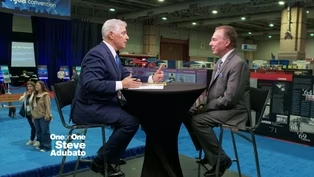
CEO of Teen Arts New Jersey talks about art education
Video has Closed Captions
Clip: S2026 Ep2908 | 8m 55s | CEO of Teen Arts New Jersey talks about the importance of art education (8m 55s)
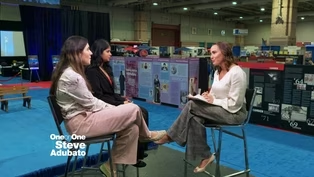
NJEA Student Panelists discuss goals for the future
Video has Closed Captions
Clip: S2026 Ep2908 | 9m 19s | NJEA Student Panelists discuss goals for the future (9m 19s)
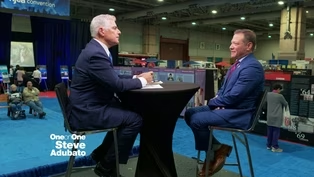
President, NJEA, examines how public policy impacts teachers
Video has Closed Captions
Clip: S2026 Ep2908 | 9m 31s | President, NJEA, examines how public policy impacts teachers (9m 31s)
Providing Support for PBS.org
Learn Moreabout PBS online sponsorship
- News and Public Affairs

Top journalists deliver compelling original analysis of the hour's headlines.

- News and Public Affairs

FRONTLINE is investigative journalism that questions, explains and changes our world.











Support for PBS provided by:
One-on-One is a local public television program presented by NJ PBS