One-on-One
The role of holistic practices in supporting mental health
Clip: Season 2026 Episode 2904 | 9m 2sVideo has Closed Captions
The role of holistic practices in supporting youth mental health
Steve Adubato is joined by Rodney Salomon, Co-Founder of Konscious Kyds, to examine the role of holistic practices in supporting youth mental health and how parents and educators play a crucial part in that foundation.
Problems playing video? | Closed Captioning Feedback
Problems playing video? | Closed Captioning Feedback
One-on-One is a local public television program presented by NJ PBS
One-on-One
The role of holistic practices in supporting mental health
Clip: Season 2026 Episode 2904 | 9m 2sVideo has Closed Captions
Steve Adubato is joined by Rodney Salomon, Co-Founder of Konscious Kyds, to examine the role of holistic practices in supporting youth mental health and how parents and educators play a crucial part in that foundation.
Problems playing video? | Closed Captioning Feedback
How to Watch One-on-One
One-on-One is available to stream on pbs.org and the free PBS App, available on iPhone, Apple TV, Android TV, Android smartphones, Amazon Fire TV, Amazon Fire Tablet, Roku, Samsung Smart TV, and Vizio.
Providing Support for PBS.org
Learn Moreabout PBS online sponsorship(upbeat music) - We're honored to be joined by Rodney Salomon, who is co-creator of Konscious Youth Development and Service, otherwise known as KYDS, K-Y-D-S.
Rodney, good to have you with us.
- Oh man.
Thank you for having me here.
- You got the website's up right now.
Tell us what KYDS is.
- Oh man, so we are a nonprofit organization where our mission is to transform youth schools and communities through holistic wellness practices.
Really focusing on giving students, educators and parents tools to transform their physical, mental, and emotional wellbeing.
- There's a lot going on there.
- Yeah, yes, yes, yes, it is.
- Let's talk about youth mental health.
There's a lot of jargon around it.
People say, "Yeah, youth mental health, it's a problem."
- Yeah.
- But you see it firsthand.
What are younger people, from your experience, dealing with that your organization, in fact, helps them with?
- It's kinda like when you think about physical health, right?
You're talking about you gotta eat good, go to the gym, take care of your body.
But when we talk about mental health, there's not a lot of tools that support the mental strength.
And we live in this age where there's so many tools of distraction that is not allowing that mind to develop the skills that are necessary, in order to have a stable mental health.
And that could be something just focus and concentration, right?
Where the ability to actually be here and be present, where these kids have technology from cell phones, tablet, TV, is constantly stimulating them, making their mind jump all over the place.
- Why is that a problem?
- So when you're able to realize peace comes from clarity, peace comes from- - Say that again.
- Peace comes from clarity.
Peace comes from calmness.
And if my mind is constantly jumping past, present, future.
When I don't have the opportunity to actually develop the skills to pause all the noise, to turn down all of the stimulation, it's gonna be difficult for me to navigate in a situation when things are troubling or challenging, if that makes sense.
- It makes a lot of sense.
But in reading about you and your colleague, you started this.
- Yes.
- Tell folks who that is.
- Brother Michael Mills.
Soul brother.
- How'd you connected to do this?
- So I was working at Asbury Park High School as a youth development specialist.
He was working at the food bank now called, Fulfill, as a food resource manager.
And I would bring my students to a soup kitchen once a month.
He would actually volunteer, 'cause he was servicing them, providing food, and helping sure they were all organized.
And we would talk every month.
My kids were there, he would be there.
And we just talk about all the issues, the challenges, the poverty, the early pregnancy, the violence.
And we were like, we don't wanna complain about.
And we were on our own journey of transforming ourselves and recognizing as men, although we didn't have tumultuous lives, we realized there was a lot of trapped emotion.
There was a lot of trauma that we didn't process.
And we started changing our diet, started becoming more present in holistic tools like meditation and yoga.
And we started to realize like I was becoming a better person.
Like I was a football player, just violent and energetic.
And that was my therapy.
But when football ended my career, I had no outlet to express myself.
And I realized I had to do things differently.
And that's when I started to see the power and potential of these tools and making an impact, not just in myself, but those that we serve.
- Let's talk about this.
It's so fascinating to me, your work, your colleague, Michael?
You used the term mindfulness.
- Yeah.
- Our daughter's 15.
The phone is the phone.
And any parent watching right now, you know exactly what I'm talking about.
How the heck do we help our kids?
- Yeah.
- The kids in public schools and our own kids, right, as parents, how do we help them understand what they don't understand which is that that phone, and by the way, it's for all of us, not just them.
- Oh man, adults too, yeah.
- It makes it so hard to be mindful and present, but they don't know that because they never experienced this thing called mindfulness.
So they think that's the way it's supposed to be.
Scattered all over the place, checking your clicks, going on social media, posting constantly, that's their norm.
- Ding, ding, ding, ding, ding.
Yeah, I think it's powerful.
And one thing that when we work with schools or with parents, the first thing we say is like, "Hey, yes, we're here to support your students.
We're here to support your child.
But the journey begins with you."
As educators, as leaders, our parents in our household, our embodiment is the first curriculum.
Our presence in how we're navigating these spaces, how we're navigating these tools is subconsciously is helping that child, that youth understand, whether it be called mirror neurons or co-regulation, but our presence and energy is laying the foundation and beginning the curriculum before I even teach that child anything.
- Explain your role here at the convention?
- So today we have been working with NJEA for the past four or five years, and they've been integrating wellness into the space.
And this year we are integrating a new aspect of wellness.
We opened up a community wellness center about a year and a half ago in Asbury Park.
And our vision is to be a safe space where the youth have a space to develop these skills of mental, emotional wellbeing.
The educators have a space to recharge, to support their wellbeing, and so can the parents.
And how we're doing that today is we believe that technology plays a pivotal role in supporting us in developing these skills.
Right, I'm not a monk.
I'm not a yogi, so I don't have the time to meditate 10 hours a day.
But when you use a tool like a PEMF mat, post electro- - A what?
- A post electromagnetic frequency mat, it is a tool that helps us just melt stress away.
It is a mat that you could lay down on for 10, 15 minutes.
Regulates your nervous system, helps the mind quiet the chatter and allows the heart to drop the weight.
And it has a lot of physical benefits, but our primary focus is on the mental and emotional wellbeing.
So as a teacher and educator, when I step into that classroom, that first curriculum is my presence, is my peace.
And if I'm burnt out, if I'm dealing with my bills and the challenges of being a human being, and then I gotta come into a classroom of 20 plus kids who got their own challenges, a dysregulated adult will never regulate a dysregulated child.
So our focus is to help educators see various ways that they can stabilize and regulate themselves from the inside out.
- You have a podcast as well?
- Yes.
- Talk about that.
- So we do a lot of staff developments in schools.
And teachers always said, "I would love to hear your voice beyond this hour, PB."
And you know, in this world of media and tech- - PD, professional development?
- Yes, staff development, professional developments.
And we realize, how do we bring this beyond just us coming to your school for hour, two hours?
How can we provide constant resources around these messages that are gonna impress upon your consciousness?
So we do a conscious educators, the Heart Center classroom.
It's for educators and anyone that works with you.
And we go through our foundation of embodiment, transformation and awakening, which talks about self-awareness, self-regulation.
(indistinct) talks about trauma, healing informed tools, and also talks about the spirit of education.
Dr.
Lisa Miller's work from Columbia University around how spirituality, not religion is a crucial and necessary component to support the wellbeing of students who are dealing with mental health, suicide, or any kind of addictions in their work.
- Before I let you go, one to 10, how passionate are you about your work you do and the young people you serve and the educators you serve?
How passionate?
- I say 10,000 like this is grassroots.
Me and Mike, we left our job like we just did this first just to give from our heart.
But seeing the impact, seeing the possibility, but seeing the transformation in myself and how that's been rippling out into the classroom, into assemblies, into our community, we realize it's more than just a job.
This is our purpose being lived in real time in a physical space.
- Well done.
Keep it up.
- Oh, thank you.
- Thank you Rondney, wish you all the best.
- Appreciate you.
Have a good day.
- This is one of the many important leaders here at the 2025 New Jersey Education Association Convention here in Atlantic City.
I'm Steve Adubato, that's Rodney Salomon.
We'll see you next time.
- [Narrator] One-On-One with Steve Adubato is a production of the Caucus Educational Corporation.
Funding has been provided by NJ Best, New Jersey’s five-two-nine college savings plan.
Stockton University.
Johnson & Johnson.
Bergen New Bridge Medical Center.
The North Ward Center.
Robert Wood Johnson Foundation.
Horizon Blue Cross Blue Shield of New Jersey.
The Fund for New Jersey.
And by United Airlines.
Promotional support provided by NJ.Com.
And by BestofNJ.com.
- Energetic music
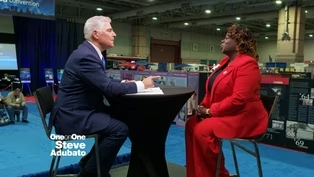
Examining the intersection between labor unions & politics
Video has Closed Captions
Clip: S2026 Ep2904 | 8m 48s | VP of the NJEA discusses the intersection of labor unions and politics (8m 48s)
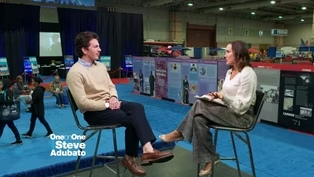
This organization’s mission to uplift the queer community
Video has Closed Captions
Clip: S2026 Ep2904 | 9m 28s | This organization’s mission to uplift the queer community in South Jersey (9m 28s)
Providing Support for PBS.org
Learn Moreabout PBS online sponsorship
- News and Public Affairs

Top journalists deliver compelling original analysis of the hour's headlines.

- News and Public Affairs

FRONTLINE is investigative journalism that questions, explains and changes our world.











Support for PBS provided by:
One-on-One is a local public television program presented by NJ PBS