
Washington Week with The Atlantic full episode, 4/24/26
4/24/2026 | 26m 46sVideo has Closed Captions
Full Washington Week with the Atlantic broadcast from April 24, 2026.
Full Washington Week with the Atlantic broadcast from April 24, 2026.
Problems playing video? | Closed Captioning Feedback
Problems playing video? | Closed Captioning Feedback
Major funding for “Washington Week with The Atlantic” is provided by Consumer Cellular, Otsuka, Kaiser Permanente, the Yuen Foundation, and the Corporation for Public Broadcasting.
Washington Week with The Atlantic full episode, 4/24/26
4/24/2026 | 26m 46sVideo has Closed Captions
Full Washington Week with the Atlantic broadcast from April 24, 2026.
Problems playing video? | Closed Captioning Feedback
Where to Watch Washington Week with The Atlantic
Washington Week with The Atlantic is available to stream on pbs.org and the PBS app.
Buy Now
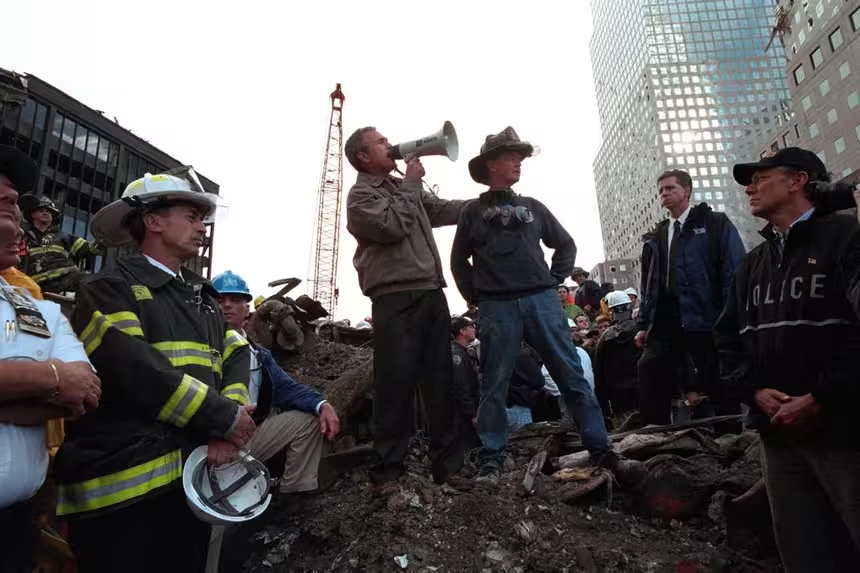
10 big stories Washington Week covered
Washington Week came on the air February 23, 1967. In the 50 years that followed, we covered a lot of history-making events. Read up on 10 of the biggest stories Washington Week covered in its first 50 years.Providing Support for PBS.org
Learn Moreabout PBS online sponsorshipJeffrey Goldberg: These are not the best of times for President Trump or the party he leads.
Iran is in the driver's seat in the Gulf.
The president's economic approval ratings are dropping faster than gas prices.
The Democratic Party seems poised to come out on top in the redistricting fight that Trump and the Republicans themselves started.
And some of his MAGA allies are abandoning him.
Tonight, why President Trump's boundary-pushing, foreign adventurism and bluster may make November a very difficult month for his party, next.
Good evening and welcome to Washington Week.
The New York Times polling average shows that 58 percent of Americans disapprove of President Trump's job performance, a new high that can be largely attributed to voters' economic concerns.
Can the president manage the Strait of Hormuz and his sagging approval ratings at the same time?
Joining us tonight to discuss this and more, Annie Linskey is a White House reporter at the Wall Street Journal, Seung Min Kim is a White House reporter for the Associated Press, Tyler Pager is a White House correspondent at The New York Times, and Yvonne Wingett Sanchez is a staff writer at The Atlantic.
I bet you're jealous that you're not a White House correspondent.
We can make you a White House correspondent.
Yvonne Wingett Sanchez, Staff Writer, The Atlantic: You can make me anything you want.
Jeffrey Goldberg: Yes.
Yvonne actually is visiting us from Phoenix.
She lives in America and is going to talk to us about what she sees actually in America.
So, that's very exciting.
Tyler, let me start with you, the approval ratings, especially on the economy.
They're slipping fairly quickly into fairly red zone territory.
So, you're -- well, all of you are in the White House every day talking to them.
What's the level of worry?
Tyler Pager, White House Correspondent, The New York Times: I mean, there's obviously concern.
Publicly, they're trying to downplay that concern and say there's months until the midterms, voters are not locking in until the summer, and their hope is that the president gets this conflict under control and prices start to go down.
But we've seen time and time again voters' one, two, three concern is the economy, that Donald Trump came back to the White House on a message about lowering prices, and we're seeing the exact opposite happening.
So, there is clearly concern, and we're seeing that in the body language of Donald Trump, the way that he's talking about this, and for as much as they're trying to tamp it down publicly.
It's obviously dictating the way in which he's behaving because Republicans don't want to lose control of Congress.
And I think there was a lot of optimism that Democrats could take back the House, but these numbers are putting the Senate in play as well.
Jeffrey Goldberg: Seung Min, do they really have months, I mean, this idea that people don't lock in until the summer?
What's getting locked in now is the perception that gas costs too much, food costs too much, that the Iran war is not being won.
Seung Min Kim, White House Reporter, The Associated Press: Yes, particularly when you have his top cabinet officials talking about how gas prices may not go down for a long time, even if President Trump disagrees with that assessment from the energy secretary, Chris Wright.
But there is certainly a lot of concern, you know, throughout Washington Republicans about their prospects in the midterms.
And I would point to just what we saw on Tuesday with the Virginia redistricting referendum.
You know, we still have to wait to see what the local courts say about that map, whether it's constitutional under Virginia law.
But if that map stands, I mean, that could be the game on its own in terms of Democrats gaining the House majority.
You know, we're talking about sentiments from the White House, James Blair, the former deputy chief of staff now leading the midterm effort said on CNN this week that it's too soon to declare defeat.
But I do think that is an acknowledgement -- Jeffrey Goldberg: That's really not a robust -- Seung Min Kim: That is a challenge there.
I think Republicans know they have a really big uphill hurdle.
Jeffrey Goldberg: I want to come back to the gerrymandering issue.
We're going to do a 40-minute slide deck presentation for our viewers on gerrymandering.
But I want to stay on the gas prices and Iran for the moment.
Annie, you wrote this week pretty remarkable story with Josh Dawsey about the president's unease with the way things are going in Iran.
I want to read this one passage.
Trump has since marveled at the ease with which the strait was closed.
A guy with a drone can shut it down, Trump has said to people, expressing belated irritation that the key waterway was so vulnerable.
He has publicly oscillated between demanding support from allies to help open it and insisting that the U.S.
doesn't need or want military assistance.
He was told, obviously, in the lead up to this war that that is the chokepoint.
I mean, so is he really surprised?
Was he not paying attention to the briefings?
Annie Linskey, White House Reporter, The Wall Street Journal: Yes.
First of all, he was told, this was a briefing that he received his top generals and war planners came to him and said, sir, one of the first things that will happen is the Strait of Hormuz will be closed.
Now, the president believed that the U.S.
bombing campaign would topple the regime before they had the chance to do that.
He was aware when he ordered -- Jeffrey Goldberg: This is what Netanyahu said, what Hegseth, other more enthusiastic participants.
Annie Linskey: And we have reported that this was the sentiment within the White House, that the president was told this will shut down, this strait will shut.
And, look, I mean, did the president order -- the president was aware that his belief could be inaccurate.
I mean, he didn't order the bombing purely thinking that that strait wouldn't close.
There was an awareness that the strait would close.
But I think the other part that was interesting is there wasn't as much of an awareness that the strait would close so fast, that boats would be so easily coerced into not passing through because there wasn't some big battle for the Strait of Hormuz.
You know, the Iranian said, we're going to shoot -- we're going to sink any boat that goes through, and companies said, okay, we will stop sending our boats through.
And so there was a disconnect there also with people advising the president, people who are around the president.
But, look, Trump believed that the regime would fall first and that turned out to be wrong.
Now, look, you know, this -- and this remains the chokepoint and remains the issue that he is going to have to wrestle with as we contend in the next few days with whether this bombing campaign starts again.
Jeffrey Goldberg: Right.
Yvonne, there's something so interesting here politically, and you've watched presidencies, as we all have.
Since Jimmy Carter, Iran has destroyed a couple of presidencies, certainly undermined other presidencies.
Maybe what we look back on this period will say that the height of confidence that the Trump administration was experiencing came right after the Maduro operation and that led them to kind of lose their balance and think, oh, we are going to deal with Iran in a different way than any president since.
I mean, I, looking at the arc of history, this is all predictable.
Yvonne Wingett Sanchez: I mean, when you go out and you talk to how this is -- you talk to people, you like really try to suss out how this is playing with everyday Americans.
Whether political operatives like it or not, like voters are locked in right now, they are locked in not because they think that Trump is any sort of badass for like going and doing, you know, the Venezuela, pulling it off in Venezuela.
They are feeling maximum pain.
That's why they are locked in.
They're not paying attention related to what is happening in foreign countries, what our foreign policy is.
They are looking at their checkbooks every day and they're looking at how much money is going.
Jeffrey Goldberg: But, Tyler, that's an interesting point.
Is there a chance that if he had done this in Iran, everything was the same except gas prices remained the same?
Do you think that this would not be a crisis for the White House?
Tyler Pager: I mean, if he had been successful in taking out the regime and then -- you know, I mean, I think when you look at the big picture, to your point, I absolutely agree with you that Maduro was the high point.
When you listen to Trump talk about his foreign policy, he lists off his accomplishments as if it's a laundry list of success.
He talks about Soleimani from the first term.
He talks about the Operation Midnight Hammer from this summer, where they dropped bombs on Iran and he said they obliterated their nuclear program.
That's not fully true.
You know, he talks about the Maduro operation.
And so I think he wants to think of himself on this pedestal of a president who has brought peace to the world and he sees these various operations as doing so.
So, I think if this operation in Iran had been successful in the sense that he was able to replace the regime with people who were more willing to cut a deal with him, like he had done in Venezuela, absolutely.
I don't think there would've been some political pain because the economy -- there are other factors contributing to rising costs, not just the war with Iran, but I do think that he overestimated and compared the Venezuela situation to Iran.
And if you talk to any experts or any foreign policy analyst, they could not be more different.
Jeffrey Goldberg: Seung Min, this is really kind of interesting moment to study his ambitions.
Because we've gotten the sense that from Cuba to Venezuela, to Iran, he wants to change their governments, and he wants the credit for bringing democracy to these places, the same reason he looks at maps and says, I want to own Greenland.
He wants to change the way things look.
We know that in Washington because he wants to build an enormous arch, you know, right across from the Lincoln Memorial.
He redecorates the White House, I don't want to talk about the redecorating, and King Charles' upcoming visit to the Oval Office, King Charles, an architecture expert, by the way.
But is he being thrown off his game now?
He had these ambitions of changing the world and now the world is saying it's not so easy.
Seung Min Kim: Well, clearly.
I mean, when you are at war with another country, the other country gets a say.
And I think that's the -- I mean, it's a basic fact and that -- but that is the complicating factor for the president right now.
And his ambitions are not something that's easily explainable to the voter who is looking at the gas tank, who was looking at the price tag when they fill up their cars.
You know, when the president gets pressed about the gas issue, he says, well, you know, it's a small price to pay, particularly if it means Iran doesn't have a nuclear weapon for the future.
And he may be right on that point, but that I'm not sure how much that matters to the voter who's now paying $50, $60, $80 for a tank.
And, I mean, we all covered the Biden administration.
Remember how excessive Ron Klain was, the former White House chief of staff, with gas prices, because it is kind of the one consumer product where you see the price tag, the sticker price all over town, wherever you go.
So, that is ingrained in voters' mind so much more in a way than like perhaps egg prices or milk or clothing or whatnot.
And that's why it is so politically potent, and the White House knows that.
Jeffrey Goldberg: Right.
Tyler Pager: And just -- I mean, just to add onto that, when the president asks for short-term pain for some sort of elusive goal that voters didn't even know they were working toward, that's a big ask.
To take the Biden administration back to it, they used the word, transitory, that rising prices were just a transitory phenomenon.
That doesn't really hit when, as Seung Min said, you're going to the gas price and it's just more expensive.
I don't think a lot of voters are making the calculation that it's okay because we're winning a war in Iran when, by all accounts, it doesn't feel like we're winning a war with Iran.
Jeffrey Goldberg: Right.
Well, let me go to this -- that direct point.
I want you to listen to something that Trump just said.
He believes that he has -- well, he says he believes that he has all the time in the world to confront Iran, but here he is comparing a possible timeline to a notably unsuccessful American war.
Listen to this.
Donald Trump, U.S.
President: So, we were in Vietnam like for 18 years.
We were in Iraq for many, many years.
We were in for -- all the -- I don't like to say World War II, because that was a biggie, but we were four-and-a-half, almost five years in World War II.
We were in the Korean War for seven years.
I've been doing this for six weeks.
Jeffrey Goldberg: I will agree that World War II was a biggie.
It was one of the biggiest wars that we ever had.
But it just seems like -- I mean, here's a man with very good political instincts, Yvonne.
And he's invoking Vietnam, the most notably, unsuccessful, devastating war in the country.
You said earlier that voters are fixed on gas prices and not these foreign adventures from Venezuela to Iran, but they hear him invoking Vietnam as a promise.
It's got to affect the mindset of people.
Yvonne Wingett Sanchez: It is terrifying to a lot of people.
They -- for a lot of people, this just came out of nowhere.
They have no idea what we're doing, why we're there.
This is a president who promised that he would not do this.
He would only bring peace.
They're paying more at the pump.
They're canceling their summer vacations.
They can't afford to take their wives and families out for dinner.
I mean, there's a huge disconnect between what is happening out in the real world and how people are absorbing this moment in his decisions and how they may view this playing out by the time the midterms actually roll around.
Annie Linskey: To put a point on it, I mean, there are two promises that President Trump ran on.
One was to tackle inflation and another was to stay out of foreign wars, foreign entanglements.
And those are two areas which, you know, that is not what people are seeing transpire.
So, we are also hearing that same concern from voters, and the White House is hearing it too.
I mean, Trump is seeing this polling numbers, he's seeing internal polling numbers from his political team.
They're showing it to him.
But in his mind, his calculation is that this has been a problem that I believe seven other presidents have wrestled with.
And, I mean, Iran has been a nettlesome issue, you know, for 47 years.
And he has been hearing from other people around him that, look, you can do something that no other president was able to do.
And I think that that was quite enticing to him.
And, you know, we still will see what will happen.
I mean, there's a scenario where this can wrap that -- there's a scenario where he gets out of this in not his four to six week timeframe, but more of a sort of two-month to two-and-a-half month timeframe.
Jeffrey Goldberg: Surprising though that he has Vietnam on his mind.
Tyler Pager: I mean, just to build on that, I mean, he has said, all these former presidents have called him and said, you did something that I could never do.
There's no evidence that that is true.
But it's to Annie's point that he wanted to do something he thought his predecessors couldn't.
And also just on that front, he is petrified of comparisons to the JCPOA, the deal that Obama -- Jeffrey Goldberg: The Obama-Iran deal.
Tyler Pager: Iran deal.
He does not want any comparison to that deal.
He's always said he could do better, and that's why he ripped it up in his first term.
So, he's caught between wanting to get out of this war.
That's why we keep seeing him extending the ceasefire with no time limit.
He's not eager to continue to drop bombs on Iran and also trying to get a deal that is better than Obama's deal, in his words.
Jeffrey Goldberg: Right.
Tyler Pager: But Iran now has leverage in a different way than they have had before.
Jeffrey Goldberg: Right.
It strikes me that he would rather perhaps have an Iranian toll booth on the Strait of Hormuz than go into back to an active shooting war with Iran, given where we are in the 2026 cycle.
Seung Min Kim: Right.
And it just all shows the complications again of war.
I mean, for example, he was pressed on the four to six-week timeline that he had said several times when he was holding an Oval Office event earlier this week.
And when a reporter asked him about that, he said, well, you know, I destroyed the military in four weeks.
So, that's kind of the timeframe that we're working on.
So, he's changing the goalpost there a little bit but the fact remains that we're on, I believe, week eight now.
So that is far -- that is beyond the initial timeframe that he gave to the American people.
And also another important thing to remember is the War Powers Act.
There's a 60-day time limit by which, you know, Congress is going to have to get their say under this law.
That 60-day is coming up fairly soon next week.
Jeffrey Goldberg: On the other hand, Congress is not the most active of the three main branches of government.
Seung Min Kim: And in theory, that's what the law would allow.
Jeffrey Goldberg: Right.
Annie Linskey: I would just say also though the Iranians are feeling pain too, and their oil reserves on Kharg Island are about to fill up.
They're at the -- almost at capacity because they haven't been able to run the U.S.
blockade and get oil out.
And so they're going to -- they're in a position where they're going to have to stop pumping oil, which is leverage for them.
Jeffrey Goldberg: Right.
We can forget in these conversations that the United States is the superpower, Iran as a third tier power.
They have chokepoint, obviously.
They're also a brutal, terrible regime who -- wildly unpopular with their own population.
And we also sometimes forget that Donald Trump has had luck throughout his career.
I want to talk through something that's a little bit unlucky for Donald Trump.
Yvonne, you've spent a lot of time crisscrossing Arizona and other states talking to Trump supporters.
And what you've heard has really surprised you.
Let me read this one observation you made in The Atlantic early this week.
Midterm elections are typically rough for an incumbent president's party, but this year threatens to be brutal.
Trump's approval is lower right now than it was at this point ahead of the 2018 midterm elections.
What are you -- what have you been hearing in the last couple of weeks, last few weeks from MAGA voters?
Yvonne Wingett Sanchez: Yes.
I mean, it is the sacrifices that they are having to make within their own homes and within their own households to be able to afford this environment.
And this is very much -- to a lot of people, this feels like COVID era prices.
It feels like -- like, psychologically, they feel like they are in a really bad economic spot.
They're pre-buying electronics.
They are cutting back on, like I said, like the family vacations.
Like they feel like they are having to make sacrifices for someone that they didn't want to.
Jeffrey Goldberg: But when you say they, you mean specifically people who had voted for Donald Trump?
Yvonne Wingett Sanchez: Voted for Trump, yes.
Jeffrey Goldberg: What are they saying about him specifically when you're asking that, like that he hasn't kept his promises?
What are they -- Yvonne Wingett Sanchez: He hasn't kept his promises.
They don't trust him because he promised no new wars.
They are poorer today than they were before he took office.
Their wages have not kept up with growth or with inflation.
They're paying more at the pump, obviously, especially working class rural voters who pay for diesel every day, $6 a gallon in Arizona.
Jeffrey Goldberg: Look, Arizona's red, obviously, but do you think that the Democrats have any chance at all in the midterms in a state like Arizona?
Yvonne Wingett Sanchez: I do.
There are two toss-up House seats, one held by representative David Schweikert, Scottsdale-based, wealthy voters, there are livid.
They are very tuned in.
This is a lot of independent voters, centrist Republicans who have just had it.
Down south in the Tucson-based Congressional district held by Representative Juan Ciscomani, a Republican that has narrowly flipped back and forth over the last several cycles, and that is a seat that Democrats think that they can flip.
They can pick up two seats in Arizona easily, possibly a third.
Jeffrey Goldberg: Right.
Are the Democrats, Annie, are they maybe getting a little bit ahead of themselves in Washington?
I mean, we're in this -- yes.
No, we're in a little bit of a hubris rollercoaster on the part of both parties where they both think that they're doing better sometimes than they actually are.
Annie Linskey: You know, I have spent quite a lot of time, running into Democrats this week.
It's been a busy week in Washington.
And I have run into quite a lot of overjoyed, very excited Democrats.
The words that I heard recently that have been ringing in my head was from one Democrat who said, they'll take the House back and there will be a subpoena cannon focused at the White House.
So, they are getting ready for investigations.
I know.
Jeffrey Goldberg: I've been to those basketball games with the (INAUDIBLE).
Those are exciting, yes.
I think a T-shirt's coming up, and all of a sudden a T-shirt you're in court.
We'll see.
I mean, it's a long time between now and November, but I do think that the prices get fixed in people's minds and they don't loosen up mentally for a long time, even if gas prices have come down.
Annie Linskey: It's very hard to turn the gas prices around so quickly.
Like it does take a long time to get some of this supply, you know, right through the Gulf and through the system.
So, once it shuts off, it does take a while.
It's like an oil tanker.
It takes a while to move.
Jeffrey Goldberg: There are two big events coming up in Washington.
The lesser of the two, the White House Correspondents' Dinner where the president will celebrate the First Amendment and the free press.
I'll leave my commentary for after the show.
The big event, King Charles and Queen Camilla will be in Washington starting on Monday to celebrate the 250th anniversary of us beating them, you know, their family, at least in a war.
Annie they're a weird combination, King Charles and Donald Trump, yes?
Annie Linskey: Yes.
Well, I mean, they have some potential similarities.
They both care a lot about architecture and building.
They might have different styles but they do -- you could imagine them talking about this, having this in common.
But, look, this is a moment for the king.
You know, the relationship right now between the U.S.
and the U.K.
feels to me at least as fraught as it's been in many, many years.
And the president regularly mocks Keir Starmer behind his back, to aides.
He's even tweeted jokes about him on his Truth Social account.
But the king is somebody that the president has really respects and really in a way that there wasn't this relationship with Biden, who was Irish and had this sort of disdain for the - - I don't want to say disdain, but he didn't have the steam kind of love of the monarchy.
Jeffrey Goldberg: He didn't romanticize.
Annie Linskey: Yes, he didn't romanticize it.
Thank you.
So, it is a kind of interesting dynamic and moment for the king to do something that he can play a very real role on the world stage.
Jeffrey Goldberg: Right.
Tyler, last few seconds, the Oval Office tour is going to be something.
Tyler Pager: It's going to be remarkable.
But I think Annie's really right.
Like Trump reveres royalty and he loved the state visit that he had in the United Kingdom.
And I think this is an opportunity, the Brits see this as an opportunity to reestablish a good relationship with Trump because they know how much he reveres the ca of the king.
Jeffrey Goldberg: Right.
Well, we'll see how that goes.
It's going to be an interesting moment.
That's all the time we do have for tonight, however.
I want to thank our guests for joining me.
I want to thank you at home for watching us.
For more of Yvonne's reporting on why President Trump's MAGA base is shrinking, please visit theatlantic.com.
I'm Jeffrey Goldberg.
Goodnight from Washington.
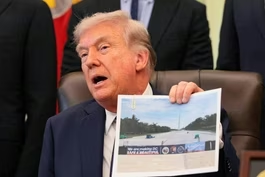
Can Trump manage Iran and sagging economic approval at the same time?
Video has Closed Captions
Can Trump manage Iran and sagging approval at once? (17m 3s)
Providing Support for PBS.org
Learn Moreabout PBS online sponsorship New Episode
- News and Public Affairs

Top journalists deliver compelling original analysis of the hour's headlines.

- News and Public Affairs

FRONTLINE is investigative journalism that questions, explains and changes our world.
 New Episode
 New Episode
 New Episode
 New Episode
 New Episode
 New Episode
 New Episode

 New Episode
 New Episode
Support for PBS provided by:
Major funding for “Washington Week with The Atlantic” is provided by Consumer Cellular, Otsuka, Kaiser Permanente, the Yuen Foundation, and the Corporation for Public Broadcasting.