State of the Arts
Alessandra Belloni: Healing Music & Movement
Clip: Season 44 Episode 7 | 7m 45sVideo has Closed Captions
Alessandra Belloni teaches the ancient Southern Italian music and dance of the Tarantella.
Alessandra Belloni teaches ancient Southern Italian music and dance, including Tarantella and Tammurriatta; art forms rooted in movement, chanting, and healing. With trance-like rhythms and expressive motions, the dances create a space for releasing emotional blockages, allowing participants to channel and transform deep emotions and energies.
Problems playing video? | Closed Captioning Feedback
Problems playing video? | Closed Captioning Feedback
State of the Arts is a local public television program presented by NJ PBS
State of the Arts
Alessandra Belloni: Healing Music & Movement
Clip: Season 44 Episode 7 | 7m 45sVideo has Closed Captions
Alessandra Belloni teaches ancient Southern Italian music and dance, including Tarantella and Tammurriatta; art forms rooted in movement, chanting, and healing. With trance-like rhythms and expressive motions, the dances create a space for releasing emotional blockages, allowing participants to channel and transform deep emotions and energies.
Problems playing video? | Closed Captioning Feedback
How to Watch State of the Arts
State of the Arts is available to stream on pbs.org and the free PBS App, available on iPhone, Apple TV, Android TV, Android smartphones, Amazon Fire TV, Amazon Fire Tablet, Roku, Samsung Smart TV, and Vizio.
Providing Support for PBS.org
Learn Moreabout PBS online sponsorship[ Music plays ] Belloni: In America, people think of Italian music, most people think of Neapolitan classical songs.
But that's not what we do.
That's not what I do.
So our first goal is educate Italian Americans here on their musical ethnic background and then teach it to the new generations.
[ Music plays ] The devotional dancing and the music is ancestral, so it goes back thousands of years.
These devotional movements actually move your energy.
So they really touch in different chakras and move the energy and release blockages, especially for women.
So release sadness, anguish, fear.
And then the chanting we sing so loud, you know, so from the throat, opens your throat chakra.
So all these energy points release blockages without thinking about it.
That's how these were created -- for healing.
Beautiful group.
[ Clapping ] I'm Alessandra Belloni and we are at the Cathedral of Saint John the Divine.
I am from Rome.
I grew up actually in a family where we didn't really go to church that much.
But coming here, I really understood what a church is supposed to do in order to help humanity and also social work and activism.
I started out as a singer and an actress as a child.
In 1977, I heard this folk music being played by a great group from Naples called La Nuova Compagnia di Canto Popolare.
And I said, this is my heart and soul.
So I started to learn how to play the tambourine, how to dance these intricate folk dances that have a general name, the Tarantella or Tammurriata.
But in the beginning, I was really young, early 20s.
I did not know the tradition.
And like any indigenous culture, to learn, you have to go on the field, learn from the old people.
[ Music plays ] If you really want to do it seriously, you can spend your life in it, dive into it and with the people from the places.
So I went to all over, to, besides my region of Rome, Naples, Campania, Calabria, Puglia, and Sicily.
Travel everywhere.
In Italian, the term is "rubare con gli occhi" -- you steal with your eyes.
And then it was a point where it clicked.
I could say I became a master of the tambourine technique of the tarantella.
And it took about ten years at least.
[ Playing tambourine ] I also met a guitarist and composer here in New York, John La Barbera, in 1979 or early 1980.
We're now celebrating 45 years.
We started our group called I Giullari di Piazza, the players of the square.
[ Music plays ] We're singers, actors, musicians, dancers, people who dance on stilts.
And it's not just entertainment, you know.
It's like a ritual experience for the audience.
[ Music plays ] Posey: I feel like what's important about this dance and this music is it brings people together and it takes us away from the individualistic into the collective.
This is such a welcoming movement.
There's a lot to be said for moving together.
That creates a powerful space for people to connect and grow.
Belloni: Just like the spiders do.
During my workshops, I also teach the dance for the Black Madonna and the drumming for the Black Madonna, which is called Tammurriata, from the region of Naples, Campania.
I'm very devoted to the Black Madonna.
[ Music plays ] She is a Christian devotion.
The truth is that she is also pre-Christian tradition.
In one word, she's the pre-Christian tradition of the goddess of the earth.
[ Music plays ] Culturally, the Black Madonna also represents the African mother, the cradle of humanity, where we come from.
The face changes.
The eyes look at you.
But each person will have a personal experience with her.
And I think that's very powerful.
Thousands of people, every year on the same day, worship the Black Madonna like they did in pre-Christian times with drumming, singing, and dancing.
And chanting and chanting.
[ Chanting ] [ All chanting ] [ Rhythmic music and singing ] -So the way people did healing in the Middle Ages and even before was honoring the Madonna, the Saints, drumming, dancing, and doing these prayers in a trance.
The 6/8 obsessive rhythm or 12/8 is a trance rhythm all over the world.
Originally African, everyone agrees on that.
[ Playing tambourines ] It was for the purpose of putting people in a trance for shamanic purposes so that you can receive the healing or the vision.
It starts spinning, spinning, and spinning and spinning.
That creates a trance.
And when I do in a workshop, the purpose is to let go of your ego, and receive the vision from above, and heal whatever you want to heal.
I want people really to experience what that does to your body, that 6/8 [vocalizing] before you dance.
The original Tarantella, Pizzica, means "bite."
Tarantata is the name of a woman afflicted by the bite of the tarantula, which is the original Tarantella done to cure from the mythical bite of the tarantula, which is a metaphor for a form of depression known as Tarantismo that afflicted mainly women, especially in Puglia, but was all over southern Italy.
And many times the women suffered this kind of sadness and depression where women were abused.
So there is a connection with that dance to heal from trauma.
[ Music plays ] Today, here where I live in America and other parts of the world, people are ready to receive something that is real and authentic.
We live with incredible stress, and we live in a society that is not just at all.
I really hope to leave a legacy.
It's a very difficult art form.
It's not commercial.
It's not, you know, I'm not a rock star, obviously.
So I chose to do something non-commercial for devotion, but I wanted to transfer it to other people, to young people and leave a legacy.
That's exactly where I am now.
[ Music plays ] [ Music plays ]
 New
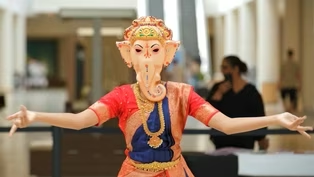
NewNeelima Raju: Connecting with Kuchipudi
Video has Closed Captions
Clip: S44 Ep7 | 7m 34s | Neelima Raju inspires students to connect with Kutchipudi, an Indian classical dance. (7m 34s)
 New
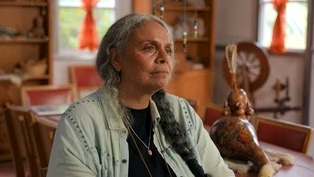
NewTyrese “Bright Flower” Gould Jacinto: Life As Art
Video has Closed Captions
Clip: S44 Ep7 | 7m 37s | Tyrese Gould Jacinto keeps Nanticoke Lenni-Lenape culture strong through art. (7m 37s)
Providing Support for PBS.org
Learn Moreabout PBS online sponsorship














Support for PBS provided by:
State of the Arts is a local public television program presented by NJ PBS