State of the Arts
Neelima Raju: Connecting with Kuchipudi
Clip: Season 44 Episode 7 | 7m 34sVideo has Closed Captions
Neelima Raju inspires students to connect with Kutchipudi, an Indian classical dance.
Neelima Raju has been dancing since the 1980s, trained in the classical South Indian tradition of Kuchipudi under renowned gurus. Rooted in a form once performed only by men, her work honors its revival while expanding its reach. In New Jersey, she inspires students to connect with their culture through a dance that blends tradition with personal expression.
Problems playing video? | Closed Captioning Feedback
Problems playing video? | Closed Captioning Feedback
State of the Arts is a local public television program presented by NJ PBS
State of the Arts
Neelima Raju: Connecting with Kuchipudi
Clip: Season 44 Episode 7 | 7m 34sVideo has Closed Captions
Neelima Raju has been dancing since the 1980s, trained in the classical South Indian tradition of Kuchipudi under renowned gurus. Rooted in a form once performed only by men, her work honors its revival while expanding its reach. In New Jersey, she inspires students to connect with their culture through a dance that blends tradition with personal expression.
Problems playing video? | Closed Captioning Feedback
How to Watch State of the Arts
State of the Arts is available to stream on pbs.org and the free PBS App, available on iPhone, Apple TV, Android TV, Android smartphones, Amazon Fire TV, Amazon Fire Tablet, Roku, Samsung Smart TV, and Vizio.
Providing Support for PBS.org
Learn Moreabout PBS online sponsorship[ Music plays ] Raju: Kuchipudi was originally a drama tradition and also it was not performed inside the temple.
It was performed on the outside.
So it has elements of rhythm, movement, gesture, and mime.
[ Music plays ] [ Vocalizing ] As an artist, whatever the form you're doing, you have to tell a story.
It has to communicate something with the body.
You may not understand the words, but you have to feel the emotion.
[ Music plays ] If you want to become that artist, you have to really touch that vein in a human being.
So if it is about love, it's trying to make somebody feel about their own personal experience.
And if it is really about estrangement or pain, everybody has these things.
You know, we are all human.
[ Music plays ] There's no formula.
It's not about technique.
It's also about learning to communicate with that technique and tell that story.
[ Music plays ] I'm Neelima Raju.
I'm a Kuchipudi performer and I'm also Kuchipudi teacher and I live in Edison.
I started this art form in 1987.
I went to one traditional guru who was from the village of Kuchipudi, and that's how I started my journey.
And in 2001, I came to this country for a higher degree.
But that was in science, and I pursued my art form simultaneously.
I was performing back in India, and I continued my performances here as well as I started my teaching and then passing the art form to the next generation.
So this is the journey so far.
[ Music plays ] Let's start with a small prayer.
You guys are ready?
[ Praying in global language ] Raju: One, two... [ Vocalizing ] Next.
[ Vocalizing ] Indupriya: I started when I was three and a half years old and for a long amount of time I just watched.
Fundamentals, you would basically think of them as like ABCs.
Instead of actual alphabets, it's like small footwork, foot movements, and hand gestures and then small building blocks or ABCs.
And then you put them together and make sentences like [ Speaking global language ] Gopichand: You are immersing yourself into something that is more than a dance.
So it is the metaphysical piece of it.
Like you are kind of meditating.
Kasturi: It's just not the dance form.
You really develop a kind of discipline and real life skills.
[ Singing ] Gopichand: We are passing it on.
So like everything, it's part of the culture, tradition.
Staying close to home a little bit, adding a flavor in American melting pot, if you will.
[ Music plays ] -So dance has been in India for quite some time.
Music and dance is in the Natya Shastra, so that is the oldest book which we all go back to.
And from there, we have the regional variations of the dance form.
It comes from the root word Kuchila means it's a broken house.
It was all males.
And they would also do not just the dance, they would also practice literature.
This continued 'til the post-Independence era.
And then there was a nationalist sentiment after the British left and everybody was searching for an identity, a unique identity for the southeast part of the country.
[ Applause ] Then a few traditional gurus came up and they structured everything.
And that's how it got recognized as Kuchipudi.
And with it came the introduction of women, because it became a more free society.
And just like women have come out of their homes to do a lot of other things.
And that's how we also learnt.
[ Music plays ] So you have the notes of music and you have rhythms.
The most important factor of interpretive dance is using your face to communicate ideas, to communicate the meaning of the poetry.
You have three modes of interpretation in Kuchipudi.
The first one is called Padartha.
It's a literal meaning.
For instance, if you want to call somebody like your beloved or something, then you -- you just say, "Swami rara," meaning, "My beloved, come here."
Vadyata is the meaning of the sentence.
The emotive meaning.
So when she's calling her beloved, obviously she won't be angry.
So she's basically going to say, "Swami, rara."
Then you have Sancharis, which are metaphors and similes, the one with the beautiful eyes.
You are so great and you are so nice.
Why don't you come here?
So this is all within that framework.
You can explore different things, keeping the poem in mind.
There is a large population of Indians in Edison.
So in terms of culture, we do have a lot of people, but it's all over from India.
So it's not just from my place.
My students do get invited and they do their cultural festivals outside.
And that is all part of learning.
And they also, you know, understand their roots much better.
The dance that Indu did today is a very traditional form of poem which is called Kavitha.
Kavitha in Telugu means poem.
[ Music plays ] The dance piece was a story about describing Ganesha and all his attributes and all his physical attributes as well.
The one with the large trunk and also describing him as the remover of obstacles.
And Ganesha -- Ganapathi basically is praying to him.
The piece that I performed is from a traditional opera.
It is an excerpt from an opera called Krishna Leela Tarangini.
The dance on the plate has a tradition where what happens is when you dance on the plate, you cannot use your space.
Automatically, the attention of the audience falls on the rhythm.
It's not for mere showmanship.
It's adding to the visual element of that poem.
The art form has to be definitely passed on from one generation to the other, not just as an art form, but it also teaches children how to really develop their intuitive skill sets, their creative skill sets.
And I think they're very important not just for artists, but also for people who are doing science and math.
So many different things that shape you as an individual.
[ Music plays ] Performance is just, it's short-lived.
It's not going to be there forever, because everybody gets old, let's face it.
Whereas as an educator, you see your dance through them.
So that is the most satisfying for an educator.
After you're gone, it still lives with them.
[ Music plays ]
 New
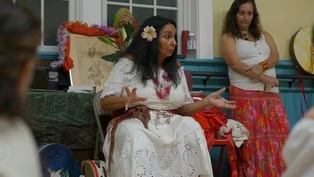
NewAlessandra Belloni: Healing Music & Movement
Video has Closed Captions
Clip: S44 Ep7 | 7m 45s | Alessandra Belloni teaches the ancient Southern Italian music and dance of the Tarantella. (7m 45s)
 New
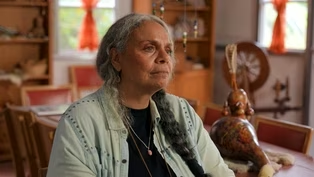
NewTyrese “Bright Flower” Gould Jacinto: Life As Art
Video has Closed Captions
Clip: S44 Ep7 | 7m 37s | Tyrese Gould Jacinto keeps Nanticoke Lenni-Lenape culture strong through art. (7m 37s)
Providing Support for PBS.org
Learn Moreabout PBS online sponsorship














Support for PBS provided by:
State of the Arts is a local public television program presented by NJ PBS