State of the Arts
Tyrese “Bright Flower” Gould Jacinto: Life As Art
Clip: Season 44 Episode 7 | 7m 37sVideo has Closed Captions
Tyrese Gould Jacinto keeps Nanticoke Lenni-Lenape culture strong through art.
Tyrese “Bright Flower” Gould Jacinto is an Indigenous artist and community leader from the Nanticoke Lenni-Lenape Nation. For her, art is something you live. Through initiatives like the Cohanzick Lenape Story Symposium, and a deep connection to the Earth, her community’s daily creative practice becomes a living dialogue between generations, carrying forward culture, memory, and identity.
Problems playing video? | Closed Captioning Feedback
Problems playing video? | Closed Captioning Feedback
State of the Arts is a local public television program presented by NJ PBS
State of the Arts
Tyrese “Bright Flower” Gould Jacinto: Life As Art
Clip: Season 44 Episode 7 | 7m 37sVideo has Closed Captions
Tyrese “Bright Flower” Gould Jacinto is an Indigenous artist and community leader from the Nanticoke Lenni-Lenape Nation. For her, art is something you live. Through initiatives like the Cohanzick Lenape Story Symposium, and a deep connection to the Earth, her community’s daily creative practice becomes a living dialogue between generations, carrying forward culture, memory, and identity.
Problems playing video? | Closed Captioning Feedback
How to Watch State of the Arts
State of the Arts is available to stream on pbs.org and the free PBS App, available on iPhone, Apple TV, Android TV, Android smartphones, Amazon Fire TV, Amazon Fire Tablet, Roku, Samsung Smart TV, and Vizio.
Providing Support for PBS.org
Learn Moreabout PBS online sponsorshipJacinto: For me, art is everyday life.
Everything we do in life is art.
Getting dressed in the morning is art.
We are living in art.
And if we don't realize that everything we do is art, then we don't have a creative process.
We're looking for somebody else to create our world for us.
Everything we do is an individual piece.
As the Creator makes us different, we also make our pieces different.
But it also has to be a useful item.
And it's a little different in the art world because they make art just for the wall.
To us, art is in the usefulness as well.
I feel like I'm an empty vessel of what the Creator has to say.
If I empty my mind and I meditate, then I'm open to what the Creator has for me.
It just pours out.
And that's where the creation comes from.
But I used a lot more colors than necessary.
Well, my name is Tyrese Gould Jacinto, also known as Bright Flower, and I am an artist.
I am from the Nanticoke Lenni-lenape Nation here in South Jersey.
I really don't put a lot of emphasis on the nomenclature of colonization of what they call us.
You know, just call me Ty, because I really don't want any labels, any names or anything.
The Creator made us this way.
But if you take away all the onion skin layers and you just realize that we're just a family, we're just a family.
And when you spend time with family, you want to do activities.
These are our things that we do.
[ Drumming and singing ] I try to bridge the past to the present.
Because we're still here.
So when you live with something on a day-to-day basis, one of the things that's really indicative of our people is making something from nature.
When we have our community festivals and there's multiple generations, you'll have from great-grandparents all the way down to newborn babies, always in the same room interacting.
The community itself allows for everybody to learn from each other.
So it's really not something that we say.
"Oh, well, we pass this down."
It's just something that we live with.
[ Singing continues ] -Our Cohanzick Nature Reserve, we purchased because we needed to expand.
We're a conservation organization.
So right now we do a lot of conservation work with the state of New Jersey DEP and so forth.
It's 63 acres of clear trails.
And the trail system has been there since pre-European incursion.
This property was once where my great-grandmother was born and lived and all our families.
In my grandmother's book, she said, this is the dust of my ancestors, and one day will be the dust of me.
And this property has never been clear-cut.
It has the same soil complexity from the Ice Age.
[ Music plays ] Saunders: Music brings people together.
The belts are artwork, the pine needle baskets are artwork.
It shows pride.
It shows that we reuse what's around us.
We make things that are practical out of things that people throw away.
[ Music plays ] [ Chanting ] We're here to share culture.
We're here to share our lives, to make people aware.
[ Chanting continues ] [ Music plays ] -On our ranch, we are what's considered the new word permaculture.
So we recycle the manure and use it for fertilizer.
We don't use any pesticides.
We have dogs that help us with herding.
We have alpacas that we use for the fibers, mainly to stuff the little dolls that I make.
The Lenape dolls.
The no-face dolls.
This was made for my granddaughter and it's made after one of my stories, also, called "The Wishing Doll."
It's made out of all leather and eventually she'll get moccasins.
Homemade moccasins and leggings.
[ Music plays ] There's so many art practices.
But I did bead work first, and I was eight years old when I learned bead work.
And I really like gourd work, because those seeds have been passed down through the gourd for thousands of years.
And then when I plant that seed into the soil, it's the dust of my ancestors.
[ Music plays ] This is the first stage.
This is planting the seed.
I got some of the seeds from my grandmother's collection.
So here is where I dry the gourds.
So I could make something out of this one.
This is actually like considered a hard wood now.
And just think, people have done this for 10,000 years.
Or more, probably.
This is absolutely gorgeous.
The perfect imperfections.
It doesn't need much.
Sometimes it'll take me all day.
[ Music plays ] This is an idea that I came up with.
It's called "It Takes a Community" and this is the grandmother, and these are all the children of the community and she is keeping them company.
Underneath her dress, there's actually a dream catcher.
And she is the keeper of all the children.
You know, I've always been a storyteller, and there were no native books and my children didn't grow up with any native books.
I'm like, "Well, I just have to fix it."
"We can only curse ourselves with bad wishes, but we can bless others through our good wishes.
Now all we say is, I wish you peace.
I wish you peace and prosperity, and may all your wishes come true."
When we thought about the symposium, it just kept growing.
We had demonstrators, we had food, we had dancing, and we had guest speakers.
But the symposium was a little different because we allowed the audience to ask questions in between, after each presentation.
It was a whole combination of all of us together, the experts that have studied in these fields, and the people that live it.
Cooper: The aunties showed up today.
They showed up today and I actually learned a lot from them today.
I learned a lot from my mom already.
She passed down gourd art, pine needles, corn husk dolls, many, many things.
But what she passed down, there are other versions of it which I rarely have seen, so I'm looking at their art, the aunties across the hall, and I'm seeing there's other ways to do it.
I'm glad that I have this stuff passed down to me because I have three kids and it's being passed down to them also.
Sernak: The symposium is bringing together arts, music, food, the sense of community.
We're bringing all that back in and we're sharing the resources from our traditions and our ancestors to help us move forward with more of the current traditions and times, especially for our youth.
It's really important for them to see it.
[ Drumming continues ] Jacinto: This symposium was very key because it was not just experts about us.
It combined us as a part of the narrative.
We opened up the door to bridge that past to the present to rewrite the narrative.
Because all the books speak of us is in the past tense.
"They used to," "They were," And "This is what they did."
And it brought it to, well, this is what we do.
This is how we are.
And this is what we still do.
[ Drumming and chanting continue ]
 New
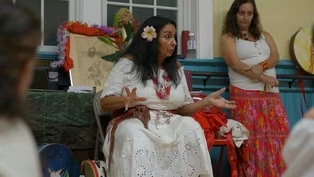
NewAlessandra Belloni: Healing Music & Movement
Video has Closed Captions
Clip: S44 Ep7 | 7m 45s | Alessandra Belloni teaches the ancient Southern Italian music and dance of the Tarantella. (7m 45s)
 New
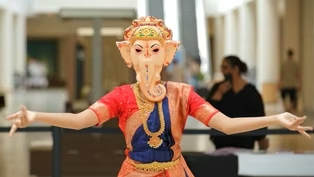
NewNeelima Raju: Connecting with Kuchipudi
Video has Closed Captions
Clip: S44 Ep7 | 7m 34s | Neelima Raju inspires students to connect with Kutchipudi, an Indian classical dance. (7m 34s)
Providing Support for PBS.org
Learn Moreabout PBS online sponsorship













Support for PBS provided by:
State of the Arts is a local public television program presented by NJ PBS