
Carole Johnson; Sam Oliker-Friedland; Helen Archontou
7/11/2026 | 27m 55sVideo has Closed Captions
Carole Johnson; Sam Oliker-Friedland; Helen Archontou
Carole Johnson, President & CEO of University Hospital, examines the impact of Medicaid cuts to vulnerable communities and encourages young professionals to pursue medicine. Sam Oliker-Friedland, CEO of Responsive Gov, discusses election integrity, poll worker safety, and trust in elections. Helen Archontou, CEO of YWCA Northern NJ, explores how the organization empowers women affected by trauma.
Problems playing video? | Closed Captioning Feedback
Problems playing video? | Closed Captioning Feedback
Think Tank with Steve Adubato is a local public television program presented by NJ PBS
Carole Johnson; Sam Oliker-Friedland; Helen Archontou
7/11/2026 | 27m 55sVideo has Closed Captions
Carole Johnson, President & CEO of University Hospital, examines the impact of Medicaid cuts to vulnerable communities and encourages young professionals to pursue medicine. Sam Oliker-Friedland, CEO of Responsive Gov, discusses election integrity, poll worker safety, and trust in elections. Helen Archontou, CEO of YWCA Northern NJ, explores how the organization empowers women affected by trauma.
Problems playing video? | Closed Captioning Feedback
Where to Watch Think Tank with Steve Adubato
Think Tank with Steve Adubato is available to stream on pbs.org and the PBS app.
Providing Support for PBS.org
Learn Moreabout PBS online sponsorship- [Narrator] Funding for this edition of Think Tank with Steve Adubato has been provided by EJI, Excellence in Medicine Awards.
A New Jersey health foundation program.
New Brunswick Development Corporation.
The New Jersey Economic Development Authority.
New Jersey Sharing Network.
Horizon Blue Cross Blue Shield of New Jersey.
PSEG Foundation.
New Jersey Manufacturing Extension Program.
The Burke Foundation And by NJ Transit.
Your ride to the world’s game.
Promotional support provided by NJBIA.
We put business at the center.
And by New Jersey Globe.
[MOTIVATIONAL MUSIC] - Hey, everyone, Steve Adubato.
What do you need to know about the world of healthcare?
The question of trust or lack of trust in public health.
We are honored to have once again Carole Johnson, who's currently the President and CEO of University Hospital.
And Carole, great to have you with us.
- It's wonderful to be here.
Thank you for having me, Steve.
- You were previously part of the state administration.
Then you went to the federal government.
Now you're back as the CEO and President of University Hospital.
For those who don't know University, we'll put up the website.
Tell everyone what the footprint is and why it's so impactful at University Hospital.
- Well, University Hospital is the only state-supported acute care public hospital in New Jersey.
We are essential to the care that's delivered immediately in our community, in Newark and the surrounding areas, but if you live in New Jersey, you should care about the health and well-being of University Hospital.
Because we are training the next generation of docs.
We are the principal teaching hospital for Rutgers.
We are the level one trauma center for North Jersey, state-designated.
So if you have a trauma event in North Jersey, you're liking coming to us, and we do world-class trauma care.
And we run the helicopter services and supports all across the state.
And so hopefully you don't encounter us that way, but if you do, that's our trained expert team on those helicopters.
So we are part of the fabric of this state.
- Thank you, Carole.
Let me try this.
Because you understand the federal government and worked in the previous administration, the Biden administration, you understand when there are cuts to Medicaid.
What is your sense as to the impact of the federal cuts in Medicaid to the most vulnerable population who depends upon Medicaid?
- These cuts, Steve, are an existential threat to healthcare services in New Jersey.
People who depend on Medicaid are going, the cuts are designed to make it hard for people to retain their Medicaid.
It's just meant to be a volume of paperwork coming at people.
So many people on Medicaid work, but now, you're gonna have to continuously prove you're working, continuously prove that you maintain your eligibility.
Again, we used to do that at the state level once a year.
Now you're gonna have to do it multiple times.
You're gonna have to have all this documentation.
Many people on Medicaid work multiple jobs.
You know, if you ask me to go find my last four pay stubs, it would take me a minute.
But now we're gonna ask families who live in very challenging circumstances to have to do that constantly, a system that doesn't even really exist yet, and this is all gonna go into effect in early January.
People are gonna lose their healthcare coverage, and when they lose their healthcare coverage, they're gonna get sicker and they're gonna show up in emergency rooms sicker and needing more services.
- And some of the federal government in the Trump administration argue, "All we're doing is making people document that they're working."
- Well, what I would say to you, Steve, is, the vast majority of people who are working age on Medicaid work.
We know that.
But what we've seen in other states that have tried to, there are a couple of states that tried to implement work requirements a few years ago.
They spent hundreds of tens of millions of dollars on administration.
They spent more on administration than they did on actually the services provided.
And what it was, was basically a whole lot of paperwork that people had to, hoops people had to jump through to be able to continuously document things that we as the State of New Jersey used to be able to do directly once a year, ensure people were eligible, get them their coverage, get them their care.
You know, actually making it harder for people to get healthcare services is not a commitment to the health and well-being of the people of New Jersey.
- You and your team are working together with Rutgers University to train doctors and nurses.
Talk about the pipeline of physicians and nurses, but let's stay on physicians right now.
Why should we be concerned about the pipeline, A, and B, what are you and your colleagues doing about it?
- Yeah, so a couple of things.
One, we are so proud to be the clinical partner where people train to become doctors.
So they do their residency and their fellowship.
So many doctors in New Jersey, if you ask them, they trained here.
Many of them come back and practice here, but if you're getting care anywhere in New Jersey, your doc probably had some time at University Hospital.
Because this year alone, we trained more than 725 residents and fellows.
So this is the pipeline and it matters.
It matters that young people choose healthcare, that they commit to it.
It is hard work.
It is multiple years of training.
And so at a time when the infrastructure of healthcare supports, things like Medicaid cuts, are happening, cuts to the marketplace, the Affordable Care Act marketplace, when those things happen, it sends a signal to the next generation about whether they should choose that line of work.
And that's what we have to push back against.
Because healthcare jobs, being physicians, being clinicians, being caregivers, is gonna be essential for all of us going forward.
And so we need that service, we need that support, and we need to encourage young people to make those choices.
- Carole, why do you believe so many?
Well, let me try it this way.
Our series, trust in public health, graphic's up right now, why is there, to some degree, distrust on the part of some in public health, and why is that such a serious problem?
- Yeah, look, part of the key issue here is about transparency, communication, building trust, talking about, from a healthcare services and public health side, what we know and what we don't know, being open and honest with the community about the things that we're facing.
And so I think public health trust is really about delivering, delivering on our commitments and our promises.
And so what we see here at University Hospital is an incredible level of community trust.
People come to us, people come to our emergency room.
We did more than 102,000 visits in our emergency department last year, because people trust this institution, the people who work here, the people who are of the community who've dedicated their life's work to this community.
And that's what people need to know.
- What's the future for University Hospital?
There have been financial challenges.
You're serving a really underserved community to a large extent.
What do you see as the future, and why are you bullish about University?
- So I'm so bullish because of the incredible community and state partners that we have, both at the city and county leadership level and our state partners and the new administration at the state, really saying, look, you know, for decades, the people of Newark have waited for us to take the trailers down that had been temporary here in Newark, that had been a space where the thought was decades ago, there'd be short-term trailers on some space that would come down and build new facilities for this community.
That was a trade-off the people of Newark made.
They made hard choices to be able to give that land for the purposes of public health in Newark.
Those trailers came down at the end of last year, and new construction is going up because we want new, modern healthcare facilities that match the high-quality care that we offer here at University Hospital.
So that's what I'm so bullish about.
What I am obviously concerned about is how Medicaid cuts are gonna impact this growth and support and agenda that we have to make Newark, to continue to make Newark a world-class healthcare city.
- Carole Johnson has had many roles in public health.
She's been a public health leader for a long time.
She is the President and Chief Executive Officer at University Hospital.
Say it again, Carole, the State of New Jersey, it's the only State of New Jersey, finish that sentence.
- We're the only public acute care hospital in New Jersey.
- Carole Johnson, thank you for joining us, Carole.
I promise we'll have future conversations.
All the best to you and your team.
Thank you.
- Thank you so much.
- You got it.
Stay with us, we'll be right back.
- To watch more Think Tank with Steve Adubato, find us online and follow us on social media.
- We're pleased to be joined for the first time by Sam Oliker-Friedland, who's the CEO of a terrific organization called the Institute for Responsive Government.
Sam, good to see you.
- Good to see you too.
Thanks for having me.
- You got it.
Website's up.
Tell folks what the organization is and why it's more important now than ever before.
- Yeah, we do policy implementation and local organizing work to make a election administration that works and a government that people don't hate.
This is incredibly important right now when our system of government is more under threat than it's ever been before.
The 8,000 or so local election administrators whose job it is to run a free and fair election this year, need everything we can do to support them in that endeavor and we're here to provide it.
After that election, our job is to actually make sure that those elections create a government that people really like and that make them want to go and participate again the next time.
- All right, you ready for a little devil's advocate?
- Absolutely.
- President Trump, federal government says, "You know what, eh, the 2024 election was stolen.
"We don't trust the process "and so we are gonna get involved.
"ICE is gonna get involved.
"We are gonna monitor the elections, we're gonna make sure "they are free and fair "and we support something called the Save Act."
Nobody knows what it is, but let's just argue devil's advocate.
People have to prove they're American citizen.
They're an American citizen before they vote.
What the heck could be wrong with any of that, Sam?
- I have some bad news, good news on this.
And the bad news is that that's not devil's advocate.
That's what the president absolutely wants to do.
He's made it very clear that he wants to intervene in this election and it's completely understandable to be worried about that.
The good news is that the federal government doesn't run elections.
- Oh, why is it understandable?
Why is that understandable?
- Oh, it's just understandable to be concerned about it.
Like if that's what you're hearing in the news, I think it's completely understandable to be worried that that's gonna happen.
And I think that's absolutely what the president wants.
The good news is that we run elections at the state level and most importantly at the city and county level.
And so you have 8,000 or so Democrats and Republicans who very much believe in running a free and fair election and who aren't gonna stand for federal intervention when the federal government just doesn't have any role under our constitution in running elections.
- The Save Act.
- Yeah.
- I don't know what's gonna... We're taping this toward the back end of April.
I don't know what's gonna happen within Congress, but say someone says, "Look, all it says "is that someone has to prove that they're a citizen."
What else does it say, Sam, that concerns you?
- Yeah, and that's not the piece that concerns me.
So the law already says that only citizens can vote in federal elections.
That law is already enforced.
And if they wanted to, there are even better sort of tech forward ways to verify voter citizenship without putting a giant burden on voters to do a bunch of paperwork.
But that's really what the Save Act does.
So what the Save Act does is says, "I have to bring my birth certificate," which I don't know about you.
I have no idea where my birth certificate is.
It says I have to bring my birth certificate to show an election official before I vote.
It says, election officials who are already overworked and underpaid have to process all of that paperwork before they vote.
It just doesn't make sense as a way to verify citizenship.
There's nothing wrong with verifying voter citizenship.
That's a really important part of the process that's already happening.
This is just a dumb way to do it.
- So lemme try this.
What is the danger of consistently questioning the results of an election?
If I win, it was a fair election.
If I lose, something must be fishy.
People are voting multiple times, illegal.
People who are here illegally are voting.
If government leaders at the highest level consistently question the results of an election, what is the danger for our representative democracy?
- I think there's a real danger, and I think your question is exactly right.
So a lot of this is like, you know how like a toddler is crying because they're like chips are gone, but really they're crying 'cause they're tired.
I think that's a lot of what you're seeing here.
You're seeing a lot of people saying, "Oh, the result, "the election was rigged, the results are fake."
Is this because they're mad that they lost an election?
And I think you see this all the time, that when people lose an election that they wanted to win, they start questioning the results.
The danger here is really for both the election officials themselves and for the health of our democracy.
When we can't be good winners, it means that the entire system gets less secure and that all we hear instead of, "Wow, "this was an incredibly safe, secure election," is we hear the whining and that's dangerous for our democracy and it's dangerous for those election officials who are gonna get threatened because of the rhetoric that's sort of permeating the space.
- You know, growing up, I grew up in Newark, New Jersey.
My family was very involved in local civic and political affairs, and I always remember going to vote at my local public school, Ridge Street School in New Jersey, in the north ward of Newark, New Jersey.
Why is this relevant?
I used to think these poll workers, they get paid 40 bucks, right, at the time back in the day.
And then I hear it's becoming harder and harder to get people to be those judges, to be those poll workers because it's dangerous and because it's polarizing and it isn't just this civic-minded positive thing people are doing.
It's scary.
Am I engaging in hyperbole, Sam?
- No, you're not engaging in hyperbole.
It is scary.
And that's why more than ever, we need really good people to volunteer to be those poll workers.
I have the exact same memories of you from growing up in Milwaukee, Wisconsin and seeing those dedicated folks who are helping my parents vote.
They are the genuine heroes of our democracy.
They are patriots and they need our support.
They need to get paid well.
They need to get supported, they need to not get threatened.
And we need to, all of us, need to sort of get around them to thank them for the work they do and encourage your friends to be those poll workers.
It's so important.
- Last question.
If the president of the United States and those closest to the president, whomever that president is, but in this case, President Trump continually says the elections are rigged when he loses.
What does that do to millions of Americans who follow and respect those leaders in terms of their view of those election results?
"It's rigged.
That means my vote doesn't count."
- It obviously has a negative effect on folks who believe in the president and if they believe him and he is saying the election is rigged, that is telling them that it's rigged.
But here's what I would say to those folks.
Look at some of the local and state leaders you have.
The Governor of Nevada is a Republican, the Governor of Georgia is a Republican.
If you look to those folks and see what they're saying after the election, listen to them and I bet you anything that those two governors among a bunch of other Republicans at state and local office are gonna say, "This was a free and fair election."
Listen to them.
Follow them.
The federal government doesn't have anything to do with this.
Listen to the Republicans who are actually running the election for your guide on how it went.
- By the way, to Sam's point, it isn't an opinion that the states and local governments run elections.
In the United States Constitution, it says states will be legally, constitutionally responsible for elections and local governments report to the states, not the feds.
And that's not by accident.
Hey, Sam, thank you so much for joining us.
We'll keep the conversation going.
All the best.
Take care.
- Thanks so much for having me.
- Sam's down in our nation's capital, taking care of the business of the nation.
Thank you, Sam.
- Thanks so much.
- You got it, stay with us.
We'll be right back.
- To watch more Think Tank with Steve Adubato, find us online and follow us on social media.
- We're now joined by Helen Archontou, who is CEO of the YWCA of Northern New Jersey.
Helen, good to see you again.
- Good to see you too, thanks for having me.
- Helen, let me ask you this.
The website's up for the YWCA Northern New Jersey.
Tell everyone what it is, and why you're particularly concerned about trauma, women in trauma.
- Well, our organization's mission is to eliminate racism and empower women.
And trauma is at the core of so many issues that are impacting the women that we serve in terms of being able to live economically stable lives.
It keeps them from being able to sometimes work, it keeps them sometimes from being able to gain housing and, you know, impacts their ability to relate to their children and others and, you know, employment issues.
So many of our programs are focused on being able to support women, the various types of trauma that they may have been exposed to.
- Talk about veterans and trauma.
This is part of a series we're doing called, it's simply, the graphic will come up, Honoring Our Veterans.
Be specific, if you could, about the trauma related services that your organization provides to veterans.
- Sure, well, we know that one in what three women who have been in the military have experienced military sexual trauma in particular.
And so, you know, that is a big focus.
- Hold on, one in three?
- One in three.
- Sexual trauma.
- Yes, yes, while they were in the military, while they were serving our country.
And so a big part of the work that we do with Women in Operation Sisterhood, which is our female veteran program, is supporting them through getting clinical care for that trauma.
But there's also trauma though from just, you know, being away from your family, and your life for so many years, servicing our country, and then transitioning back to civilian life.
There's a trauma related to that as well.
That's a different type of trauma.
But that also is something that is very prevalent and our female veterans need support with that as well.
We know that they don't come back to communities that are always open arms to them, as much as that's hard to believe.
They don't always find employment so easily.
You know, we don't always look at the experience that they received in the military as from a job description perspective, that they don't have a specific degree, but they've done years of work.
You know, in the military, a lot of employers aren't looking at that and kind of giving them credit and then giving them a chance.
So there's a lot of work to be done in terms of educating our community, but at the same time, supporting our women veterans.
- Along those lines, how significant are the mental health issues many of these female veterans face?
- There's very high rates of depression and very high rates of suicide, unfortunately, with this population.
And so it's so important that we have good mental health care for them.
- So, and by the way, let's make sure we have the website up again for anyone in your Northern New Jersey is a funny term, 'cause North, South, Central.
- Yes.
- Define it, please?
- Yes, for us it's five counties that we serve.
Bergen, Essex, Hudson, Morris, and Passaic.
- Okay, that's a fair number of people.
You're in that area, you wanna find out more about the YWCA Northern New Jersey, checkout the site.
Talk to us about the Center for Racial Healing.
What is it and why is it significant?
- So the Center for Racial Healing is the first of its kind in the state of New Jersey.
And it's really anchored at being able to support individuals that have experienced racial trauma.
It is a systemic issue, but we know that racial trauma impacts health, it impacts economic mobility, it impacts community stability.
But yet as a society, we really haven't set up our, even our clinical staff.
I'm a social worker by training.
You know, we don't teach folks enough in school to even be able to support individuals that are impacted by racial trauma.
Most people don't even even know that exists.
- I'm sorry, go, go back, go back for a second.
Using the term racial trauma and I'm not convinced everyone.
- Yes.
- Has a sense of exactly what you mean.
So what do you mean?
- By the very fact that someone falls into certain, you know, lives at certain racial groups that they experienced trauma.
- Because say we're talking about an African American woman.
- A person, a Latino woman, someone from the API community.
The fact that we as society either have a generalization about who they are and treat them in that way, or as a society, we just are set up in a way that they don't have access to from a privileged perspective of same access for jobs, same access equal pay, you know, equal pay at jobs.
And that all creates trauma.
It impacts their lives, it impacts their livelihoods, it impacts their families.
And it's something that folks carry with them.
And there are ways to provide clinical support to help help with that.
- So let me try this, because there are some watching right now, and some just who think this trauma, oh, trauma, you're talking about challenges people face in life and disappointment in life and rejection in life, and things that are hard in life.
That's not exactly what you're talking about, is it?
- I'm not, I mean, you know, look, one of the stories that helped inspire the center that we started at the YWCA was a national headline that happened in Essex County of a little girl that was outside killing lantern flies in her community.
You know, one of her neighbors decided to call a neighbor who she grew up in that community from the time she was an infant, decided to call and say, there's a black woman that's making me fearful outside of my house.
So I think was the actual language on the police call.
- That's exactly what was said.
- Yeah.
- Exactly.
- And this little girl was surrounded by eight cop cars, and the mother was standing, you know, at the field across the street talking to another neighbor and saw her child surrounded by eight cop cars.
Now look, at the end of the day, the cop in that specific situation, we were lucky.
The cops understood what had happened and they dissipated quickly.
- So I wanna be clear, this is an issue with the cops.
The cops responded to a call.
- The cops did what they were supposed to do.
They realized - Sorry, ahead.
yeah, they realized it was not a situation.
- What did it do to the little girl?
- What does it do to, what does it do to that mother too?
What does it do to that mother?
And you know, that little girl was eight years old.
She was eight years old.
And, and so she, even now, I mean, this is a few years ago, that little girl is now 13 years old.
As she gets older, she will continue to understand in differently, at different ages in her life.
We know what has happened to her.
And that mother was very traumatized by seeing her child surrounded by cop cars.
You know, she feared the worst.
Was fortunate not to have that happen, but had to live with that fear.
And how do you then relate to your child and let your child live in the world knowing that that kind of thing could happen.
So that family needed mental health services, they needed specialized mental health services.
That child needed mental health services, that mother needed mental health services, but they didn't.
We weren't able to access it, because there were not specialized clinicians to support them.
- And that's what the center is, to be clear.
- Yes.
- Our daughter happens to be 15, so I'm thinking about she's eight years old.
- Yeah, yeah.
- She's doing exactly what you just said, that this little girl was doing.
Nobody's calling the cops, are they?
- No, and the funny thing for me is when I met this family, my daughter is the same age as this little girl.
So this mother to mother, as we were having this conversation, you know, we both said that nobody would've surrounded my daughter.
Nobody would've called the police on my daughter, if she were out there killing lantern flies.
They would've praised her.
They would've said, what a great job you're doing.
Look at you helping the environment.
But that's not what happened to little Bobbie.
- Let me just say this, and I won't get on my soapbox.
For people who say, people are making too much of this, just think about the story.
It's not a story, it's a real life experience with an 8-year-old little girl who's now 13.
And ask yourself, would that happen if that were my daughter?
And what does the color of that little girl's skin have to do with the response, the reaction, and the trauma that happened?
It's not political, it's not ideological.
It's what happened.
Helen, I cannot thank you enough for joining us.
We wish you and your team all the best doing important work, making a difference every day, thank you, Helen.
- Thank you for having me.
- I'm Steve Adubato.
I wanna thank you so much for watching us.
We'll see you next time.
- [Narrator] Think Tank with Steve Adubato is a production of the Caucus Educational Corporation.
Funding has been provided by EJI, Excellence in Medicine Awards.
A New Jersey health foundation program.
New Brunswick Development Corporation.
The New Jersey Economic Development Authority.
New Jersey Sharing Network.
Horizon Blue Cross Blue Shield of New Jersey.
PSEG Foundation.
New Jersey Manufacturing Extension Program.
The Burke Foundation And by NJ Transit.
Promotional support provided by NJBIA.
And by New Jersey Globe.
- (Narrator) Visitors traveling to New Jersey for the FIFA World Cup can use New Jersey Transit Services statewide.
Train bus, light rail, and paratransit services connect riders to Newark Liberty International Airport MetLife Stadium, New York City, and communities throughout New Jersey.
New Jersey Transit Safe Passage Initiative raises awareness about the signs of human trafficking and encourages reporting suspicious activity.
Travel information, schedules, and safe passage resources are available at njtransit.com.
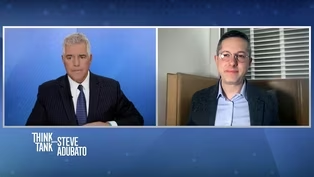
CEO of Responsive Gov explores election integrity and trust
Video has Closed Captions
CEO of Responsive Gov explores election integrity and trust (9m 4s)
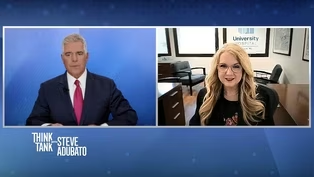
CEO of University Hospital examines impact of medicaid cuts
Video has Closed Captions
CEO of University Hospital examines impact of medicaid cuts (9m 43s)
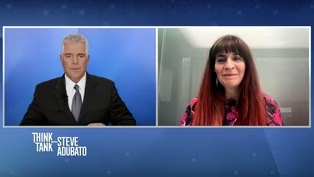
YWCA explores how they're empowering trauma-affected women
Video has Closed Captions
YWCA explores how they're empowering trauma-affected women (10m)
Providing Support for PBS.org
Learn Moreabout PBS online sponsorship New Episode
- News and Public Affairs

Top journalists deliver compelling original analysis of the hour's headlines.
 New Episode
- News and Public Affairs

Today's top journalists discuss Washington's current political events and public affairs.
 New Episode
 New Episode
 New Episode
 New Episode
 New Episode
 New Episode
 New Episode

 New Episode
Support for PBS provided by:
Think Tank with Steve Adubato is a local public television program presented by NJ PBS