One-on-One
Essential skills for the next generation of physicians
Clip: Season 2026 Episode 2955 | 15m 29sVideo has Closed Captions
Essential skills for the next generation of physicians
Steve Adubato talks with Keith P. Lewis, RPh, MD, Vice Dean of Rutgers Robert Wood Johnson Medical School, and Diane Calello, MD, Executive Medical Director of the New Jersey Poison Information and Education System at Rutgers New Jersey Medical School, about why empathy, patience, and communication are essential skills for the next generation of physicians.
Problems playing video? | Closed Captioning Feedback
Problems playing video? | Closed Captioning Feedback
One-on-One is a local public television program presented by NJ PBS
One-on-One
Essential skills for the next generation of physicians
Clip: Season 2026 Episode 2955 | 15m 29sVideo has Closed Captions
Steve Adubato talks with Keith P. Lewis, RPh, MD, Vice Dean of Rutgers Robert Wood Johnson Medical School, and Diane Calello, MD, Executive Medical Director of the New Jersey Poison Information and Education System at Rutgers New Jersey Medical School, about why empathy, patience, and communication are essential skills for the next generation of physicians.
Problems playing video? | Closed Captioning Feedback
Where to Watch One-on-One
One-on-One is available to stream on pbs.org and the PBS app.
Providing Support for PBS.org
Learn Moreabout PBS online sponsorship(upbeat music) - Hey, everyone, as part of our series on "Tomorrow's Physicians," and also part of another series we're doing called "Trust in Public Health," we have two really important healthcare leaders to share their perspective on these issues, Dr.
Keith Lewis is Vice Dean of the Rutgers Robert Wood Johnson Medical School, and also Dr.
Diane Calello is Executive Medical Director of the New Jersey Poison Information and Education Center, and also professor of emergency medicine at Rutgers New Jersey Medical School, and both honorees at the EJI Excellence in Medicine Awards that I've been honored to host for the last many years, good to see you, doctors.
- Great to see you, and thanks, Steve.
- Hey, let's do this, I'm curious, I've got to meet you through the EJI Excellence in Medicine Awards, but I wanna follow up on this first, Diane, your reason for going into medicine and at one point being a future physician, why'd you do that?
- Well, you know, Steve, I spent actually a fair amount of my childhood being a patient for a variety of reasons, and I was in college and trying to figure out what I wanted to do with the rest of my life, and I realized the choice was very obvious, that I wanted to basically be able to influence lives the way the physicians I had interacted with influenced mine.
- Dr.
Lewis, what's your rationale and your motivation?
- It was pretty easy, I was a pharmacist in a clinic and I spent more time talking to the patients than I did in my infusion center... (indistinct) Chemotherapy drugs in New Haven, so I was curious and listening, and one of the physicians in the clinic said, "You like being with patients, I think you should go to medical school," and I listened, it was probably the best advice I ever got.
- You know, you mentioned medical school, and then, much of the work of the EJI Excellence in Medicine Awards is really scholarships to students who are in medical school, tomorrow's physicians.
- Right.
- Dr.
Calello, let me ask you this, what's the main message you share with those who are in medical school today trying to figure out the financing, the economics of it, and also the struggles, the burnout, the exhaustion, the challenges, the juggling?
What's your message to them in these incredibly challenging but important times in healthcare?
- It is a very challenging time to be in healthcare, and there are a lot of things that tomorrow's physicians will hear about obstacles and challenges, and burnout is real, and the financial challenges, right?
Those are known.
But I still, after 35 years in healthcare, believe that this is not a job, it's really a vocation and it becomes who you are, and so it really shouldn't be viewed as kind of the same lens of, "Should I go into, you know, other sectors or other kinds of jobs?"
Because this is a very different thing.
Medicine's a privilege, Steve, you know, like, we have the ability to interact with patients and their families on some of the most consequential days of their lives, and not everybody can say at, you know, the end of their day and the end of their years that they've made as big of a difference as people in healthcare can.
- You know, Dr.
Lewis, you listen to your colleague, and Dr.
Calello says it's not just what you do, it's who you are as a physician.
Do you feel the same way?
- I do, and I heard... And Diane used the word "privilege," and I would say it's a privilege and it's an honor, and I was probably that person you were describing with financial stress, you know, and not knowing how I'd pay for my education, but the one thing I knew is that if I maintain my curiosity and my kind of inquisitive nature, that that would really fuel me and fund me with the energy to sustain what was really difficult, and I think for my entire career, by listening to patients and their stories, that it inspires you through those difficult and challenging times, so I think it's the medicine to success, and being kind to people is always my message.
- Yeah, what the heck is the Kindness Campaign?
- That's a really good question.
The Kindness Campaign is about that... What I learned is after COVID and during the time you've described where fulfillment may be low and burnout may be high, that everybody wants to be listened to, and everybody's fighting a battle that you know nothing about, and if there's one thing in the world that anybody can be, it's be kind to other people, so for me, the Kindness Campaign means that I make eye contact with you and I listen with my eyes, that I listen with my ears, that I actually hear what you say before you speak, that I'm positive, that it's a difficult time for you and you're struggling with something in healthcare, and that I connect to you, you know, and that I connect in a way that you feel that I am kind, that you begin to trust me, and if you trust me and I'm kind to you, you really do what you need to do in order to get the best care possible, and the last... (indistinct) Physicians, and we have such a reputation about this, is being timely shows respect, just like washing your hands, people always say, "Does washing your hands have anything to do with professionalism?"
And to me it does, 'cause it means you respect your patient and you don't want them to get an infection, so the Kind Campaign to me is that it's the most powerful drug we have, refills are unlimited, there's no insurance clearance, you know, the supply is endless and the therapeutic index is really high, so I start with kindness and lead with kindness every day, that's the campaign.
- Well said, Dr.
Lewis, Dr.
Calello, let me try this, the other focus for us programmatically, and the graphic will come up, "Trust in Public Health."
How do you deal with the fact that there are a fair number of people who have less, particularly post-COVID, who have less trust in the public health system, less trust in our medical and healthcare professionals?
How do you deal with that knowing that it's not a job, it's a vocation, it's a mission, it's who you are at the core with some people not trusting, what do you say to those folks right now?
Particularly when it comes to vaccines, et cetera, like, "Well, I went on the internet, I found my own information.
I was watching a news show," which often really means they were... Saw something on Instagram or whatever, "So I don't believe you."
How do you deal with that?
- It's more challenging now than it's ever been, Steve, I think because of what you just described with the information environment.
There's information everywhere, a lot of it is wrong, some of it is right, and it truthfully... A lot of the experts in public health and health in general are busy doing that work and don't have time to populate the space with as much volume of accurate information as a lot of the misinformation or alternate information that's out there, but I think we must engage, we have to engage with, you know, people who are coming to us with information that we know to be wrong or inaccurate, and it can be difficult, particularly for young physicians, I think, to meet with somebody who believes things that we just know to not be true, but if we don't have the counter-communication, if we don't say, "Let's talk about, you know, why you think that," and, "Where did you see that information?"
And, "Why don't I tell you what I know?"
Sometimes you're gonna break through, sometimes you're not, but if we're not the other voice, then we're not doing as much as we can to really engender that trust in public health.
- You know, Dr.
Lewis, in light of what Dr.
Calello just said, you talked about listening, empathy, trying to understand where the other person's coming from as best we can, the kindness campaign, how hard is it to do that in light of what Dr.
Calello just said when you know some patients not only distrust, but are dead wrong and are potentially doing things, or not doing things as it relates to their health that is not good for them?
Quote, "You know better, you went to medical school, you went through this training, this is your mission in life," they pick something up... I'm not minimizing them or many of us who distrust in certain situations, but we should be trusting you more, but still asking questions, that fair to say, Dr.
Lewis?
- I think it's fair, and I think patients are just afraid, and you're finding them at their most vulnerable moments where they're the most anxious and they're looking for an answer, it's kinda easy for me 'cause I'm an anesthesiologist and you come to me often in an incredibly vulnerable moment and I can put you to sleep and you need to trust me in a relatively short period of time, and the way I generate trust in that situation, so if something horrible is happening, I may know that Steve is thinking about, "Am I gonna survive?"
So my comment to gain your trust in that moment may be, "Steve, I'll see you when you wake up in the recovery room, or tomorrow 'cause you may sleep a little bit longer than the OR," and I think it goes back to that guiding principle I have of, "I'm gonna listen and I'm not gonna judge."
That the patient has all of the answers, and if they have questions and they haven't been answered, I'm gonna listen to what they have to say, I'm gonna process it, and I may learn something that they may be right in what they're telling me, and there have been many situations with patients where I may have wanted to go down a certain algorithm, but they direct me in a different pathway, which is the pathway where they wanna go, which may be the right one for them, and I go with them on that journey wherever I think it's safe, but I think that both Diane and I would say that we're always guided by patient safety and helping guide people to what is best for them, providing them with information to help them make the decision with us as a team as opposed to me imposing a decision upon them.
- And by the way, speaking of getting solid information, on our vaccine awareness initiative, "Vaccines: What You Need to Know," the graphic will come up, the website for the New Jersey Department of Health, they have a section on vaccines, but I also want to talk about another place to get important information, the Poison Control Center has a 24/7 hotline dedicated to assisting residents with all concerns about drugs, chemicals, food and other poison exposures.
Talk about that, Dr.
Calello, we'll put up the website, why would someone go there?
- We are here all the time, the person who picks up the phone is a healthcare provider, We’re there whenever you need us with any kind of question, of course, our expertise is poison and toxic exposures and, you know, medication safety and things like that, but the National Poison Control Network, you know, we are the New Jersey Poison Center, but we're part of a national network, is really the... - And the telephone number's 24/7.
- Yes, it is, and the number is the same no matter where you are in the country, but it routes to your poison center.
- And who picks up the phone?
- Nurses, doctors and pharmacists who are certified in poison information.
They answer the phone, there's not a... You're not calling a big call center, you're calling healthcare providers, and they're there and they provide the advice, and of course, it's no charge, and I can't really think of any other way or any other entity where a patient could get real-time medical advice in that way, you know, in that moment immediately, and that's why I'm so proud of that.
- And by the way, ChatGPT has its place, but the Poison Control Center has can we say more accurate and better information?
- Definitely, without question, and you... - I just want to... (laughs) - Yeah, ChatGPT is... - That's not... That shouldn't be controversial.
- I actually feel like it has become a major issue even just in the last maybe, you know, six to nine months or so, I think, you know, there's so much information available from AI, specifically GPT, but others, and it reads like truth, but sometimes it is not.
- Yeah, talk about what you should and who you should be trusting, in the couple minutes we have left, I often think about this, "Oh, it's just a physician shortage," I mean, we talk about this with our good friend and colleague, Patricia Costante, heading up the EJI Excellence in Medicine Awards, we meet these young people going into medicine and medical school, and they... Who we have, I believe, 10 scholarship winners every year, and I think about who these people are and why they would be going into this profession, this... Not just a job, but it becomes a big part of your life, into the world of medicine, becoming physicians, what would you say, Dr.
Lewis...?
Who are the kinds of people in these incredibly challenging times who go into medicine?
- Funny you asked, this week's the first day of medical school here, so I got to see them all on Monday morning walk into the new Helix building... - Hold on, we're taping on July 22nd, how could this be the first day of medical school?
(Keith laughing) - It's the first day of medical school when they start, they just come in.
- Okay, go ahead.
- Yeah, so they walked in, and I think what I heard, 'cause we did bios on each one of them, all almost 170, is there are people who wanna help others, and despite all the challenges and the fear and the anxiety out there, have this overwhelming compassion to make a difference, you know, and I think that, you know, when I looked at medical school, I said, "I don't wanna just go there to be different, I want to make a difference," and what I hear is people with stories that have been around the world and worked in, you know, organizations helping the most vulnerable around the world, and others that have entirely different careers of being an opera singer in Carnegie Hall or whatever, so I think they're so attracted because it's such a privilege to think about it, to be able to take care of someone else's life and have them trust you, and kudos to Diane and her team because in COVID, they were there, they were the lifeline, the 24/7 365, someone answered questions no one knew the answer to and did their best, and I think that's why medicine is so alluring because we're always getting new information and it's hard to say we ever had a job 'cause we all have a career, and a career where we're continuously stimulated.
- To Dr.
Calello, to Dr.
Lewis and all the physician leaders that we've had and medical students that we've had as part of our "Tomorrow's Physicians" initiative, as well as our "Trust in Public Health," we say thank you, particularly thank you to both of you right now, and again... Once again, congratulations on winning the EJI Excellence in Medicine Awards in your respective categories.
Thank you so much, we appreciate it.
- Thank you.
- I'm Steve Adubato, we thank you so much for watching.
We'll see you next time.
- [Narrator] One-On-One with Steve Adubato is a production of the Caucus Educational Corporation.
Funding has been provided by EJI, Excellence in Medicine Awards.
A New Jersey health foundation program.
PSEG Foundation.
NJ Best, New Jersey’s five-two-nine college savings plan.
Robert Wood Johnson Foundation.
New Jersey Sharing Network.
The Burke Foundation The Adler Aphasia Center.
New Brunswick Development Corporation.
And by United Airlines.
Promotional support provided by Meadowlands Chamber.
And by BestofNJ.com.
- Next, please.
Okay, we need a neutral expression.
Sir, you're smiling.
- Oh, am I?
- [Narrator] Over 1 million lives in the US have been saved by organ donations.
So when you choose to become a donor, you're doing something good, which can make you feel really good.
- Next.
(woman sighs) - [Narrator] Register today at NJSN.org.
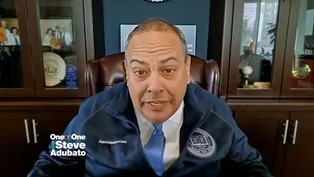 New
NewPreparing students for success at Newark Public Schools
Video has Closed Captions
Clip: S2026 Ep2955 | 10m 41s | Preparing students for success at Newark Public Schools (10m 41s)
Providing Support for PBS.org
Learn Moreabout PBS online sponsorship New Episode
- News and Public Affairs

Top journalists deliver compelling original analysis of the hour's headlines.
 New Episode
- News and Public Affairs

Today's top journalists discuss Washington's current political events and public affairs.
 New Episode

 New Episode
 New Episode
 New Episode
 New Episode
 New Episode
 New Episode

Support for PBS provided by:
One-on-One is a local public television program presented by NJ PBS